Long truck combinations: road trains, B-doubles, Gigaliners and LCVs
Australia's 53.5 m road trains, 34.5 m in Sweden, 32 m in Spain, 25.25 m in Germany and the US LCV freeze: what each national text allows, and on which roads.
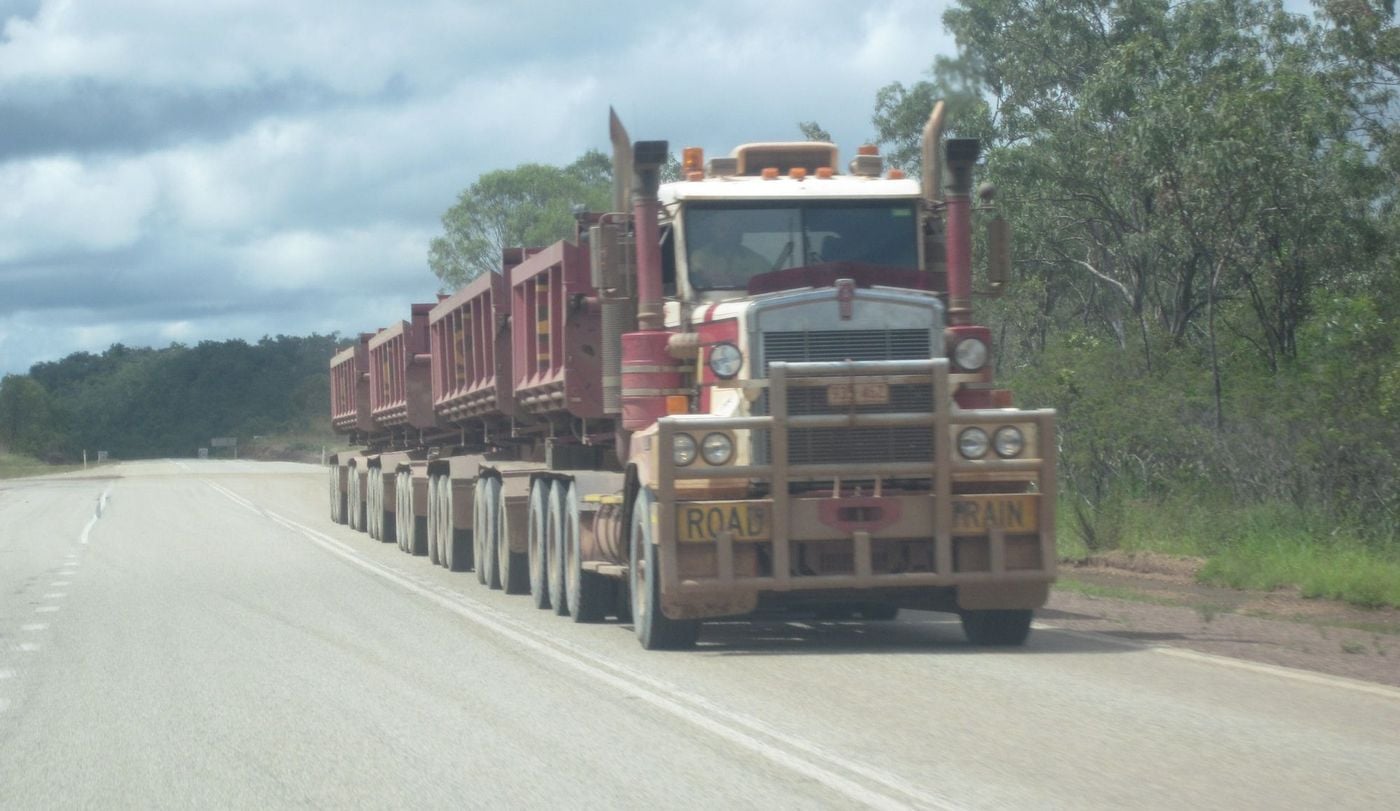
There is no single definition of a long truck combination and no single limit. In the EU, Directive 96/53/EC sets 16.50 m for an articulated vehicle and 18.75 m for a road train, and lets a Member State go further for certain national operations; the national texts read for this page allow up to 25.25 m in Germany, 32 m in Spain and 34.5 m in Sweden, on listed routes, published networks or designated roads. In Australia a road train is a vehicle towing two or more trailers, with a length limit of 53.5 m, and a B-double has a limit of 25 m. In the United States a longer combination vehicle, or LCV, is defined by weight: a truck tractor with two or more trailers above 80,000 pounds on the Interstate System, allowed only as listed in an appendix that holds the values of 1991.
Status as at 4 November 2026. Read on that day: the consolidated text of Directive 96/53/EC of 14 August 2019; the German exemption regulation for vehicles with excess length; Spain’s Reglamento General de Vehículos, consolidated to 26 June 2026; Sweden’s Trafikförordning as amended up to SFS 2026:1052; the Dutch Regeling voertuigen in the version in force from 1 July 2026; Finlex’s page for Finnish Decree 1257/1992; six pages of Australia’s National Heavy Vehicle Regulator (NHVR); and 23 CFR Part 658 in the edition of 1 April 2024, with later amendments not read. No other country’s text was read.
The same words, different vehicles
The word road train shows this. Article 2 of the Directive defines “a road train consisting of a motor vehicle coupled to a trailer”. The NHVR says road trains in Australia “consist of a motor vehicle towing two or more trailers (excluding converter dollies supporting a trailer)”. The two limits, 18.75 m and 53.5 m, apply to different vehicles.
| Term | Text | Meaning there |
|---|---|---|
| Road train | Directive 96/53/EC, Art. 2 | A motor vehicle coupled to a trailer |
| Road train | NHVR, class 2 | A motor vehicle towing two or more trailers, other than a B-double |
| B-double | NHVR, class 2 | A prime mover towing two semi-trailers: the first on the prime mover’s fifth wheel, the second on a fifth wheel coupling on the first |
| B-triple | NHVR, class 2 | A type of road train: a prime mover towing three semi-trailers |
| PBS A-double | NHVR, class 2 | A Performance Based Standards vehicle that meets the road train definition and is classified as a road train |
| Longer combination vehicle (LCV) | 23 CFR 658.5 | A truck tractor and two or more trailers or semitrailers above 80,000 pounds gross on the Interstate System |
| Truck-tractor semitrailer-semitrailer | 23 CFR 658.13(e)(3) | Specialized equipment; the B-train assembly between the two semitrailers is excluded from trailer length |
| Fahrzeugkombination mit Überlänge; Lang-Lkw | Germany, LKWÜberlStVAusnV | The regulation’s term for a combination with excess length; Lang-Lkw is the wording of the rear sign (§ 5) |
| Configuración euro-modular | Spain, RGV, Annex IX, 1.23 | A set with more than 6 axle lines or at least 3 modules, each within the Annex’s limits for its vehicle type when taken separately |
| Modular concept | Directive 96/53/EC, Art. 4(4)(b) | Motor vehicles, trailers and semi-trailers that each comply with Annex I, used in combinations reaching at least the loading length the Member State authorises |
The names Gigaliner, EuroCombi, Rocky Mountain double, turnpike double and pup trailer do not appear in any of these texts. The bodies of the trailers themselves are described in trailer types explained.
Limits by country
| Country | Length in the text read | Where and on what terms | Source of this row |
|---|---|---|---|
| EU baseline | 16.50 m articulated vehicle; 18.75 m road train | Normal circulation in every Member State | Directive 96/53/EC, Art. 4(1), Annex I, 1.1 |
| Germany | 25.25 m for three types; 24.00 m for a truck with one trailer; 17.88 m for a single semi-trailer combination | Routes in the regulation’s Anlage. The 17.88 m type also on the road networks of all Länder except Berlin, until 31 December 2026 | LKWÜberlStVAusnV, §§ 2, 3, 4 and 13 |
| Spain | 32 m; 72 tonnes | Route networks published in the Boletín Oficial del Estado | RGV, Annex IX, tables 2 and 3, point 6 |
| Sweden | 34.5 m; 25.25 m on conditions; 24.0 m otherwise | 34.5 m on a road or stretch designated by Trafikverket or the municipal road manager. Gross weight: not verified | Trafikförordning, ch. 4, ss. 17 and 17 f |
| Netherlands | 16.50 m and 18.75 m. Not verified above that | Apart from an extended-cab allowance (paragraph 12), the article names no length above 18.75 m for a goods combination; its 20.00 m is for mobile machinery with a trailer and its 24.00 m for fairground and circus vehicles. Any exemption for longer goods combinations: not verified | Regeling voertuigen, Art. 5.18.11 |
| Finland | Not verified | Finlex’s text of Decree 1257/1992 gives 34.50 m for a truck with one or more trailers, but the page marks the decree as not in force, repealed from 1 June 2020 with a reference to Act 729/2018. The provisions now in force were not read | Finlex, 1257/1992 |
| Poland | Not verified | National text not read | None |
| Italy | Not verified | National text not read | None |
| France | Not verified | National text not read | None |
| Australia | 53.5 m road train; 25 m B-double, 26 m on conditions | Under a notice or a permit. The NHVR handles applications for six States and Territories; the Northern Territory and Western Australia handle their own, and their own limits were not read | NHVR, length, B-double permit and road train permit pages |
| United States | LCVs and combinations with two or more cargo units, State by State; up to 115.5 feet of cargo-carrying length | Routes and conditions in Appendix C; weights and dimensions frozen at their 1991 values | 23 CFR 658.23, Appendix C |
What EU law allows
Article 4(1) of Directive 96/53/EC bars Member States from authorising the normal circulation of goods vehicles or combinations that do not conform to the Annex I lengths, among other points. Those lengths, and the kingpin measure behind the 13.62 m semi-trailer, are set out in semi-trailer dimensions.
Under Article 4(4), a Member State may allow vehicles that “carry out certain national transport operations that do not significantly affect international competition in the transport sector” to run with dimensions deviating from Annex I. That test is met under one of two conditions:
- Specialised vehicles (a): operations carried out by specialised vehicles in circumstances in which vehicles from other Member States do not normally carry them out, “e.g. operations linked to logging and the forestry industry”.
- Modular concept (b): the Member State also permits “motor vehicles, trailers and semi-trailers which comply with the dimensions laid down in Annex I to be used in such combinations as to achieve at least the loading length authorized in that Member State, so that every operator may benefit from equal conditions of competition (modular concept)”.
The Directive names no figure above 18.75 m for a goods combination. The 25.25 m, 32 m and 34.5 m in the table come from national texts. Article 4(5) adds trials: vehicles “incorporating new technologies or new concepts” may carry out “certain local transport operations for a trial period”, with the Commission informed.
Weights are handled separately. Article 4(2) lets a Member State authorise vehicles in national goods transport that do not conform to, among others, points 2 and 3 of Annex I, the vehicle and axle weights.
Article 3(1) stops a Member State from refusing a vehicle from another Member State for reasons of dimensions “provided that such vehicles comply with the limit values specified in Annex I”. Article 7 keeps local restrictions possible “where the infrastructure is not suitable for long and heavy vehicles, such as city centres, small villages or places of special natural interest”.
Other routes to extra length are not long combinations in this sense. Indivisible loads run on special permits under Article 4(3), covered in low-loader trailers and abnormal loads. Aerodynamic cabs and rear devices may exceed the maximum length without more load capacity or loading length, and Article 10c adds 15 cm for 45-foot containers and swap bodies in an intermodal transport operation; both are covered in aerodynamic cabs and length rules.
National texts in Germany, Spain and Sweden
Germany. The exemption regulation LKWÜberlStVAusnV lists five types in § 3 and allows 25.25 m for a semi-trailer combination with a centre-axle trailer, a truck with a dolly axle and semi-trailer, and a semi-trailer combination with a second semi-trailer; 24.00 m for a truck with one trailer; and 17.88 m for a single semi-trailer combination, with 13.38 m from the kingpin axis to the rear (§ 4; paragraph 1 also names the two 25.25 m types built on a semi-trailer combination). Its sections set lengths and conditions of use, and none of them sets a higher gross weight. Under § 13(1) the provisions for the single 17.88 m type, § 2(2), § 3 sentence 1 number 1, § 4(1) and § 12, are no longer to be applied after 31 December 2026; the text read on 4 November 2026 still gives that date.
Spain. Tables 2 and 3 of Annex IX to the Reglamento General de Vehículos give euro-modular sets 72 tonnes and 32 m, and point 3.2.2 lets their turning circle radii reach 14.50 m and 6.5 m. Point 6 confines them to networks of routes set by each traffic authority and published in the Boletín Oficial del Estado, after a binding report from the road owners. Their load may not project beyond the plan of the vehicles, and dangerous goods that require ADR placards are excluded. The technical requirements are left to a resolution of the Jefatura Central de Tráfico, which was not read for this page.
Sweden. Chapter 4, section 17 of the Trafikförordning sets 24.0 m on roads other than private ones for a motor vehicle other than a bus, with or without a coupled vehicle. A vehicle train may reach 25.25 m where eleven conditions are met, among them at most 12.0 m for each motor vehicle and each trailer other than a semi-trailer, and at most 21.86 m of load length behind the cab. Under section 17 f, Trafikverket, or the municipality where it is the road manager, may prescribe that on a given road, part of a road or stretch a vehicle train may run at up to 34.5 m including its load. The conditions include at most 29.25 m of load length behind the cab and the construction and equipment requirements set by Transportstyrelsen, which were not read for this page.
Australia: road trains and B-doubles
The NHVR sorts access into General Access Vehicles, which “do not require a notice or permit”, and Restricted Access Vehicles, which operate under one. B-doubles and road trains are class 2 heavy vehicles and must comply with the prescribed mass and dimension requirements. The class 2 definition of a road train gives no maximum number of trailers.
| Vehicle | Maximum length |
|---|---|
| Combination other than a B-double, road train or vehicle carrier | 20 m; 19 m where it includes a heavy trailer without braking to ADR 38/05 or a later version of ADR 38 that is not powered by the towing vehicle |
| B-double | 25 m; 26 m on the conditions below |
| Vehicle carrier | 25 m |
| Road train | 53.5 m |
A B-double may run at up to 26 m if the distance from the front articulation point of the most forward semi-trailer to the rear is not more than 20.6 m and the prime mover has a front under-run protective device, a cab complying with UN Regulation 29 if manufactured after 31 December 2005, and no area built to carry goods, except for a B-double vehicle carrier.
Access works through notices first. “A road train permit is required for travel on a road that is not authorised under notice”, and the main notice is the National Class 2 Road Train Authorisation Notice 2026 (No.2), for New South Wales, Queensland, South Australia and Victoria. For B-doubles, a permit is required outside the approved network, and the National Class 2 B-double Authorisation Notice 2026 (No.1) covers the Australian Capital Territory, New South Wales, Queensland, South Australia, Tasmania and Victoria. For travel within the Northern Territory and Western Australia, applications go directly to the road transport authority there.
A heavy vehicle that does not comply with the prescribed requirements, and is not class 1, is class 3. The NHVR’s examples include a B-double or road train with a load wider than 2.5 m, a prime mover and semi-trailer towing a converter dolly, and a 3 or 4-axle rigid truck towing a dog trailer with 3 or 4 axles, weighing more than 42.5 t. Performance Based Standards vehicles are class 2 heavy vehicles under a scheme with four levels. The NHVR pages read give lengths, not gross masses for road trains.
United States: LCVs and the 1991 freeze
Section 658.5 of 23 CFR defines the LCV as “any combination of a truck tractor and two or more trailers or semitrailers which operates on the Interstate System at a gross vehicle weight greater than 80,000 pounds”. The test is weight on a named road system, not length; 80,000 pounds is about 36.3 t by our conversion, and the federal weight rules are in how much a semi-truck weighs.
Section 658.23 holds two freezes. Under (a)(1) a State may allow LCVs on the Interstate System “only as listed in appendix C to this part”. Under (a)(2) a State may not allow on the National Network a combination with two or more cargo-carrying units longer than State law authorised, or than was in lawful operation and listed in Appendix C, on or before June 1, 1991. A State that restricts these vehicles further notifies the Federal Highway Administration, which publishes the change as an amendment to the appendix (paragraph (e)).
Doubles with units of up to 28.5 feet sit outside the length freeze. Section 658.23(b)(1) lets combinations “with a maximum length of the individual cargo units of 28.5 feet or less” run on the National Network, and section 658.13(b)(4) says “No State shall prohibit commercial motor vehicles operating in truck tractor-semitrailer-trailer combinations”. The 28-foot minimum and the absence of an overall limit are in semi-truck dimensions.
Appendix C says weights and dimensions are “frozen” at the values it shows, those in effect on June 1, 1991, or July 6, 1991, for Alaska. It lists 52 jurisdictions. By our count, 26 show NO in all three of its columns, 26 list a truck tractor with two trailing units and 17 list one with three.
| State | Truck tractor and 2 trailing units | Truck tractor and 3 trailing units |
|---|---|---|
| Alaska | 95 ft | 110 ft |
| Arizona | 95 ft; 129,000 lb | 95 ft; 129,000 lb |
| Colorado | 111 ft; 110,000 lb | 115.5 ft; 110,000 lb |
| Florida | 106 ft (note a) | No |
| Hawaii | 65 ft (note a) | No |
| Idaho | 95 ft; 105,500 lb | 95 ft; 105,500 lb |
| Indiana | 106 ft; 127,400 lb | 104.5 ft; 127,400 lb |
| Iowa | 100 ft; 129,000 lb | 100 ft; 129,000 lb |
| Kansas | 109 ft; 120,000 lb | 109 ft; 120,000 lb |
| Massachusetts | 104 ft; 127,400 lb | No |
| Michigan | 58 ft; 164,000 lb | No |
| Mississippi | 65 ft (note a) | No |
| Missouri | 110 ft; 120,000 lb (note c) | 109 ft; 120,000 lb |
| Montana | 93 ft; 137,800 lb | 100 ft; 131,060 lb |
| Nebraska | 95 ft; 95,000 lb | 95 ft (note a) |
| Nevada | 95 ft; 129,000 lb | 95 ft; 129,000 lb |
| New Mexico | 86,400 lb (note b) | No |
| New York | 102 ft; 143,000 lb | No |
| North Dakota | 103 ft; 105,500 lb | 100 ft; 105,500 lb |
| Ohio | 102 ft; 127,400 lb | 95 ft; 115,000 lb |
| Oklahoma | 110 ft; 90,000 lb | 95 ft; 90,000 lb |
| Oregon | 68 ft; 105,500 lb | 96 ft; 105,500 lb |
| South Dakota | 100 ft; 129,000 lb | 100 ft; 129,000 lb |
| Utah | 95 ft; 129,000 lb | 95 ft; 129,000 lb |
| Washington | 68 ft; 105,500 lb | No |
| Wyoming | 81 ft; 117,000 lb | No |
The appendix’s notes qualify these entries:
- Note a. No maximum weight is set, because the combination is not an LCV under the ISTEA definition. Florida’s may not run on the Interstate System, and those of Hawaii, Mississippi and Nebraska may not exceed 80,000 pounds.
- Note b. No maximum cargo-carrying length is set for New Mexico’s combination. State law limits each trailing unit to 28.5 feet, so it may run on all National Network routes whatever its actual cargo-carrying length.
- Note c. Missouri’s two figures do not apply to the same combination: the 110-foot length is for vehicles entering from Oklahoma, limited to 90,000 pounds, and the 120,000 pounds is for vehicles entering from Kansas, limited to 109 feet.
For Alaska the appendix gives no weight, because “There are no highways in the State subject to Interstate System weight limits”. The longest entry is Colorado’s 115.5 feet, about 35.2 m by our conversion. The highest weight is Michigan’s 164,000 pounds, about 74.4 t, at 58 feet.
The State listings under the table add routes and conditions. Several require a commercial driver’s license “with the appropriate endorsement”; the federal endorsement for double and triple trailers is described in CDL classes and endorsements. Indiana’s Toll Road entry requires drivers “at least 26 years old, in good health, and with 5 years of experience”. Massachusetts limits its combination to the I-90 Massachusetts Turnpike from the New York State line to Exit 18 in Boston, and its units “shall not leave the Turnpike right-of-way and shall be assembled and disassembled only in designated areas”. Colorado’s entry requires between six and nine axles.
Quick answers
- What is the difference between a road train and a B-double?
- In Australia, as the National Heavy Vehicle Regulator describes them, a B-double is a prime mover towing two semi-trailers, the second mounted on a fifth wheel coupling on the first, with a length limit of 25 m, or 26 m under conditions. A road train is a motor vehicle towing two or more trailers, other than a B-double, with a limit of 53.5 m. EU Directive 96/53/EC uses road train for something else: a motor vehicle coupled to a trailer, at most 18.75 m.
- How long can a road train be?
- In Australia 53.5 m, on the National Heavy Vehicle Regulator's length page, where a road train is a motor vehicle towing two or more trailers. In the EU 18.75 m, under Annex I of Directive 96/53/EC, where a road train is a motor vehicle coupled to a trailer. Longer European combinations rest on national texts under other names: 25.25 m in Germany, 32 m in Spain and 34.5 m on designated roads in Sweden.
- Are Gigaliners allowed in Europe?
- The word Gigaliner does not appear in the legal texts read for this page. Directive 96/53/EC sets 16.50 m and 18.75 m for normal circulation, and Article 4(4) lets a Member State allow other dimensions for certain national operations, including under the modular concept. Germany allows up to 25.25 m on listed routes, Spain up to 32 m and 72 tonnes on published route networks, and Sweden up to 34.5 m on designated roads. The Netherlands' exemptions, Finland's current text, Poland, Italy and France were not verified.
- What is a longer combination vehicle (LCV) in the US?
- Under 23 CFR 658.5 it is any combination of a truck tractor and two or more trailers or semitrailers that operates on the Interstate System at a gross vehicle weight above 80,000 pounds. Under section 658.23 a State may allow LCVs on the Interstate System only as listed in Appendix C, whose values are those in effect on June 1, 1991, or July 6, 1991, for Alaska.
- Which US states allow triple trailers?
- Appendix C to 23 CFR Part 658, edition of 1 April 2024, lists a truck tractor with three trailing units in 17 States: Alaska, Arizona, Colorado, Idaho, Indiana, Iowa, Kansas, Missouri, Montana, Nebraska, Nevada, North Dakota, Ohio, Oklahoma, Oregon, South Dakota and Utah. Each has its own routes, conditions and cargo-carrying length, from 95 feet in several States to 115.5 feet in Colorado. Nebraska's combination may not exceed 80,000 pounds.
Sources
- Council Directive 96/53/EC, consolidated text of 14 August 2019 — Articles 2, 3, 4, 7, 8b, 9a and 10c and Annex I — EUR-Lex, European Union
- Verordnung über Ausnahmen von straßenverkehrsrechtlichen Vorschriften für Fahrzeuge und Fahrzeugkombinationen mit Überlänge (LKWÜberlStVAusnV) — §§ 1 to 13 and the Anlage (BGBl. 2025 I Nr. 25), read on 4 November 2026 — gesetze-im-internet.de (Bundesministerium der Justiz)
- Reglamento General de Vehículos, Real Decreto 2822/1998 — consolidated text, last update published on 26 June 2026: Annex IX, points 1.23, 2, 3 and 6 — Boletín Oficial del Estado (Spain)
- Trafikförordning (1998:1276), as amended up to SFS 2026:1052 — chapter 4, sections 17 and 17 f — Sveriges riksdag (Sweden)
- Regeling voertuigen (BWBR0025798), version in force from 1 July 2026 — Article 5.18.11 — wetten.overheid.nl (Netherlands)
- Asetus ajoneuvojen käytöstä tiellä 1257/1992 — Finlex page with its status note, read on 4 November 2026 — Finlex (Finland)
- Classes of heavy vehicles, read on 4 November 2026 — National Heavy Vehicle Regulator (Australia)
- Class 2 heavy vehicles: B-doubles, road trains, PBS vehicles, read on 4 November 2026 — National Heavy Vehicle Regulator (Australia)
- Class 3 heavy vehicles, read on 4 November 2026 — National Heavy Vehicle Regulator (Australia)
- Dimension requirements: length, with amendments from 1 August 2026, read on 4 November 2026 — National Heavy Vehicle Regulator (Australia)
- B-double permit, read on 4 November 2026 — National Heavy Vehicle Regulator (Australia)
- Road train permit, read on 4 November 2026 — National Heavy Vehicle Regulator (Australia)
- 23 CFR Part 658, Truck Size and Weight, Route Designations, edition of 1 April 2024 — sections 658.5, 658.13 and 658.23 and Appendix C — govinfo, U.S. Government Publishing Office