Truck racing: the European Truck Racing Championship and Dakar rally trucks
An ETRC race truck is a two-axle road tractor of at least 5,300 kg limited to 160 km/h; a Dakar T5.1 prototype truck is a 4x4 or 6x6 limited to 135 km/h. The FIA rules, formats and dates.
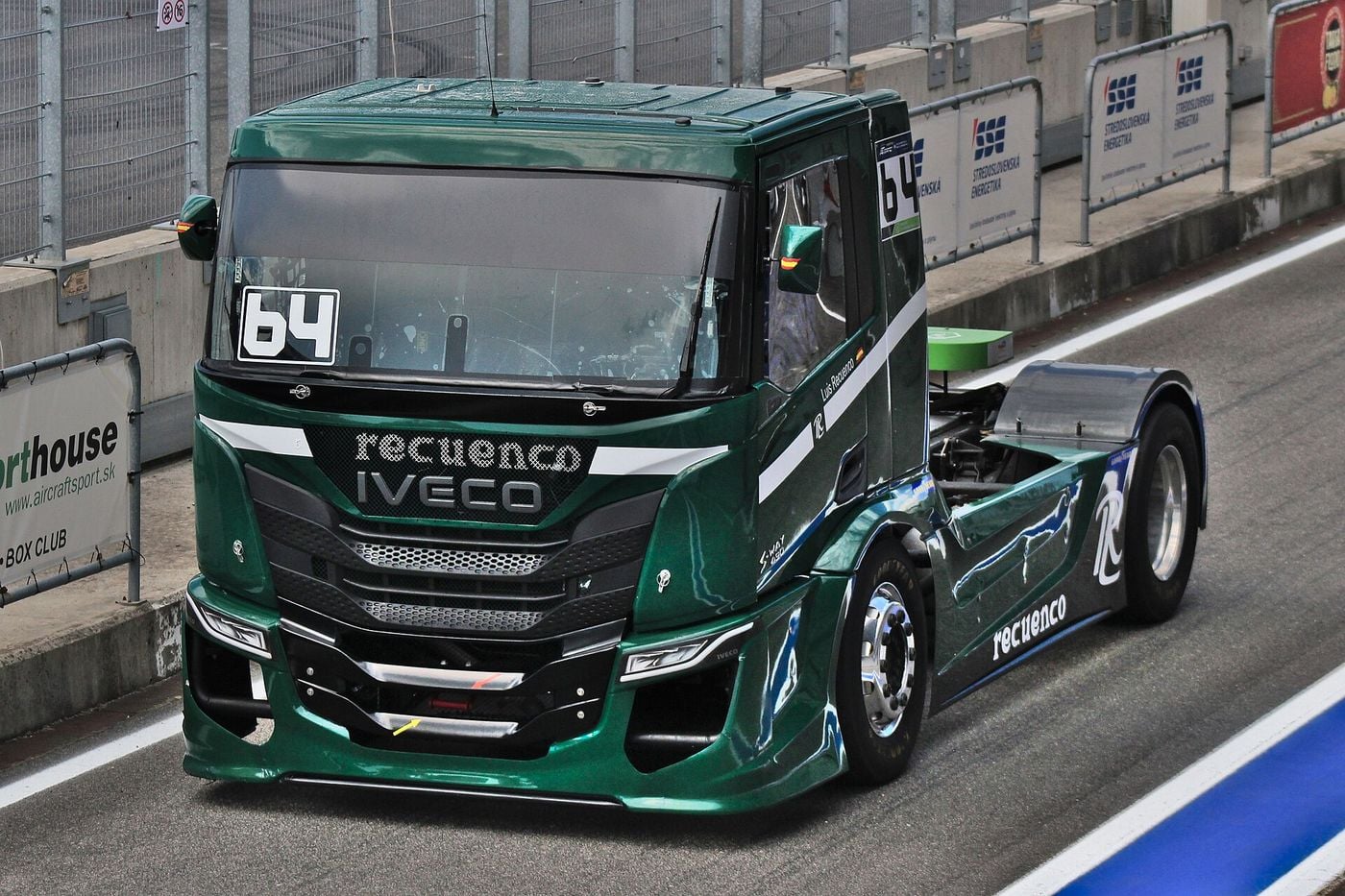
Under the rules of the FIA, the global governing body for motor sport, trucks race on circuits and in cross-country rallies. On circuits, the Goodyear FIA European Truck Racing Championship (ETRC) races two-axle road tractor units built to Article 290 of the FIA’s Appendix J: their speed is limited to 160 km/h, their minimum weight is 5,300 kg with the driver and their engine may not exceed 13,000 cm³. In cross-country rallies such as the Dakar, trucks race in Group Truck, which is open to vehicles of more than 3,500 kg gross weight: the prototypes of class T5.1 are four- or six-wheel-drive trucks with a supercharged diesel engine, built to Article 287, with a maximum speed of 135 km/h. The 2026 ETRC ran seven competitions in seven countries between 30 May and 4 October, the first season under the FIA’s full control. The 49th Dakar is scheduled for 9 to 23 January 2027 in Portugal and Morocco, with dates subject to approval by the FIA’s World Motor Sport Council.
Status as of 8 November 2026. Read on that day: Articles 290 (published 15 December 2025) and 287 (published 24 June 2026) of the FIA’s Appendix J; the 2026 ETRC Sporting Regulations; the 2026 Cross-Country Rally Sporting Regulations in their version of 23 June 2026; the FIA Supplementary Regulations of the 2026 Dakar; the FIA’s 2026 ETRC season and classification pages and the championship’s own site; the Dakar organiser’s news of 25 and 30 October 2026 and its 2027 route page; and the site of the Int. Shell ADAC Truck-Grand-Prix.
Two rule books
Circuit trucks and rally trucks are different vehicles under different texts. Article 290 opens: “These Technical Regulations govern competitions run on circuits between two-axle heavy tractor units from tractor/semi-trailer combinations only.” Article 287 covers prototype cross-country trucks, and the Cross-Country Rally Sporting Regulations sort them into classes.
| ETRC race truck (Appendix J, Art. 290) | Dakar T5.1 prototype truck (Appendix J, Art. 287) | |
|---|---|---|
| Vehicle | Two-axle road tractor unit, at least 50 of the type (cab and chassis) built in any 12-month period; the general shape of a road tractor homologated for a gross vehicle weight of at least 18 t (1.2) | Up to 3 axles with up to 2 wheels per axle; 4x4 and 6x6 only; may be unit-built but must be registered in one country (introduction) |
| Engine | Up to 13,000 cm³, from a commercial range of truck engines, at least 100 built; need not be from the cab’s maker (3.5) | Supercharged diesel only; up to 13,000 cm³, from a commercial range of truck engines, at least 200 built, production stopped less than 15 years ago (introduction, 5.1) |
| Air restrictor | Supplied by the FIA: 63 mm for one turbocharger, 44.5 mm per turbocharger for two (3.10.3) | Required where the turbo compressor inlet is larger than 74 mm: internal diameter up to 74 mm; “This diameter may be revised at any moment without notice” (5.7.2) |
| Weight | Minimum 5,300 kg including the driver, of which 3,150 kg at the front wheels; maximum 6,500 kg (3.3) | Minimum without crew 8,760 kg, of which 4,400 kg at the front wheels, above 10 litres; 6,760 kg, of which 3,550 kg at the front, at 10 litres or less (4.1) |
| Maximum speed | 160 km/h, with an FIA-approved speed measuring instrument (2.2) | 135 km/h, set in Article 27.3.1 of the Cross-Country Rally Sporting Regulations, to which Art. 287 refers |
| Wheels | Tyres 315/70R 22.5; rims up to 22.5 x 9 in (3.14.3, 3.15.1) | Rims up to 14 x 22.5 in; wheel diameter up to 1,300 mm mounted and inflated to 5 bar (8.1.1) |
| Driving aids | Anti-lock braking prohibited (3.16.2); electronic traction control prohibited, differential 100 % locked (3.11.3) | ABS, ASR, traction control and ESP prohibited (introduction) |
Both texts deal with the makers’ names. For the ETRC, “The name of the truck manufacturer must always precede that of the engine manufacturer”, and a title won by a hybrid truck goes to the manufacturer of the truck (Art. 290, 1.3). For Group Truck, when a vehicle maker fits an engine it does not make, the engine maker’s name may be associated with that of the cabin’s maker, and “Should a vehicle win a Championship Title, Cup or Trophy, this will be awarded to the manufacturer from which the cabin of the vehicle comes” (Art. 287, introduction).
The ETRC race truck
Cab and chassis. The eligible vehicles are “Series production two-rigid-axle road tractor units as defined in Article 290 of Appendix J” (Sporting Regulations, Article 2). The gearbox, the front and rear axles, the steering box and the components of the braking systems must come from road-going tractor units homologated for the carriage of goods, and “No mechanical part must be designed to generate an aerodynamic effect” (3.1). The structure of the cab, including the floor and doors, must be of the original cab material, and its exact model and year of manufacture are declared at registration (3.17, 3.17.2). The cab must be at least 1,800 mm wide, its floor at least 1,000 mm above the ground (3.17.1), and the truck at least 2,500 mm high at the cab’s highest point (3.2.2). The overall width is limited to 2,550 mm without mirrors (3.2.1) and the minimum ground clearance is 190 mm, with lower minimums for some bodywork fairings, the rear axle housing and the front axle’s lower steering arms (3.2.3). Road cab types are set out in European truck cabs, and the record sizes, weights and outputs of road vehicles in the biggest trucks and buses in the world.
Speed. Article 2.2 reads: “The speed is limited to 160 kph.” Every truck must carry a correctly functioning speed measuring instrument approved by the FIA, and any attempt to disable it or to corrupt its data is prohibited. The speed limiter of road trucks is covered in truck and bus speed limits in Europe.
Engine and driveline. Article 290 limits the nominal capacity to 13,000 cm³ and the air intake, through the FIA’s restrictors, but gives no power or torque figure. The championship’s series page states: “Power output of 1200bhp and torque of around 6000Nm”. The gearbox must come from a commercial range of truck gearboxes produced at a rate of at least 300 a year; “The use of automatic gearboxes of any type is prohibited”, and each shift is made by the driver (3.11.1). The clutch must be of the friction type, worked by the driver’s foot at each gearshift (3.11.2).
Fuel. The only fuels authorised are diesel, a diesel and vegetal fuel blend with at least 25 % vegetal fuel to EN 14214:2003, and HVO, each to a specification table (3.6). The tank holds at most 90 litres (3.7.1). The Sporting Regulations oblige competitors to use the single fuel supplier selected by the FIA (9.2.1); the series page names TotalEnergies as the partner supplying “its 100% renewable HVO” to the teams. The fuel itself is described in what is HVO.
Tyres. The tyre size is 315/70R 22.5, with an integrated RFID chip and an identification number engraved in the sidewall. All tyre carcasses must be of tubeless radial steel construction, and all tyres must have a speed rating of “L” or higher and a load index of at least 3.5 tons; the tread depth is at least 2 mm at the start of each race or practice, and “The use of re-treaded tyres is not permitted at any time” (3.15.1). Competitors must use the single tyre supplier selected by the FIA (Sporting Regulations, 9.1.1). The championship’s series page adds that “Goodyear retreads its racing tyres into standard truck tyres” after the rounds. The sidewall codes are explained in truck tyre markings and retreading in retreaded truck and bus tyres.
Fifth wheel. Appendix 3 of the 2026 Sporting Regulations modifies Article 3.4.4 of Article 290 for the standard fifth wheel supplied to each competitor: it may not be altered in any way, and it “must be situated between 1000 mm and 1300 mm from the ground at all times”. On road tractors the coupling height is one of the figures in kingpin and fifth wheel.
Electric and hybrid trucks. Article 4 of Article 290 sets a framework for full-electric and hybrid race trucks. They may be hybrid of any type or fully electric, with rear-wheel drive, and may be unit-built; the truck “must be able to travel a complete race distance”. The truck is inspected at the FIA’s technical centre in Valleiry, France, before an FIA/F technical passport is issued, valid for five years. Several items in Article 4, among them the drawing for the battery position and the lateral protection of the battery, are still marked “TBD”.
How an ETRC competition runs
A competition consists of at most four championship races and normally takes two days (Sporting Regulations, 3.5.1). Each day has 30 minutes of qualifying in three parts: the first, of 15 minutes, open to all trucks; the second, of 10 minutes, to the 12 fastest of the first; the third, of 5 minutes, to the 6 fastest of the second. Two races of 45 km plus or minus one lap follow on each day. Qualifying sets the grid for Races 1 and 3. For Races 2 and 4, “The first eight trucks classified at the end of Race 1 and Race 3 will be placed in reverse order”, and the others start from ninth place (12.1.3).
Races 1 and 3 award 20, 15, 12, 10, 8, 6, 4, 3, 2 and 1 points to the first ten; Races 2 and 4 award 10 points to the winner down to 1 point for tenth (4.6.1). To be classified, a truck must have completed at least 70 % of the winner’s laps (4.5). The championship has four titles: two for drivers, in the overall classification and in the Chrome category, one for teams, counting the results of a team’s two drivers, and one for young drivers, who must be under 30 on 1 January of the season (1.1, 4.1 to 4.3). Drivers are categorised Titan or Chrome according to their experience in the series, and all race together.
Every competitor and driver must hold an A, B or C international licence issued by their national sporting authority (6.5). The championship has at most ten competitions and needs at least three to award titles. The FIA may cancel it if fewer than 16 trucks are registered at the closing date for entries, and an organiser may cancel a competition with fewer than 12 (3.1, 3.4). On the calendar, Article 3.3 states: “The definitive list of Competitions is published by the FIA before 1 January each year.”
The 2026 season
The FIA’s season page states that the FIA, which already oversaw the sporting and technical regulations, “has assumed full control of the series” from 2026. The championship lists seven rounds.
| Round | Country | Circuit | Championship site | FIA season page: event and dates | Source |
|---|---|---|---|---|---|
| 1 | Italy | Misano World Circuit | 30–31 May | Misano FIA European Truck Racing Championship, 30–31 May | goodyearfiaetrc.com/events; fia.com season 2026 |
| 2 | Slovakia | Slovakia Ring | 6–7 June | Slovakiaring, 6–7 June | goodyearfiaetrc.com/events; fia.com season 2026 |
| 3 | Germany | Nürburgring | 10–12 July | 39. Int. ADAC Truck Grand Prix, 10–12 July | goodyearfiaetrc.com/events; fia.com season 2026 |
| 4 | Czech Republic | Most | 29–30 August | Czech Truck Prix, 28–30 August | goodyearfiaetrc.com/events; fia.com season 2026 |
| 5 | Belgium | Zolder | 12–13 September | Belgian Truck Grand Prix, 11–13 September | goodyearfiaetrc.com/events; fia.com season 2026 |
| 6 | France | Le Mans Bugatti | 26–27 September | 24 Heures Camions, 25–27 September | goodyearfiaetrc.com/events; fia.com season 2026 |
| 7 | Spain | Jarama | 3–4 October | Jarama, 3–4 October | goodyearfiaetrc.com/events; fia.com season 2026 |
Makers on the grid. The championship’s series page names Freightliner, IVECO, MAN and Scania among the manufacturers “represented on the Goodyear FIA ETRC grid”. Its 19 team profile pages each carry a Truck field, undated; read on 8 November 2026 they give Iveco for 6 teams, MAN for 11 and Scania for 2, and none gives Freightliner.
| Truck field | Teams | Number |
|---|---|---|
| Iveco | Don’t Touch Racing, GPS Sport, MM Technology, Reid Trucksport, Team Hahn Racing, Team Schwabentruck | 6 |
| MAN | Garrett Trucksport, Kursch Kurtscheid Racing, Lion Truck Racing, NWT Motorsport, Reboconort Racing Truck Team, Reinert Racing, Révész Racing, Ruppert Motorsport, SL30 Trucksport, T Sport Bernau, Taylors Trucksport Racing | 11 |
| Scania | Hecker Racing, tankpool24-Racing Team | 2 |
The series page also says that Iveco “introduced its electric S-eWay as the official Goodyear FIA ETRC pace truck in 2025” and remains a partner. The road tractors of the three makers in the team profiles are on their model pages: the Iveco S-Way, the MAN TGX and TGS, and the Scania S-series and R-series.
Classification. The FIA’s 2026 classification, with results from all seven competitions, lists Norbert Kiss of Hungary first among the drivers with 383 points, ahead of Jochen Hahn and Sascha Lenz of Germany, level on 244, and Antonio Albacete of Spain on 222. John Newell of Great Britain heads the Chrome classification with 315 points, José Eduardo Rodrigues of Portugal the Young Drivers with 348, and the Revesz-Reinert Racing Team the teams with 521.
A national series in Germany. The Int. Shell ADAC Truck-Grand-Prix at the Nürburgring, the German round, is an event of ADAC Mittelrhein e.V. staged by ETRA Promotion GmbH. The same site presents the TGP-Meisterschaft, a series started in 2026, as an official, open German championship approved by the DMSB, and adds that its regulations are currently with the DMSB for approval, in a draft version. Its first season had three race weekends and twelve scored races, with Sascha Lenz as its first champion. For 2027 the organiser’s news of 1 October 2026 lists three confirmed rounds, the Hockenheimring on 14–16 May, the Lausitzring on 18–20 June and the Nürburgring, at the Int. Shell ADAC Truck-Grand-Prix, on 9–11 July, and says that talks with further circuits are under way.
Dakar trucks: Group Truck in cross-country rallies
Cross-country rallies are open to vehicles of up to 3,500 kg gross weight in the groups Ultimate, Stock, Challenger and SSV, “and greater than 3,500 kg for Group Truck”, with a valid registration certificate (Cross-Country Rally Sporting Regulations, 8.1). Group Truck has three classes.
| Class | Vehicles | Maximum speed (27.3.1) |
|---|---|---|
| T5.1 | Prototype cross-country trucks to Appendix J 2026, Art. 287; also production cross-country trucks to Appendix J 2019, Art. 287, under the conditions of Article 8.5.1 | 135 km/h |
| T5.U | Prototype cross-country trucks to Appendix J 2026, Art. 287-13: hybrid or full-electric | 135 km/h |
| T5.2 | Race service trucks to Appendix J 2026, Art. 287, Appendix 1 | 125 km/h |
The T5 prototype. Article 287 allows single-engined vehicles with up to three axles and two wheels per axle, 4x4 or 6x6, with at most four seats, which may be unit-built but must be registered in one country and comply with the International Convention on Road Traffic on lighting. “Only vehicles fitted with Diesel supercharged engine are authorized.” Each truck needs an FIA TRUCK technical passport. The minimum weights in the table above are without crew; with a crew of at least three and their equipment the minimum is 240 kg higher, and with a crew of two, 160 kg is added to the measured mass (4.3). The rear face of the cylinder block may not be behind the centre of the wheelbase (5.1). On tachographs, Article 12 reads: “Any such system can be removed or rendered inoperative.”
Electric and hybrid: T5.U. Article 287-13 covers vehicles with two or three axles, 4x4 or 6x6, which “must be hybrid (any type) or full-electric”, with at most three seats, a minimum working voltage of 200 V for the electric system and the range to complete a full leg. As for electric and hybrid circuit trucks, the first vehicle of a type is inspected by the FIA at Valleiry, and the T5.U technical passport is valid for five years. Organisers must include the Group Truck classes, but may remove the T5.U class if they are unable to comply with Appendix VIII, 8.5.4, which sets the electrotechnical safety measures for a rally at which such vehicles are entered (8.2).
Race service trucks: T5.2. Appendix 1 to Article 287 sets the safety equipment of the T5.2 trucks, from extinguishers to the safety cages of the cab and the cargo body. No FIA technical passport is required for them (8.3).
Crew. “A crew is made up of two persons (up to three for Truck vehicles)”, each with an international competition licence. Two members of a crew “should be able to drive during the rally and thus must hold a valid driving licence for the current year, the country of the rally and the vehicle entered” (Article 2). The maximum speeds in the class table apply with “a tolerance of 3 kph, applied only for the first pulse with excessive speed” (27.3.1).
Entry fee. For the 2026 Dakar, run from 3 to 17 January 2026, the Supplementary Regulations set the race entry fee for a truck at €45,900, against €32,650 for an Ultimate, Stock, Challenger or SSV vehicle, before discounts (Article 4.4).
The 2027 Dakar
On 25 October 2026 the organiser, Amaury Sport Organisation (A.S.O.), and Saudi Motorsport Company announced their joint decision that Dakar Saudi Arabia 2027, scheduled from 1 to 15 January 2027, would not be held in the Kingdom, and that Saudi Arabia will host the 50th edition in 2028. On 30 October A.S.O. announced the 49th edition in Portugal and Morocco, as the opening round of the 2027 FIA and FIM World Rally-Raid Championships.
The service park opens at Loulé-Faro on 5 January 2027, with administrative and technical scrutineering there from 6 to 8 January. The prologue runs on 9 January and twelve stages follow, with a rest day in Agadir on 17 January, to the finish in Marrakech on 23 January. A.S.O. gives the route as 7,824 km, of which 4,341 km of special stages, with six bivouacs. The announcement marks the dates: “Dates subject to approval by the WMSC (World Motor Sport Council - FIA).”
Quick answers
- How fast do racing trucks go?
- In the European Truck Racing Championship the speed is limited to 160 km/h by Article 290 of the FIA's Appendix J, and every truck must carry an FIA-approved speed measuring instrument. In cross-country rallies such as the Dakar the maximum for Group Truck is 135 km/h, and 125 km/h for the T5.2 race service trucks, under Article 27.3.1 of the 2026 Cross-Country Rally Sporting Regulations; a tolerance of 3 km/h applies only to the first pulse over the limit.
- How heavy is a European Truck Racing Championship truck?
- At least 5,300 kg including the driver, of which at least 3,150 kg measured at the front wheels, and no more than 6,500 kg (Appendix J 2026, Article 290, 3.3). A Dakar T5.1 prototype truck has a higher minimum: at least 8,760 kg without crew with an engine of more than 10 litres, or 6,760 kg with 10 litres or less (Article 287, 4.1).
- What engines do race trucks use?
- In the ETRC the engine must come from a commercial range of truck engines, with at least 100 built, and its capacity is limited to 13,000 cm³; it need not come from the cab's maker, and the FIA supplies air restrictors of 63 mm for one turbocharger or 44.5 mm per turbocharger for two. A Dakar T5.1 prototype truck must have a supercharged diesel engine of at most 13,000 cm³ from a commercial range of truck engines, with at least 200 built and production stopped less than 15 years ago; a turbo whose compressor inlet is larger than 74 mm must be fitted with a restrictor of at most 74 mm internal diameter.
- Which trucks race in the European Truck Racing Championship?
- Two-axle road tractor units of which at least 50 of the type were built in any 12-month period, with the general shape of a road tractor homologated for a gross vehicle weight of at least 18 tonnes. The championship site names Freightliner, Iveco, MAN and Scania on the grid; its 19 team profile pages, read on 8 November 2026, give Iveco for 6 teams, MAN for 11 and Scania for 2.
- When and where is the 2027 Dakar?
- The organiser A.S.O. announced on 30 October 2026 that the 49th Dakar will run from 9 to 23 January 2027 between Loulé-Faro in Portugal and Marrakech in Morocco, with a prologue and twelve stages over 7,824 km, of which 4,341 km of special stages. The dates are subject to approval by the FIA World Motor Sport Council. The edition had been planned in Saudi Arabia from 1 to 15 January 2027; Saudi Arabia is to host the 50th edition in 2028.
Models in this article
Sources
- FIA Appendix J 2026, Article 290: Racing Trucks Technical Regulations (Group F), WMSC 10 December 2025, published 15 December 2025 — Articles 1 to 4 — Fédération Internationale de l'Automobile (FIA), 15 Dec 2025
- FIA European Truck Racing Championship, 2026 Sporting Regulations, version approved by the WMSC of 10 December 2025 — Articles 1 to 4, 6.5, 9.1, 9.2, 12.1.3 and Appendix 3 — Fédération Internationale de l'Automobile (FIA), 10 Dec 2025
- FIA Appendix J 2026, Article 287: Specific regulations for Prototype Cross-Country Trucks (Group TRUCK), WMSC 23 June 2026, published 24 June 2026 — definitions, Articles 4, 5, 8.1.1, 12, 13 and Appendix 1 — Fédération Internationale de l'Automobile (FIA), 24 Jun 2026
- 2026 Cross-Country Rally Sporting Regulations, published 23 June 2026 — Article 2 (crew), Articles 8.1 to 8.3, 8.5.1 and 27.3.1, and Appendix VIII, 8.5.4 — Fédération Internationale de l'Automobile (FIA), 23 Jun 2026
- Rally Dakar 2026, FIA Supplementary Regulations, 3 to 17 January 2026 — Article 4 (classes and race entry fees) — Amaury Sport Organisation (A.S.O.)
- Goodyear FIA European Truck Racing Championship, season 2026: overview and races calendar (read on 8 November 2026) — Fédération Internationale de l'Automobile (FIA)
- 2026 FIA European Truck Racing Championship classifications: Overall Drivers, Chrome Drivers, Young Drivers and Teams (read on 8 November 2026) — Fédération Internationale de l'Automobile (FIA)
- The Series: format, the championship in short, partners and driver categories (read on 8 November 2026) — Goodyear FIA European Truck Racing Championship
- Events: the 2026 calendar, rounds 1 to 7 (read on 8 November 2026) — Goodyear FIA European Truck Racing Championship
- Teams: the list of 19 teams and their profile pages, Truck field (read on 8 November 2026) — Goodyear FIA European Truck Racing Championship
- Dakar 2027 will not take place in Saudi Arabia: the rally will return to the Kingdom in 2028 for its 50th edition (news, 25 October 2026) — Dakar, Amaury Sport Organisation (A.S.O.), 25 Oct 2026
- Portugal and Morocco to exceptionally host the 49th edition (news, 30 October 2026) — Dakar, Amaury Sport Organisation (A.S.O.), 30 Oct 2026
- Dakar 2027 route: stages, dates and distances (read on 8 November 2026) — Dakar, Amaury Sport Organisation (A.S.O.)
- TGP-Meisterschaft 2027: Bewährte Strecken mit starken Partnern (news, 1 October 2026) — Int. Shell ADAC Truck-Grand-Prix (ETRA Promotion GmbH), 1 Oct 2026
- TGP-Meisterschaft: the series and its regulations (read on 8 November 2026) — Int. Shell ADAC Truck-Grand-Prix (ETRA Promotion GmbH)