Airport fire trucks (ARFF vehicles): US and EU rules and what makers build
What US 14 CFR Part 139 and EASA set for airport fire trucks: Index A to E, categories 1 to 10, agents and response times, and the 4x4 to 8x8 ARFF vehicles makers build.
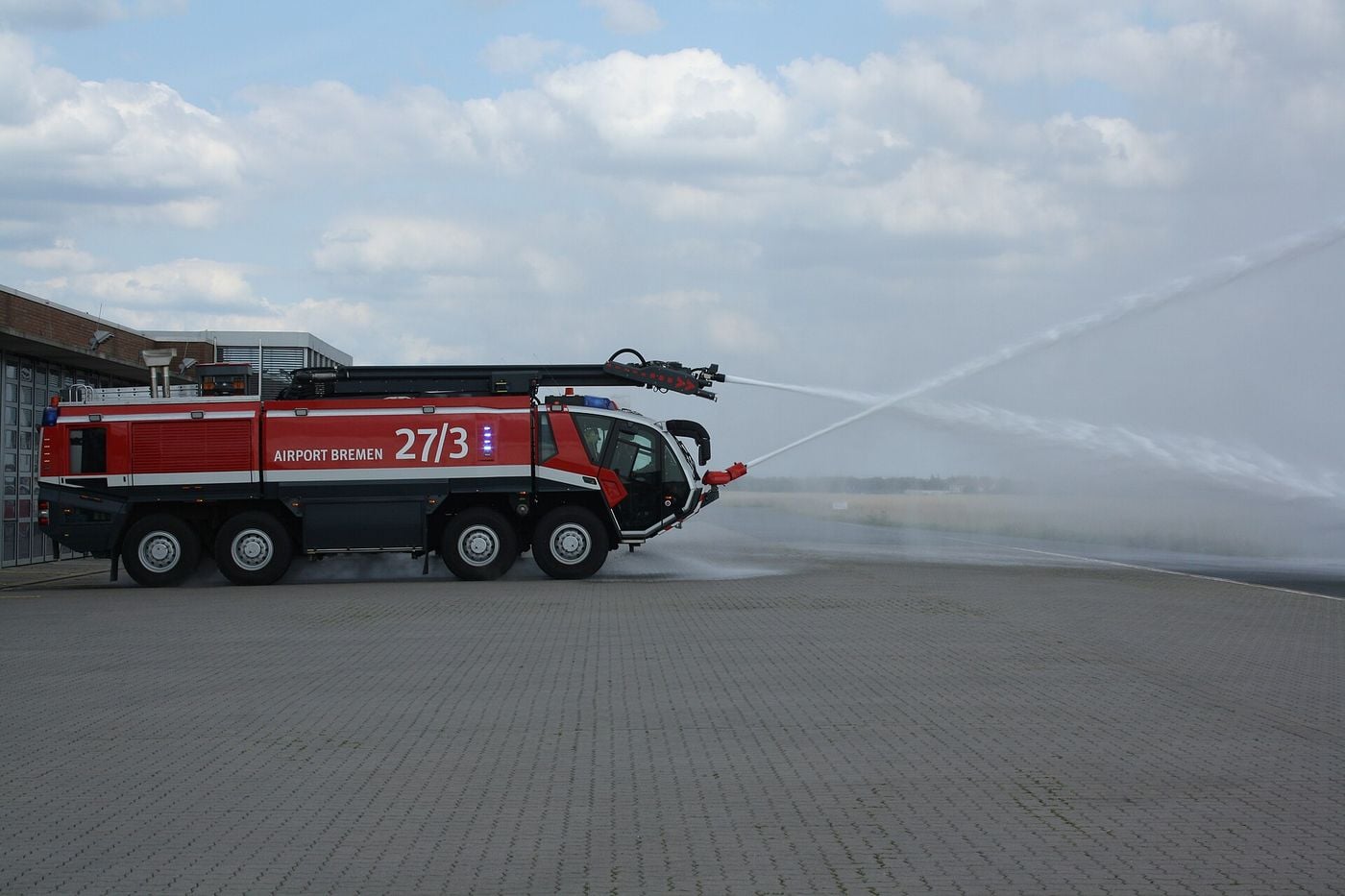
An airport fire truck is a firefighting vehicle that carries water, foam concentrate and a complementary agent such as dry chemical powder to an aircraft accident at or near an airport; US federal rules call it an aircraft rescue and firefighting (ARFF) vehicle. In the United States, 14 CFR 139.317 sets the minimum vehicles and extinguishing agents for five airport Indexes, A to E, which depend on the length of the air carrier aircraft using the airport and on their average daily departures, and 14 CFR 139.319 requires at least one required vehicle to reach the midpoint of the farthest runway serving air carrier aircraft within 3 minutes of the alarm. In the European Union, Regulation (EU) No 139/2014 obliges the aerodrome operator to provide rescue and firefighting services, and the figures — ten aerodrome categories, one to three vehicles, the agent quantities and a response time of no more than three minutes — are in the acceptable means of compliance of the European Union Aviation Safety Agency (EASA). Both sets of figures concern agents, discharge rates, numbers of vehicles and response times. The drive layout, acceleration and top speed of the vehicles come from their makers, who build them with every axle driven, as 4x4, 6x6 and 8x8; Rosenbauer gives its PANTHER 8x8 two engines and up to 19,000 l of extinguishing agent.
Status as at 8 November 2026. Read on that day: sections 139.315 to 139.319 of 14 CFR Part 139 in the Code of Federal Regulations edition revised as of 1 January 2025, with the 2024 edition for comparison; Regulation (EU) No 139/2014 in its Official Journal text and Delegated Regulation (EU) 2020/2148, which replaced points (c) to (e) of ADR.OPS.B.010; EASA’s Easy Access Rules for Aerodromes, published in March 2026, for the current wording and the acceptable means of compliance; and the ARFF pages, brochures and data sheets of Rosenbauer, Oshkosh, E-ONE, Ziegler and Magirus. ICAO’s own standards and manuals, and the FAA advisory circulars to which 14 CFR 139.317(j) refers, were not among the texts read.
What the vehicles are for
EASA’s guidance material to Regulation (EU) No 139/2014 states that the “principal objective of rescue and firefighting services is to save lives in the event of an aircraft accident or incident occurring at, or in the immediate surroundings of, the aerodrome” (GM1 ADR.OPS.B.010(a)(1)). The same guidance places the fire station “normally” on the aerodrome, without precluding a site off it “provided that the response time can be met”, and puts ambulance and medical services outside the scope of the rescue and firefighting services described in ADR.OPS.B.010. EASA’s guidance calculates the quantity of water for foam production from a critical area around the aeroplane, applying the “ICAO critical-area concept”, which “seeks to control only that area of fire adjacent to the fuselage” (GM6 ADR.OPS.B.010(a)(2)).
The makers describe the work in their own terms. Ziegler designs its Z-Class for “engine, landing gear and fuel fires; evacuation support; securing emergency landings and escort and standby services”. Oshkosh’s ARFF reference guide says airport fire trucks, unlike municipal ones, carry a larger water tank because they “don’t have access to water supplies when locations of emergencies vary and are uncertain”, and that an ARFF apparatus “may require the operator to drive over wreckage or reach an aircraft off a paved runway”. What the European standard for fire and rescue service vehicles, EN 1846-2, covers and leaves out is set out in fire engines on truck chassis. Apron buses and ground support equipment such as catering high-loaders, refuellers and de-icers are covered in airport apron vehicles.
United States: Index A to E in 14 CFR Part 139
Under 14 CFR 139.315 an airport’s Index follows from the length of its air carrier aircraft and their average daily departures. Where there are five or more average daily departures in a single Index group, the longest aircraft with an average of five or more daily departures determines the Index; where the longest aircraft makes fewer than five, the airport takes the next lower Index. The minimum is Index A. Section 139.317 then lists, “unless otherwise authorized by the Administrator”, the minimum equipment and agents for each Index.
| Index | Length of air carrier aircraft | Minimum vehicles and agents |
|---|---|---|
| A | Less than 90 feet | One vehicle carrying at least 500 pounds of sodium-based dry chemical, halon 1211 or clean agent; or 450 pounds of potassium-based dry chemical and water with a commensurate quantity of AFFF to total 100 gallons |
| B | At least 90 but less than 126 feet | One vehicle carrying at least 500 pounds of sodium-based dry chemical, halon 1211 or clean agent and 1,500 gallons of water with AFFF; or two vehicles, one with the Index A agents and one bringing the water for foam production on both to at least 1,500 gallons |
| C | At least 126 but less than 159 feet | Three vehicles, one with the Index A agents, with at least 3,000 gallons of water for foam production on all three; or two vehicles, one with the agents of the single Index B vehicle, with at least 3,000 gallons on both |
| D | At least 159 but less than 200 feet | Three vehicles, one with the Index A agents, with at least 4,000 gallons of water for foam production on all three |
| E | At least 200 feet | Three vehicles, one with the Index A agents, with at least 6,000 gallons of water for foam production on all three |
Every vehicle used for Index B to E that carries at least 500 gallons of water for foam production must have a turret. With a tank of at least 500 but less than 2,000 gallons, the turret must discharge at least 500 and not more than 1,000 gallons per minute; with 2,000 gallons or more, at least 600 and not more than 1,200 gallons per minute (139.317(f)). The minimum discharge rate for dry chemical, halon 1211 or clean agent is 5 pounds per second through a hand line or 16 pounds per second through a turret (139.317(g)), and each vehicle that carries AFFF must carry enough “to mix with twice the water required to be carried by the vehicle” (139.317(i)). Paragraph (j) adds that “FAA Advisory Circulars contain methods and procedures for ARFF equipment and extinguishing agents that are acceptable to the Administrator.”
Section 139.319 deals with equipment on the vehicles and with response. Each required vehicle must have two-way voice radio reaching at least the other required emergency vehicles, the air traffic control tower, the common traffic advisory frequency where no tower operates, and the fire stations named in the airport emergency plan. It must have a flashing or rotating beacon and be “painted or marked in colors to enhance contrast with the background environment and optimize daytime and nighttime visibility and identification”. Where an airport lies in an area subject to prolonged temperatures below 33 degrees Fahrenheit, the vehicles must have cover or other means to ensure that equipment operates and discharges under freezing conditions.
When the Administrator requests it, the airport must demonstrate a response in which at least one required vehicle, within 3 minutes of the alarm, reaches the midpoint of the farthest runway serving air carrier aircraft, or another point of comparable distance, and begins applying extinguishing agent; all other required vehicles must reach that point and begin applying agent within 4 minutes. A required vehicle that becomes inoperative must be replaced at once with equipment of at least equal capability; if the Index level of capability is not restored within 48 hours, the airport operator, unless otherwise authorised, must limit air carrier operations to those compatible with the Index of the remaining equipment. The source notes of the three sections cite 69 FR 6424 of 10 February 2004 and Amendment 139-26 of 4 June 2004.
European Union: categories 1 to 10
Annex IV of Regulation (EU) No 139/2014 applies to aerodromes certified under its Article 6 from the date the certificate is issued (Article 11(3)). In point ADR.OPS.B.010 it requires the aerodrome operator to ensure that “aerodrome rescue and firefighting facilities, equipment and services are provided” and that “adequate equipment, fire extinguishing agents and sufficient personnel are available in a timely manner”, and to train its rescue and firefighting personnel. Delegated Regulation (EU) 2020/2148 of 8 October 2020 replaced points (c) to (e): training follows point ADR.OR.D.017, with proficiency checks at intervals not exceeding 12 months, and a temporary reduction of the level of protection “due to unforeseen circumstances, shall not require prior approval by the competent authority”. Point ADR.OPS.B.010 gives no figures for vehicles or agents.
The figures are in EASA’s acceptable means of compliance (AMC), which Annex I to the Regulation defines as “non-binding standards adopted by the Agency to illustrate means to establish compliance”. An aerodrome operator that wishes to use an alternative means of compliance must first give its competent authority a full description of it (ADR.OR.A.015). Under AMC2 ADR.OPS.B.010(a)(2), the aerodrome category for rescue and firefighting follows from the overall length of the longest aeroplanes normally using the aerodrome and their fuselage width: an aeroplane whose fuselage is wider than the maximum for its length moves one category higher. Where the movements of passenger aeroplanes in the highest category are fewer than 700 in the busiest consecutive three months, the level of protection may be reduced by no more than one category. For all-cargo, mail, ferry, training, test, positioning and end-of-life operations, Table 2 of AMC2 allows a lower level, for example 7 at a category 10 aerodrome. AMC3 sets the minimum number of vehicles.
| Category | Aeroplane overall length | Maximum fuselage width | Vehicles |
|---|---|---|---|
| 1 | 0 m up to but not including 9 m | 2 m | 1 |
| 2 | 9 m up to but not including 12 m | 2 m | 1 |
| 3 | 12 m up to but not including 18 m | 3 m | 1 |
| 4 | 18 m up to but not including 24 m | 4 m | 1 |
| 5 | 24 m up to but not including 28 m | 4 m | 1 |
| 6 | 28 m up to but not including 39 m | 5 m | 2 |
| 7 | 39 m up to but not including 49 m | 5 m | 2 |
| 8 | 49 m up to but not including 61 m | 7 m | 3 |
| 9 | 61 m up to but not including 76 m | 7 m | 3 |
| 10 | 76 m up to but not including 90 m | 8 m | 3 |
AMC4 names foam meeting performance level A, B or C, or a combination, as the principal agent and a dry chemical powder suitable for hydrocarbon fires, or an alternate agent with equivalent firefighting capability, as the complementary agent. The water quantities are based on the average overall length of aeroplanes in a category and on application rates of 8.2, 5.5 and 3.75 l/min per m² for foam of levels A, B and C. At categories 1 and 2 up to 100 % of the water may be replaced by complementary agent, 1 kg of which counts as 1 l of water for level A foam. AMC4 also provides for foam concentrate on each vehicle sufficient for at least two loads of foam solution, and for a reserve on the aerodrome of foam concentrate equal to 200 % and of complementary agent equal to 100 % of the quantities in the table.
| Category | Level A foam: water, l / l/min | Level B foam: water, l / l/min | Level C foam: water, l / l/min | Dry chemical powder: kg / kg/s |
|---|---|---|---|---|
| 1 | 350 / 350 | 230 / 230 | 160 / 160 | 45 / 2.25 |
| 2 | 1,000 / 800 | 670 / 550 | 460 / 360 | 90 / 2.25 |
| 3 | 1,800 / 1,300 | 1,200 / 900 | 820 / 630 | 135 / 2.25 |
| 4 | 3,600 / 2,600 | 2,400 / 1,800 | 1,700 / 1,100 | 135 / 2.25 |
| 5 | 8,100 / 4,500 | 5,400 / 3,000 | 3,900 / 2,200 | 180 / 2.25 |
| 6 | 11,800 / 6,000 | 7,900 / 4,000 | 5,800 / 2,900 | 225 / 2.25 |
| 7 | 18,200 / 7,900 | 12,100 / 5,300 | 8,800 / 3,800 | 225 / 2.25 |
| 8 | 27,300 / 10,800 | 18,200 / 7,200 | 12,800 / 5,100 | 450 / 4.5 |
| 9 | 36,400 / 13,500 | 24,300 / 9,000 | 17,100 / 6,300 | 450 / 4.5 |
| 10 | 48,200 / 16,600 | 32,300 / 11,200 | 22,800 / 7,900 | 450 / 4.5 |
AMC5 gives a response time “not exceeding three minutes with an operational objective of not exceeding two minutes” from the initial call to any point of each operational runway, in optimum visibility and surface conditions, and the service in a position to apply foam at no less than 50 % of the discharge rate in the table; any further vehicle needed for continuous application arrives no more than one minute after the first. AMC6 provides for trained personnel available to ride the vehicles during flight operations and for at least 15 minutes after the departure of the last flight. Under the Regulation’s rules for vehicles on the manoeuvring area, emergency vehicles going to the assistance of an aircraft in distress “shall be afforded priority over all other surface movement traffic” (ADR.OPS.B.027(b)(1)).
The two rule sets side by side
| United States | European Union | |
|---|---|---|
| Where the figures are | 14 CFR 139.315 to 139.319, as “the minimum required” unless otherwise authorised by the Administrator | AMC2 to AMC5 to ADR.OPS.B.010, “non-binding standards”; the Regulation sets the duty without figures |
| What sets the level | Length of air carrier aircraft in feet and five or more average daily departures | Overall length in metres and fuselage width of the longest aeroplanes normally using the aerodrome; one category lower with fewer than 700 passenger aeroplane movements in the highest category in the busiest consecutive three months |
| Levels and vehicles | Index A to E; one to three vehicles | Categories 1 to 10; one to three vehicles |
| Response | At least one required vehicle within 3 minutes of the alarm at the midpoint of the farthest runway serving air carrier aircraft, applying agent; all others within 4 minutes | No more than 3 minutes, objective 2, from the initial call to any point of each operational runway; foam at 50 % of the table rate or more; further vehicles needed for continuous agent application within 1 minute of the first |
| Communication | Two-way voice radio to the other emergency vehicles, the tower, the common traffic advisory frequency and the fire stations | A discrete communication system linking a fire station with the control tower, any other fire station and the vehicles (AMC1 ADR.OPS.B.010(a)(2)) |
| Marking and lighting | Flashing or rotating beacon; colours that enhance contrast with the background | Conspicuous colours or flags and, at night or in low visibility, flashing blue low-intensity obstacle lights for emergency vehicles (ADR.OPS.B.080); red or yellowish green “should preferably be used” for emergency vehicles (AMC1 ADR.OPS.B.080(a)) |
| A vehicle out of service | Replaced at once with equal capability; if the Index capability is not restored within 48 hours, air carrier operations limited to the Index of the remaining equipment | A temporary reduction due to unforeseen circumstances needs no prior approval (ADR.OPS.B.010(e)); GM4 lists the “breakdown of RFFS vehicles” among such circumstances |
Built for the airport or taken from a truck range
Rosenbauer says it develops and manufactures the chassis, the superstructure and the firefighting technology of the PANTHER itself. Its own timeline puts the first PANTHER 8x8, on a MAN chassis, in 1991, the start of production of its own chassis for the PANTHER 6x6 and 4x4 in Wyoming, Minnesota, in 2003, and its own four-axle chassis with two drive motors for the PANTHER 8x8 in 2007. Magirus says that in its latest DRAGON generation the special chassis, the superstructure, the firefighting technology and the controls all come from Magirus, and bases its IMPACT range, which it intends for airports of lower categories, on modified components from high-volume truck production; for the IMPACT X4 its brochure of 2016 names those of the IVECO Trakker. Rosenbauer’s MT Airport is “based on a standard chassis”: its data sheet of November 2020 has a Mercedes-Benz Zetros 3348 6x6 with 350 kW (480 PS), a 5,050 mm wheelbase and a permitted total weight of 29,000 kg. Oshkosh builds the Striker on what it calls a custom chassis, with a centre steering position and its TAK-4 all-wheel independent suspension, which Oshkosh introduced on its T-Series in 1996 and made standard on the first Striker in 2000.
Rosenbauer’s brochure describes the PANTHER series as “ARFF vehicles on 2-, 3-, and 4-axle chassis with permanent all-wheel drive”, and Ziegler’s data sheets give permanent 4x4, 6x6 and 8x8 drive; what such a notation counts is explained in axle configurations explained. Rosenbauer and Ziegler say their cabs were crash tested to ECE R29-3, and E-ONE says the Titan cab meets the SAE 2420 / 2422 and ECE-R29 structural requirements. Crew seating, as the makers give it: four in E-ONE’s Titan, 1 + 3 in the PANTHER electric, up to 1 + 5 in Ziegler’s Z-Class, up to five firefighters in Oshkosh’s Striker, and three, four or six in Magirus’s SUPERDRAGON X8 according to its web page, with the driver’s seat on the left, on the right or in the centre; Magirus’s data sheets of 2016 give 1 + 2, 1 + 3 or 1 + 4 for the SUPERDRAGON X8 and the DRAGON X6.
What the makers publish in figures
Rosenbauer, Oshkosh, E-ONE, Ziegler and Magirus publish the following figures for individual models.
| Maker and model | Drive and weight | Power as printed | Water, foam, powder | Pump and turrets | 0–80 km/h; top speed |
|---|---|---|---|---|---|
| Rosenbauer PANTHER 4x4 | 4x4 | 700 hp (Volvo) | Up to 6,950 l extinguishing agent | Pump 7,000 l/min (web page), 9,000 l/min (brochure) | 22 s; 115 km/h |
| Rosenbauer PANTHER 6x6 S | 6x6; superstructure 2.5 m wide | 700 hp (Volvo) | Up to 10,300 l extinguishing agent | Pump 7,000 l/min | 28 s; 115 km/h |
| Rosenbauer PANTHER 6x6 | 6x6 | 750 hp (Volvo) | Up to 14,000 l extinguishing agent | Pump 9,000 l/min | 31 s, or 28 s with the 8-speed performance package; 120 km/h |
| Rosenbauer PANTHER 8x8 | 8x8, two engines | Up to 1,450 hp combined | Up to 19,000 l extinguishing agent | Pump 10,000 l/min | 25 s; 135 km/h |
| Rosenbauer PANTHER electric | Rosenbauer 40.980 6x6; 40,500 kg | 720 kW (980 hp) electric; 880 kW (1,200 hp) in boost mode | 12,000 l water, 1,450 l foam, 250 kg powder | N80 pump up to 9,000 l/min at 12 bar; roof turret RM 80 up to 9,000 l/min, front turret RM 15 up to 2,000 l/min | 25 s, 20 s in boost mode; 120 km/h |
| Rosenbauer MT Airport 6100/750/250 | Mercedes-Benz Zetros 3348 6x6; 29,000 kg | 350 kW (480 PS) | 6,150 l water, 750 l foam, 250 kg powder | N35 pump 3,500 l/min at 10 bar; roof turret RM35C max. 3,000 l/min, front turret RM15C max. 1,500 l/min | — |
| Oshkosh Striker 8x8 | 8x8, two engines | — | — | — | 0–50 mph (80 kph) in 25 s (Striker page), in less than 20 s (reference guide); — |
| Oshkosh Striker Volterra 6x6 | 6x6, TAK-4 suspension | Scania DC13 engine with onboard batteries; output not given | 3,170 gal (12,000 l) water; 550 lb (225 kg) dry chemical | Pump 2,000 GPM (7,570 LPM); 50 ft (15.2 m) Snozzle HRET | 0–50 mph (0–80 kph) in 25 s; — |
| E-ONE Titan 4x4 | 4x4 | Scania DC16, 500 kW (670 hp) | 1,585 gal (6,000 l) water, 225 gal (852 l) foam; dry chemical up to 550 lb (250 kg) optional | Rhino II bumper turret optional | — |
| E-ONE Titan 6x6 | 6x6 | Scania DC16, 574 kW (770 hp) | 3,170 gal (12,000 l) water with an integral 445 gal (1,680 l) foam tank; dry chemical up to 550 lb (250 kg) optional | HRET up to 65 ft (19.8 m) elevation and Rhino II bumper turret optional | — |
| E-ONE Titan 4x4 AT | 4x4, for transport in C-5, C-17 and C-130 aircraft | — | 1,000 gal (3,785 l) water, 140 gal (529 l) foam; dry chemical up to 250 lb (113 kg) optional | Darley PSP pump up to 1,500 GPM (5,678 LPM); bumper and roof turrets 375 GPM (1,419 LPM) low flow or 750 GPM (2,839 LPM) high flow, optional | —; over 70 mph |
| Ziegler Z4 | Permanent 4x4; 26,000 kg | Scania DC16, 566 kW (770 hp) Stage V; optionally 522 kW (710 hp) Euro 6 | 6,000 l water, 750 l foam; 250 kg dry powder system among additional systems | Z-Pump 10-8000; bumper turret ZT-2000, roof turret ZT-6000 | Under 20 s; 120 km/h |
| Ziegler Z6 | Permanent 6x6; 39,000 kg | As the Z4 | Up to 13,500 l water, up to 1,650 l foam; 250 kg dry powder system among additional systems | Z-Pump 10-8000, 10-10000 optional; turrets as the Z4, roof turret ZT-8000 and Z-Attack 17 HRET optional | Under 28 s; 120 km/h |
| Ziegler Z8 and Z8 LWB | Permanent 8x8; 52,000 kg; wheelbase 4,500 or 5,500 mm | Scania DC16 twin engine, 1,132 kW (1,540 hp) Stage V; optionally 1,044 kW (1,420 hp) Euro 6 | Up to 17,000 l water, up to 2,000 l foam; 500 kg dry powder system among additional systems | As the Z6 | Under 20 s; 140 km/h |
| Magirus DRAGON X6 TEP | Magirus IM40X6 6x6; 40,000 kg | Two IVECO Cursor 13 engines of 540 PS (Euro 3) or 560 PS (Euro 5) each; 794 kW / 1080 PS (Euro III) or 824 kW / 1120 PS (Euro V) in the data sheet | 10,000, 11,500, 12,000 or 12,500 l water; foam up to 1,500 l; powder up to 500 kg optional | Pump over 9,000 l/min at 10 bar (data sheet), up to 9,400 l/min (web page); roof and front monitor | 18 to 21 s (data sheet), about 21 s (web page); 115 km/h, 135 km/h with retarder (data sheet), about 135 km/h electronically limited (web page) |
| Magirus SUPERDRAGON X8 TEP | Magirus IM52X8 8x8; 52,000 kg; wheelbase 4,050 mm (SWB) or 5,050 mm (LWB) | 824 kW / 1120 PS (Euro V) or 794 kW / 1080 PS (Euro III) | Up to 14,000 l (SWB) or 17,000 l (LWB) water; foam up to 2,000 or 2,500 l; powder up to 500 kg optional | Pump over 9,000 l/min at 10 bar; roof and front monitor | About 23 s (SWB), about 25 s (LWB); 115 km/h, 135 km/h with retarder |
Some makers give different figures in different documents. For the PANTHER 4x4 pump, Rosenbauer’s web page gives 7,000 l/min and its brochure of July 2024 9,000 l/min; Oshkosh gives the Striker 8x8 0–50 mph in 25 seconds on its Striker page and in “less than 20 seconds” in its ARFF reference guide. Rosenbauer’s brochure gives the times from 0 to 80 km/h of the PANTHER 4x4, 6x6 and 8x8 as “less than” 22, 28 and 25 seconds, and its web page gives the PANTHER 6x6 31 seconds in the model list and 28 seconds with the performance package of 750 hp and an 8-speed gearbox. Magirus’s page for the DRAGON X6 NEO, with Euro 6 engines and what Magirus calls a two-engine strategy, gives 0–80 km/h in under 20 seconds and availability from the second quarter of 2025, and no further figures.
Ziegler’s Z-Class and E-ONE’s Titan 4x4 and 6x6 use the Scania DC16, which is described in Scania 16-litre V8 engine. Ziegler’s Z8 and Magirus’s SUPERDRAGON X8 are each given a permitted weight of 52,000 kg; trucks and buses measured by payload, length and power are set out in the biggest trucks and buses in the world.
Turrets, high-reach arms and pump and roll
14 CFR 139.317(f) requires a turret on every US vehicle that carries 500 gallons or more of water for foam production for Index B to E. Beyond roof and bumper turrets, the makers offer high-reach extendable turrets (HRET): a boom that carries a turret and, on Oshkosh’s Snozzle and Rosenbauer’s STINGER and as an option on Ziegler’s Z-Attack, a piercing tool. Oshkosh offers the Snozzle with a 50 ft or 65 ft boom, more than 36 in. (914 mm) of penetrating depth and a “40 ft. (12 m) cold shower pattern of 250 gpm (947 lpm)”. E-ONE offers an HRET with up to 65 ft (19.8 m) elevation on the Titan 6x6, Rosenbauer the STINGER 54 and 66, Ziegler the Z-Attack 17 as an option on the Z6 and Z8, and Magirus its Spiker arm on the SUPERDRAGON X8. Ziegler rates its ZT-6000 and ZT-8000 roof turrets at 6,000 and 8,000 l/min, and Rosenbauer gives the PANTHER’s roof and front turrets up to 9,000 l/min and a range of up to 100 m.
Pump and roll, which in Oshkosh’s words lets the crew “have the vehicle in motion while still powering the pump”, appears in the makers’ descriptions. Magirus’s data sheets give “Pump & Roll bis zu 70 km/h”, Oshkosh says its power divider allows pump and roll “in any condition”, Ziegler’s Z-Class brochure names it “in any driving state and at any speed”, and Rosenbauer’s MT Airport data sheet states that pump and roll operation is possible.
Electric and hybrid drives
Rosenbauer started sales of the PANTHER electric in 2024, according to its PANTHER timeline. The vehicle, on a Rosenbauer 40.980 6x6 chassis with four electric motors, has high-voltage batteries with a nominal energy content of 256 kWh and an energy backup system powered by a 235 kW diesel engine. It charges through a CCS type 2 connection at up to 22 kW AC or 2 × 150 kW DC, and Rosenbauer says that at up to 300 kW a charge from 0 % to 100 % takes around 45 minutes. A Rosenbauer data sheet of February 2026 for one build, with a STINGER 54 HRET, lists 11,400 l of water and 1,370 l of foam agent, where the product page gives 12,000 l and 1,450 l. How a nominal battery figure differs from what can be used is explained in installed vs usable battery capacity.
Oshkosh introduced the Striker Volterra in June 2021. It combines onboard batteries with a diesel engine, a Scania DC13 in the 6x6 configuration Oshkosh lists, and Oshkosh says daily operations can run on battery power with an automatic switch to the diesel engine when the situation requires it. A connection to the power grid is not required to keep the batteries charged while they are coupled with the engine, Oshkosh says, and the vehicle can charge from the “standard 220 or 480 electrical grid”.
Dates in the makers’ own histories
| Year | Event | Maker’s document |
|---|---|---|
| 1930 | Magirus delivers a tank fire engine with large water and foam capacities, a front-mounted Magirus pump and two rapid-attack devices to an airfield in southern Germany; Magirus calls it its first airfield fire engine | Magirus ARFF brochure, August 2016 |
| 1968 | Oshkosh builds the MB-5 for the U.S. Navy; the MB-1, of 1,000 gallons, follows | Oshkosh ARFF Vehicle Reference Guide |
| 1969 | Ziegler dates its airport technology from this year | Ziegler Z-Class page |
| 1972 | Magirus delivers ARFF vehicles on 8x8 chassis with two engines to the airport of Munich | Magirus ARFF brochure, August 2016 |
| 1991 | First Rosenbauer PANTHER 8x8, on a MAN chassis, presented; the first delivery, to Geneva Airport, follows in 1992 | Rosenbauer PANTHER page |
| 1996 | Oshkosh introduces TAK-4 independent suspension on its T-Series | Oshkosh TAK-4 page |
| 2000 | First Oshkosh Striker, with TAK-4 as standard | Oshkosh TAK-4 page |
| 2003 | Rosenbauer starts producing its own chassis for the PANTHER 6x6 and 4x4 in Wyoming, Minnesota | Rosenbauer PANTHER page |
| 2007 | Rosenbauer builds its own four-axle chassis with two drive motors for the PANTHER 8x8 | Rosenbauer PANTHER page |
| 2013 | Rosenbauer adds the PANTHER 6x6 S, 2.5 m wide, developed for smaller, regional or national airports | Rosenbauer PANTHER page |
| 2020 | The 2,000th PANTHER is delivered to Fort Lauderdale Airport | Rosenbauer PANTHER page |
| 2021 | Next-generation Oshkosh Striker released in January; Striker Volterra introduced in June | Oshkosh ARFF Vehicle Reference Guide |
| 2024 | Rosenbauer starts sales of the PANTHER electric | Rosenbauer PANTHER page |
| 2025 | Magirus DRAGON X6 NEO available from the second quarter | Magirus DRAGON X6 NEO page |
| 2026 | The 3,000th PANTHER, one of seven PANTHER 6x6 for Athens International Airport | Rosenbauer PANTHER page |
Quick answers
- What is an ARFF vehicle?
- An aircraft rescue and firefighting vehicle: a fire truck that carries water, foam concentrate and a complementary agent such as dry chemical powder to an aircraft accident at or near an airport. In the United States, 14 CFR 139.317 sets the minimum vehicles and agents for airport Indexes A to E; in the European Union, EASA's acceptable means of compliance under Regulation (EU) No 139/2014 set them for aerodrome categories 1 to 10. Rosenbauer, Oshkosh, E-ONE, Ziegler and Magirus build them with every axle driven, as 4x4, 6x6 or 8x8.
- How many fire trucks must an airport have?
- In the United States, 14 CFR 139.317 requires, unless the FAA Administrator authorises otherwise, one vehicle at Index A, one or two at Index B, two or three at Index C and three at Indexes D and E; the Index depends on the length of the air carrier aircraft and their average daily departures. In the European Union, EASA's AMC3 ADR.OPS.B.010(a)(2) gives one vehicle for aerodrome categories 1 to 5, two for categories 6 and 7 and three for categories 8 to 10.
- How fast must airport fire trucks reach the runway?
- Under 14 CFR 139.319, within 3 minutes of the alarm at least one required vehicle must reach the midpoint of the farthest runway serving air carrier aircraft and begin applying extinguishing agent, and all other required vehicles must do so within 4 minutes. EASA's AMC5 ADR.OPS.B.010(a)(2) gives a response time of no more than three minutes, with an operational objective of no more than two, from the initial call to any point of each operational runway in optimum visibility and surface conditions; any further vehicle needed for continuous agent application arrives no more than one minute after the first.
- How much water does an airport fire truck carry?
- That depends on the model, while the rules set totals per airport. Ziegler gives 6,000 l of water for its Z4 and up to 17,000 l for its Z8, Rosenbauer up to 19,000 l of extinguishing agent for the PANTHER 8x8, and E-ONE and Oshkosh 3,170 gallons (12,000 l) of water for the Titan 6x6 and the Striker Volterra 6x6. US rules require at least 6,000 gallons of water for foam across three vehicles at Index E, and EASA's AMC4 gives 48,200 l for foam of performance level A at aerodrome category 10.
- Are airport fire trucks built on ordinary truck chassis?
- Some are. Rosenbauer builds the chassis of its PANTHER itself, Magirus its DRAGON range on a special chassis, and Oshkosh the Striker on a custom chassis with its TAK-4 independent suspension. Rosenbauer's MT Airport is based on a standard chassis, a Mercedes-Benz Zetros 3348 6x6 in its data sheet of November 2020, and Magirus bases its IMPACT range for airports of lower categories on modified truck components, those of the IVECO Trakker in the case of the IMPACT X4.
Models in this article
Sources
- 14 CFR Part 139, Certification of Airports — sections 139.315, 139.317 and 139.319 on aircraft rescue and firefighting, Code of Federal Regulations, Title 14, Volume 3, edition revised as of 1 January 2025 — U.S. Government Publishing Office (govinfo), 1 Jan 2025
- 14 CFR Part 139, Certification of Airports — sections 139.317 and 139.319, Code of Federal Regulations, Title 14, Volume 3, edition revised as of 1 January 2024 (comparison) — U.S. Government Publishing Office (govinfo), 1 Jan 2024
- Commission Regulation (EU) No 139/2014 of 12 February 2014 laying down requirements and administrative procedures related to aerodromes — Official Journal text: Article 11, Annex I definition (1) and Annex IV point ADR.OPS.B.010 — EUR-Lex, European Union, 12 Feb 2014
- Commission Delegated Regulation (EU) 2020/2148 of 8 October 2020 amending Regulation (EU) No 139/2014 as regards runway safety and aeronautical data — Article 2 and Annex point (3)(i) — EUR-Lex, European Union, 8 Oct 2020
- Easy Access Rules for Aerodromes (Regulation (EU) No 139/2014), published March 2026 — Annex I definition (1), ADR.OR.A.015, ADR.OPS.B.010 with AMC1 to AMC6 and GM1 to GM6, ADR.OPS.B.027, ADR.OPS.B.080 and AMC1 ADR.OPS.B.080(a) — European Union Aviation Safety Agency (EASA)
- PANTHER – ARFF vehicles: product page with models, features and milestones, read on 8 November 2026 — Rosenbauer International AG
- PANTHER brochure, English edition of July 2024 (PA14X) — Rosenbauer International AG
- PANTHER electric: product page with technical data, read on 8 November 2026 — Rosenbauer International AG
- PANTHER 6x6 electric data sheet, ARFF 11400-1370-250 with HRET, product number PA146-9701, document KR272 of February 2026 — Rosenbauer International AG
- MT Airport: product page, read on 8 November 2026 — Rosenbauer International AG
- MT data sheet, aircraft fire fighting vehicle 6100/750/250 on Mercedes-Benz Zetros 3348 6x6, version 1.0 of 17 November 2020 — Rosenbauer International AG, 17 Nov 2020
- The Oshkosh Striker ARFF vehicle: product page, read on 8 November 2026 — Oshkosh Airport Products
- ARFF Vehicle Reference Guide, read on 8 November 2026 — Oshkosh Airport Products
- Striker Volterra electric ARFF vehicle guide, read on 8 November 2026 — Oshkosh Airport Products
- Snozzle HRET: product page, read on 8 November 2026 — Oshkosh Airport Products
- TAK-4 independent suspension: page with its history on the Striker, read on 8 November 2026 — Oshkosh Airport Products
- Titan ARFF 4×4: product page, read on 8 November 2026 — E-ONE
- Titan ARFF 6×6: product page, read on 8 November 2026 — E-ONE
- Titan ARFF Air Transportable: product page, read on 8 November 2026 — E-ONE
- Z-Class Z4 Airport Rescue and Firefighting vehicle: data sheet, English, undated, read on 8 November 2026 — Albert Ziegler GmbH
- Z-Class Z6 Airport Rescue and Firefighting vehicle: data sheet, English, undated, read on 8 November 2026 — Albert Ziegler GmbH
- Z-Class Z8 Airport Rescue and Firefighting vehicle: data sheet, English, undated, read on 8 November 2026 — Albert Ziegler GmbH
- Z-Class Z8 LWB Airport Rescue and Firefighting vehicle: data sheet, English, undated, read on 8 November 2026 — Albert Ziegler GmbH
- Z-Class: product page, read on 8 November 2026 — ZIEGLER Group
- Z-Turret: product page with the ZT-6000 and ZT-8000, read on 8 November 2026 — ZIEGLER Group
- Z-Class Airport Rescue and Firefighting vehicles: brochure, English, undated, read on 8 November 2026 — Albert Ziegler GmbH
- DRAGON X6 TEP Flugfeldlöschfahrzeug: technical data sheet, German, December 2016 — Magirus GmbH
- SUPERDRAGON X8 TEP (LWB) Flugfeldlöschfahrzeug: technical data sheet, German, November 2016 — Magirus GmbH
- SUPERDRAGON X8 TEP (SWB) Flugfeldlöschfahrzeug: technical data sheet, German, March 2016 — Magirus GmbH
- Magirus Flugfeldlöschfahrzeuge: ARFF brochure, German, August 2016 — Magirus GmbH
- Flugfeldlöschfahrzeuge: overview page of the DRAGON and IMPACT ranges, German, read on 8 November 2026 — Magirus GmbH
- Magirus DRAGON X6: product page, German, read on 8 November 2026 — Magirus GmbH
- DRAGON X6 NEO: product page, German, read on 8 November 2026 — Magirus GmbH
- Magirus SUPERDRAGON X8: product page, German, read on 8 November 2026 — Magirus GmbH