BYD
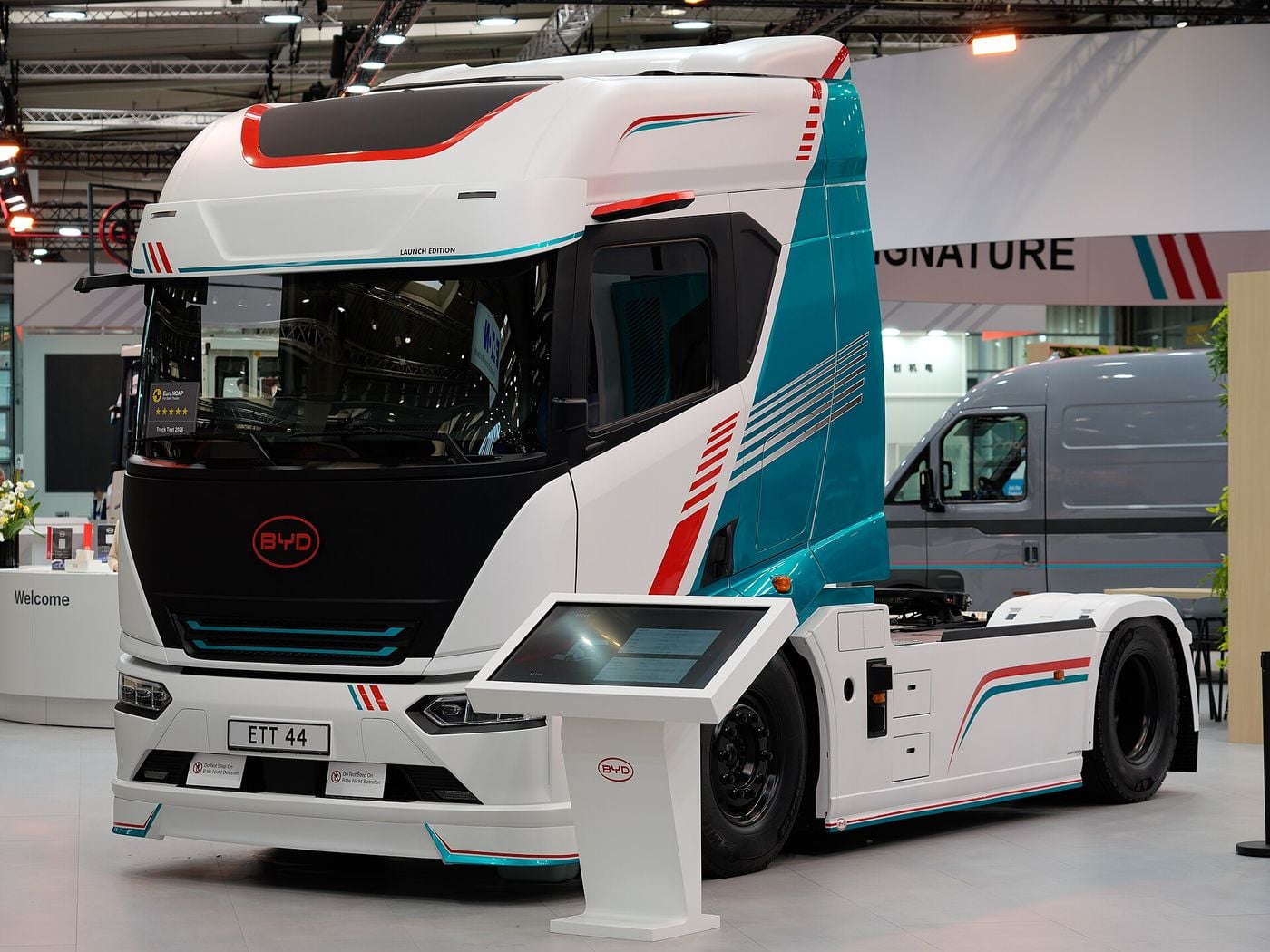
BYD ETT44
BYD's 4x2 battery-electric tractor for Europe: LFP battery of 434 or 651 kWh, 540 kW rated and 750 kW peak output, 400 or 600 km range, CCS2 at 450 kW and MCS at 950 or 1,500 kW.
- 4x2
- 540 kW
- 6.4 m

Model overview
- Segment
- Long-haul tractor
- Axle configurations
- 1 (4x2…)
- Gross combination
- 65 t
- Gross vehicle
- 22 000 kg
- Battery capacity
- 434–651 kWh
- Range
- 600 km
- Charging
- 450 kW (CCS2)
- Electric motor
- 540 kW · 750 kW peak
- Length
- 6 400 mm
- Wheelbase
- 3 800 mm
| Variant | Axle configurations | Wheelbase (mm) | Kerb weight (kg) | Gross vehicle (kg) | Gross combination (kg) | Sheet |
|---|---|---|---|---|---|---|
| ETT44 LFP 434 kWh | 4x2 | 3,800 | 9,565 | 22,000 | 65,000 | BYD Truck & Van Europe, EU product page, undated, read 4 November 2026 |
| ETT44 LFP 651 kWh | 4x2 | 3,800 | 11,120 | 22,000 | 65,000 | BYD Truck & Van Europe, EU product page, undated, read 4 November 2026 |
The ETT44 is an all-electric 4x2 tractor in BYD’s European truck range. BYD presents it for regional and long-haul transport and showed it at IAA Transportation 2026. Its German press release, datelined Hannover, 16 September 2026, calls it the new flagship of BYD’s commercial vehicles and writes the name as ETT 44; the product page writes ETT44.
This page is built from three BYD documents: the EU product page of BYD Truck & Van Europe with its table of technical specifications (English edition, undated, read on 4 November 2026), the core-technology section of the same site’s home page (undated, read the same day), and the press release.
BYD lists two versions, with LFP batteries of 434 kWh and 651 kWh. In the overview at the top of this page, the range is that of the 651 kWh version and the charging figure is the CCS2 rating both versions share. The press release speaks of the ETT 44’s market launch without giving a date. No document opened gives a start of production, an order date or first deliveries, and none names an earlier generation of the model.
Two battery versions
BYD’s table has one column for each battery. The two versions differ in curb weight, CCS2 charging time, MCS charging power and driving range; every other row carries the same figure in both columns.
| Specification | LFP 434 kWh | LFP 651 kWh |
|---|---|---|
| Configuration | 4×2 battery-electric tractor | 4×2 battery-electric tractor |
| L × W × H | 6,400 × 2,530 × 3,860 mm | 6,400 × 2,530 × 3,860 mm |
| Wheelbase | 3,800 mm | 3,800 mm |
| GVW | 22,000 kg | 22,000 kg |
| GCW | Up to 65,000 kg | Up to 65,000 kg |
| Curb weight | 9,565 kg | 11,120 kg |
| Axle design load front/rear | 9,000/13,000 kg | 9,000/13,000 kg |
| Nominal voltage | 850 V | 850 V |
| Rated power | 540 kW | 540 kW |
| Peak power | 750 kW | 750 kW |
| CCS2 charging | 450 kW | 450 kW |
| CCS2 20–80% SOC | 40 min | 60 min |
| MCS charging | 950 kW | 1,500 kW |
| MCS 20–80% SOC | 20 min | 20 min |
| AC charging | 43 kW optional | 43 kW optional |
| Driving range | 400 km | 600 km |
| ePTO AC | 43 kW | 43 kW |
| ePTO DC (rated/peak) | 110/170 kW | 110/170 kW |
| Top speed | 90 km/h | 90 km/h |
Electric drive and power take-off
BYD gives 540 kW of rated output and up to 750 kW of peak power, a nominal voltage of 850 V and a top speed of 90 km/h. The product page ties these power figures to a gross combination weight of up to 65 tonnes. The press release gives the output in PS only, “bis zu 1000 PS”, and the product page in kW only.
The release says the ETT 44 was developed from the ground up as a purely electric platform, on an architecture of its own. The home page says BYD designs and manufactures every key component in-house, and names motors, batteries and onboard electronics. No document opened gives the number of motors, a gearbox, a torque figure or an axle ratio.
Both versions have an electric power take-off: 43 kW as ePTO AC, and 110 kW rated and 170 kW peak as ePTO DC.
Battery and warranty
The table gives the chemistry of both batteries as LFP. The release names the 651 kWh unit as a BYD Blade battery and calls it the centrepiece of the ETT 44. The home page’s core-technology section, which names no model, says the Blade Battery is engineered for the heavy-duty cycles of commercial vehicles. No document opened says whether 434 kWh and 651 kWh are installed or usable figures, or how many packs make them up.
The product page gives the ETT44 battery warranty as up to 10 years, 1.2 million kilometres or 4,500 full charging cycles. The home page gives up to 10 years or 1.2 million kilometres, with no cycle figure. Neither gives a state-of-health threshold; how makers state such limits is set out in how electric truck battery warranties are defined.
Range
BYD’s table gives a driving range of 400 km for the 434 kWh version and 600 km for the 651 kWh version. The feature text on the same page reads “more than 600 km”, and the press release gives a range of 600 kilometres. No document opened states the load, the temperature or the test procedure behind these figures. The bases on which makers declare range are set out in how electric-truck range is declared.
Charging
The table lists three ways to charge:
- CCS2: 450 kW on both versions. From 20 to 80 per cent SOC it takes 40 minutes on the 434 kWh version and 60 minutes on the 651 kWh version.
- MCS: 950 kW on the 434 kWh version and 1,500 kW on the 651 kWh version. From 20 to 80 per cent SOC it takes 20 minutes on both.
- AC: 43 kW, listed as optional.
The top MCS figure is worded differently across the documents. The table prints 1,500 kW. The product page’s feature text reads “more than 1.5 MW”. The home page’s core-technology section, which names no model, says “exceeding 1.5 MW” and labels the figure MCS peak power. In the press release, Stella Li, Executive Vice President of BYD, gives a charging power of 1.5 megawatts and about 20 minutes from 20 to 80 per cent, equal to up to 400 additional kilometres of range. The release’s own text gives the same 400 kilometres for the 651 kWh battery and says “in nur 20 Minuten”.
The release uses the name FLASH Charging. Stella Li says BYD has already put it into practice on passenger cars and is now bringing it to commercial vehicles, starting with its trucks. The home page’s term is Megawatt Flash Charging. What the Megawatt Charging System is, as a standard, is covered in megawatt charging explained. No document opened gives the conditions behind the charging times or the position of the charging ports.
Cab
BYD’s product page describes the cab under seven headings:
- Interior: a flat-floor layout with integrated storage and, in BYD’s words, generous headroom.
- Cockpit: an ergonomic layout that keeps essential information and frequently used controls within reach of the driver.
- Seats: supportive seats with integrated armrests for driver and passenger.
- HVAC: a climate and ventilation system that distributes air throughout the interior.
- Bed: a bunk that BYD calls generously sized.
- Display: a central touchscreen for infotainment, phone connectivity and climate settings.
- Refrigerator: an integrated refrigerator for food and drinks.
The press release says the ETT 44 embodies a new design direction for commercial vehicles. No document opened gives a cab name, cab dimensions or a number of bunks.
Driver-assistance systems
The product page lists 12 advanced driver-assistance systems. It does not say which are standard and which are optional.
| Short name | System | Function, as BYD describes it |
|---|---|---|
| AEB | Automatic Emergency Braking | Detects a potential frontal collision and can brake automatically to help avoid or reduce an impact |
| BSIS | Blind Spot Information System | Warns of cyclists and other vulnerable road users in the passenger-side blind spot, particularly when turning |
| ELKA | Emergency Lane Keeping Assist | Detects collision risks with vehicles in an adjacent lane and can give corrective steering support |
| FCTA | Front Cross Traffic Alert | Warns of approaching vehicles crossing the truck’s path at a junction |
| FCTB | Front Cross Traffic Braking | Can brake automatically if crossing traffic creates an imminent collision risk |
| CSW | Curve Speed Warning | Alerts the driver when approaching a curve at a potentially unsafe speed |
| PCC | Predictive Cruise Control | Adapts vehicle speed using upcoming road information |
| LDP | Lane Departure Prevention | Gives corrective steering support to help prevent the truck leaving its lane unintentionally |
| MOIS | Moving Off Information System | Warns of cyclists or pedestrians directly in front of the vehicle before moving off |
| ICC | Intelligent Cruise Control | Helps hold the selected speed, the distance from traffic ahead and the position within the lane |
| BSD | Blind Spot Detection | Monitors adjacent blind spots and alerts the driver when another vehicle is detected |
| ELK | Emergency Lane Keeping | Intervenes in critical situations to help prevent an unintended departure from the lane or road |
Dimensions and weights
Both versions measure 6,400 mm long, 2,530 mm wide and 3,860 mm high, on a 3,800 mm wheelbase. The curb weight is 9,565 kg with the 434 kWh battery and 11,120 kg with the 651 kWh battery.
The table gives a GVW of 22,000 kg and an axle design load of 9,000 kg at the front and 13,000 kg at the rear, and a GCW of up to 65,000 kg; what these weights mean is covered in truck weights, GVW and GCW. The press release says BYD’s European commercial-vehicle range will cover vehicle classes from 3.5 to 44 tonnes. No document opened gives a payload, a fifth-wheel height, a turning circle or the axle, suspension, brake or tyre specification.
BYD’s European truck range
The product page lists five other vehicles beside the ETT44: the ETH20 (4×2 rigid truck), the ETH28 (6×2 rigid truck), the ETM6 (light-duty truck), the ETH8 (medium-duty truck) and the EYT 2.0 (terminal tractor). The press release says new 4x2 and 6x2 models were shown at IAA Transportation as 26-tonne swap-body and hook-lift variants.
Source notes
BYD’s table on the EU product page is undated; it was read on 4 November 2026. It lists a 434 kWh and a 651 kWh LFP version, and no document says whether these are installed or usable figures. Range is 400 km and 600 km in the table; the same page’s text says more than 600 km and the German press release of 16 September 2026 says 600 km; none states a load, a temperature or a test procedure. CCS2 charging is 450 kW, with 20 to 80 per cent in 40 and 60 minutes. MCS charging is 950 kW and 1,500 kW, with 20 to 80 per cent in 20 minutes; the page’s text and the home page say more than 1.5 MW, and the press release quotes 1.5 megawatts. Output is 540 kW rated and 750 kW peak on the product page and up to 1000 PS in the press release. The battery warranty is up to 10 years, 1.2 million km or 4,500 full charging cycles on the product page; the home page gives no cycle figure. Gross combination weight is up to 65,000 kg; the press release puts BYD’s commercial-vehicle classes at 3.5 to 44 tonnes.
Quick answers
- What axle configurations does the BYD ETT44 come in?
- 4x2.
- What is the gross combination weight of the BYD ETT44?
- Gross combination weight: 65 t.
- What is the gross vehicle weight of the BYD ETT44?
- Gross vehicle weight: 22 000 kg.
- What battery capacity does the BYD ETT44 have?
- Battery capacity: 434–651 kWh; Range: 600 km; Charging: 450 kW (CCS2).
- How long is the BYD ETT44?
- Length: 6 400 mm; Wheelbase: 3 800 mm.
- How much does the BYD ETT44 weigh?
- Kerb weight: 9 565 kg (ETT44 LFP 434 kWh); 11 120 kg (ETT44 LFP 651 kWh).
More BYD on this site
Sources
- BYD ETT44 — all-electric tractor, technical specifications — BYD Truck & Van Europe
- BYD Truck & Van Europe — core technology (home page) — BYD Truck & Van Europe
- BYD präsentiert emissionsfreies Nutzfahrzeug-Portfolio auf der IAA 2026 (press release, 16 September 2026) — BYD, 16 Sept 2026