Ebusco
Ebusco 3.0
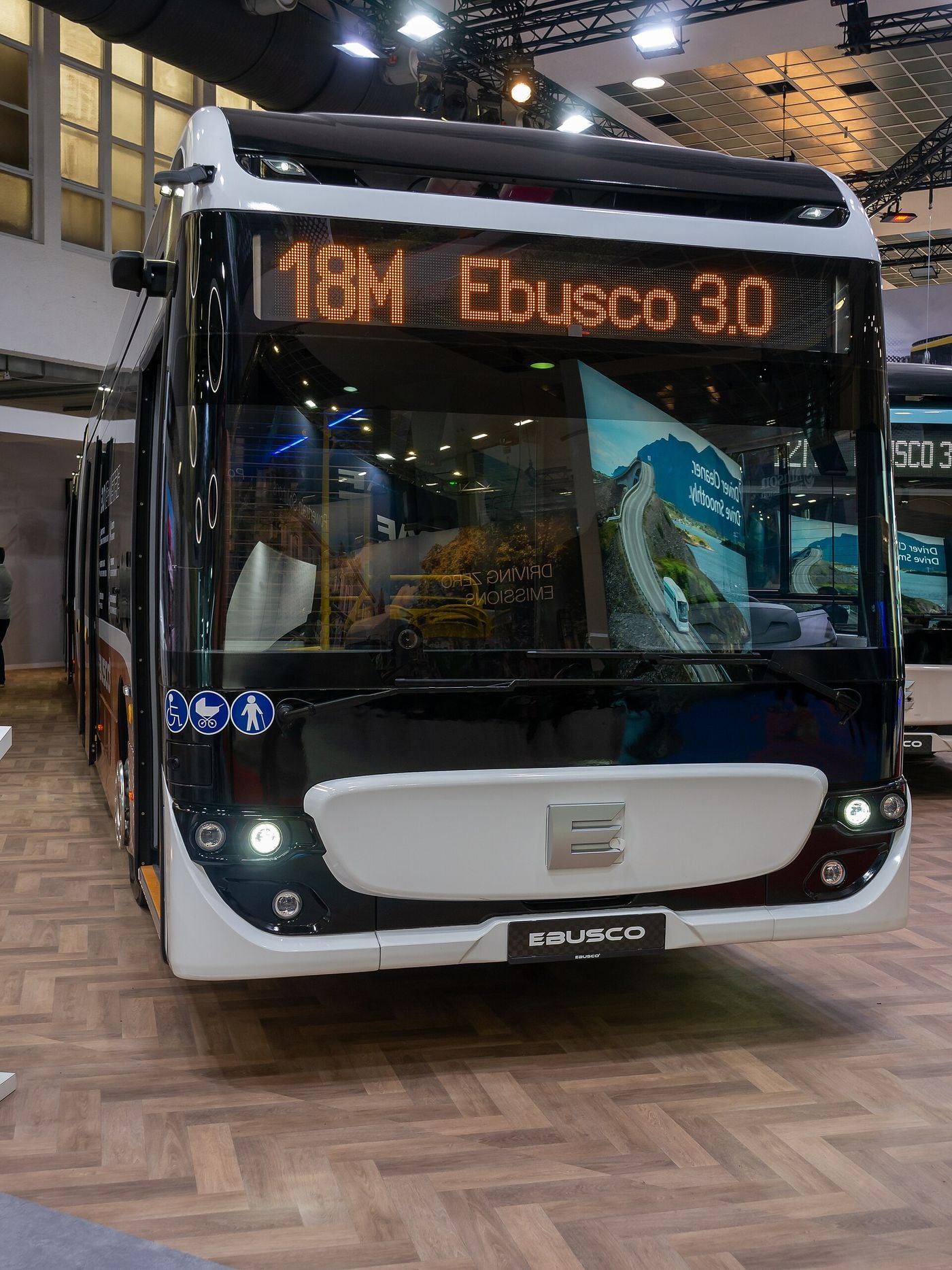
Ebusco's battery-electric city bus with a composite body, in 12 m and articulated 18 m versions: 2x125 kW drive, LFP batteries, dimensions, kerb weights and axle capacities.
- 12 m

Model overview
- Segment
- Bus
- Range
- 700 km
- Electric motor
- 125 kW peak · 2×
- Length
- 12 000 mm
- Doors
- 2 / 3 doors
| Variant | Kerb weight (kg) | Sheet |
|---|---|---|
| Ebusco 3.0 12-meter | 9,950 | Ebusco 3.0 specsheet, brochure EN - V2 (sheet dated May 2023): "Kerb vehicle weight 9,950 kg"; product page, read 8 November 2026: "Kerb weight 9950 kg" |
| Ebusco 3.0 18-meter | 14,900 | Ebusco 3.0 specsheet, brochure EN - V2 (sheet dated May 2023): "Kerb vehicle weight 14,900 kg"; product page, read 8 November 2026: "Kerb weight 14900 kg" |
The Ebusco 3.0 is the battery-electric city bus of the Dutch maker Ebusco, with composite materials in the main structure of its body. Ebusco’s product page gives specifications for a 12-meter version and an articulated 18-meter version; a 13.5-meter version appears in an Ebusco press release of November 2022. The figures on this page come from Ebusco’s own English documents: the Ebusco 3.0 product page, which carries no date and was read on 8 November 2026; the Ebusco 3.0 brochure marked “EN - V2”, whose spec sheet is dated May 2023 and whose PDF file was created on 2 April 2025; and Ebusco press releases of 2 December 2021, 22 November 2022, 16 December 2022 and 19 June 2023. Battery-electric city buses in general are described in electric buses explained; Ebusco, based in Deurne in the Netherlands, is among the makers in who builds buses and coaches in Europe.
Versions and dimensions
The product page lists two versions, the “12-meter” and the “18-meter”, and the brochure’s spec sheet the same two as “12M” and “18M”. The 12-meter is given as “Low entry / Low floor” with “2 / 3 doors”, the 18-meter as “Low floor” with “3 / 4 doors”. Low-floor and low-entry layouts are explained in bus accessibility.
| Row | 12-meter | 18-meter |
|---|---|---|
| Body type | Low entry / Low floor | Low floor |
| Door configuration | 2 / 3 doors | 3 / 4 doors |
| Passenger capacity, product page | 100 persons | 140 persons |
| Passenger capacity, spec sheet | up to 110 persons | up to 150 persons |
| Kerb weight | 9,950 kg | 14,900 kg |
| Length | 12,000 mm | 18,000 mm |
| Width | 2,550 mm | 2,550 mm |
| Height | 3,190 mm | 3,190 mm |
| Floor to ceiling height | 2,350 mm | 2,350 mm |
| Step-in height | 340 mm | 340 mm |
The two documents agree on every row except passenger capacity. The product page gives 100 persons for the 12-meter and 140 for the 18-meter and heads the page “Max. 140 PAX”; the May 2023 spec sheet gives “Up to 110 persons” and “Up to 150 persons”. The press release of 16 December 2022 gives the 18-meter “a maximum capacity of 150 passengers”. No document opened gives a seat count or a standing figure for the 12-meter or the 18-meter, a wheelbase, overhangs, a turning circle or a gross vehicle weight. The length and weight limits for buses are covered in bus and coach dimensions and bus weight and seating capacity.
Body, floor and weight
Ebusco describes the 3.0 as a “Composite bus”, built by “using composite materials in the main structure of the body”. The product page lists it as “substantially lighter (27% | 9.950 kg)”; the brochure gives “WEIGHT REDUCTION UP TO 5,000 KG DUE TO THE USE OF COMPOSITE MATERIALS”. Neither document names the vehicle the reduction is measured against. Both documents give the 12-meter a kerb weight of 9,950 kg and the 18-meter 14,900 kg; the press release of 16 December 2022 gives the 18-meter “a starting weight of just 14,500 kg”.
The brochure lists a “FULLY FLAT FLOOR” with “BATTERIES INCORPORATED”, a “900 MM WIDE AISLE” and “INSULATED WALLS”, and its drawing of the body gives “LOW CENTRE OF GRAVITY” with “860 MM” and “HEIGHT” with “3,190 MM”. The product page says that floor-mounted batteries “free up roof space for customizations like solar panels”. The 18-meter release says that the composite side walls are injected with a foam that provides high thermal insulation, and that because of the lightweight structure all axles can be equipped with a single tyre, which makes room for an aisle 90 centimetres wide from front to rear.
Ebusco gives the bus an operational life span of “up to 25 years” on the product page and in the brochure; the type-approval release of 2 December 2021 speaks of “an extended estimated average life span of 25 years”.
Electric drive and axles
Both documents list the maximum range under “Electric drive”; the other electric-drive rows are the same for both lengths in both documents: a rated voltage of “AC 3-phase 400V”, a maximum power of “2x125 kW” (printed “2x 125 kW” on the spec sheet) and a maximum traction torque of 22,000 Nm. No document opened names the motor’s maker, type or position, gives a continuous rating or a top speed, or names a transmission.
| Axle | 12-meter, product page | 12-meter, spec sheet | 18-meter, product page | 18-meter, spec sheet |
|---|---|---|---|---|
| Front (1st) axle | 8,200 kg | 8,165 kg | 8,200 kg | 8,165 kg |
| Rear axle, drive axle on the spec sheet | 13,000 kg | max 11,500 kg | 10,500 kg | max 10,350 kg |
| 3rd axle | no figure | - | 8,200 kg | 8,165 kg |
The brochure’s “AXLE CONFIGURATIONS” page, subtitled “LESS ROLLING RESISTANCE AND REDUCED USE OF MATERIALS”, gives the first axle of both lengths “Indepentent front suspension” (spelt so), the drive axle of both “Standard single tyres” and the 18-meter’s third axle an “Optional steering system”. Ebusco prints no wheel formula. The product page gives rims of 22.5 x 7.5 / 22.5 x 11.75 and tyres of 275 70 R22.5 / 385 55 R22.5 for both lengths, without assigning them to axles.
Batteries, range and charging
| Row | 12-meter | 18-meter |
|---|---|---|
| Cell chemistry | LFP | LFP |
| Cell capacity and voltage, product page | 104 Ah, 3.2 V | 104 Ah, 3.2 V |
| Cell capacity and voltage, spec sheet | 105 Ah, 3.2 V | 105 Ah, 3.2 V |
| Pack capacity, product page | >250 or >350 kWh | >350 kWh |
| Pack capacity, long range version, product page | >500 kWh | >500 kWh |
| Pack capacity, spec sheet | >250, >350 or >500 kWh | >250, >350 or >500 kWh |
| Maximum range, product page | 700 km | 550 km |
| Maximum range, spec sheet | up to 700 km | up to 700 km |
The product page adds “(inherent fireproof battery)” to the LFP chemistry, and the brochure lists “NON-FLAMMABLE LFP BATTERIES” under safety. The 18-meter release says that Ebusco “again opts for cobalt-free LFP batteries because of safety, ethical and durability considerations”, gives “battery packs of 350+ and 500+ kWh” and “a range of up to 700 kilometers on a single charge”. Chemistries in general are described in battery chemistries.
The product page is headed “700 KM RANGE” and lists “Only overnight charging needed” among the bus’s advantages; the brochure gives “RANGE UP TO 700 KM” with “DRIVING A FULL OPERATION ON A SINGLE CHARGE”. The type-approval release of 2 December 2021 said that the bus “reaches a substantial longer single-charge range of up to 575 kilometers”, without naming a length. No document opened names a test cycle for these ranges, gives a usable battery capacity, a charging power or a charging connector, or mentions a pantograph.
Safety and equipment
The product page lists an “Innovative Camera System” among the reasons for the Ebusco 3.0, without describing it. The brochure groups the bus’s features under “COMFORT” (“SPACIOUS, ACCESSIBLE AND LUXURIOUS”), “SAFETY” (“NON-FLAMMABLE LFP BATTERIES”) and “RELIABILITY” (“REAL-TIME MONITORING SYSTEM FOR PREVENTIVE MAINTENANCE”). Ebusco’s home page describes Ebusco Live as “the real-time monitoring system for all buses”, which shows “among other things the battery status and the average efficiency”. No document opened lists driver-assistance systems, the brake system or the type of suspension beyond the independent front suspension.
The 13.5-meter
On 22 November 2022 Ebusco announced a contract with the Dutch operator EBS for 31 Ebusco 3.0 13.5-meter buses, with delivery planned for the end of 2023. The release calls the 13.5-meter “a new addition to the line-up of the innovative, lightweight Ebusco 3.0” that “reaches the maximum length on one rear axle”. The buses for EBS were to have an all-electric heating system and “an optimal combination of 49 seats for regional transport and additional standing places for urban transport”. The current product page lists the 12-meter and the 18-meter only, and no document opened gives further figures for the 13.5-meter.
Model line and dates
Ebusco’s news archive carries a video titled “How it’s made: Ebusco 3.0”, posted on 10 October 2019. On 2 December 2021 Ebusco announced EU Vehicle Type Approval for the Ebusco 3.0 under the subtitle “First composite bus to obtain such approval”. The release said that the bus was “currently manufactured exclusively in the Netherlands, at the company’s facility in Deurne” and that the first delivery was expected in the coming weeks.
On 16 December 2022 Ebusco revealed the 18-meter: “Today marks the reveal of the first produced Ebusco 3.0 18-meter.” The release names orders “for Oslo, Orebro Lan, Rouen and Vaxjo” and says that in 2023 Ebusco would scale up production with a dedicated line for articulated bus models.
On 19 June 2023 Ebusco announced that it was starting delivery of the first Ebusco 3.0 buses from serial production, 12-meter buses for Transdev in the Hilversum region of the Netherlands; because of supply-chain issues, “the buses had been waiting for the final parts since the end of last year”. The same release says that the very first Ebusco 3.0 had by then been running for over a year and a half on line 100 in downtown Munich, with an energy consumption over 30 per cent lower than that of its predecessor, the Ebusco 2.2. Ebusco’s electric-bus menu lists two models, the Ebusco 2.2 and the Ebusco 3.0.
Source notes
The overview figures are the 12-meter’s, from the product page and the May 2023 spec sheet, which agree on them. Maximum power is given as 2x125 kW with a maximum traction torque of 22,000 Nm; no document names the motor or gives a continuous rating. The range of 700 km is a maximum, given as the maximum range on the product page and as up to 700 km on the spec sheet. Battery packs are given as more than 250 or more than 350 kWh, with a long-range version of more than 500 kWh, on the product page, and as more than 250, 350 or 500 kWh on the spec sheet; no document opened gives a usable capacity or a charging power. The 12-meter carries 100 persons on the product page and up to 110 on the spec sheet. The 18-meter is 18,000 mm long with 3 or 4 doors and a kerb weight of 14,900 kg; the press release of 16 December 2022 gives it a starting weight of 14,500 kg. The product page gives the 18-meter 140 persons and a maximum range of 550 km, the spec sheet up to 150 persons and up to 700 km. Axle capacities differ between the two documents: the product page gives 8,200 kg at the front, 13,000 kg at the rear of the 12-meter, and 10,500 kg at the rear and 8,200 kg on the third axle of the 18-meter; the spec sheet gives 8,165 kg on the first axle, a maximum of 11,500 kg (12-meter) or 10,350 kg (18-meter) on the drive axle and 8,165 kg on the third axle of the 18-meter. The cells are LFP, 104 Ah and 3.2 V on the product page, 105 Ah and 3.2 V on the spec sheet. A 13.5-meter version was announced with an order for 31 buses with 49 seats in November 2022.
Quick answers
- How long is the Ebusco 3.0?
- Length: 12 000 mm.
- How much does the Ebusco 3.0 weigh?
- Kerb weight: 9 950 kg (Ebusco 3.0 12-meter); 14 900 kg (Ebusco 3.0 18-meter).
Articles that mention the Ebusco 3.0
Sources
- Ebusco 3.0 — product page with the 12-meter and 18-meter specifications — Ebusco
- Ebusco 3.0 brochure, EN - V2, with the Ebusco 3.0 specsheet dated May 2023 (PDF created 2 April 2025) — Ebusco
- Ebusco reveals extremely lightweight Ebusco 3.0 18-meter — Ebusco, 16 Dec 2022
- Ebusco signs first order for Ebusco 3.0 13.5-meter — Ebusco, 22 Nov 2022
- Ebusco starts delivery of the first Ebusco 3.0 from serial production — Ebusco, 19 Jun 2023
- Ebusco 3.0 bus obtaining EU Vehicle Type approval — Ebusco, 2 Dec 2021
- Video | How it's made: Ebusco 3.0 — Ebusco, 10 Oct 2019
- Ebusco home page (Ebusco Live) — Ebusco