Articulated and bi-articulated buses: definitions, length limits and R107 rules
An EU articulated bus has one joint and may be 18.75 m long; Directive 96/53/EC excludes buses with more. Sweden allows them 24.0 m. What UN R107 requires of the joint, and makers' figures.
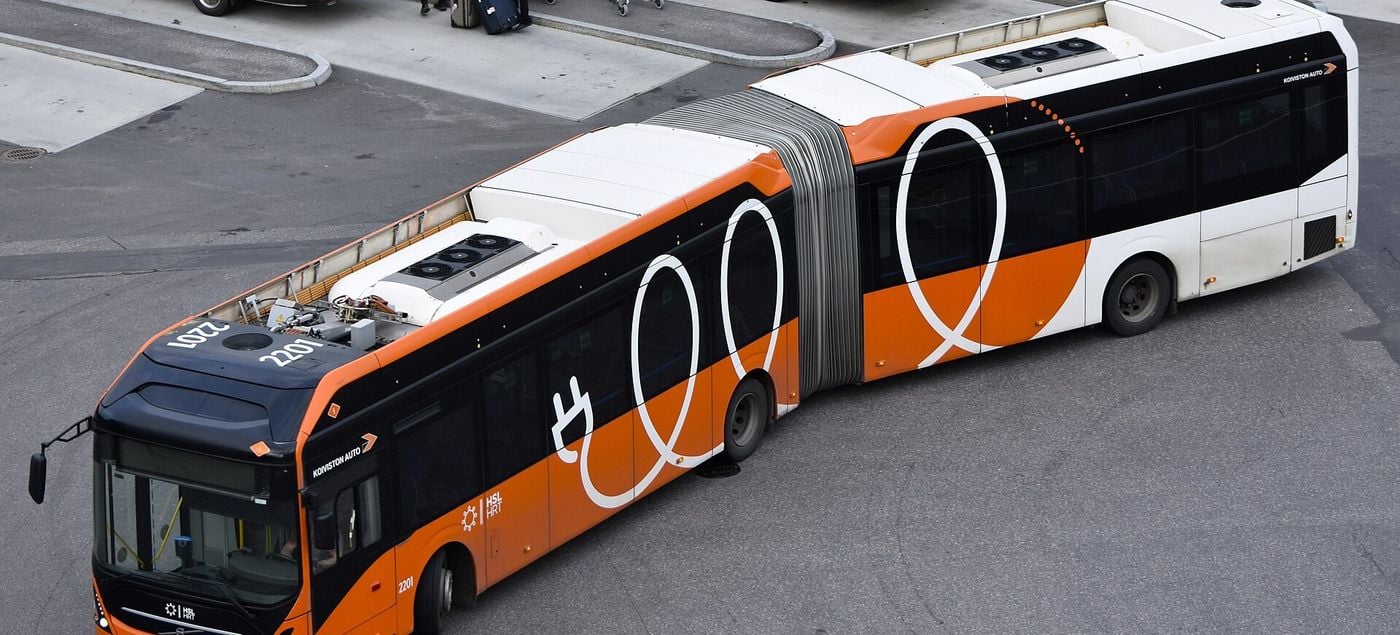
An articulated bus is a bus of rigid sections joined by an articulated section through which passengers move from one section to the next; a bi-articulated bus has two such joints. In the European Union, Directive 96/53/EC defines the articulated bus as two rigid sections connected by an articulated section and allows it 18.75 m in length, but Article 1(3) says the Directive “shall not apply to articulated buses comprising more than one articulated section”. UN Regulation No. 107, on the general construction of buses, defines an articulated vehicle as two or more rigid sections and sets requirements for the joint itself. Of the national texts read, Sweden’s Trafikförordning gives a bus with more than one articulated section 24.0 m and 60 km/h; the German and Dutch texts give an articulated bus 18.75 m. The makers’ documents read give single-joint articulated buses from 17,950 mm to 20,995 mm.
Status as at 9 November 2026. The legal texts and the makers’ documents were read on 8 November 2026; Türkiye’s Highway Traffic Regulation (Karayolları Trafik Yönetmeliği) was read in its consolidated text on 14 November 2026. Directive 96/53/EC is the consolidated text of 14 August 2019, and UN Regulation No. 107 the text published in the Official Journal on 29 January 2026, incorporating the 11 series of amendments. The Swedish Trafikförordning is amended up to SFS 2026:1052. The Dutch Regeling voertuigen is the version valid from 1 January to 30 June 2026; the version in force since 1 July 2026 was not read. The dated data sheets are of April 2026 (Mercedes-Benz) and 15 August 2024 (Volvo).
What makes a bus articulated
Article 2 of Directive 96/53/EC reads: “‘articulated bus’ shall mean a bus consisting of two rigid sections connected to each other by an articulated section.” The passenger compartments of the two sections “shall be intercommunicating”, the articulated section “shall permit the free movement of travellers between the rigid sections”, and “Connection and disconnection of the two sections shall be possible only in a workshop”. Annex I lists a bus with a trailer as a separate entry.
UN Regulation No. 107 applies to “every single-deck, double-deck, rigid or articulated vehicle of category M2 or M3” (paragraph 1.1). An articulated vehicle “consists of two or more rigid sections which articulate relative to one another”; the passenger compartments intercommunicate so that passengers can move freely between them, and the sections can only be separated “by an operation involving facilities which are normally only found in a workshop” (paragraph 2.1.3). A double-decker articulated vehicle intercommunicates “on at least one deck” (paragraph 2.1.3.1); the other two-deck rules are in double-decker buses. For an articulated vehicle the approval forms of Annex 1 ask for the number of seats in each rigid section. The bodywork codes for articulated vehicles are listed in vehicle categories M, N and O.
| Text | Rigid sections | Wording |
|---|---|---|
| Directive 96/53/EC, Article 2 | Two | “a bus consisting of two rigid sections connected to each other by an articulated section” |
| UN Regulation No. 107, paragraph 2.1.3 | Two or more | “a vehicle which consists of two or more rigid sections which articulate relative to one another” |
| Germany, StVZO § 32(3) no. 4 | Not stated | Kraftomnibusse “die als Gelenkfahrzeug ausgebildet sind (Kraftfahrzeuge, deren Nutzfläche durch ein Gelenk unterteilt ist, bei denen der angelenkte Teil jedoch kein selbstständiges Fahrzeug darstellt)” (buses built as an articulated vehicle: motor vehicles whose useful area is divided by a joint, the articulated part not being a vehicle in its own right) |
| Netherlands, Regeling voertuigen, Article 1.1 | Two or more | “bus die bestaat uit twee of meerdere starre delen die scharnierend met elkaar verbonden zijn” (a bus consisting of two or more rigid parts hinged to one another); a vehicle with bodywork type CC, CD, CG, CH, CK, CL, CO, CP, CS or CT is in any case a gelede bus |
| Sweden, Trafikförordning, 4 kap. 17 a § | Counted by articulated sections | “Ledbuss med en ledad sektion” and “Ledbuss med fler än en ledad sektion” (articulated bus with one articulated section; with more than one) |
One articulated section: the EU limits
Point 1.1 of Annex I gives an articulated bus 18.75 m, against 13.50 m for a bus with two axles and 15.00 m for a bus with more than two; a bus with a trailer is also 18.75 m. Bus and coach dimensions sets out how the figure rose from 18.00 m, with the width and height limits. Article 4(1)(b) says Member States “shall not authorise the normal circulation within their territories” of vehicles for national passenger transport that do not conform to points 1.1, 1.2, 1.4a, 1.5 and 1.5a. Article 4(5) lets them allow vehicles “incorporating new technologies or new concepts” which cannot comply with the Directive to carry out “certain local transport operations for a trial period”, informing the Commission.
In the turning test of point 1.5a, “the two rigid portions shall be aligned with the plane” established by a line on the ground before an articulated vehicle drives into the 12.50 m circle; bus and coach dimensions gives the test in full. Annex 11 of UN Regulation No. 107 (paragraph 3.4.2) and Article 5.18.16(5) of the Dutch Regeling voertuigen set the same alignment.
Point 2.4 gives a three-axle articulated bus 28 tonnes, raised by up to 1 tonne for alternative fuel technology and up to 2 tonnes for a zero-emission vehicle. Makers’ gross weights and passenger totals for articulated models are set against it in bus weight and seating capacity.
More than one articulated section
Article 1(3) of the Directive reads: “This Directive shall not apply to articulated buses comprising more than one articulated section.” Directive 2002/7/EC added the paragraph. The Directive gives no length or weight for such a bus.
Sweden’s Trafikförordning names a length. Under 4 kap. 17 a §, a bus may be driven on roads other than private roads (“andra vägar än enskilda”) only if its length does not exceed the figures listed and it meets the turning requirements that Transportstyrelsen, the Swedish Transport Agency, sets. The list gives 13.5 m for a bus with two axles, 15.0 m with more than two, “Ledbuss med en ledad sektion 18,75 meter”, “Ledbuss med fler än en ledad sektion 24,0 meter”, 24.0 m for a bus with a trailer for passenger transport and 18.75 m for a bus with another trailer. Under 17 b §, Transportstyrelsen may issue regulations allowing vehicles to exceed those lengths, on conditions that keep road safety from being endangered, and may limit them to a certain road or road network. Under 17 d §, it may grant permits for a trial period “om det behövs för att pröva ny teknik eller nya konstruktioner” (if this is needed to test new technology or new designs), limited to a certain road or road network.
The speed table of 4 kap. 20 § gives “Ledbuss Med fler än en ledad sektion” 60 km/h, against 90 km/h for a heavy bus, or 100 km/h if everyone older than three years travelling in it has a seat with a seat belt. The section is replaced on 1 December 2026, and the replacing text keeps the three figures. Limits that other countries set for articulated buses are among the national rows of truck and bus speed limits in Europe.
None of the makers’ documents read describes a bus with more than one articulated section. Bi-articulated buses and their figures are in the biggest trucks and buses in the world, and trolleybuses in 12, 18 and 24 m lengths in trolleybuses explained.
National rules
| Country | One articulated section | More than one | Other provisions | Source |
|---|---|---|---|---|
| EU Member States | 18.75 m (Annex I, point 1.1); 28 tonnes with three axles (point 2.4) | The Directive does not apply (Article 1(3)) | Trial operation of vehicles with new technologies or concepts in certain local transport (Article 4(5)); national rules not verified except in the rows below | Directive 96/53/EC, consolidated text of 14 August 2019 |
| Germany | 18.75 m for a bus built as an articulated vehicle (§ 32(3) no. 4) | No separate figure in § 32 | The higher administrative authorities may approve exceptions from § 32 in individual cases or generally for individual applicants (§ 70(1) no. 1); where the supreme Land authorities, or the bodies they designate, approve an exception from § 32 for vehicles based on new technologies or concepts used during a trial period in certain local areas, they send a copy to the Federal Ministry for Transport and Digital Infrastructure with regard to Article 4(5) of the Directive (§ 70(1a)); the local scope of every exception is to be fixed (§ 70(3)) | StVZO §§ 32 and 70, read on 8 November 2026 |
| Netherlands | “Gelede bussen mogen niet langer zijn dan 18,75 m” (Article 5.3a.6(4)), ski box included (paragraph 5) | No separate figure; the definition covers two or more rigid parts (Article 1.1) | A gelede bus may not draw a trailer (Article 5.18.1(2)) or tow a motor vehicle (Article 5.18.2(7)); laden, the load under the steered axle or axles is at least one fifth of the laden mass of the front part (Article 5.18.18(2)) | Regeling voertuigen, version valid from 1 January to 30 June 2026 |
| Sweden | 18.75 m | 24.0 m; 60 km/h | Longer vehicles by Transportstyrelsen regulations, which may be limited to a road or road network (17 b §); trial permits for new technology or designs (17 d §) | Trafikförordning (1998:1276), 4 kap. 17 a, 17 b, 17 d and 20 §§, amended up to SFS 2026:1052 |
| France | Not verified | None read | ||
| Italy | Not verified | None read | ||
| Poland | Not verified | None read | ||
| Spain | Not verified | None read | ||
| Switzerland | Not verified | None read | ||
| Russia | Not verified | None read | ||
| Türkiye | 18.75 m for an articulated bus, mafsallı (körüklü) in the text (Article 128(1)(c)); maximum total weight 28 tonnes, in the row for three-axle semi-trailer vehicles and articulated buses (Article 128(1)(d)(2)) | No separate figure in Article 128 | Maximum width 2.55 m for vehicles and 2.65 m for trolleybuses belonging to municipalities (Article 128(1)(a)); the dimensions and weights apply whatever the date of manufacture (Article 128(2)) | Highway Traffic Regulation (Karayolları Trafik Yönetmeliği), Article 128 as amended in the Official Gazette of 17 April 2015, No. 29329, read on 14 November 2026 |
Countries without a row are not covered.
What UN R107 requires at the joint
The table lists what the Regulation sets for an articulated vehicle in particular; paragraphs numbered 7 are in Annex 3. Door and exit counts per section are in bus doors and emergency exits, and the classes in bus classes under R107. For a low-floor vehicle, the share of standing area without steps is measured on the forward section of an articulated vehicle (paragraph 2.1.4), as bus accessibility sets out.
| Paragraph | Rule |
|---|---|
| 7.9.1 | The articulated section allows “at least one rotary movement about at least one horizontal axis, and at least one vertical axis” |
| 7.9.2 | With the vehicle at its mass in running order, stationary on a horizontal level surface, no uncovered gap between the floor of either rigid section and the floor of the rotating base wider than 10 mm with all wheels on the same plane, or 20 mm with the wheels of the axle adjacent to the articulated section on a surface 150 mm higher |
| 7.9.3 | Difference in level between the floor of the rigid portions and the floor of the rotating base, measured at the joint: not more than 20 mm and 30 mm in the same two conditions |
| 7.9.4 | Means to physically prevent passengers reaching any part of the articulated section where the floor has a gap that does not comply, the floor cannot carry the mass of the passengers, or the movements of the walls constitute a danger |
| 7.10 | Moving in a straight line, “the longitudinal median planes of its rigid portion shall coincide and form a continuous plane without any deflection” |
| 7.7.5.4 | The gangway gauging device passes unobstructed through the articulated section on any deck where the sections permit through passage; “No part of the soft covering of that section, including parts of bellows, shall project into the gangway” |
| 7.8.1.1 | Internal electrical lighting for the articulated section, as for the passenger compartments |
| 7.7.9.1 | On Classes I, II and A, the illuminated “bus stopping” sign in each rigid section |
| 7.6.4.6 | Where direct view is not adequate, optical or other devices let the driver detect passengers near every side service door that is not automatically operated; “In the case of doors situated behind the articulated section of an articulated vehicle, mirrors shall not be deemed to be a sufficient optical device” |
| Annex 11, 3.2.3.3 | The front axle or group of axles carries at least 20 per cent of the mass in running order or of the technically permissible maximum laden mass for an articulated vehicle of any class, against 20 per cent for a rigid vehicle of Classes I and A and 25 per cent for Classes II, III and B (20 per cent for three-axle vehicles of Classes II and III with two steered axles); for an articulated vehicle of Class I with four or more axles and two steered axles, 15 per cent |
Articulated buses in makers’ documents
| Model | Length | Axles and wheelbases | Joint | Turning figure as printed | Doors |
|---|---|---|---|---|---|
| Mercedes-Benz Citaro G | 18,125 mm | Front, centre and driven axle; wheelbases front–centre 5,900 mm, centre–drive 5,990 mm | Articulation Turntable Controller (ATC) | Turning circle 22,970 mm | 3 or 4 |
| Mercedes-Benz CapaCity | 19,725 mm | Front, centre, driven and trailing axle; wheelbases 5,900, 5,990 and 1,600 mm; the fourth axle steered electrohydraulically | One articulation joint | Turning circle 22,926 mm | 4 |
| Mercedes-Benz CapaCity L | 20,995 mm | As the CapaCity, with a centre–drive wheelbase of 7,260 mm | One articulation joint | Turning circle 24,466 mm | 4 |
| Volvo 7900 Electric Articulated, 18.0 m and 18.7 m | 17,950 mm and 18,660 mm | Front, middle and drive axle; front wheelbase 5,945 mm, rear 5,897 or 6,605 mm | Maximum horizontal/vertical turning angle 52°/10° | Turning radius at the outer front corner 12,500 mm | Not stated |
The joint. Daimler Buses calls the ATC an anti-jackknife system for articulated buses. Its CapaCity page says the ATC regulates the hydraulic damping of the joint “depending on the steering angle, the angle of the articulation joint, the speed and the load, among other factors”, and that under normal running conditions the joint “runs freely”.
Longer than 18.75 m with one joint. Daimler Buses says the CapaCity and the CapaCity L “manage with just one articulation joint”, and its model page attributes their turning circles, 22.93 m and 24.47 m, to the “electrohydraulically steered fourth axle”. The fourth axle is also actively steered when the bus reverses, and when it pulls away from a stop its steering “reacts to the steering movement of the front axle with a defined delay”. Two side-mounted cameras “positioned directly behind the articulation joint” monitor the rear section. The CapaCity documents read name no country and no permit.
Lengths, weights and seats of other 18 m city buses are on the model pages of the Mercedes-Benz Conecto, Iveco Bus E-Way, Iveco Streetway, Anadolu Isuzu Citiport, Otokar Kent, Karsan e-ATA, Solaris Urbino 18 hydrogen, Ebusco 3.0, BMC Procity and VDL Citea. How the EU CO2 standards group articulated city buses is in city bus propulsion.
Not verified
- Netherlands. The version of the Regeling voertuigen in force since 1 July 2026 was not read.
- MAN Lion’s City 18 and Iveco Bus Urbanway 18 m. MAN’s data sheet gives the Lion’s City 18 as 18,060 mm long with wheelbases of 5,200 mm and 6,680 mm and 2, 3 or 4 doors, and its model overview gives the Lion’s City 18 E as 18.1 m with “Two driven axles, two electric central motors”. Iveco Bus’s sheet gives the Urbanway CNG 18 m as 18,000 mm on a front, middle and rear axle, with wheelbases of 5,355 mm and 6,675 mm, and lists “ECE R107 and R66 compliant”. Neither maker’s document read calls these buses articulated.
- Hess lighTram 25. Hess gives it as 24.7 m long with two steered axles; the page read states neither the number of articulations nor a passenger capacity.
Quick answers
- What is the difference between an articulated and a bi-articulated bus?
- An articulated bus has one articulated section joining two rigid sections; a bi-articulated bus has two. Directive 96/53/EC defines the articulated bus with two rigid sections and allows it 18.75 m, but under Article 1(3) it does not apply to articulated buses comprising more than one articulated section. UN Regulation No. 107 defines an articulated vehicle as two or more rigid sections, and Sweden's Trafikförordning gives 18.75 m with one articulated section and 24.0 m with more than one.
- Are bi-articulated buses allowed in the EU?
- Directive 96/53/EC, which sets the EU limits on vehicle dimensions, does not apply to articulated buses comprising more than one articulated section (Article 1(3)) and gives no length or weight for them. Of the national texts read, Sweden's Trafikförordning allows a bus with more than one articulated section 24.0 m on roads other than private roads, at up to 60 km/h. The German StVZO and the Dutch Regeling voertuigen give an articulated bus 18.75 m; the Dutch definition covers two or more rigid parts. The rules of other countries were not verified.
- Can the sections of an articulated bus be separated?
- Only in a workshop. Article 2 of Directive 96/53/EC says that connection and disconnection of the two sections shall be possible only in a workshop, and UN Regulation No. 107 requires the rigid sections to be permanently connected so that they can only be separated by an operation involving facilities normally only found in a workshop. Annex I of the Directive lists a bus with a trailer as a separate entry, also at 18.75 m, and in the Netherlands an articulated bus may not draw a trailer.
- What does UN Regulation No. 107 require of the articulated section?
- It must allow at least one rotary movement about at least one horizontal axis and at least one vertical axis. With the bus stationary on a level surface, an uncovered floor gap at the joint may not exceed 10 mm, or 20 mm with the wheels of the axle next to the joint 150 mm higher, and the floor level difference 20 or 30 mm. Passengers must be physically kept from any part of the section where the gap does not comply, the floor cannot carry them or the moving walls are a danger. The gangway gauge must pass through it, bellows may not project into the gangway, the section must be lit, and in a straight line the rigid sections must form a continuous plane.
- Can an articulated bus with one joint be longer than 18.75 m?
- Annex I of Directive 96/53/EC gives an articulated bus 18.75 m, and Article 4(1)(b) says Member States shall not authorise the normal circulation of vehicles for national passenger transport that do not conform to it; Article 4(5) lets them allow vehicles with new technologies or concepts in certain local transport operations for a trial period. Mercedes-Benz gives its CapaCity and CapaCity L, each with one articulation joint, as 19,725 mm and 20,995 mm long, and the pages read name no country or permit. In Sweden, Transportstyrelsen may issue regulations allowing vehicles longer than the listed lengths.
Models in this article
Sources
- Council Directive 96/53/EC on the maximum authorised dimensions and weights of certain road vehicles — consolidated text of 14 August 2019: Article 1(3), Article 2, Article 4(1)(b) and 4(5), Annex I points 1.1, 1.5a and 2.4 — EUR-Lex, European Union
- UN Regulation No. 107 — Uniform provisions concerning the approval of category M2 or M3 vehicles with regard to their general construction (OJ L, 2026/139, 29.1.2026), incorporating the 11 series of amendments: paragraphs 1.1, 2.1.3, 2.1.3.1 and 2.1.4; Annex 1 approval forms; Annex 3 paragraphs 7.6.4.6, 7.7.5.4, 7.7.9.1, 7.8.1.1, 7.9 and 7.10; Annex 11 paragraphs 3.2.3.3 and 3.4.2 — UNECE / Official Journal of the European Union, 29 Jan 2026
- Straßenverkehrs-Zulassungs-Ordnung (StVZO), § 32 Abmessungen von Fahrzeugen und Fahrzeugkombinationen, paragraph 3 — read on 8 November 2026 — Federal Ministry of Justice, gesetze-im-internet.de
- Straßenverkehrs-Zulassungs-Ordnung (StVZO), § 70 Ausnahmen, paragraphs 1, 1a and 3 — read on 8 November 2026 — Federal Ministry of Justice, gesetze-im-internet.de
- Regeling voertuigen (BWBR0025798), version valid from 1 January to 30 June 2026 — Article 1.1 (gelede bus), Articles 5.3a.6, 5.18.1, 5.18.2, 5.18.16 and 5.18.18 — wetten.overheid.nl (Netherlands)
- Trafikförordning (1998:1276), as amended up to SFS 2026:1052 — chapter 4, sections 17 a, 17 b, 17 d and 20, including the section 20 text in force from 1 December 2026 — Sveriges riksdag (Sweden)
- The Citaro: technical data and equipment at a glance (data PDF, 04/2026), pages 2, 3, 6, 9 and 11 — Daimler Buses
- CapaCity and CapaCity L: technical data and equipment at a glance (data PDF, 04/2026), pages 2 to 4, 6 and 9 — Daimler Buses
- CapaCity and CapaCity L, model page, read on 8 November 2026 — Daimler Buses
- MAN Lion's City 18 — technical data sheet — MAN Truck & Bus SE
- The MAN Lion's City: all models and specifications, read on 8 November 2026 — MAN Truck & Bus SE
- Volvo 7900 Electric Articulated — data sheet (BED 377248, 2024-08-15), page 1 — Volvo Buses, 15 Aug 2024
- URBANWAY — Low Floor Cursor 9 CNG Euro VI/E GSR B, 12 m and 18 m (international technical sheet, code DTHQBGL2021) — Iveco Bus
- lighTram, product page, read on 8 November 2026 — Hess AG
- Karayolları Trafik Yönetmeliği (Highway Traffic Regulation, Türkiye), Official Gazette 18/7/1997 No 23053, consolidated text including the amendment of 3/7/2026 No 33299 — Article 128(1) and (2), as replaced by Official Gazette 17/4/2015 No 29329, read on 14 November 2026 — Mevzuat Bilgi Sistemi, Republic of Türkiye