Trolleybuses explained: overhead wires, batteries and legal status
A trolleybus is an electric bus fed from an overhead line, at 600 or 750 V on makers' sheets. What batteries add off the wire, and how EU recital 18 and Turkish law class it.
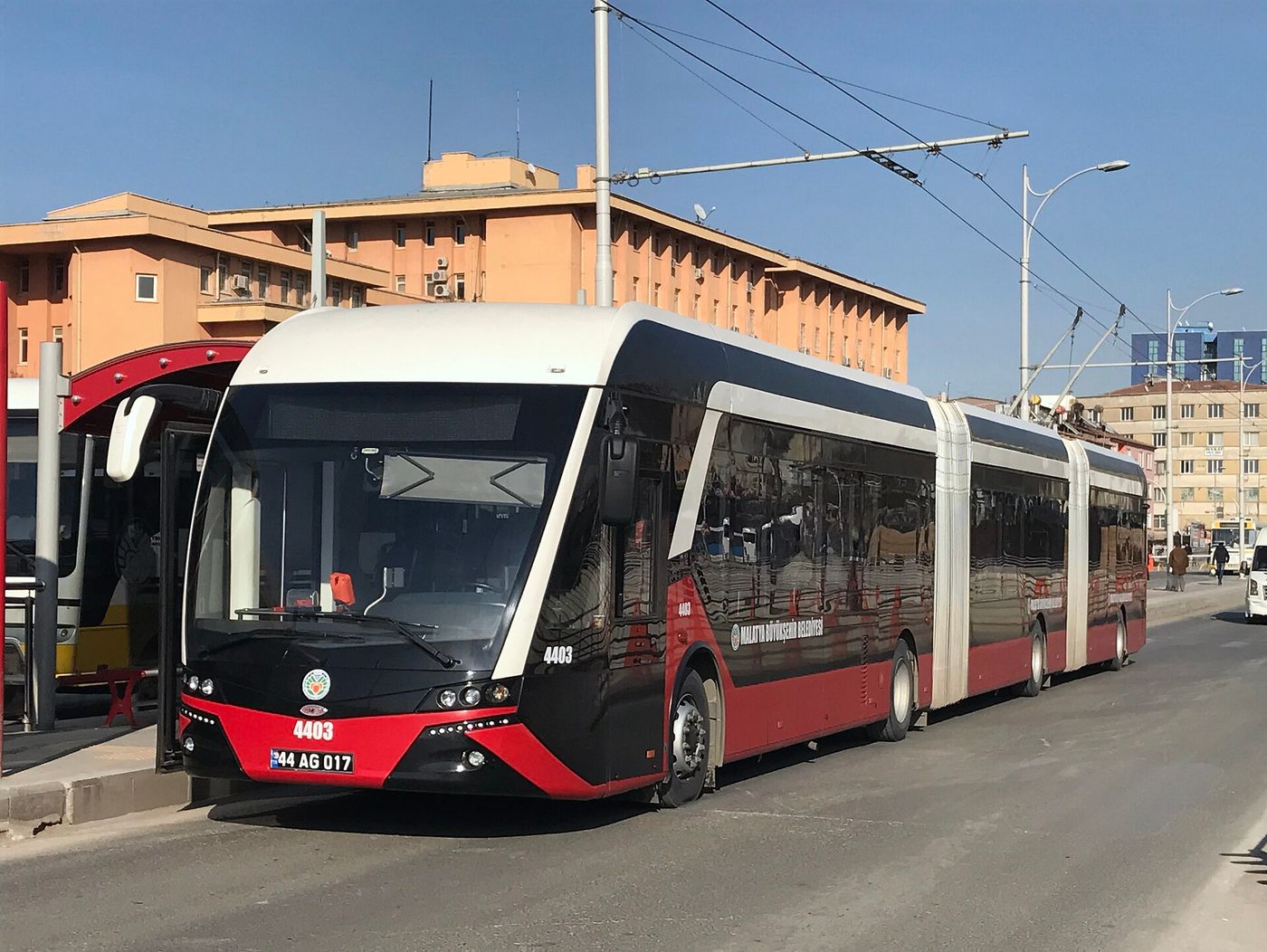
A trolleybus is an electric bus that takes its power from an overhead line hanging along the road and drives on the road itself, with no rails. That is the description on the product page of Bozankaya, which builds trolleybuses in Ankara, and the page adds a battery system for places where there is no line. Škoda Group and Bozankaya give the line voltage as 600 or 750 V. In the European Union, recital 18 of Directive (EU) 2019/1161 says trolley buses count as zero-emission buses on a condition about how they run off the grid; in Türkiye, Article 3 of Law No 2918 places them in the bus class.
Status as at 4 November 2026. Read on that day: Directive (EU) 2019/1161 in six language versions and the consolidated text of Directive 2009/33/EC; Law No 2918; the trolleybus pages of Škoda Group, Bozankaya and Solaris, and Bozankaya’s English catalogue; the trolleybus topic page of UITP, the International Association of Public Transport. Not opened: the data sheets behind Solaris’s Trollino pages, which did not load; Škoda’s 26Tr and 36Tr reference pages, which returned an error; UITP’s Global Trolleybus Figures 2025; any operator’s or city’s own figures. No fleet or network count appears below for that reason.
What the vehicle is
Bozankaya’s product page answers “What is trolleybus?” in one sentence: the vehicle receives its power from the line along the road and uses a battery system where there is no line, and trolleybuses “are electric buses that do not require a rail system infrastructure, have low infrastructure costs and have freedom of route because they use the highway”. The page gives no figure for those infrastructure costs. UITP’s summary of its Knowledge Brief of 18 December 2023 calls the trolleybus “a mode that’s been around for over 130 years”.
The makers describe low-floor vehicles. Solaris calls the Trollino “a family of low-floor trolleybuses”, and Škoda calls the 32Tr a “fully low-floor car”. Bozankaya’s catalogue states “100% Low Floor, M3 Class I” for all three of its lengths; what Class I means is set out in bus classes explained, and the emergency-exit rules, which have a provision of their own for the roof of a trolleybus, are covered in bus doors and emergency exits. On the Škoda 30Tr all electric equipment “is stored in a container on the roof of the vehicle”. The Škoda 32Tr page and the Bozankaya catalogue both list regenerative braking.
A battery-electric bus is charged by cable at a depot or by pantograph or charging rails on the way, as set out in electric buses explained. A trolleybus takes its energy from the line while it drives under it.
What the makers’ sheets give
The three makers whose pages were read use the same three length labels. Škoda’s product page has 12 m, 18 m and 24 m headings, Solaris names models Trollino 12, 18 and 24, and Bozankaya’s catalogue has 12 M, 18 M and 24 M columns. Parameters were open for two Škoda 12 m models and all three Bozankaya lengths.
| Parameter | Škoda 30Tr | Škoda 32Tr | Bozankaya 12 M | Bozankaya 18 M | Bozankaya 24 M |
|---|---|---|---|---|---|
| Length | 12,180 mm | 12,000 mm | 12,150 mm (+ 200 mm) | 18,230 mm (+ 200 mm) | ~25 M |
| Width | 2,550 mm | 2,550 mm | 2,555 mm | 2,555 mm | 2,555 mm |
| Height | 3,400 mm | 3,370 mm | 3,400 mm | 3,400 mm | 3,400 mm |
| Articulations | Not given | Not given | 0 | 1 | 2 |
| Axles | Not given | Not given | 2 | 3 | 4 |
| Line voltage | 600 or 750 V DC | 600 or 750 V DC | 600 V / 750 V (+/- % 30) | 600 V / 750 V (+/- % 30) | 600 V / 750 V (+/- % 30) |
| Power (Škoda); nominal engine power (Bozankaya) | 160 kW † | 160 kW † | 160 / 240 kW | 240 kW | 2 x 160 or 2 x 240 kW |
| Maximum speed | 65 km/h † | 65 km/h † | 80 km/h | 80 km/h | 80 km/h |
| Traction battery | Option; capacity not given | Capacity not given | Up to 60 kWh (standard LTO) | Up to 60 kWh (standard LTO) | Up to 90 kWh (standard LTO) |
| Range on battery | Not given | Up to 12 km on a single charge | Up to 40 km | Up to 25 km | Up to 25 km |
| Charging from the line | Not given | Not given | Up to 60 kW | Up to 60 kW | Up to 60 kW |
| Charging by plug | Not given | Not given | CCS, up to 360 kW | CCS, up to 360 kW | CCS, up to 360 kW |
| “Number of seats” (Škoda); maximum seats (Bozankaya) | 104 † | 95 † | 38 with 2 doors, 34 with 3 doors | 52 with 3 doors, 48 with 4 doors | 65 |
| Passenger capacity | Not given | Not given | Up to 100 | Up to 140 | Up to 200 |
Škoda’s parameter table labels 104 and 95 “Number of seats”; Bozankaya’s catalogue gives seats and passenger capacity on separate rows. The same catalogue answers “Yes” on its row “Operation in Reverse Polarity” for all three lengths, and gives a maximum slope of 18 %.
For North America, Solaris lists Trollino versions of 12 m (40 ft) and 18 m (60 ft), “tailored to local overhead infrastructure and operator requirements”. The figures of a Trollino 12 from a 2018 Solaris sheet are in city bus propulsion.
Running where there is no line
The pages read name these arrangements:
- Line only. Solaris lists “trolleybuses with traction power supply only”.
- Traction battery. Škoda says the 30Tr can have traction batteries in the rear part of the vehicle, “allowing a full-fledged ride in places without overhead contact lines”, and that the 32Tr “can travel up to 12 kilometers on a single charge”. Bozankaya’s catalogue gives LTO as standard, with “NMC or LFP” possible “depending on project demand”. Solaris’s North American page says batteries enable off-wire operation “even over distances of several dozen kilometers”.
- Supercapacitors. Solaris describes “hybrid trolleybuses equipped with additional power reservoirs in the form of batteries of supercapacitors”.
- Auxiliary diesel generator. Škoda lists this as the other option for the 30Tr.
- Fuel cell. Solaris “also sells models fitted with a fuel cell range extender, working beyond the traction line”.
Škoda’s product page calls the off-wire arrangement “a partial solution”, with which trolleybuses “can also serve areas without overhead lines”.
UITP’s term for charging on the line is in-motion charging, IMC: “IMC trolleybuses charge as they ride”. Bozankaya’s catalogue says that in the catenary field the line supplies “energy for both the vehicle and its batteries”, and its specification page lists that charging at up to 60 kW, beside a CCS plug at up to 360 kW. The catalogue words its range in two ways: page 4 speaks of “a minimum range of 25 km with its battery”, while page 5 gives “Up to 25 km” for the 18 M and 24 M and “Up to 40 km” for the 12 M, under the heading “Battery Range (With Operating Conditions and Single Charge)”.
Charging a battery-electric bus at a stop by pantograph, and the EU’s interface rules for that charging, are covered in opportunity charging and pantographs.
How the legal texts class it
| Jurisdiction | Source | What it says |
|---|---|---|
| European Union | Directive (EU) 2019/1161, recital 18 | “trolley buses are considered to be zero-emission buses, provided that they run only on electricity or that they use only a zero-emission powertrain when they are not connected to the grid, otherwise they still count as clean vehicles” |
| Türkiye | Law No 2918 on Road Traffic, Article 3, as amended by Law No 6495 of 12 July 2013 | Otobüs, the bus, is a motor vehicle used in passenger transport with more than nine seating positions including the driver. “Troleybüsler de bu sınıfa dahildir.” (Trolleybuses are also included in this class.) |
| Russia | None opened | Not verified |
| EU Member States, national traffic codes | None opened | Not verified |
The EU sentence comes directly after the one saying that half of the minimum target for the buses procured has to be fulfilled through zero-emission buses. A recital is not an operative article. It names no particular powertrain, whether battery, generator or fuel cell. The word trolley does not appear in the consolidated text of Directive 2009/33/EC of 20 May 2024, whose Article 4 definitions of clean vehicle and zero-emission heavy-duty vehicle, and whose shares for each Member State, are set out in the Clean Vehicles Directive and public bus procurement.
The language versions of the same recital use “Oberleitungsbusse” (German), “trolebuses” (Spanish), “trolejbusy” (Polish), “filobus” (Italian) and “trolleybus” (French); the English version writes “trolley buses” as two words.
The manufacturer-side CO2 rule for heavy-duty vehicles, and where a trolleybus stands under it, are covered with the other drive options in city bus propulsion.
The makers named above
Škoda Group states: “Škoda has produced more than 15,000 trolleybuses.” It says the 30Tr has been made since 2010 and that the 32Tr “had its world premiere in Opava at the end of 2018”, where the transport company bought ten to replace its Škoda 14 Tr trolleybuses. Its product page also lists a 26Tr and a 36Tr. Solaris sells the Trollino family. Bozankaya’s product page uses the name “Bozankaya Trambus”. These three are the makers whose pages were read; they are not a complete list of builders.
Quick answers
- What is a trolleybus?
- An electric bus that takes its power from an overhead line hanging along the road and drives on the road itself, with no rails, in the description on Bozankaya’s product page, which adds a battery system for places where there is no line. Škoda Group’s product page lists 12, 18 and 24 m trolleybuses; Solaris calls its Trollino “a family of low-floor trolleybuses”, with models named 12, 18 and 24.
- What voltage does a trolleybus run on?
- Škoda Group gives 600 or 750 V DC for its 30Tr and 32Tr. Bozankaya’s catalogue lists “600 V / 750 V (+/- % 30)” as catenary voltage for its 12, 18 and 24 M trolleybuses. Those are makers’ figures for their vehicles, not figures from a network operator.
- Can a trolleybus run without overhead wires?
- Where it is equipped for that. Škoda says the 32Tr can travel up to 12 kilometers on a single charge of its traction battery. Bozankaya’s catalogue gives up to 40 km for the 12 M and up to 25 km for the 18 M and 24 M. Solaris’s North American page says batteries enable off-wire operation “even over distances of several dozen kilometers”. Škoda also lists an auxiliary diesel generator for the 30Tr, and Solaris a fuel cell range extender. Solaris also lists trolleybuses with traction power supply only.
- Is a trolleybus a zero-emission bus under EU rules?
- Recital 18 of Directive (EU) 2019/1161 says “trolley buses are considered to be zero-emission buses, provided that they run only on electricity or that they use only a zero-emission powertrain when they are not connected to the grid, otherwise they still count as clean vehicles”. A recital is not an operative article, and the word trolley does not appear in the consolidated text of Directive 2009/33/EC of 20 May 2024.
- Is a trolleybus legally a bus?
- In Türkiye, Article 3 of Law No 2918 defines the bus and then says “Troleybüsler de bu sınıfa dahildir” (trolleybuses are also included in this class). Recital 18 of Directive (EU) 2019/1161 considers them zero-emission buses on a condition, otherwise clean vehicles, and Bozankaya’s catalogue states category “M3 Class I” for its trolleybuses. No Russian official text was verified, and the national traffic codes of the EU Member States were not opened.
Sources
- Directive (EU) 2019/1161 of 20 June 2019 amending Directive 2009/33/EC — recital 18, in the English, German, Spanish, Polish, Italian and French versions — Official Journal of the European Union (EUR-Lex), 20 Jun 2019
- Directive 2009/33/EC on the promotion of clean road transport vehicles in support of low-emission mobility, consolidated text of 20 May 2024 — Article 4, points (4) and (5) — EUR-Lex, Publications Office of the European Union
- Karayolları Trafik Kanunu, Law No 2918 of 13 October 1983 on Road Traffic — Article 3, definition of Otobüs, as amended by Law No 6495 of 12 July 2013 — Mevzuat Bilgi Sistemi, Presidency of the Republic of Türkiye
- Trolleybuses — product page (read on 4 November 2026) — Škoda Group
- 12 m Škoda 30Tr — reference page with parameters (read on 4 November 2026) — Škoda Group
- 12 m Škoda 32Tr — reference page with parameters (read on 4 November 2026) — Škoda Group
- Trolleybus — product page, “What is trolleybus?” (read on 4 November 2026) — Bozankaya A.Ş.
- Trolleybus — English catalogue, document TB_0824_rev00_EN, pages 4 and 5 — Bozankaya A.Ş.
- Trollino — family page (read on 4 November 2026) — Solaris Bus & Coach sp. z o.o.
- Solaris Trolleybuses for the North American Market (read on 4 November 2026) — Solaris Bus & Coach sp. z o.o.
- Trolleybus — topic page listing UITP publications (read on 4 November 2026) — UITP, International Association of Public Transport