Karsan
Karsan e-ATA
Karsan's battery-electric e-ATA city bus in 10, 12 and 18 m and as the 12 m low-entry LE: hub-motor drive of 250 or 500 kW, LFP batteries of up to 662 kWh, charging and dimensions.
- 12.22 m
- 19 t
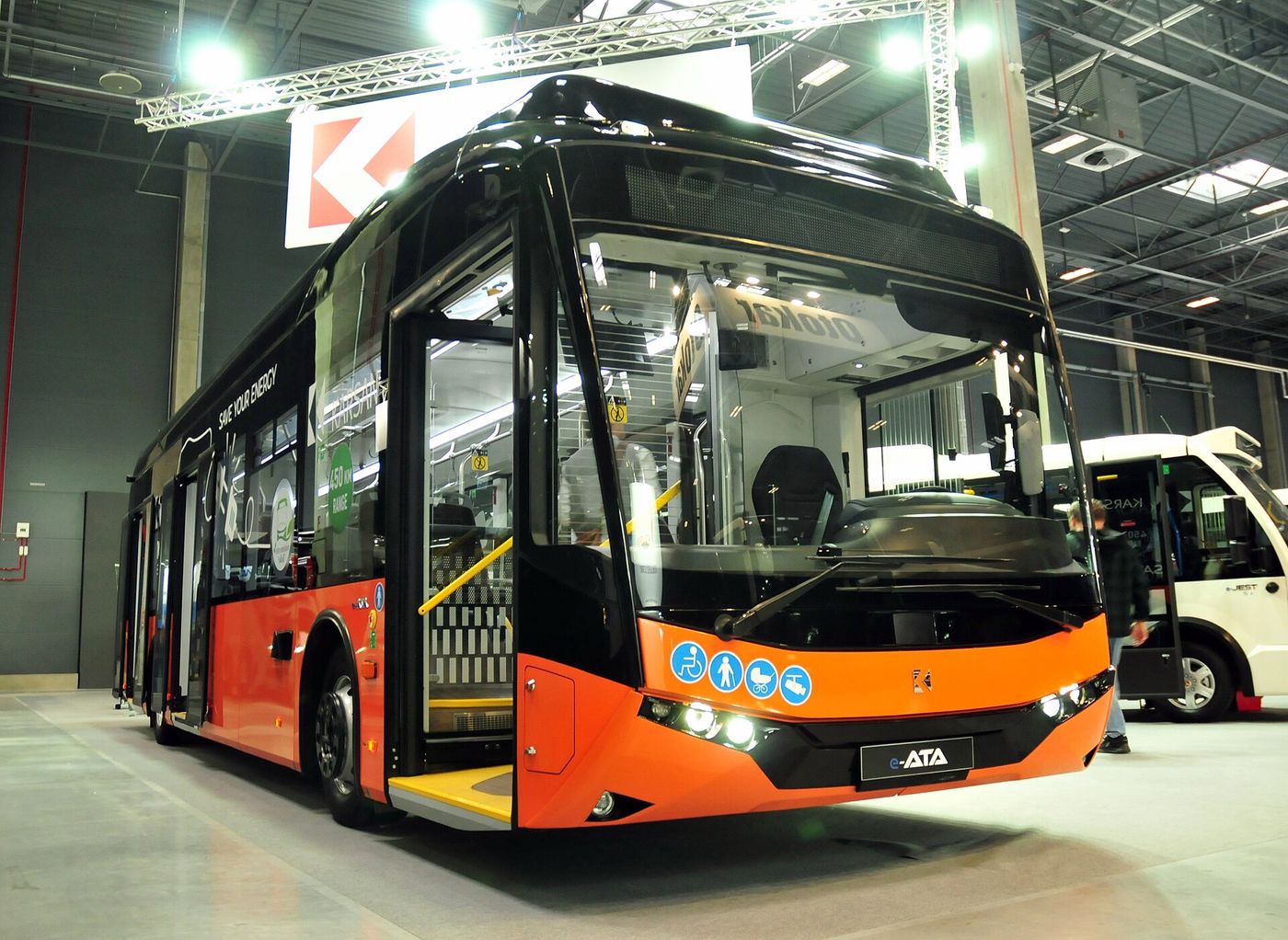

Model overview
- Segment
- Bus
- Gross vehicle
- 19 000 kg
- Battery capacity
- 528 kWh
- Range
- 500 km
- Charging
- 150 kW
- Electric motor
- 250 kW peak
- Length
- 12 220 mm
- Capacity
- 40 maximum
- Doors
- 2 or 3 door options
The e-ATA is Karsan’s battery-electric city bus. Karsan offers it in three full low-floor lengths, the e-ATA 10, the e-ATA 12 and the articulated e-ATA 18, and as the e-ATA LE, a 12 m low-entry version. The figures on this page come from Karsan’s own English documents on its international site, all read on 4 November 2026: the specs page and the product page of each of the four versions, which carry no date, and the English catalogue of the e-ATA 10, 12 and 18, whose PDF file was created on 7 October 2025 and last modified on 27 October 2025. The catalogue does not cover the e-ATA LE. Battery-electric city buses in general are described in electric buses explained.
Versions and dimensions
Karsan’s category line gives the e-ATA 10, e-ATA 12 and e-ATA 18 as a “Full Low Floor Electric Bus, M3 Category, Class I, LHD” and the e-ATA LE as a “Low Entry Electric Bus, M3 Category, Class II, LHD”. The product pages head them “10-METER ZERO-EMISSION ELECTRIC CITY BUS”, “12-METER ELECTRIC CITY BUS”, “18-METER ELECTRIC ARTICULATED BUS” and “ELECTRIC LOW-ENTRY CITY BUS FOR URBAN & SUBURBAN TRANSPORT”; the e-ATA 18 page also names the bus “e-ATA 18M”. The M3 category and the classes are explained in bus classes.
| Specs row | e-ATA 10 | e-ATA 12 | e-ATA 18 | e-ATA LE |
|---|---|---|---|---|
| Overall length | 10,750 mm | 12,220 mm | 18,300 mm | 12,220 mm |
| Overall width | 2,550 mm | 2,550 mm | 2,550 mm | 2,550 mm |
| Overall height | 3,350 mm | 3,350 mm | 3,350 mm | 3,350 mm |
| Gross vehicle weight | 19,000 kg (19,500 kg optional) | 19,000 kg (19,500 kg optional) | 29,000 kg (28,000 kg optional) | 19,000 kg (19,500 kg optional) |
| Door arrangement | 2 or 3 door options | 2 or 3 door options | 3 or 4 door options | 2 doors |
| Maximum seat capacity | 32 seats | 40 seats | 52 seats | 41 seats |
| Passenger capacity | +/- 79 | +/-89 | +/-135 | up to 90 |
| Tyres | 275/70 R22.5 | 275/70 R22.5 | 275/70 R22.5 | front 315/60 R 22.5, rear 275/70 R22.5 |
Karsan prints its tables with a point as the thousands separator, so “12.220” is 12,220 mm and “29.000 (28.000 Optional)” is the e-ATA 18’s 29,000 kg with 28,000 kg as the option. The product pages give the lengths as 10 m, 12 m and 18 m, and 12 m for the e-ATA LE. The documents opened give no wheelbase, no overhangs, no turning circle, no kerb weight and no axle loads; the catalogue mentions “a small turning radius” without a figure.
Electric drive and axles
All four specs tables give the drive type as a hub electric motor (“Hub Electric Motor”; on the e-ATA LE table “Hub Electric”). Maximum power is 250 kW for the e-ATA 10, e-ATA 12 and e-ATA LE and 500 kW for the e-ATA 18. The catalogue reads: “Providing 250 kW power and 22.000 Nm torque in 10 and 12 meter sizes and 500 kW power in 18 meter size”. The e-ATA 12 product page gives “250 kW power and 22,000 Nm torque”, and the e-ATA 10 page “up to 250 kW power and 22,000 Nm torque”. No document gives a torque figure for the e-ATA 18 or the e-ATA LE, a continuous rating or the number of motors; the e-ATA 10, 12 and 18 product pages speak of “electric hub motors” in the plural. On the design tab of the e-ATA 10, 12 and 18 product pages, the item “Hub Motor” carries the caption “ZF AVE 130 provides superior traction.”
The front axle is listed as “Independent” on all four versions and the rear axle as an “Electric Portal Axle”. The articulated e-ATA 18 lists a second “Electric Portal Axle” as its central axle; the central-axle row of the e-ATA 10 and 12 reads “-”. Karsan prints no wheel formula. The top speed is given as 80 km/h for the e-ATA 10, 12 and 18; the e-ATA LE table has no speed row.
Batteries, range and charging
| Row | e-ATA 10 | e-ATA 12 | e-ATA 18 | e-ATA LE |
|---|---|---|---|---|
| High voltage battery (type, capacity) | LFP, up to 399 kWh | LFP, up to 528 kWh | LFP, up to 662 kWh | LFP, up to 528 kWh |
| Range | 350 km | 500 km | 450 km | 500+ km |
| Charging type | Plug-in DC charger, pantograph optional | Plug-in DC charger, pantograph optional | Plug-in DC charger, pantograph optional | Plug-in DC charger, pantograph optional |
| Charging time with the plug-in DC charger | up to 2 h 45 min | up to 3 h 30 min | up to 4 h 20 min | up to 3 h 30 min |
| DC charging power (product page) | up to 150 kW | up to 150 kW | up to 150 kW | up to 200 kW |
The footnotes of the specs tables attach “Under realistic conditions. Range may change with battery capacity and driving profile.” to the range, “Different battery packs can be offered.” to the battery and “With maximum battery capacity.” to the charging time. The battery chemistry is given as LFP on all four; chemistries in general are described in battery chemistries. The documents give no usable capacity beside these figures and no number of packs per length. The catalogue speaks of “7 battery alternatives”, and the e-ATA 10 page of “up to seven battery configurations”.
The product pages also give range figures in their text. The e-ATA 12 page says the bus “offers a range of up to 450 km, even in demanding conditions”, while its specs table and its highlights give 500 km. The e-ATA 10 page gives “a driving range of up to 450 km on a single charge, even under demanding conditions”, while its specs table and highlights give 350 km. The e-ATA 18 page gives “up to 450 km on a single charge”, as does its table. The catalogue gives “up to 450 km even in harshest conditions” for the series. No document names a test cycle or gives an energy consumption figure.
The e-ATA 10, 12 and 18 pages give DC charging “up to 150 kW”, as does the catalogue; the e-ATA LE page gives “DC charging support up to 200 kW”. Pantograph charging is an option on all four equipment lists, with the footnote “Option can be offered during tender process.”; the catalogue adds that there are “different types of pantographs” for charging “on the stops or in your garage”. No document names a connector standard for the plug-in DC charger. Charging methods for buses are described in charging electric trucks and buses.
Body, suspension, brakes and wheels
The body is listed as “Carbon Steel: Space Frame Steel Tube Structure”, with “Cataphoresis & Underbody Coating” as its corrosion resistance; the catalogue says that “cataphoresis and sub-chassis coating is standard in all Karsan buses”. The suspension row of the e-ATA 10, 12 and 18 reads “Air Suspension + Electronic Level Control + Kneeling”, and that of the e-ATA LE “Air Suspension, Electronic Leveling, Kneeling Function”.
The brake system row of all four reads “ABS, ASR, EBS, Regenerative Braking System”. HSA (Hill Start Aid) and front and rear anti roll bars are standard, and an Electronic Parking Brake is an option. “Front & Rear 22.5” Steel Wheels” are standard on all four lists, with wheel nut covers; a mudguard set is an option.
Doors, floor and passenger area
The e-ATA 10 and e-ATA 12 have 2 or 3 door options and the e-ATA 18 has 3 or 4; the catalogue describes “inward opening doors, offered as 2, 3 or 4 door options”. “Metro Type Sliding Doors” are an option on all four lists. The e-ATA LE has 2 doors. The seat figures carry the footnote “May change with door arrangement and seat layout.” on the three low-floor buses and “May change with seat layouts” on the e-ATA LE. The passenger figures carry “May change with battery capacity, seat layout, door arrangement, GVW and technical gross axle value depending on country of registration.” on the three low-floor buses; the e-ATA LE footnote has the same words without “door arrangement”. No separate standing figure is given.
The e-ATA 12 page says that its low-floor structure “ensures seamless access between front and rear doors”, and the e-ATA 18 page describes “a low-floor layout throughout the passenger area”. A Manual Wheelchair Access Ramp is standard on all four, with “Backrest Totem and Wheelchair Designations”; electric and double electric wheelchair access ramps are options that carry the tender footnote. Access rules in general are covered in bus accessibility. Plastic passenger seats are standard on the e-ATA 10, 12 and 18 and plastic seats with upholstery an option; the e-ATA LE list gives “Shuttle Type Passenger Type” as standard and a Luggage Rack as an option. USB on Sidewalls (Type A + Type C) is standard on all four, and a Hand Luggage Area is an option.
The e-ATA LE
The e-ATA LE specs table gives a 12,220 mm low-entry bus in M3 Class II with 250 kW, an LFP battery of up to 528 kWh, a range of 500+ km, a gross vehicle weight of 19,000 kg (19,500 kg optional), 2 doors, 41 seats and up to 90 passengers. Its front tyres are 315/60 R 22.5 and its rear tyres 275/70 R22.5. The product page says the bus is “Engineered for urban routes, suburban corridors, and intercity connections” and gives it for “urban, suburban, and intercity routes up to 1–2 hours”. It describes “a low-entry layout, 100% forward-facing seating” and climate equipment of “24.9 kW inverter cooling and a 30 kW heat pump”. On its equipment list, the Turbofan option carries the footnote “It may not be selected depending on battery capacity.”
Safety and driver-assistance systems
The four equipment lists open their safety section with a standard “GSR Package”, whose footnote reads: “Includes: Emergency stop signal, Tyre pressure monitoring system, Blind spot information system, Reversing information system, Moving off information system, Alcohol Interlock Facilitation Installation, Driver drowsiness and inattention warning, Intelligent speed assistance.” The systems and their timetables are covered in mandatory driver assistance systems. “Cyber Security” is standard too; its footnote names “ECE R.155: Protection of vehicle against cyberattacks” and “ECE R.156: Software update and software updates managment system”, spelt as Karsan prints it on the e-ATA 12 page.
Also standard on all four lists: AVAS (Acoustic Vehicle Alerting System), EBS, ABS, ASR (Anti-Slippage System), RBS (Regenerative Brake System), HSA, a Fire Detection System, a Tire Pressure Monitoring System, Rear Park Sensors and a Reverse Gear Buzzer. ESP (Electronic Stability Program) is standard on the e-ATA 10, e-ATA 12 and e-ATA LE; the e-ATA 18 list marks it “-”, and the catalogue’s safety page carries the footnote “ESP can not be selected for e-ATA 18 meter.” The e-ATA 10 and e-ATA 12 product pages say that AVAS generates an artificial external sound for pedestrians, visually impaired people and street animals; the e-ATA 18 page speaks of “artificial exterior sound” for pedestrian awareness. Mirror Cameras are an option; the design tab says that “Cameras and warning screens placed at critical points allow you to see passengers, cyclists and any object in the blind spots.”
Driver’s area, climate and equipment
The catalogue describes a “VDV-compatible ergonomic driver cabin”. An Isolated Cabin is standard and a Separated Driver Cabin with High Glass an option. The 8-Way Pneumatic Driver Seat with 3-Point Seat Belt is listed twice: “(SEGE)” as standard and “(ISRI)” as an option. A Sliding Heated Driver’s Window and a manual front sun visor for the driver are standard; a Heated Windscreen, an electric front sun visor, a Driver Seat with Heating Function and Cruise Control are options.
Technology on the standard list: Full Digital Cluster, Smart Tachograph, Telematics System and FMS Socket. Options: Ticket Validator Preparation, Passenger Counting System, Passenger Information System, Wi-Fi Infrastructure, an MP3 player with USB and Aux, an announcement system, external speakers, a dashboard-mounted 7” LCD screen with rear camera and a roof-mounted 19” LCD screen.
Climate: Passenger A/C with Heating Function, Driver A/C with Heating Function and an Electrical Heater are standard. Passenger Sidewall Heaters, a diesel pre-heater, whose footnote reads “Option includes Fire Supression System for pre-heater area.”, Vehicle Pre-Conditioning, an Air Purifier System and a Turbofan are options.
Exterior, standard: LED front and rear lights, LED day-time running lamps, a front fog lamp, electrical and heated pipe-type mirrors, light tinted side glass, front and rear towing hooks, a white body and roof, and preparation for monocolour LED destination signs at the front, side and rear. Options include the destination signs themselves, cornering lamps, a 3rd stop lamp, double glass windows, a heated windscreen, a flag holder and a special body or roof colour; a billboard is an option in the interior list. A 4-transom side window is an option on the e-ATA 10, 12 and LE, and a 6-transom side window on the e-ATA 18.
Model line
The catalogue says that, completed with the e-ATA series, Karsan’s electric range covers “different sizes from 6 m to 18 m”. Karsan’s electric bus menu lists the e-ATA HYDROGEN, e-ATA LE, e-ATA 10, e-ATA 12, e-ATA 18, e-ATAK and e-JEST; the fuel-cell Karsan e-ATA HYDROGEN, the Karsan e-ATAK and the Karsan e-JEST are described on their own model pages. No document opened gives a launch date, a start of production or an earlier version of the battery-electric e-ATA.
Source notes
The overview figures are the e-ATA 12’s. Karsan gives its LFP battery as up to 528 kWh, notes that different battery packs can be offered, and gives the range as 500 km under realistic conditions, varying with battery capacity and driving profile; its product page and the catalogue also give up to 450 km in demanding conditions. The charging time of up to 3 h 30 min with the plug-in DC charger is given for the maximum battery capacity; the product page gives DC charging of up to 150 kW. A gross vehicle weight of 19,500 kg is optional. Passenger capacity is given as +/-89, varying with battery capacity, seat layout, door arrangement, GVW and technical gross axle value depending on country of registration. The e-ATA 10 is 10,750 mm long with 250 kW, up to 399 kWh, 350 km, 32 seats and +/- 79 passengers; the articulated e-ATA 18 is 18,300 mm long with 500 kW, up to 662 kWh, 450 km, 52 seats, +/-135 passengers and a gross vehicle weight of 29,000 kg (28,000 kg optional); the low-entry e-ATA LE (M3, Class II) is 12,220 mm long with 250 kW, up to 528 kWh, 500+ km, DC charging of up to 200 kW, 41 seats and up to 90 passengers.
Quick answers
- What is the gross vehicle weight of the Karsan e-ATA?
- Gross vehicle weight: 19 000 kg.
- What battery capacity does the Karsan e-ATA have?
- Battery capacity: 528 kWh; Range: 500 km; Charging: 150 kW.
- How long is the Karsan e-ATA?
- Length: 12 220 mm.
- How many passengers does the Karsan e-ATA carry?
- Capacity: 40 maximum.
Articles that mention the Karsan e-ATA
More Karsan on this site
Sources
- e-ATA 12 — specs — Karsan Otomotiv Sanayi ve Ticaret A.Ş.
- e-ATA 12 — product page with standard and optional equipment — Karsan Otomotiv Sanayi ve Ticaret A.Ş.
- e-ATA 10 — specs — Karsan Otomotiv Sanayi ve Ticaret A.Ş.
- e-ATA 10 — product page with standard and optional equipment — Karsan Otomotiv Sanayi ve Ticaret A.Ş.
- e-ATA 18 — specs — Karsan Otomotiv Sanayi ve Ticaret A.Ş.
- e-ATA 18 — product page with standard and optional equipment — Karsan Otomotiv Sanayi ve Ticaret A.Ş.
- e-ATA LE — specs — Karsan Otomotiv Sanayi ve Ticaret A.Ş.
- e-ATA LE — product page with standard and optional equipment — Karsan Otomotiv Sanayi ve Ticaret A.Ş.
- e-ATA 10, 12 and 18 — catalogue (English), PDF created 7 October 2025 — Karsan Otomotiv Sanayi ve Ticaret A.Ş.