Karsan
Karsan e-ATAK
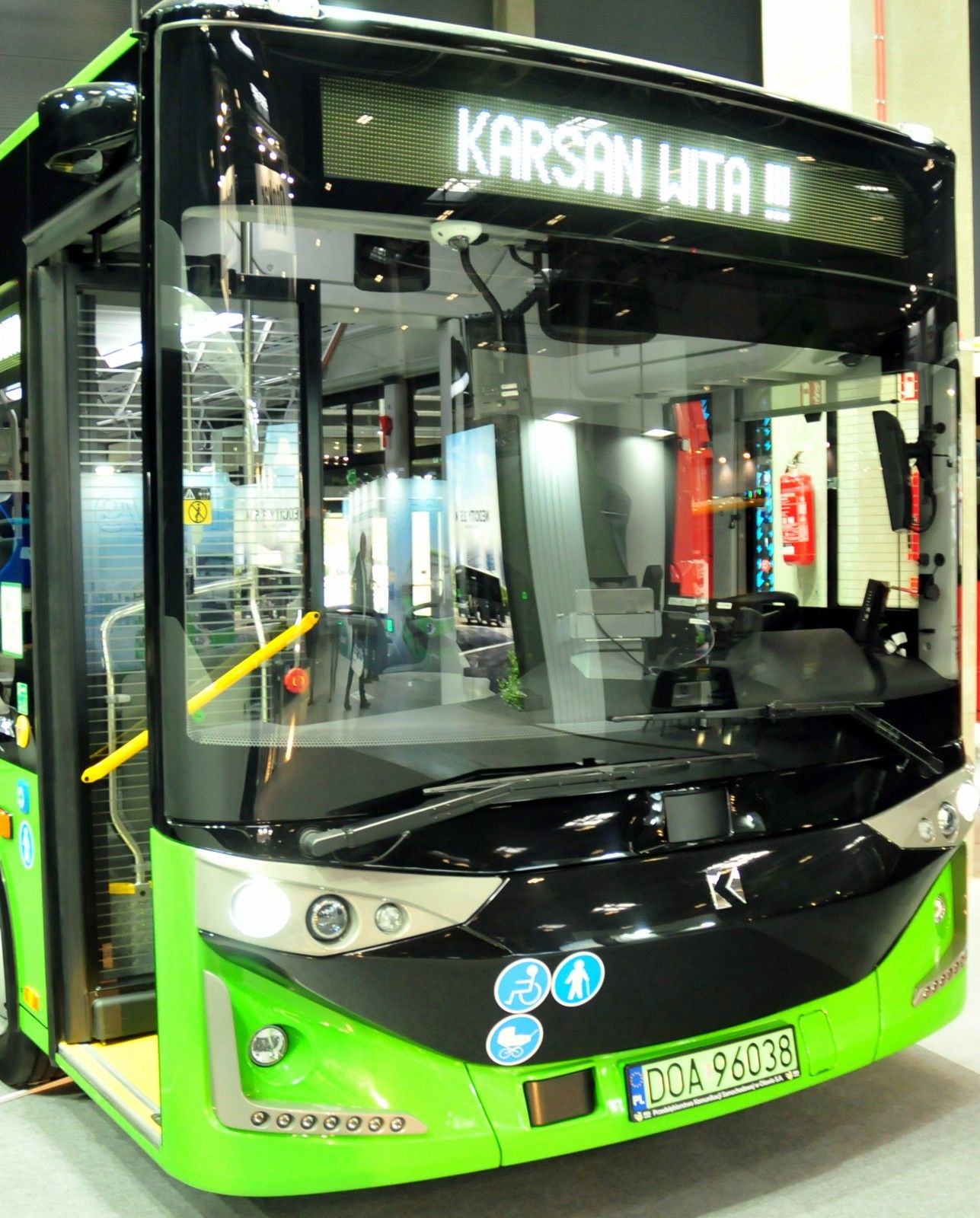
Karsan's battery-electric low-floor city bus, 8,315 mm long: a 230 kW TM4 motor, 220 kWh, up to 300 km, M3 Class I or II and up to 52 passengers (2025 catalogue).
- 8.31 m
- 11.5 t

Model overview
- Segment
- Bus
- Transmission
- Direct drive
- Gross vehicle
- 11 500 kg
- Battery capacity
- 220 kWh
- Range
- 300 km
- Charging
- 80 kW (DC Combo 2)
- Electric motor
- 230 kW peak
- Length
- 8 315 mm
- Wheelbase
- 4 580 mm
- Capacity
- 18, 21 or 23, by layout + 19 to 34, by layout
The Karsan e-ATAK is a battery-electric low-floor city bus of about eight metres. Karsan’s specification tables give it as “Low Floor Electric Bus, M3 Category, Class I / Class II, LHD”, and its product page calls it the “e-ATAK Midi Bus”, with an “8m compact length”. The figures on this page come from Karsan’s own documents: the English product page and its specification page (read on 26 October 2026; neither carries a date), the English catalogue whose back page is dated 20 October 2025, the earlier English catalogue dated 11 January 2024, and the product page of the Autonomous e-ATAK. Karsan’s battery-electric minibus is described in Karsan e-JEST, and its fuel-cell city bus in Karsan e-ATA HYDROGEN.
Category, body and dimensions
Both catalogues and the specification page give the vehicle type as “Low Floor Electric Bus, M3 Category, Class I / Class II, LHD”. The equipment lists have one column for each class: “Class I” and “Class II” in the catalogue, “e-ATAK” and “e-ATAK Class II” on the product page. Class I and Class II under UN Regulation No 107 are set out in bus classes.
The body is listed as “Carbon Steel: Space Frame Steel Tube Structure”, with “Cataphoresis & Underbody Coating” against corrosion; the coating is also a standard item in the equipment list. The catalogue describes “horizantal LED main and dipped beam lights” (spelt as printed) at the front and “Rear LED lights placed vertically”.
| Row | Catalogue, 20 October 2025 | Catalogue, 11 January 2024 | Product and specification pages |
|---|---|---|---|
| Overall length | 8,315 | 8,315 | 8,315 |
| Overall width | 2,436 | 2,490 | 2,436 |
| Overall height | 3,090 | 3,090 | 3,090 |
| Wheelbase | 4,580 | 4,580 | 4,580 |
| Front overhang | 2,040 | 2,040 | 2,040 |
| Rear overhang | 1,695 | 1,695 | 1,695 |
| Standing height | 2,372 | 2,372 | 2,372 |
| Step height, door 1 and door 2 | 340 (with kneeling) & 270 (with kneeling) | 340 (with kneeling) & 270 (with kneeling) | 340 (without kneeling) & 270 (with kneeling) |
| Approach / departure angles | 7.8° / 8.8° | 7.8° / 8.8° | 7.8° / 8.8° |
| Turning radius, kerb to kerb | 6,312 | 6,312 | 6,312 |
| Gross vehicle weight | 11,500 | 11,500 | 11,500 |
The turning figure is a radius, “Kerb to Kerb”; the catalogues add “Standard Mirrors”, and the catalogue’s footnote says it “May change in case of using Mirror Camera option”. The product page’s heading figures are “Total Length (m) 8” and “Maximum Passenger Capacity 52”. No document opened gives a kerb weight, axle loads or a wheel formula.
Electric motor and drive
Every specification table opened gives “Drive Type Direct Drive”, “Engine TM4 Electric Motor”, a maximum power of 230 kW and a maximum torque of 2,500 Nm (“2.500” in the catalogues). The product page’s FAQ repeats the pair: “e-ATAK’s high performance TM4 electric motor provides 230 kW power and 2.500 Nm torque”. The rear axle is listed as “Rigid Drive Axle”. No document opened gives a top speed, a continuous power rating or a gradeability figure.
A regenerative brake system (RBS) is standard in both classes. The catalogue says that with it “e-ATAK can recover the kinetic energy during braking and use it to charge its batteries and extend the range”, and adds: “You can select one of the 2 regenerative brake modes according to preference of kinetic energy re-gain amount.”
Battery and range
The catalogues give “High Voltage Battery (Type - Capacity) Li-ion 360V - 220 kWh”; the product, specification and Autonomous e-ATAK pages print “Li-ion - 220 kWh” without the voltage. The catalogue’s battery page, headed “BMW i. BATTERY”, gives “Capacity: 220 kWh” as “5 battery packs x 44 kWh” and says “Proven BMW Li-Ion batteries vitalize e-ATAK”; the product page speaks of “high-performance BMW lithium-ion battery technology”. No Karsan document opened says whether 220 kWh is installed or usable capacity; the difference is explained in installed vs usable battery capacity.
The range is printed as “Up to 300 km - Class I” and “Up to 280 km - Class II”, with a footnote that it “may vary depending on various factors, in particular: individual driving style, route characteristics, outside temperature, heating/air conditioning, seated & standing passenger weight, vehicle category”; the catalogue’s text pages add “Range may change by vehicle class.” No test cycle is named. The footnote to the fixed roof hatch, an option for Class II only, says that it “must be selected with 4 battery option”; no document opened gives the capacity or range of a four-battery version.
The product page gives “Battery warranty: 4 years or 200,000 km (whichever comes first).” The catalogue of January 2024 prints the same battery warranty (“4 YEARS / 200.000 KM”) and a mechanical warranty panel reading “2 YEARS / 200.000 KM”; the catalogue of October 2025 prints neither.
Charging
The catalogues say the bus “is easily charged through the connection on front right side”. The charging rows are the same in both catalogues and on the specification page:
| Type | Power | Time |
|---|---|---|
| AC Type 2, single | 22 kW | 10 h |
| AC Type 2, double | 44 kW | 5 h |
| DC Combo 2 | 80 kW | 3 h |
On the product and specification pages the three rows carry an asterisk, but the only notes printed under that table are the numbered ones on the mirror camera option and the range; the Autonomous e-ATAK page prints the same rows with the footnote “From %0 to %80 battery capacity in ideal conditions.” The catalogue’s text says “e-ATAK can charge its battery in 5 hours by AC or in 3 hours by DC”, and the product page speaks of “AC charging in approximately 5 hours and DC fast charging in around 3 hours”. A single on-board charger is standard and double on-board chargers are an option. Depot and fast charging of buses in general are covered in charging electric trucks and buses.
Suspension, brakes, steering and tyres
The suspension is listed as “Air Suspension + Electronic Level Control + Kneeling”, with an “Independent” front axle and a “Rigid Drive Axle” at the rear; a front anti-roll bar is standard. The catalogue’s cockpit page reads: “Set the level upon road conditions or kneel while passengers get on and off the bus, with Electric Controlled Air Suspension (ECAS).” How such systems hold and lower the ride height is covered in ECAS air suspension.
The brakes are a “Pneumatic Disc Brake System” front and rear; an electronic parking brake is an option. The steering wheel is “Tiltable & Telescopic Electro Hydraulic”, and a leather steering wheel is an option. The tyres are 245/70 R17.5 on 6.75” x J17.5” rims at the front, single, and 225/75 R17.5 on 6” x J17.5” rims at the rear, double. Front and rear 17.5” steel wheels are standard; wheel covers, a mudguard set and a spare tyre are options.
Passenger capacity and layouts
The catalogue gives “8 mt e-ATAK | 52 Passenger Capacity”. Its table of passenger capacity alternatives, which the product and specification pages print with the same values, carries the note “Values are examples. These values may change as +/- depending on the selected features.”
| Class | Layout | Seated | Max. standing | Foldable | Wheelchair | Max. total |
|---|---|---|---|---|---|---|
| Class I | 18+4 | 18 | 34 | – | – | 52 |
| Class I | 18+4 | 18 | 28 | – | 1 | 47 |
| Class I | 18+4 | 18 | 29 | 4 | – | 51 |
| Class I | 21+2 | 21 | 31 | – | – | 52 |
| Class I | 21+2 | 21 | 25 | – | 1 | 47 |
| Class I | 21+2 | 21 | 25 | 2 | – | 48 |
| Class I | 21+4 | 21 | 31 | – | – | 52 |
| Class I | 21+4 | 21 | 25 | – | 1 | 47 |
| Class I | 21+4 | 21 | 25 | 4 | – | 50 |
| Class II | 23+4 | 23 | 24 | – | – | 47 |
| Class II | 23+4 | 23 | 19 | – | 1 | 43 |
| Class II | 23+4 | 23 | 19 | 4 | – | 46 |
Plastic passenger seats are standard in Class I, with plastic seats with pad and fabric as an option; the Class II column has a dash for both, and lists shuttle-type passenger seats with two-point seat belts as standard (an option in Class I). A backrest totem and wheelchair designations are standard. A grid parcel rack, a school bus pictogram front and rear (both footnoted “Options will be released during order.”) and a fixed roof hatch are listed as options for Class II, with a dash for Class I; the roof hatch footnote says it “can not be used as an emergency exit because of the HV cables”.
Doors, floor and access
Karsan describes the floor as “ORIGINAL LOW FLOOR”: “The low-height floor which enables to get on with only half a step”, and adds that “Passengers can reach the seats that are mounted on the low floor without any extra steps after getting on the vehicle.” The specification tables give step heights for “Door 1” and “Door 2”; the catalogues mark both figures “with Kneeling” and the web pages mark the 340 mm figure “without kneeling” (see the table above). The product page names a “1200 mm Pneumatic Door”; “Metro Type Sliding Doors (Central Doors)” are an option.
A manual wheelchair access ramp (with a standard black floor cover) is standard and an electric ramp an option. The catalogue says the “Manual ramp enables wheelchairs to get on the vehicle” and that “e-ATAK has a wheelchair area”; the product page lists a “Wheelchair Traveling Area” and a “Wide Aisle Clearance & Broad Central Standing Area”. The accessibility rules for buses are set out in bus accessibility under UN Regulation 107.
Safety and driver-assistance systems
A “GSR Package” is standard in both classes. Its footnote reads: “Includes: Emergency stop signal, Tyre pressure monitoring system, Blind spot information system, Reversing information system, Moving off information system, Alcohol Interlock Facilitation Installation, Driver drowsiness and inattention warning, Intelligent speed assistance.” The systems and their dates are covered in mandatory driver assistance systems. “Cyber Security” is standard too, footnoted “ECE R.155: Protection of vehicle against cyberattacks; ECE R.156: Software update and software updates management system” (“managment” in the catalogue).
The product page lists ESP (electronic stability program), EBS (electronic brake system), ABS, ASR (anti-slippage system), RBS, HSA (hill start aid), a front anti-roll bar and a reverse gear buzzer as standard in both classes. The October 2025 catalogue’s equipment table gives ESP, EBS and ABS as standard in Class I and as options in Class II. The catalogue’s safety page also names an “E-MOTOR ROOM FIRE DETECTION SYSTEM” (FDS). A fire suppression system is an option, and the optional pre-heater “includes Fire Supression System for pre-heater area” (spelt as printed). Rear park sensors are standard; a rear camera with a 7” LCD screen and a 1 TB DVR with front, driver, inside and service door cameras are options.
Driver’s area, climate and equipment
The driver’s seat is an “8-Way Pneumatic Driver Seat with 3-Point Seat Belt” by SEGE as standard, or by ISRI as an option; a heated seat is an option. An isolated cabin with a glass rear is standard and a separated driver cabin with high glass an option. A full digital cluster is standard; the catalogue says it shows “charge status, remaining range and average consuption” (spelt as printed). The product page’s design section lists “Keyless Start & Stop”, while its equipment list gives an ignition key and a manual locking system as standard. Two driver area speakers, a telematic system, a smart tachograph, an FMS gateway, a coat hook and ticket validator preparation with a cable at the front are standard; validator preparation with a stanchion and an external speaker are options.
Passenger air conditioning with a heating function, driver air conditioning with a heating function, a 12 kW passenger area heater and a passenger sidewall heater are standard; the pre-heater is an option. Outside, LED front and rear lights, LED daytime running lamps, front fog lamps, electrical and heated pipe-type mirrors, five transom side windows, gray tinted side glass, a sliding heated driver’s window, a heated front door window, preparation for monocolour LED destination signs (front, side and rear) and a white body are standard. Options include a third stop lamp, horn-type mirrors, mirror cameras, dark tinted glass, seven sliding side windows (which “can be selected with Dark Tinted Color Side Glass”), double glass, a heated windscreen, an electric and heated driver’s window, monocolour LED destination signs, a flag holder and other body and roof colours.
Inside, a green-patterned anti-slip PVC floor, yellow handrails (stainless steel as an option), handgrips, and stop signs with a digital clock and temperature indicator are standard. A radio with MP3, USB and AUX, an announcement system with five passenger speakers, a gooseneck microphone and an amplifier, a Wi-Fi router, a roof-mounted 19” LCD screen with USB, and a billboard (only without the rear cabin separation window) and outdoor billboards are options. USB sockets (Type A and Type C) on the sidewalls are standard on the product page and an option in the October 2025 catalogue; the product page’s design section also names “USB On Hand Rails” and an “LED Light Path for Passenger Area”.
Autonomous e-ATAK
Karsan’s site lists the Autonomous e-ATAK under “AUTONOMOUS BUS”, apart from the e-ATAK; its product page calls it a “LEVEL 4 AUTONOMOUS ELECTRIC CITY BUS”. The page says that “Autonomous e-ATAK operates safely on predefined routes without the need for human intervention”, and names its sensors: LiDAR, RGB and thermal cameras, an IMU, GNSS, radar (for “Emergency Braking, Dynamic Speed Control Assistance and Speed Based Vehicle Tracking”) and ultrasonic sensors. Karsan states that it “calculates the movement of each object around 20 times per second” and that “Data can be obtained instantly from Autonomous e-Atak and remote route changes can be made.”
Its specification gives “Low Floor Electric Bus, M3 category, Class I, LHD”, the same motor, battery, charging rows, range of up to 300 km, length, wheelbase, overhangs, gross vehicle weight and tyres as the e-ATAK, and an overall width of 2,613 mm, an overall height of 3,379 mm, a standing height of 2,363 mm and a turning radius of 7,015 mm. Its equipment list gives a 12” full digital cluster, a 10.1” multimedia touchscreen with radio, USB and Bluetooth, a rear camera, “Door Compress Prevention” and an “E-Motor Room Fire Detection System” as standard and an “Alcoholmeter Preperation” as an option; it has no GSR package or cyber security row.
Catalogue editions
Karsan’s two English catalogues are dated 11 January 2024 and 20 October 2025 on their back pages. Their technical tables differ in the overall width, 2,490 mm in 2024 and 2,436 mm in 2025, and only the January 2024 edition prints the warranty panels. No document opened gives the year the e-ATAK was introduced or describes an earlier version.
Source notes
The figures above are from Karsan’s English catalogue whose back page is dated 20 October 2025; Karsan’s English product and specification pages print the same values: M3 category, Class I or Class II, left-hand drive; a TM4 electric motor with direct drive, 230 kW maximum power and 2,500 Nm maximum torque; a Li-ion battery of 220 kWh (360 V in the catalogues), five packs of 44 kWh, which Karsan does not split into installed and usable capacity; range up to 300 km in Class I and up to 280 km in Class II, with no test cycle named; charging AC Type 2 at 22 kW (single) in 10 h or 44 kW (double) in 5 h, and DC Combo 2 at 80 kW in 3 h, which the catalogues footnote as from 0% to 80% of battery capacity; length 8,315 mm, width 2,436 mm, height 3,090 mm, wheelbase 4,580 mm, front overhang 2,040 mm, rear overhang 1,695 mm, standing height 2,372 mm, approach and departure angles 7.8 and 8.8 degrees, turning radius 6,312 mm kerb to kerb with standard mirrors; gross vehicle weight 11,500 kg; tyres 245/70 R17.5 on 6.75 x 17.5 rims at the front (single) and 225/75 R17.5 on 6 x 17.5 rims at the rear (double); up to 52 passengers. The catalogues print the step height at both doors as 340 mm and 270 mm, both marked with kneeling; the web pages give 340 mm without and 270 mm with kneeling. The product page names a 1,200 mm pneumatic door. The English catalogue of 11 January 2024 gives a width of 2,490 mm and the same other figures. The 2025 catalogue’s equipment table lists ESP, EBS and ABS as standard in Class I and optional in Class II, and USB sockets on the sidewalls as optional; the product page lists all four as standard in both classes. The Autonomous e-ATAK page gives Class I only, a width of 2,613 mm, a height of 3,379 mm, a standing height of 2,363 mm and a turning radius of 7,015 mm, with the same motor, battery, charging, length and weight.
Quick answers
- Which transmission does the Karsan e-ATAK use?
- Transmission: Direct drive.
- What is the gross vehicle weight of the Karsan e-ATAK?
- Gross vehicle weight: 11 500 kg.
- What battery capacity does the Karsan e-ATAK have?
- Battery capacity: 220 kWh; Range: 300 km; Charging: 80 kW (DC Combo 2).
- How long is the Karsan e-ATAK?
- Length: 8 315 mm; Wheelbase: 4 580 mm.
- How many passengers does the Karsan e-ATAK carry?
- Capacity: 18, 21 or 23, by layout; Standing places: 19 to 34, by layout.
Articles that mention the Karsan e-ATAK
More Karsan on this site
Sources
- e-ATAK — product page (English, global) — Karsan Otomotiv Sanayii ve Ticaret A.Ş.
- e-ATAK — specs (English, global) — Karsan Otomotiv Sanayii ve Ticaret A.Ş.
- e-ATAK — catalogue (English), dated 20.10.2025 — Karsan Otomotiv Sanayii ve Ticaret A.Ş.
- e-ATAK — earlier catalogue (English), dated 11.01.2024 — Karsan Otomotiv Sanayii ve Ticaret A.Ş.
- Autonomous e-ATAK — product page (English, global) — Karsan Otomotiv Sanayii ve Ticaret A.Ş.