VDL
VDL Citea
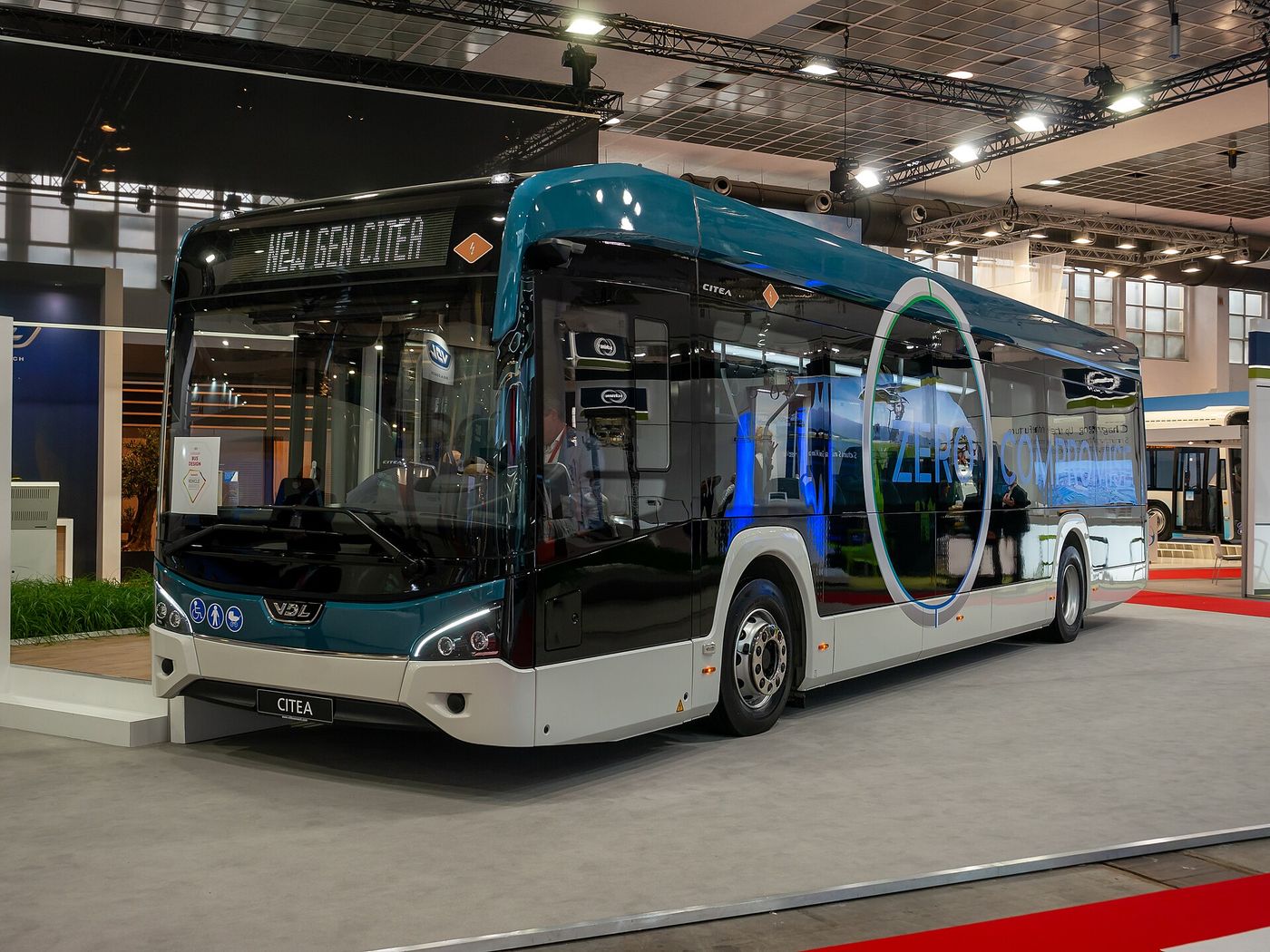
VDL's new-generation Citea battery-electric bus in five types, LF-122 to LE-149: ZF drives, VDL batteries of up to 791 kWh, CCS2 and pantograph charging, sizes and capacity.
- 12.2 m
- 19.5 t

Model overview
- Segment
- Bus
- Gross vehicle
- 19 500 kg
- Length
- 12 200 mm
- Capacity
- at least 45
The new generation VDL Citea is a battery-electric city and regional bus built by VDL Bus & Coach in five types and four lengths, in Low Floor (LF) and Low Entry (LE) form: the Citea LF-122, LF-181, LE-122, LE-135 and LE-149. The figures on this page come from VDL’s own documents: the English brochure “The new generation Citea”, whose back page reads “v4.0 January. - 2025” and adds that the product range may vary from country to country, and the English product page and five topic pages on vdlbuscoach.com (capacity, range, driver, passenger and sustainability), which carry no date and were read on 26 October 2026. How a battery-electric city bus is built and charged is set out in electric buses explained.
Overview and earlier electric Citeas
VDL describes the new generation Citea as “completely developed from scratch” and “completely based on an electric driveline”, under the slogan “Zero Compromise”. The brochure says VDL has been conducting market research on the future of mobility since 2015 and began the development from a blank sheet, setting the traditional diesel bus layout aside. On the product page, Alex de Jong, Business Manager Public Transport at VDL Bus & Coach, is quoted: “We started completely from scratch, focusing on zero emissions.” The same page lists “Batteries in the floor, a one-piece composite side wall, clever energy management, a sophisticated climate control system and an ergonomic driver’s environment” as the five innovations of the range. The brochure says the bus has won the Red Dot Award and the iF Design Award, and gives no year for either.
The brochure’s timeline of milestones and experience lists:
- 2013: introduction of the Citea Electric;
- 2014: Project Münster, five Citea SLF-120 Electric;
- 2015: Project Cologne, eight Citea SLFA-181 Electric;
- 2016: Project Eindhoven, 43 Citea SLFA-181 Electric;
- 2018: Project Schiphol, 100 Citea SLFA-181 Electric;
- 2019: “Factory Roeselare ZE/LE only”;
- 2022: “over 1,300 registered electric buses and more than 200,000,000 electric km of electric driving”.
The timeline ends with “Tomorrow”. No document opened gives a launch date or a start of series production for the new generation.
Types, dimensions and capacity
| Brochure row | LF-122 | LF-181 | LE-122 | LE-135 | LE-149 |
|---|---|---|---|---|---|
| Vehicle type | BEV | BEV | BEV | BEV | BEV |
| Bus length | 12.2 m | 18.1 m | 12.2 m | 13.5 m | 14.9 m |
| Bus width | 2.55 m | 2.55 m | 2.55 m | 2.55 m | 2.55 m |
| Bus height | 3.19 m | 3.19 m | 3.19 m | 3.19 m | 3.19 m |
| Available classes | Class 1/2 | Class 1 | Class 1/2 | Class 1/2 | Class 1/2 |
| Maximum passenger capacity | 110 | 163 | 105 | 89 | 138 |
| Gross vehicle weight | 19,500 kg | 30,000 kg | 19,500 kg | 19,500 kg | 25,250 kg |
The product page describes the range as “4 length variants and 5 types in Low Entry and/or Low Floor execution” and says all types are suited to city and regional transport, “with the exception of the 18.1-metre Low Floor, which comes into its own as a city bus”. In the brochure table the LF-181 is the one type listed for Class 1 alone; the other four are listed for Class 1/2. The brochure does not define the classes; the bus classes of UN Regulation No 107 are set out in bus classes. The product page describes the 13.5-metre type as a vehicle “on 2 axles”.
The product page and the capacity page say each type “has room for at least 45 seated passengers”, and give “up to a maximum of 110 people in a 12.2-metre vehicle”, the LF-122’s figure in the brochure table. No document opened gives a seat count per type, a standing figure or a door count. None gives a wheelbase, overhangs, a turning circle, an unladen weight or axle loads, and none gives an axle count except for the 13.5-metre type.
Electric motor and drive
The brochure table gives a ZF electric motor for all five types. The two Low Floor types, LF-122 and LF-181, are listed with the “AxTrax AVE Electric portal axle”; the three Low Entry types, LE-122, LE-135 and LE-149, with the “CeTrax Central Electrical Drive”. The brochure’s text puts it this way: “hub motors are integrated in the low floor types; a central motor is used for the low entry vehicles.” The capacity page, writing of the whole new generation, speaks of “integrating the motors into the wheels” and does not single out the Low Entry types.
Neither document gives a motor power, a torque figure or a motor count, and the brochure table has no transmission row. The drive layouts a city bus can have are described in city bus propulsion.
Battery and charging
| Brochure row | LF-122 | LF-181 | LE-122 | LE-135 | LE-149 |
|---|---|---|---|---|---|
| Battery supplier | VDL High Energy battery | VDL High Energy battery | VDL High Energy battery | VDL High Energy battery | VDL High Energy battery |
| Max. total energy | 575 kWh | 791 kWh | 575 kWh | 647 kWh | 791 kWh |
| Charging solution | CCS2, bus-mounted pantograph, infrastructure-mounted pantograph (all five types) | ||||
The battery figures are maxima. The brochure says “For all vehicles there are multiple optional battery sizes and configurations available” and lists no other size. No document opened says whether the figures are installed or usable energy; the difference between the two is set out in installed vs usable battery capacity.
According to the capacity page, the standard battery package is integrated into the floor. The brochure says the batteries in the floor lower the centre of gravity and, with less weight on the roof, allow a lighter roof construction, and that the mechanic “can easily lower the battery modules from the floor to be individually replaced.”
The table lists the same charging solution for every type: CCS2, a bus-mounted pantograph or an infrastructure-mounted pantograph. The brochure’s text calls the choices “a combo 2 plug, roof-mounted- and infrastructure-mounted pantograph”. No document opened gives a charging power. The two pantograph arrangements are explained in opportunity charging and pantographs.
Range and energy consumption
The product page and the range page say that “all vehicles cover a distance of 500 to 600 kilometres” and that “Even during a harsh winter, the Citeas can still drive 250 kilometres 100% electrically”. Neither page names a test cycle, a load or a battery for these figures. VDL adds that in metropolitan areas the Citeas can handle 24-hour operation, and that on regional lines distances of up to 70 kilometres “are no longer an exception”.
The range page says the new generation was tested in different climate regions, in winter conditions and at high temperatures in Southern Europe, and states: “In winter, energy consumption is reduced by an average of 30%. Throughout the year, customers can count on an average of 20-25% less energy consumption and 20% more action radius.” The page does not say what these percentages are measured against. The brochure adds tests in the cold of Scandinavia and the warm regions of Mediterranean Europe, a winter and a summer test, and tests on durability, safety and driveability.
Body, sidewall and aerodynamics
The sidewall is a single piece of composite that VDL says it developed itself; the brochure describes the material as “recyclable, lightweight composite”. The capacity page gives the construction as “15% lighter than a conventional sidewall”, says there are no cold bridges in it, and attributes to it less vibration, filtered outside noise and lower energy consumption, including that of the climate system.
On aerodynamics the brochure names “Curves at the front, various spoilers, and the sharp angles at the rear”, and says the bus “has been intensively tested in the wind tunnel, with simulations and on the road”. The product page adds that the one-piece side wall leaves “no gaps or holes”.
Climate system
The brochure table lists the same climate system for all five types: an electric heat pump, with an optional HV and/or diesel fuel heater. The passenger page says VDL interviewed over a thousand passengers in Europe about the temperature inside the bus and that the new Citea has different climate zones. Double glazing is standard, and VDL says its use “has reduced energy consumption by 10%”; a defrosting system thaws ice or snow on the windows. The product page mentions special filters, combined with monitoring, for the air quality inside the bus.
For the driver, the driver page describes an additional cab heater that supplies warm air around the legs and torso, allowing a temperature to be set “from 17 to 27 degrees”.
Driver’s workplace and safety
The driver page says VDL’s researchers interviewed dozens of drivers across Europe and that VDL cooperated with public transport industry associations and universities; it notes that a driver spends “an average of 2 to 3 hours in the same city bus during a shift”. The new generation has a steering column with a larger adjustment range and lower steering forces, flexible and extensive adjustment possibilities for the driver’s workplace and storage space, and VDL says future developments in payment systems and autonomous driving were anticipated in the design. The brochure states the aim as making the bus the “workplace of choice” for drivers.
The brochure names “Comprehensive passive and active safety systems” among the design aims and lists none of them; no document opened names the individual safety or driver-assistance systems. It also says the power “can be switched off easily and safely, not only by mechanics but by security services”.
Passenger area
The brochure says all seats are reachable under the “one-step-away-principle”, within one step from the aisle. The passenger page names a wide entry door for passengers with reduced mobility, and an optional private armrest and headrest, a built-in USB connection and luggage racks. What low floor and low entry mean for access is set out in bus accessibility.
The product page describes the lighting: a green light when the doors open and it is safe to get out, a red light that flashes when the door closes and the bus departs, and indirect lighting under the seats. Colour and intensity can be adjusted, and the driver can set the lighting so that it has “a de-escalating effect”. For hygiene VDL lists the one-piece composite side wall, cantilever furniture, rounded forms and mostly smooth materials, and says the vertical and horizontal grab rails and the passenger seats can be given an antibacterial coating.
Service and production
The brochure says filters and filling points are placed for easy access, that connectivity is used for diagnosis, and that battery modules can be lowered from the floor one by one.
The sustainability page says the new generation is built in VDL’s production facilities in the Netherlands and Belgium. The brochure says VDL opened a factory in Roeselare, Belgium, in early 2023, which it describes as its centre for e-mobility alongside Valkenswaard; the production hall covers 27,000 square metres, and VDL says it will be able to double capacity there. According to the sustainability page, more than 80% of the bus’s weight is supplied from Western European countries within a 1,250 km range of the assembly lines. The brochure also says UNICEF will support VDL in mapping the links in the battery chain for the new generation Citea.
Source notes
The figures above are the Citea LF-122, the first column of the technical specifications table in VDL’s English brochure The new generation Citea, version 4.0 of January 2025: 12.2 m long, 2.55 m wide and 3.19 m high, a maximum passenger capacity of 110 and a gross vehicle weight of 19,500 kg; the seat figure is from VDL’s product page, which says each type has room for at least 45 seated passengers. The same table gives the other four types: the LF-181 at 18.1 m, 163 passengers and 30,000 kg; the LE-122 at 12.2 m, 105 passengers and 19,500 kg; the LE-135 at 13.5 m, 89 passengers and 19,500 kg; and the LE-149 at 14.9 m, 138 passengers and 25,250 kg. All five are battery-electric, 2.55 m wide and 3.19 m high, and the table lists the available classes as Class 1/2 for four types and Class 1 for the LF-181. The electric motor is from ZF on all five: an AxTrax AVE electric portal axle on the two Low Floor types and a CeTrax central electrical drive on the three Low Entry types. The battery is a VDL High Energy battery with a maximum total energy of 575 kWh on the LF-122 and LE-122, 647 kWh on the LE-135 and 791 kWh on the LF-181 and LE-149; the brochure says multiple optional battery sizes and configurations are available for all vehicles and lists no other size. Charging is by CCS2, a bus-mounted pantograph or an infrastructure-mounted pantograph, and no charging power is given. The climate system is an electric heat pump with an optional HV and/or diesel fuel heater. VDL’s web pages give a range of 500 to 600 km for all vehicles and 250 km in a harsh winter, with no test cycle, load or battery named. No document opened gives a motor power, a wheelbase, a turning circle, an unladen weight or a start of production.
Quick answers
- What is the gross vehicle weight of the VDL Citea?
- Gross vehicle weight: 19 500 kg.
- How long is the VDL Citea?
- Length: 12 200 mm.
- How many passengers does the VDL Citea carry?
- Capacity: at least 45.
Articles that mention the VDL Citea
Sources
- The new generation Citea — Zero Compromise (brochure, English, v4.0 January 2025) — VDL Bus & Coach
- New generation Citeas: 'Zero compromise' becomes the new standard for VDL Bus & Coach (product page) — VDL Bus & Coach
- New generation Citeas — Capacity — VDL Bus & Coach
- New generation Citeas — Range — VDL Bus & Coach
- New generation Citeas — Driver — VDL Bus & Coach
- New generation Citeas — Passenger — VDL Bus & Coach
- New generation Citeas — Sustainability — VDL Bus & Coach