Iveco
Iveco Streetway
Iveco Bus's Streetway low-floor city bus in 12, 18 and 18.75 m with Cursor 9 diesel and CNG engines, and the 12 m Streetway ELEC: dimensions, weights, tanks, batteries and seats.
- 228–265 kW
- Euro VI Step E
- 12 m
- 20 t
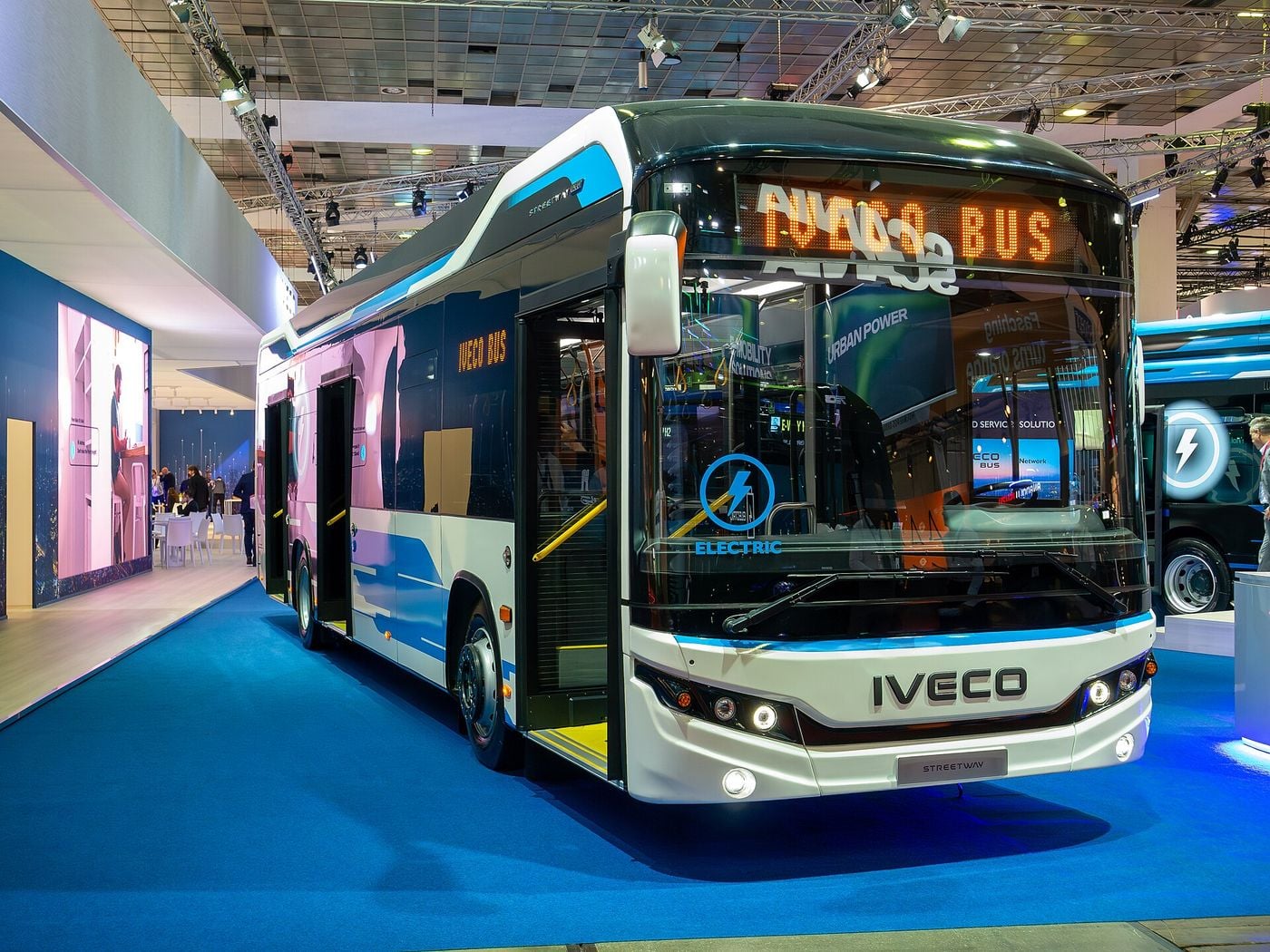

Model overview
- Segment
- Bus
- Emission
- Euro VI Step E
- Transmission
- Automatic Voith Diwa 6 with SENSOTOP or ZF Ecolife 2 with TOPODYN (diesel and CNG); central Voith EHD electric motor, gearbox N/A (electric)
- Gross vehicle
- 20 000 kg
- Battery capacity
- 346–486 kWh
- Range
- 400 km
- Charging
- 150 kW (CCS Combo 2)
- Electric motor
- 410 kW peak · 1×
- Length
- 12 000 mm
- Wheelbase
- 5 900 mm
- Capacity
- 24 to 32 (3 doors) or 26 to 34 (2 doors) at 12 m; 31 to 47 (4 doors) or 33 to 49 (3 doors) articulated; 23 (3 doors) or 35 (2 doors) on the 12 m electric
- Doors
- 2 or 3 doors (12 m), 3 or 4 doors (18 m), opening inwards
Engine families
- Power
- 228–265 kW
- Torque
- 1300–1650 Nm
- Rated speed
- 2200 rpm
- Power
- 228–264 kW
- Torque
- 1300–1640 Nm
The Streetway is Iveco Bus’s low-floor city bus with a Cursor 9 engine that runs on diesel or compressed natural gas, offered in lengths of 12 m, 18 m and 18.75 m, and, as the Streetway ELEC, with a battery-electric drive in a 12 m length. Iveco’s product page heads the model “Clean city transport, in a cost-effective way” and says the Streetway “extends the IVECO BUS offering for city transport with an efficient bus optimized for urban mobility”. The figures on this page come from Iveco Bus’s three international technical sheets for the Streetway — diesel and CNG, each in 12, 18 and 18.75 m, and full electric in 12 m — which are marked September 2023 and whose PDF files were created on 6 October 2023; from the English Streetway brochure, footed PUBLICATION STREETWAY_EN 12/24 and created on 10 December 2024; and from the undated Streetway product page on Iveco Bus’s worldwide site, which links the brochure and the three sheets. All were read on 8 November 2026.
Lengths and versions
The brochure says the Streetway “offers a choice of 3 lengths – 12 m, 18 m and 18.75 m”; the product page gives “a choice of two lengths, 12 metres and 18.75 metres”. The diesel and CNG sheets, both headed “12 m / 18.75 m”, have a column for each of the three lengths. Their equipment lists give 2 or 3 door versions at 12 m and 3 or 4 door versions at 18 m, and the brochure’s line-up gives the same door counts for the 12 m bus and for the 18.00 m and 18.75 m buses.
The brochure calls the Streetway ELEC a “new model” with which Iveco Bus “extends its offer for zero-emission mobility”, for “targeted markets in Central, Eastern and Southern Europe, Africa, the Middle East and Asia”, and marks it “Available in 12 m only”. The product page groups the drivelines under “Natural Gas & Biomethane”, “Diesel & Biofuels” and “Electric”. Iveco Bus’s other city buses are described on the Iveco Urbanway and Iveco E-Way pages, and the drivelines used in city buses in city bus propulsion.
Dimensions and weights
| Data sheet row | 12 m | 18 m | 18.75 m | 12 m electric |
|---|---|---|---|---|
| Length | 12,000 mm | 18,000 mm | 18,750 mm | 12,130 mm |
| Width | 2,540 mm | 2,540 mm | 2,540 mm | 2,550 mm |
| Height, diesel sheet | 3,245 mm | 3,245 mm | 3,245 mm | no column |
| Height, CNG sheet | 3,390 mm | 3,390 mm | 3,390 mm | no column |
| Height, electric sheet | no column | no column | no column | 3,220 mm |
| Wheelbase | 5,900 mm | 5,900 / 5,990 mm | 5,900 / 6,740 mm | 5,900 mm |
| Front / rear overhang, diesel sheet | 2,700 / 3,400 mm | 2,700 / 3,410 mm | 2,700 / 3,410 mm | no column |
| Front / rear overhang, CNG sheet | 2,700 / 3,400 mm | 2,700 / 3,400 mm | 2,700 / 3,400 mm | no column |
| Front / rear overhang, electric sheet | no column | no column | no column | 2,700 / 3,530 mm |
| Front / rear track | 2,160 / 1,890 mm | 2,160 / 1,890 mm | 2,160 / 1,890 mm | 2,158 / 1,911 mm |
| Interior height (aisle) | 2,438 / 2,431 mm | 2,438 / 2,431 mm | 2,438 / 2,431 mm | 2,358 mm |
| Front / middle / rear door access height | 330 / 330 / 330 mm | 330 / 330 / 330 mm | 330 / 330 / 330 mm | 330 / 330 / 330 mm |
| Front / middle / rear door width | 1,200 mm | 1,200 mm | 1,200 mm | 1,210 mm |
| Turning radius (curb to curb) | 9,200 mm | 9,800 mm | 10,100 mm | 9,200 mm |
| Internal turning radius | 3,500 mm | 4,100 mm | 4,700 mm | 3,500 mm |
| Turning radius (wall to wall) | 11,600 mm | 11,500 mm | 12,000 mm | 11,600 mm |
| Approach / departure angles | 7° / 7° | 7° / 7° | 7° / 7° | 7° / 7° |
| Max. technically permissible GVW | 20,000 kg | 29,000 kg | 29,000 kg | 20,500 kg |
| Max. technically permissible front axle load | 8,000 kg | 8,000 kg | 8,000 kg | 8,000 kg |
| Max. technically permissible middle axle load | - | 11,500 kg | 11,500 kg | - |
| Max. technically permissible rear axle load | 13,000 kg | 13,000 kg | 13,000 kg | 13,000 kg |
The diesel and CNG sheets print the same dimensions and weights except for the height, 3,245 mm on the diesel sheet and 3,390 mm on the CNG sheet, and for the overhangs: the diesel sheet gives 2,700 / 3,400 mm at 12 m and 2,700 / 3,410 mm at 18 m and 18.75 m, and the CNG sheet prints 2,700 / 3,400 mm once for all three lengths. The brochure’s line-up gives 3,245 mm (Diesel) and 3,390 mm (CNG) for the Streetway and 3,220 mm for the Streetway ELEC. A footnote on every sheet reads “Max allowed vehicle axles load and GVW is depending on local regulation in registration country”. No document opened gives a kerb weight.
Seats and doors
| Sheet and length | Doors | Drawn layout | Seat range |
|---|---|---|---|
| Diesel and CNG, 12 m | 3 | 24 seats + 1 wheelchair and pram area | 24 to 32 |
| Diesel and CNG, 12 m | 2 | 26 seats + 1 wheelchair and pram area | 26 to 34 |
| Diesel and CNG, articulated | 4 | 36 seats + 1 wheelchair and pram area | 31 to 47 |
| Diesel and CNG, articulated | 3 | 38 seats + 1 wheelchair and pram area | 33 to 49 |
| Electric, 12 m | 3 (drawing) | 23 seats + 1 wheelchair and pram area | not printed |
| Electric, 12 m | 2 (drawing) | 35 seats + 1 wheelchair and pram area | not printed |
Every sheet adds “Seat Layout can be changed in case of request”. The articulated drawings carry no length, and the electric sheet prints no door count beside its two drawings, one with three doors and one with two. No sheet gives a number of standing passengers; the brochure says the Streetway ELEC “can accommodate more than 90 passengers” and offers “a new 5 seats area on the rear part”, and the product page mentions “the option of having five seats at the rear”.
The doors open inwards, with a manual ramp at the second door; electric sliding external doors, with the front door opening inwards, and an electric wheelchair ramp are options. The diesel and CNG sheets list one wheelchair place combined with a place for a pram at 12 m and one wheelchair place plus one pram place at 18 m, with layouts for 2 wheelchairs (12 m) or 2 wheelchairs and 1 pram (18 m) as options. The product page says “The lowered platform between the front and middle doors facilitates access for all passengers”; access requirements are described in bus accessibility.
Cursor 9 engine
The diesel and CNG Streetway use the Cursor 9, which the product page and the brochure credit to FPT Industrial: 8.7 litres, six cylinders in line, mounted longitudinally at the rear, with common rail named on the diesel sheet. Both sheets carry “EURO VI STEP E” in their titles. The engine family is described in FPT Cursor 9.
| Sheet | 12 m | 18 m and 18.75 m |
|---|---|---|
| Diesel | 228 kW (310 hp) at 2,200 rpm; 1,300 Nm at 1,100 rpm | 265 kW (360 hp) at 2,200 rpm; 1,650 Nm at 1,200 rpm |
| CNG | 228 kW (310 hp) at 2,200 rpm; 1,300 Nm at 1,100 rpm | 264 kW (360 hp) at 1,900 rpm; 1,640 Nm at 1,100 rpm |
Both sheets label the power row “POWER @ 2500 RPM”, while each figure in the row carries its own engine speed. The brochure’s line-up gives “310 hp / 1300 Nm” for the 12 m bus and 360 hp with “Diesel: 1650 Nm CNG: 1640 Nm” for the 18 m and 18.75 m buses.
The product page says the Cursor 9 is “combined with the HI-SCR after-treatment system without active regeneration”, and that the Streetway “is also compatible with XTL fuels - also known as synthetic fuels or e-fuels - and biogas”. The brochure describes the diesel version as “compatible with second-generation biofuels” and the CNG version as “compatible with bio-methane featuring high-capacity tanks for long range”. The sheets list an exhaust pipe with its outlet on the roof toward the back, an aftertreatment system, fire detection in the engine compartment with an alert on the dashboard and a water-mist fire extinguisher system for the engine; an exhaust outlet at ground level is an option.
Fuel and gas tanks
The diesel sheet gives a 280 litre diesel tank at 12 m, filled on the right-hand side near the front door above the front axle wheel, and a 380 litre tank at 18 m, filled on the right-hand side near the middle door above the middle axle wheel, with a 50 litre AdBlue tank filled at the rear on the right-hand side at both lengths. The CNG sheet lists the gas storage in bottles of type CNG3:
| Length | Standard | Option |
|---|---|---|
| 12 m | 4 longitudinal bottles, 1,280 litres | 5 longitudinal bottles, 1,600 litres |
| 18 m | 5 longitudinal bottles, 1,600 litres | 5 longitudinal and 1 transversal bottles, 1,805 litres |
Filling is through NGV2 connectors on the left and at the rear on the right-hand side, with NGV1 and NGV2 filling at the rear on the right side as an option. The brochure’s line-up gives the same volumes as “serial” and “opt.” figures.
Streetway ELEC: motor, batteries and charging
The electric sheet lists an “Electric Central Motor Voith EHD E-Motor” with a nominal power of 310 kW and a peak power of 410 kW, a maximum torque of 3,100 Nm and a maximum motor speed of 3,800 rpm, in a “central e-motor drive line”; the brochure’s line-up names it “VOITH HD E-Motor” and gives the gearbox as “N/A”. The rear axle is a ZF AV 133 with a rear axle ratio of 7.36, and the maximum vehicle speed is limited to 85 km/h. The retarder entry reads “Incorporated into electric tracking drive line – recuperation braking”, with a recuperation hand lever under the steering wheel. Battery-electric city buses are described in electric buses explained.
The batteries are FPT NMC cells in packs placed on the roof and at the back of the vehicle. The sheet and the brochure give the same pack counts and differ on the standard energy:
| Packs | Electric sheet | Brochure |
|---|---|---|
| 5 (standard) | 347 kWh | 346 kWh |
| 6 (option) | 416 kWh | 416 kWh |
| 7 (option) | 486 kWh | 486 kWh |
The brochure calls these figures the “overall embedded on board energy” and says the NMC Li-ion battery technology is “assembled by FPT”. Charging is overnight at the depot through a CCS Combo 2 plug of up to 150 kW, with the socket at the front on the right-hand side as standard and in another position as an option. The brochure says the battery capacity “enables a range of up to 400 km”, and gives the duration of night-time recharging at the depot as “up to 5 hours depending on the charging system capacity, max 150 kW”. No document opened gives a usable battery capacity.
Gearbox, axles, suspension and brakes
The diesel and CNG sheets list as standard an automatic Voith Diwa 6 gearbox with SENSOTOP or a ZF Ecolife 2 with TOPODYN, with a 3 or 6 touch gearbox selector. The rear axle is a lowered ZF AV 133, with a lowered ZF AVN 132 middle axle on the 18 m bus, and the maximum vehicle speed is limited to 90 km/h. Beside the rear axle, the optional column of the diesel sheet prints “12 m – 6,20 (S) / 5,76 (O)” and “18,00-18,75 m – 5,76 (S) / 6,20 (O)”, and that of the CNG sheet “12 m – 5,76 (S) / 6,2 (O)” and “18,75 – 6,20 (S) / 5,76 (O)”, without a label.
The front axle is an RL 82 EC with independent suspension, written IFS RL 82 EC on the diesel and CNG sheets and ZF RL 82 EC on the electric sheet. Steering is a Hema worm-type unit with integrated power steering on the diesel and CNG buses and an electrically powered system on the electric bus. All three sheets list electronic full air suspension with a self-levelling function and a kneeling function.
Compressed air comes from a dual-cylinder compressor of 630 cm³, with air drying, oil separation and low-carbon steel air tanks, on the diesel and CNG buses, and from an electrically powered compressor with an air dryer, optional oil separation and aluminium air tanks on the electric bus. The service brake is pneumatically controlled on the diesel and CNG buses and electro-pneumatically on the electric bus, with disc brakes front and rear, EBS (with ABS and ASR on the diesel and CNG sheets), two independent circuits front and rear and a parking brake; the electric sheet’s brake list adds an item for bus stops with opened doors and a hill holder (automatic hand brake) with a switch-off button. ESP is an option on all three sheets, marked “12m only” on the diesel and CNG sheets. The diesel and CNG buses have a hydraulic retarder in the gearbox, linked to the service brake pedal, with a manual lever to control it as an option. Tyres are 275/70 R22.5 on 22.5x7.5 steel rims; the electric sheet adds “front 152/148, rear 150/145” beside the size.
Body, interior and driver’s area
The sheets give the Streetway as “Vehicle Type M3 Class 1 (EU type approval)” and ECE R107 compliant, written “ECE R 107.07” on the diesel and CNG sheets, and the product page says “Compliance with UNECE R66 and R29 is integral to the STREETWAY”; the rollover requirement is described in bus rollover strength. The structure is steel with an anti-corrosion cataphoresis treatment, self-supporting and made of 6 panels welded together, with a roof of sandwich composite panel (fibreglass, polystyrene and fibreglass), aluminium side panel segments glued to the body and polyester bumpers front and rear.
The passenger area has Kiel IDEO seats with plastic trim, on the electric bus with cantilever fixing apart from the seats on the wheel arches and the rear bench, and fabric trim with foam as an option; painted handrails, with stainless steel as an option; a 6 kg fire extinguisher; and 8 stop buttons with a sign box at the front on the 12 m bus, 13 stop buttons on the 18 m bus. Electrical equipment on all three sheets includes a multiplex system, 2 batteries of 225 Ah on a sliding tray and LED lighting inside and outside; the diesel and CNG sheets add a NATO plug for battery charging and alternators of 2 x 150 A at 12 m and 3 x 150 A at 18.75 m. The electric sheet lists a Digital Smart tachograph as an option.
Standard glazing is tinted on the diesel and CNG buses and grey on the electric bus, with tilting upper ventilation windows (sliding as an option) and a manual sliding driver’s window. The diesel sheet lists glazed roof hatches and the CNG sheet “1 roof hatch glazed (no emergency exit)”, manually operated, with electric operation as an option. Options on the diesel and CNG buses include floor heating by 2 heaters (12 m) or 3 heaters (18 m), an independent heater of 30 kW at 12 m and 35 kW at 18 m on the diesel sheet, 30 kW at both lengths on the CNG sheet, a roof-mounted air-conditioning unit of 39 kW (12 m) or 48 kW, 2x24 kW (18 m), with a reheating function, and double glazing. The electric bus has a 20 kW electric heater and heats the passenger room by heaters and a convector; its options are reinforced heaters, a hybrid heater (electrical and HVO), an electric roof air-conditioning unit with 30 kW cooling and 19 kW heating capacity with a heat pump, air conditioning for the driver, and pre-conditioning and heating at the depot.
The driver has a closed cabin, with a door with half glazing on the diesel and CNG buses and with high glazing, opening backwards, on the electric bus, a dashboard adjustable on the steering column, upper storage, a seat with air suspension and a safety belt, and external mirrors with electric de-icing and manual control. Electrically controlled mirrors, other cabin doors and Grammer or ISRI seats are options, and the electric sheet adds rear view camera mirrors and door cameras. The brochure says the driver’s workplace “was completely renewed” and “is compliant with VDV 234”, that the steering column position “is now pneumatically lockable”, and that turning seats of 35° (VDV) with ISRI are optional. The product page calls the driver’s position “comfortable and slightly elevated”.
Safety and driver assistance
All three sheets list “GSR B compliant M3 class I.” with MOIS, BSIS, ISA, DDAW, REV, ESS, ALC and TPMS. The brochure names four of these systems as hosted in the new front face — blind spot information system (BSIS), moving off information system (MOIS), intelligent speed assistant (ISA) and driver drowsiness attention warning (DDAW) — with a radar in the front face and a camera behind the windscreen that together detect vulnerable road users approaching from the front and the sides, and road signals, and a light sensor in the camera that switches the headlights on automatically. The GSR systems are listed in mandatory driver assistance systems. The product page says Iveco Bus “is actively developing technologies” for recognising blind spots, warning systems against collisions with pedestrians or cyclists, tyre pressure monitoring, alcohol testing devices and on-board cybersecurity.
Connectivity
The brochure says the Smart Pack is included as series equipment in all IVECO BUS heavy range vehicles, with the IVECO ON customer portal and the IVECO Easy Bus app, which offers driving style evaluation and over-the-air software updates. It describes a Premium Pack for fleet management, fleet management products from ChargePoint, and the TiGR Web API, “specified by the European ITxPT association”, as “a standardized multi-brand fleet management data stream”.
Model line
No document opened gives a launch date, a production plant or an earlier generation of the Streetway. The product page calls it “This new low-floor city bus”, and the brochure presents a “New front face”, a renewed driver’s workplace and the “new model Streetway ELEC”.
Source notes
The overview figures are the 12 m diesel Streetway’s, from the international technical sheet 12 m / 18.75 m CITY BUS LOW FLOOR – CURSOR 9 DIESEL EURO VI STEP E, marked September 2023. Two further international sheets cover the CNG Streetway in the same lengths and the 12 m Streetway Full Electric, also marked September 2023; the PDF files of all three were created on 6 October 2023. The diesel and CNG sheets have columns for 12 m, 18 m and 18.75 m: lengths of 12,000, 18,000 and 18,750 mm, a width of 2,540 mm, wheelbases of 5,900 mm, 5,900 / 5,990 mm and 5,900 / 6,740 mm, front and rear tracks of 2,160 / 1,890 mm, an aisle interior height of 2,438 / 2,431 mm, door access heights of 330 mm, a door width of 1,200 mm, kerb-to-kerb turning radii of 9,200, 9,800 and 10,100 mm, internal turning radii of 3,500, 4,100 and 4,700 mm, wall-to-wall turning radii of 11,600, 11,500 and 12,000 mm and approach and departure angles of 7° / 7°. Height is 3,245 mm on the diesel sheet and 3,390 mm on the CNG sheet. The diesel sheet gives front and rear overhangs of 2,700 / 3,400 mm at 12 m and 2,700 / 3,410 mm at 18 m and 18.75 m; the CNG sheet prints 2,700 / 3,400 mm once. The maximum technically permissible GVW is 20,000 kg at 12 m and 29,000 kg at 18 m and 18.75 m, with axle loads of 8,000 kg at the front, 11,500 kg at the middle axle and 13,000 kg at the rear, footnoted as depending on local regulation in the registration country. The Cursor 9 has a displacement of 8.7 litres and six cylinders in line, mounted longitudinally at the rear. The diesel gives 228 kW (310 hp) at 2,200 rpm and 1,300 Nm at 1,100 rpm at 12 m, and 265 kW (360 hp) at 2,200 rpm and 1,650 Nm at 1,200 rpm at 18 m and 18.75 m; the CNG gives 228 kW (310 hp) at 2,200 rpm and 1,300 Nm at 1,100 rpm, and 264 kW (360 hp) at 1,900 rpm and 1,640 Nm at 1,100 rpm. Both sheets label the power row POWER @ 2500 RPM. The gearbox is an automatic Voith Diwa 6 with SENSOTOP or ZF Ecolife 2 with TOPODYN. The diesel carries 280 litres of diesel at 12 m and 380 litres at 18 m, with 50 litres of AdBlue; the CNG carries 4 longitudinal bottles of 1,280 litres at 12 m and 5 of 1,600 litres at 18 m, all of type CNG3, with 5 bottles of 1,600 litres at 12 m and 5 longitudinal and 1 transversal bottles of 1,805 litres at 18 m as options. Seat layouts on both sheets are 24 to 32 seats with 3 doors and 26 to 34 with 2 doors at 12 m, and 31 to 47 with 4 doors and 33 to 49 with 3 doors on the articulated layouts, each drawn with 1 wheelchair and pram area. The electric sheet gives a length of 12,130 mm, a width of 2,550 mm, a height of 3,220 mm, a wheelbase of 5,900 mm, front and rear overhangs of 2,700 / 3,530 mm, tracks of 2,158 / 1,911 mm, an aisle interior height of 2,358 mm, a door width of 1,210 mm, a maximum technically permissible GVW of 20,500 kg, a Voith EHD central motor of 310 kW nominal and 410 kW peak power with 3,100 Nm and a maximum motor speed of 3,800 rpm, FPT NMC batteries in 5 packs of 347 kWh as standard and 6 packs of 416 kWh or 7 packs of 486 kWh as options, a CCS Combo 2 plug of up to 150 kW, a rear axle ratio of 7.36 and layouts of 23 or 35 seats, each with 1 wheelchair and pram area. The brochure, footed PUBLICATION STREETWAY_EN 12/24, gives the three battery options as 346, 416 or 486 kWh, a range of up to 400 km and depot charging of up to 5 hours, and says the Streetway ELEC is available in 12 m only and can accommodate more than 90 passengers. It lists 3 lengths, 12 m, 18 m and 18.75 m, where the product page, read on 8 November 2026, gives two lengths, 12 metres and 18.75 metres. No document opened gives a launch date, a production plant, an earlier generation, kerb weights or standee numbers.
Quick answers
- Which engines are available in the Iveco Streetway?
- The record for the Iveco Streetway covers these engine families: FPT Cursor 9 diesel Euro VI step E (8.7 l), FPT Cursor 9 CNG Euro VI step E (8.7 l). Output spans 228–265 kW and 1300–1650 Nm.
- What emission standard does the Iveco Streetway meet?
- Euro VI Step E.
- Which transmission does the Iveco Streetway use?
- Transmission: Automatic Voith Diwa 6 with SENSOTOP or ZF Ecolife 2 with TOPODYN (diesel and CNG); central Voith EHD electric motor, gearbox N/A (electric).
- What is the gross vehicle weight of the Iveco Streetway?
- Gross vehicle weight: 20 000 kg.
- What battery capacity does the Iveco Streetway have?
- Battery capacity: 346–486 kWh; Range: 400 km; Charging: 150 kW (CCS Combo 2).
- How long is the Iveco Streetway?
- Length: 12 000 mm; Wheelbase: 5 900 mm.
- How many passengers does the Iveco Streetway carry?
- Capacity: 24 to 32 (3 doors) or 26 to 34 (2 doors) at 12 m; 31 to 47 (4 doors) or 33 to 49 (3 doors) articulated; 23 (3 doors) or 35 (2 doors) on the 12 m electric.
Articles that mention the Iveco Streetway
More Iveco on this site
Sources
- STREETWAY — 12 m / 18.75 m City Bus Low Floor, Cursor 9 Diesel Euro VI Step E (international technical sheet, September 2023) — Iveco Bus
- STREETWAY — 12 m / 18.75 m City Bus Low Floor, Cursor 9 CNG Euro VI Step E (international technical sheet, September 2023) — Iveco Bus
- STREETWAY — 12 m City Bus Low Floor, Full Electric (international technical sheet, September 2023) — Iveco Bus
- Streetway — brochure (PUBLICATION STREETWAY_EN 12/24) — Iveco Bus
- STREETWAY City Bus — product page (worldwide site) — Iveco Bus