Iveco
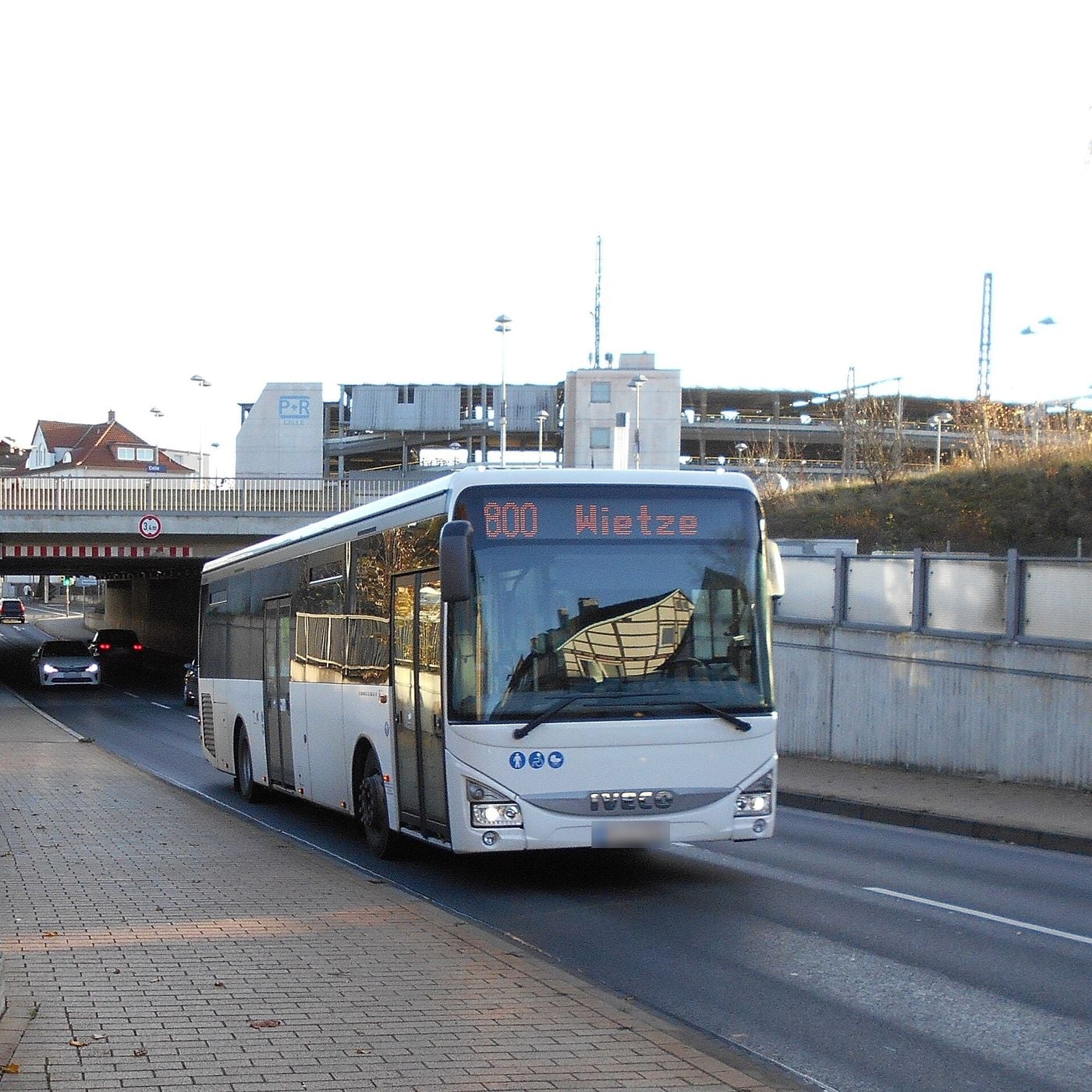
Iveco Crossway LE
Iveco Bus's low-entry Crossway in City and Line versions from 10.8 to 14.5 m, with Tector 7 and Cursor 9 diesel, natural-gas, 48 V hybrid and battery-electric drivelines.
- 210–265 kW

Model overview
- Segment
- Bus
- Transmission
- 2 automatic gearboxes (not named in the brochure)
- Battery capacity
- 346–485 kWh
- Range
- 400 km
- Electric motor
- 290 kW peak · 1×
- Doors
- City: two or three doors
Engine families
- Power
- 210–228 kW
- Power
- 265 kW
- Power
- 265 kW
The Crossway LE, in full Crossway Low Entry, is Iveco Bus’s low-entry bus for city and intercity service. Iveco calls it “The universal bus”. The floor is low between the front and middle doors, and the product page describes the power train as “based on the proven CROSSWAY normal-floor vehicle”, the bus described on the Iveco Crossway page. The brochure lists two versions, City and Line; four lengths, 10.8 m, 12 m, 13 m and 14.5 m, the last with three axles; and six drivelines: full electric, Tector 7 diesel, Cursor 9 diesel, Cursor 9 CNG, hybrid diesel and hybrid CNG.
This page is built from five Iveco documents, all read on 9 November 2026: the English Crossway Low Entry brochure, footed “PUBLICATION CROSSWAY LE_EN 02/25”; the Crossway Low Entry and Crossway product pages on Iveco Bus’s worldwide site, both undated; the French data sheet “LINE 12/13 m – ELEC – MY2024” for the electric Line, document code DTCWLEELEC0224; and the Iveco Group press release of 3 December 2024 on the normal-floor Crossway ELEC. No document opened gives a launch date, earlier generations, an emission class, the displacement or torque of the combustion engines, the names of the gearboxes, a wheel formula, or a full set of dimensions and weights for any version other than the electric Line.
Versions, lengths and drivelines
The product page describes the City version as “Designed primarily for urban traffic, but also suitable for suburban routes”, with barrier-free access through the lowered floor between the front and middle doors and a manual wheelchair ramp as standard; the brochure lists it in two- and three-door versions. The Line version is for short and medium-range transport, and the product page names internal luggage racks and reclining seats among its options and ESP as standard. Either version can be fitted with manual or electric ramps and a dedicated internal area for disabled passengers, the subject of bus accessibility. The brochure gives “up to 1200 possible configurations” and doors that are operated electrically or pneumatically.
| Version and length | Diesel | Natural gas | Hybrid | Electric |
|---|---|---|---|---|
| City 10.8 m | Tector 7 (210 or 228 kW), Cursor 9 | — | Cursor 9 Diesel / XTL | — |
| City 12 m | Tector 7 (210 or 228 kW), Cursor 9 | Cursor 9 Natural Gas | Cursor 9 Diesel / XTL, Cursor 9 Natural Gas | 346, 416 or 485 kWh |
| City 13 m | Tector 7 (210 or 228 kW), Cursor 9 | — | Cursor 9 Diesel / XTL | 346, 416 or 485 kWh |
| City 14.5 m | Cursor 9 | — | Cursor 9 Diesel / XTL | — |
| Line 10.8 m | Tector 7 (228 kW), Cursor 9 | — | Cursor 9 Diesel / XTL | — |
| Line 12 m | Tector 7 (228 kW), Cursor 9 | Cursor 9 Natural Gas | Cursor 9 Diesel / XTL, Cursor 9 Natural Gas | 416 or 485 kWh |
| Line 13 m | Tector 7 (228 kW), Cursor 9 | Cursor 9 Natural Gas | Cursor 9 Diesel / XTL, Cursor 9 Natural Gas | 416 kWh |
| Line 14.5 m | Cursor 9 | — | Cursor 9 Diesel / XTL | — |
The product page counts the range differently, as “City & Intercity versions, 4 lenghts and 3 drivelines availability”. It presents the three-axle Crossway LE for city and intercity missions “such as line operations on regional / national roads requiring significant passenger capacity” and gives its turning circle as 23.8 m.
Engines and gearboxes
The combustion engines are Iveco’s Tector 7 and Cursor 9. The brochure lists the Tector 7 and the Cursor 9 for “Diesel / HVO / XTL” and a natural-gas Cursor 9 for CNG or biomethane; HVO is described in what is HVO fuel.
| Engine | Fuel | Output |
|---|---|---|
| Tector 7 | Diesel, HVO, XTL | 210 kW (286 hp) or 228 kW (320 hp) |
| Cursor 9 | Diesel, HVO, XTL | 265 kW (360 hp) |
| Cursor 9 Natural Gas | CNG or biomethane | 265 kW (360 hp) |
| Cursor 9 Diesel / XTL, hybrid | Diesel, XTL | 265 kW (360 hp) |
| Cursor 9 Natural Gas, hybrid | CNG, biomethane | 265 kW (360 hp) |
The brochure’s summary page lists “Electric, CNG, HYBRID and HI-SCR engines” and “2 automatic gearboxes”, and names neither gearbox. Its natural-gas section calls the engine the “Cursor 9 NP/360 hp”.
Hybrid
The brochure describes the Crossway LE Hybrid’s system in one sentence: “The hybrid system mainly consists of a 48 V battery and a 35 kW generator connected to the gearbox.” A control unit manages it, and the brochure’s drawing adds a 24/48 V converter. The system assists the engine when the bus accelerates, recovers energy when it brakes and stops the engine at standstill, which Iveco calls Stop&Start. Iveco claims “Up to 16% reduction in CO2 emissions”. The brochure lists the hybrid range as the 10.8, 12, 13 and 14.5 m buses with the Cursor 9 diesel engine, “XTL compatible, available in Class I and II”; the 12 m Class I bus with a Cursor 9 Natural Gas engine, biomethane compatible; and 12 and 13 m Class II natural-gas versions. Class I and Class II are the bus classes explained in bus classes.
Natural gas
In the CNG bus, the brochure says, “the patented integrated gas tanks have been integrated into the roof space”; it gives the height as 3,210 mm from wheel to roof and states that the maximum internal headroom remains “identical to a Crossway coach”. Its summary page gives the same height, “3,21”, for both the diesel and the CNG versions. Iveco states that with natural gas “particle levels are close to zero and NOx emissions are reduced by more than one third”, and that the biomethane version has its emissions “reduced by up to 95%”; the product page attributes the 95% to CO2.
Crossway LE ELEC
The brochure says that the Crossway LE ELEC “is available in 12 m and 13 m long versions in its city variant (Class I) and will also be available in an intercity version (Class II)”. In its December 2024 release on the normal-floor Crossway ELEC, Iveco Group refers to “the already available Low Entry version” and gives the new model an electric powertrain “identical to that of the Low Entry ELEC model”.
The bus has a central electric motor, a Siemens unit in the brochure’s table, with an output of 290 kW and a maximum torque of 3,000 Nm, and NMC lithium batteries assembled by FPT. Five, six or seven packs, distributed between the roof and the rear compartment, give 346, 416 or 485 kWh in the Class I version and 416 or 485 kWh in the Class II version. The brochure gives a depot charge of 5 hours through an individual CCS Combo 2 socket, an optional pantograph, ascending or descending, and a range of “around 400 km”. Pantograph charging is described in opportunity charging and pantographs. The brochure’s component drawing shows a 7.5 t front axle and an air-conditioning unit with an integrated compressor.
| City 12 m (Class I) | City 13 m (Class I) | Intercity 12 m (Class II) | Intercity 13 m (Class II) | |
|---|---|---|---|---|
| Motor | Siemens central motor, 290 kW | Siemens central motor, 290 kW | Siemens central motor, 290 kW | Siemens central motor, 290 kW |
| Traction batteries (FPT) | 346, 416 or 485 kWh | 346, 416 or 485 kWh | 416 or 485 kWh | 416 kWh |
| Charging | CCS c2 plug, pantograph | CCS c2 plug, pantograph | CCS c2 plug, pantograph | CCS c2 plug, pantograph |
| Max. seats | 42 + 2 | 48 + 2 | 42 + 2 | 48 + 2 |
| Doors | 2, electric | 2, electric | 2, electric | 2, electric |
The electric Line data sheet
Iveco Bus France’s sheet “LINE 12/13 m – ELEC – MY2024”, headed “CROSSWAY LE ELEC Classe II”, gives the electric Line in two lengths.
| 12 m | 13 m | |
|---|---|---|
| Length | 12,050 mm | 12,965 mm |
| Width | 2,550 mm | 2,550 mm |
| Height, overnight charging / pantograph | 3,422 / 3,470 mm | 3,422 / 3,470 mm |
| Wheelbase | 6,030 mm | 6,945 mm |
| Overhang, front / rear | 2,725 / 3,295 mm | 2,725 / 3,295 mm |
| Track, front / rear | 2,068 / 1,814 mm | 2,068 / 1,814 mm |
| Interior height, front / rear | 2,265 / 2,080 mm | 2,265 / 2,080 mm |
| Access height, front / middle door | 320 / 330 mm | 320 / 330 mm |
| Door width, front / middle | 800 / 1,200 mm | 800 / 1,200 mm |
| Turning radius between kerbs | 8,870 mm | 10,070 mm |
| Inner turning radius | 3,910 mm | 4,700 mm |
| Turning radius between walls | 10,720 mm | 11,930 mm |
| Approach / departure angle | 7° / 7° | 7° / 7° |
| Gross vehicle weight | 17,900 kg | 17,900 kg |
| Max. front / rear axle load | 7,500 / 12,500 kg | 7,500 / 12,500 kg |
| Seats | 44, or 42 + 1 wheelchair place | 50, or 48 + 1 wheelchair place |
The sheet prints the height row under the label “Hauteur H.T. (sans / avec AC)” with its two values marked “charge de nuit” and “pantographe”, and adds standing places to both seat counts under the note “Calcul de répartition des charges obligatoire”. The motor is a Siemens synchronous motor of the ELFA 3 series, given as “310 kW / ECE R85 290 kW” under “PUISSANCE (max / peak)”, 185 kW for 30 minutes at 1,150 rpm, a nominal torque of 1,536 Nm at 1,150 rpm and a maximum torque of 3,000 Nm; the traction motor also acts as the retarder. The standard battery is seven liquid-cooled FPT NMC packs of 485 kWh, homologated to R100.03, with six packs of 416 kWh as the option. The CCS Combo 2 socket sits at the rear on the right side; sockets at the front over the wheel arches and a 450 A pantograph fast charge are options.
The rear axle is a Meritor U17X with single central reduction and a ratio of 6x37 (6.17); the front axle is an R175E with independent wheels, and steering is electrically assisted. The suspension is fully electro-pneumatic with level correction: two air bellows, two dampers, an anti-roll bar and one levelling valve at the front, and four air bellows, four dampers, an anti-roll bar and two levelling valves at the rear, with a raising and kneeling system. An electric air compressor works at 11 bar. The pneumatic brakes have ABS, ASR, EBS, AFU and ESP, disc brakes front and rear with floating calipers, and a pneumatic parking brake with two spring cylinders on the rear wheels. Tyres are 275/70 R 22.5.
The body is a welded steel structure with moulded composite front and rear faces and cataphoretic dip anti-corrosion protection. The front door is an electric sliding door of 800 mm with one leaf and the middle door an electric sliding door of 1,200 mm with two leaves; a 1,200 mm two-leaf front door is an option. Inside are fixed Lineo cantilever seats with 2-point belts, a flat floor in the front area, two seats for passengers with reduced mobility and one wheelchair place, an electric wheelchair ramp, with a manual ramp as the option, and passenger luggage racks. The sheet lists full-LED headlights with fog lamps and dynamic bending lights, roof air conditioning, a 30 kW all-electric autonomous pre-heater, an air-suspended ISRI NTS2 driver’s seat with a 3-point belt, a movable VDV dashboard, a 7-inch colour screen, cruise control, a Draeger alcohol interlock and the Smart Pack data interface. It declares conformity with annex 8 of regulation R107 and with annex 11, and with “GSR B - 2019/2144”, the General Safety Regulation (EU) 2019/2144: right-side blind-spot monitoring (BSIS), front blind-spot monitoring (MOIS), a rear camera (REV), speed-limit information from road signs (ISA), drowsiness warning (DDAW), preparation for an alcohol interlock (ALC), tyre pressure monitoring (TPMS), the emergency stop signal (ESS) and cyber security; left-side blind-spot monitoring is an option.
Driver’s area
The brochure describes a redesigned dashboard with new controls close to the driver, steering-wheel controls for the main functions, and a fully coloured 7-inch display cluster showing the Driving Style Evaluation, engine oil level, gearbox information and the speed set for cruise control. Dashboard commands can be customised, and the brochure lists storage space, charging plugs, a double USB socket and a cup and bottle holder. Its summary page calls the driver area “VDV compliant”, and a footnote reads “VDV options available for Crossway Low Entry, city and intercity versions, all lengths”; the brochure’s drawing shows a waterproof central climate control positioned according to VDV/EBSF, a rotating seat, a bag space integrated in the driver’s door and a space for the operator’s system terminal. The product page adds radio controls on the steering wheel and a single integrated panel for the climate in the driver area and passenger compartment and for the independent heating.
Safety and driver assistance
The product page lists brake control with ABS and ASR, and ESP. It states that the vehicle, its structure and components undergo cathodic dip coating against corrosion, and gives “Compliance with Regulation R66/02 with a reinforced structure in case of vehicle rollover”, the rollover test described in UN Regulation No 66.
According to the brochure, the new front face hosts four assistance systems: BSIS, the Blind Spot Information System; MOIS, the Moving Off Information System; ISA, the Intelligent Speed Assistant; and DDAW, Driver Drowsiness Attention Warning. A radar in the front face and a camera behind the windscreen detect “Vulnerable Road Users approaching frontally and from lateral directions, as well as road signals”, and a light sensor in the camera switches the headlights on automatically. The product page names blind-spot recognition, collision warnings for pedestrians and cyclists, tyre pressure monitoring, preparation for an alcohol testing device and on-board cybersecurity among the technologies of the General Safety Regulation, whose list is set out in mandatory driver assistance systems.
Connectivity
The brochure states that “The Smart Pack is included as a series equipment in all IVECO BUS heavy range vehicles”, giving access to the IVECO ON customer portal with fleet dashboards and Driving Style Evaluation and to control-room reports including a traction battery report for electric buses; the brochure also describes the IVECO Easy Bus app, with over-the-air software updates. The TiGR Web API, specified by the European ITxPT association, delivers the fleet data to an operator’s own systems, and an optional Premium Pack adds fleet management by ChargePoint, including monitoring of charging stations and smart charging.
Production and sales
Iveco Group’s December 2024 release says that the new Crossway ELEC “will be produced at the Vysoke Myto plant in the Czech Republic”, “Like the other models in the CROSSWAY range”. The Crossway LE product page states that “The CROSSWAY has already sold nearly 33,000 units since its launch more than 10 years ago”; Iveco’s worldwide Crossway page gives “more than 50.000 units sold so far” for the Crossway.
Source notes
The grid gives the engines and the height Iveco’s 02/25 brochure gives for the diesel and natural-gas versions, 3,210 mm, and the electric drive of the City ELEC (Class I). The brochure prints the Tector 7 at 210 kW (286 hp) and 228 kW (320 hp), the second rating alone on the Line, and the Cursor 9 at 265 kW (360 hp) as a diesel, as a natural-gas engine and in both hybrids. The hybrid adds a 48 V battery and a 35 kW generator connected to the gearbox. The City ELEC has a Siemens central motor of 290 kW and 3,000 Nm and FPT NMC batteries of 346, 416 or 485 kWh in five, six or seven packs; the brochure gives a depot charge of 5 hours through a CCS Combo 2 socket and a range of around 400 km. The electric Line (Class II), which the brochure says “will also be available”, has a French MY2024 data sheet: 12,050 or 12,965 mm long, 2,550 mm wide, 3,422 mm high for overnight charging and 3,470 mm with a pantograph, on wheelbases of 6,030 and 6,945 mm, with a gross vehicle weight of 17,900 kg, axle loads of 7,500 kg front and 12,500 kg rear, a Meritor U17X rear axle at 6.17, tyres 275/70 R 22.5, and 485 kWh in seven packs as standard with 416 kWh in six as the option. Iveco’s documents disagree in four places: the motor is 290 kW in the brochure and “310 kW / ECE R85 290 kW” on the French sheet; the electric Line seats 42 + 2 and 48 + 2 in the brochure and “44 places ou 42 + 1UFR” and “50 places ou 48 + 1UFR” on the sheet; the brochure counts six drivelines and the product page “3 drivelines”; and the product page gives “nearly 33,000 units” sold for the Crossway while the worldwide Crossway page gives “more than 50.000”. No document opened gives a launch date, earlier generations, an emission class, the displacement or torque of the combustion engines, the names of the gearboxes or a wheel formula.
Quick answers
- Which engines are available in the Iveco Crossway LE?
- The record for the Iveco Crossway LE covers these engine families: IVECO Tector 7, IVECO Cursor 9, IVECO Cursor 9 Natural Gas. Output spans 210–265 kW.
- Which transmission does the Iveco Crossway LE use?
- Transmission: 2 automatic gearboxes (not named in the brochure).
- What battery capacity does the Iveco Crossway LE have?
- Battery capacity: 346–485 kWh; Range: 400 km.
More Iveco on this site
Sources
- CROSSWAY Low Entry — brochure (PUBLICATION CROSSWAY LE_EN 02/25) — Iveco Bus
- CROSSWAY Low Entry — versatile city & intercity transport (product page, Iveco Bus worldwide) — Iveco Bus
- CROSSWAY LE ELEC Classe II — LINE 12/13 m – ELEC – MY2024 (fiche technique, DTCWLEELEC0224) — Iveco Bus France
- CROSSWAY — intercity vehicle designed for interurban roads (product page, Iveco Bus worldwide) — Iveco Bus
- European premiere: unveiling of the IVECO BUS CROSSWAY ELEC, a powerful new solution to decarbonize the intercity mobility — Iveco Group, 3 Dec 2024