Solaris
Solaris Urbino 18 hydrogen
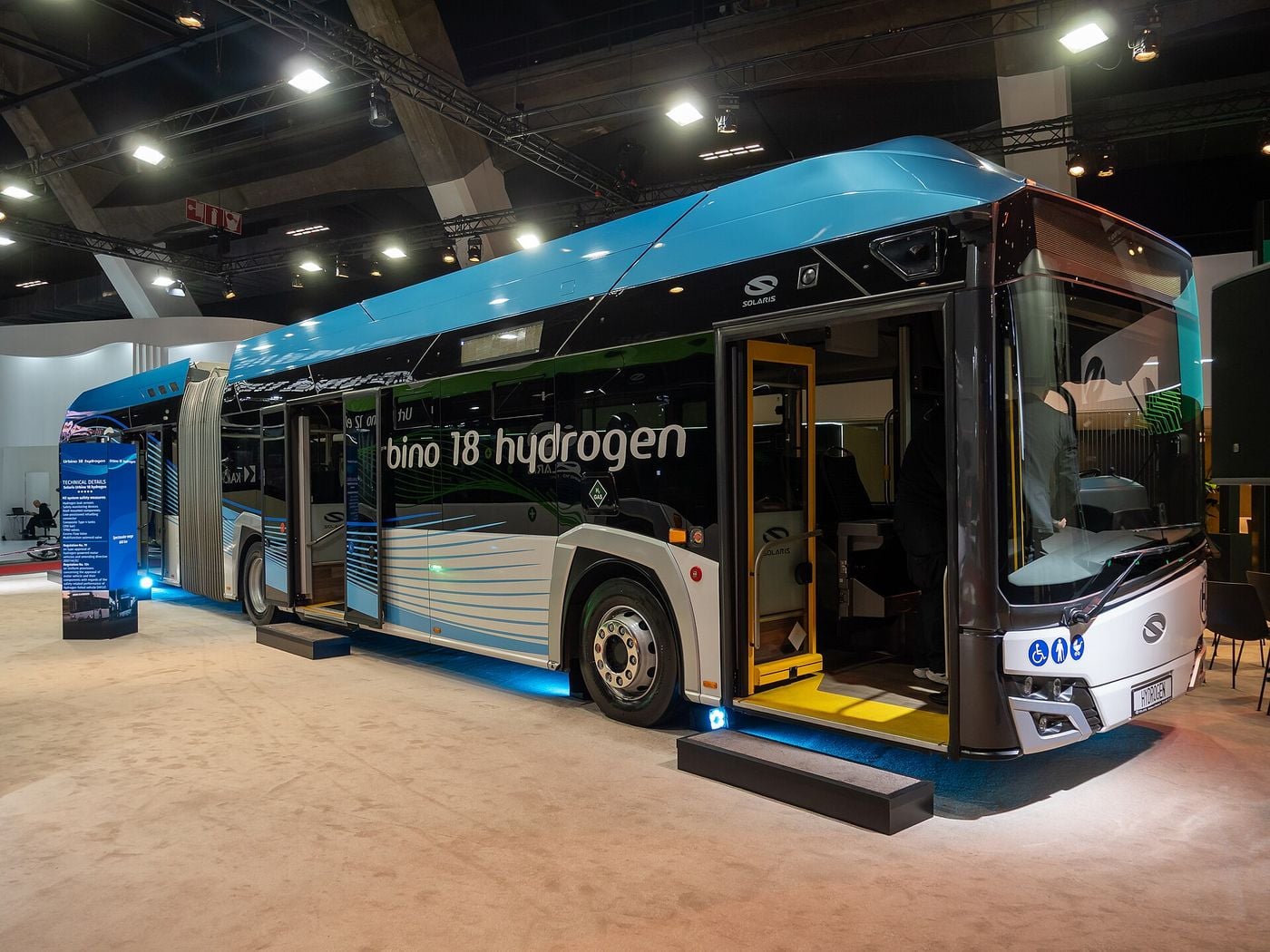
Solaris's 18-metre articulated fuel-cell city bus: a 100 kW Ballard fuel cell, 51.2 kg of hydrogen at 350 bar, a 60 kWh LTO battery, a 240 kW motor and up to 140 passengers.
- 240 kW
- 18 m
- 29 t

Model overview
- Segment
- Bus
- Transmission
- Modular drive, SiC technology; drive axle ratio i = 9.8
- Gross vehicle
- 29 000 kg
- Battery capacity
- 60 kWh
- Electric motor
- 240 kW · 240 kW peak
- Fuel cell
- 100 kW · Ballard
- Hydrogen tank
- 51.2 kg · gaseous
- Storage pressure
- 350 bar
- Range on hydrogen
- 600 km
- Length
- 18 000 mm
- Capacity
- Up to 52 (up to 18 low floor seats) + Up to 88
- Doors
- 2-2-2-2
The Urbino 18 hydrogen is an 18-metre articulated city bus from Solaris whose electric drive is powered by electricity generated from a hydrogen fuel cell, with a battery of around 60 kWh as an auxiliary power source. Solaris unveiled it on 14 September 2022. This page is built from four Solaris documents in English, all read on 8 November 2026: the model’s product page on solarisbus.com; the technical data sheet that page links as “download full specification”, headed “Bus of the Year 2025”, with no printed date or market and file properties dated 11 September 2024; Solaris’s overview page for its hydrogen buses; and the press release of 23 September 2026 on the Sustainable Bus Award 2027.
Unveiling, awards and the next generation
Solaris’s hydrogen overview page dates the unveiling: “On 14 September 2022 Solaris unveiled its Urbino 18 hydrogen bus.” The same page says the bus has no conventional engine compartment because it is equipped with a modular drive system, and that the space saved allowed Solaris to increase the passenger capacity; depending on the configuration, the page adds, the bus will be able to carry up to 140 passengers. The page also lists the Urbino 12 hydrogen, whose premiere it places at the UITP event in Stockholm on 9-12 June 2019.
The product page carries the title “Bus of the Year 2025”. It says the International Jury of the Bus of the Year competition gave the Urbino 18 hydrogen that title after the Bus Euro Test, organised by the Association of Commercial Vehicle Editors (ACE) since 1989, and calls it the first hydrogen-powered vehicle to win the award in the competition’s history. In 2017, the page adds, the title went to the battery-powered Urbino 12 electric.
Solaris’s press release of 23 September 2026 reports that the next-generation Urbino 18 hydrogen won the Sustainable Bus Award 2027 in the Urban category, presented at the FIAA trade fair in Madrid. The release describes it as “a zero-emission, low-floor articulated city bus powered by hydrogen” and says the jury recognised its electric driveline, passenger capacity and short refuelling time, and praised its accessibility and passenger-comfort solutions and its safety systems. In the two previous editions, according to the release, the award went to the Urbino 10,5 electric and the Urbino 12 electric. The release gives no technical figures, and no document opened says whether the bus on the data sheet is the one it calls next-generation.
Fuel cell
The data sheet gives the fuel cell as a “BALLARD FCmove HD+” with a rated power of 100 kW, a maximum efficiency of 57% and an estimated lifetime of the product of “>30,000 hours of operation”. It lists a cold start “From -25°C (no need for preconditioning and external power supply)” and operation in temperatures from -30°C to +50°C. The sheet’s component drawing, captioned “Solaris Urbino 18 hydrogen – layout of components”, labels the unit “FUEL CELL INCL. RADIATOR”.
The product page describes the fuel cell as acting as “a miniature hydrogen power plant”: hydrogen is transformed by the fuel cell into electricity, which is then transferred to the driveline, and the only product of the reaction aside from electricity is water. In a quotation on the same page, Solaris’s CTO Dariusz Michalak says that “the small number of batteries and the increased power of the fuel cell” allow the bus to operate efficiently even when carrying 140 passengers. How fuel-cell buses are built in general is set out in hydrogen fuel-cell buses and coaches.
Hydrogen tanks, refuelling and range
The data sheet lists Type IV composite hydrogen tanks with a nominal working pressure of 350 bar and a capacity of “2,142 l, 51.2 kg (at 350 bar and 15oC)”. The refuelling connector is placed “Over the right 1st wheelarch (on both sides as an option)”. The product page gives the “light hydrogen tanks” a total capacity of 51.2 kg, and the overview page refers to “an increased number of new, light hydrogen tanks”; no document opened gives the number of tanks. The product page puts a full refuelling at “only about 20 minutes”, the overview page at “around 20 minutes”.
The documents give different ranges. The product page gives “> 600 km range” and says the bus “can cover 600 km on a single refill (based on energy consumption in e-SORT 2 tests)”; the cover of the data sheet prints “>600 km range”. The overview page, in its Urbino 18 hydrogen section, which opens with the 2022 unveiling, says the bus “will be able to cover about 350 km on a single refill in various weather conditions”.
Battery
The data sheet lists the batteries as Solaris High Power, with LTO cell chemistry, placed on the roof, with a total capacity of 60 kWh. The product page gives “around 60 kWh” and describes the batteries as an auxiliary power source, used, for example, during acceleration and for energy storage; the overview page gives the same capacity and adds “a storage for recovered energy”. The component drawing labels the batteries “TRACTION BATTERIES SOLARIS HIGH POWER” and, as a separate unit next to the fuel cell, a “BTMS”. No document opened says whether the 60 kWh is installed or usable energy; the difference is explained in installed vs usable battery capacity.
Electric motor and drive
The data sheet’s drive rows read: drive “Modular drive, SiC technology”; motor 240 kW; continuous power 240 kW; peak power “240 kW (electronically limited)”; continuous torque 1,470 Nm; peak torque 2,100 Nm. The row headed “Arrangement to front axle” reads “Rear mounted motor, left side”. The component drawing labels a “CENTRAL MOTOR” and, under “MODULAR DRIVE”, a braking resistor, a DC/DC converter, an HV box and a traction inverter.
The product page says the vehicle is designed without a conventional engine compartment, its modular drive system having components placed on the roof and at the rear of the vehicle, and that the arrangement maximises passenger capacity and provides flexibility in roof arrangement options. How city-bus drivelines are arranged is set out in city bus propulsion.
Axles, suspension and steering
Under “Chassis” the data sheet lists the front axle as “Independent, with stabilizer”, the rear axle as “Drive axle, ratio i = 9.8”, pneumatic suspension, a stabilizer on the front axle and a maximum internal steering angle of “45.5° +0° -0.5°”. The chassis rows name a front axle and a rear axle; the sheet’s side-view drawing shows three axles. No document opened gives an axle make, the brakes, the tyre size or a list of driver-assistance systems.
Dimensions and weight
| Row | Data sheet |
|---|---|
| Length | 18,000 |
| Width | 2,550 |
| Height | 3,300 |
| Front end to first axle | 2,700 |
| First to second axle | 5,900 |
| Second to third axle | 6,000 |
| Third axle to rear end | 3,400 |
| Entrance height | 320/320/320 |
| Interior headroom | Max 2,280 |
| Turning radius | Min. 11,475 |
| Gross vehicle weight | 29,000 kg |
The length, width, height and the four distances along the side come from the sheet’s dimension drawing, which gives the distances without labels; they add up to the printed length: 2,700 + 5,900 + 6,000 + 3,400 = 18,000. The front view of the drawing also marks 320 mm. The other rows are from the sheet’s table. No document opened gives a kerb weight or axle loads. How bus lengths and weights are set in the rules is covered in bus and coach dimensions.
Doors, seats and capacity
The data sheet gives up to 52 seats, up to 18 of them low floor seats, up to 88 standing places and a total capacity of up to 140. The door layout is 2-2-2-2, the doors at least 1,200 mm wide with an electric drive; the first door is an inward-gliding door (“IG (Inward Gliding)”) and the second to fourth are plug-sliding doors (“PS (Plug Sliding)”). The driver’s seat is a “Seat with integrated headrest and seatbelt”. The product page and the overview page give up to 140 passengers depending on the configuration. No document opened states the bus’s class under UN Regulation No 107; the classes are set out in bus classes.
Climate control
The data sheet lists air-conditioning by “2 x CO2 heat pump”, with CO2 as the refrigerant and the driver’s workspace air-conditioned by the AC of the passenger space. It gives the cooling and heating capacity as “2 x 25 kW (cooling) + 2 x 21 kW (max heating) / Heating: 37 kW (electric heater)”, and the auxiliary heating as an electric heater (boiler) that “acts as a support, heating is mainly done by heat pump”.
Source notes
The figures above are the Solaris data sheet headed “Bus of the Year 2025”, linked from the product page as the full specification, with no printed date or market; its file properties are dated 11 September 2024. It gives a 100 kW Ballard FCmove HD+ fuel cell with a maximum efficiency of 57%, an estimated lifetime of more than 30,000 hours of operation, a cold start from -25°C and operation from -30°C to +50°C; Type IV composite hydrogen tanks with a nominal working pressure of 350 bar holding 2,142 l, 51.2 kg at 350 bar and 15°C, with the refuelling connector over the right first wheel arch (on both sides as an option); Solaris High Power LTO batteries of 60 kWh on the roof; a modular drive with SiC technology and a rear-mounted motor on the left side, 240 kW continuous and 240 kW peak (electronically limited), with 1,470 Nm continuous and 2,100 Nm peak torque; an independent front axle with stabiliser, a drive axle with a ratio of i = 9.8, pneumatic suspension and a maximum internal steering angle of 45.5° (+0°, -0.5°). Its drawing gives a length of 18,000 mm, a width of 2,550 mm, a height of 3,300 mm, 320 mm at the entrance and, front to rear, 2,700, 5,900, 6,000 and 3,400 mm between the ends of the bus and its three axles. Its table gives a minimum turning radius of 11,475 mm, a maximum interior headroom of 2,280 mm, up to 52 seats (up to 18 of them low floor seats), up to 88 standing places, a total capacity of up to 140, a 2-2-2-2 door layout with doors at least 1,200 mm wide, and two CO2 heat pumps giving 25 kW of cooling and up to 21 kW of heating each, supported by a 37 kW electric heater. Range differs by document: the product page and the sheet’s cover give more than 600 km, the product page basing its 600 km on energy consumption in e-SORT 2 tests, while Solaris’s hydrogen overview page gives about 350 km on a single refill in various weather conditions. Both pages give a full refuelling time of about 20 minutes and a battery of around 60 kWh. Solaris’s release of 23 September 2026 reports that the next-generation Urbino 18 hydrogen won the Sustainable Bus Award 2027 in the Urban category, and gives no technical figures. No document opened gives a wheel formula, a kerb weight, axle loads, an axle make, the brakes, the tyre size, a usable battery capacity, the number of hydrogen tanks or a UN Regulation No 107 class.
Quick answers
- Which transmission does the Solaris Urbino 18 hydrogen use?
- Transmission: Modular drive, SiC technology; drive axle ratio i = 9.8.
- What is the gross vehicle weight of the Solaris Urbino 18 hydrogen?
- Gross vehicle weight: 29 000 kg.
- What battery capacity does the Solaris Urbino 18 hydrogen have?
- Battery capacity: 60 kWh.
- How long is the Solaris Urbino 18 hydrogen?
- Length: 18 000 mm.
- How many passengers does the Solaris Urbino 18 hydrogen carry?
- Capacity: Up to 52 (up to 18 low floor seats); Standing places: Up to 88.
Articles that mention the Solaris Urbino 18 hydrogen
More Solaris on this site
Sources
- Solaris Urbino 18 hydrogen — technical data sheet headed "Bus of the Year 2025" (linked from the product page as "download full specification") — Solaris Bus & Coach
- Urbino 18 hydrogen | Bus of the Year 2025 — Solaris Bus & Coach
- Hydrogen — Urbino 18 hydrogen and Urbino 12 hydrogen — Solaris Bus & Coach
- Solaris Urbino 18 hydrogen next generation wins the Sustainable Bus Award 2027 — Solaris Bus & Coach, 23 Sept 2026