Solaris
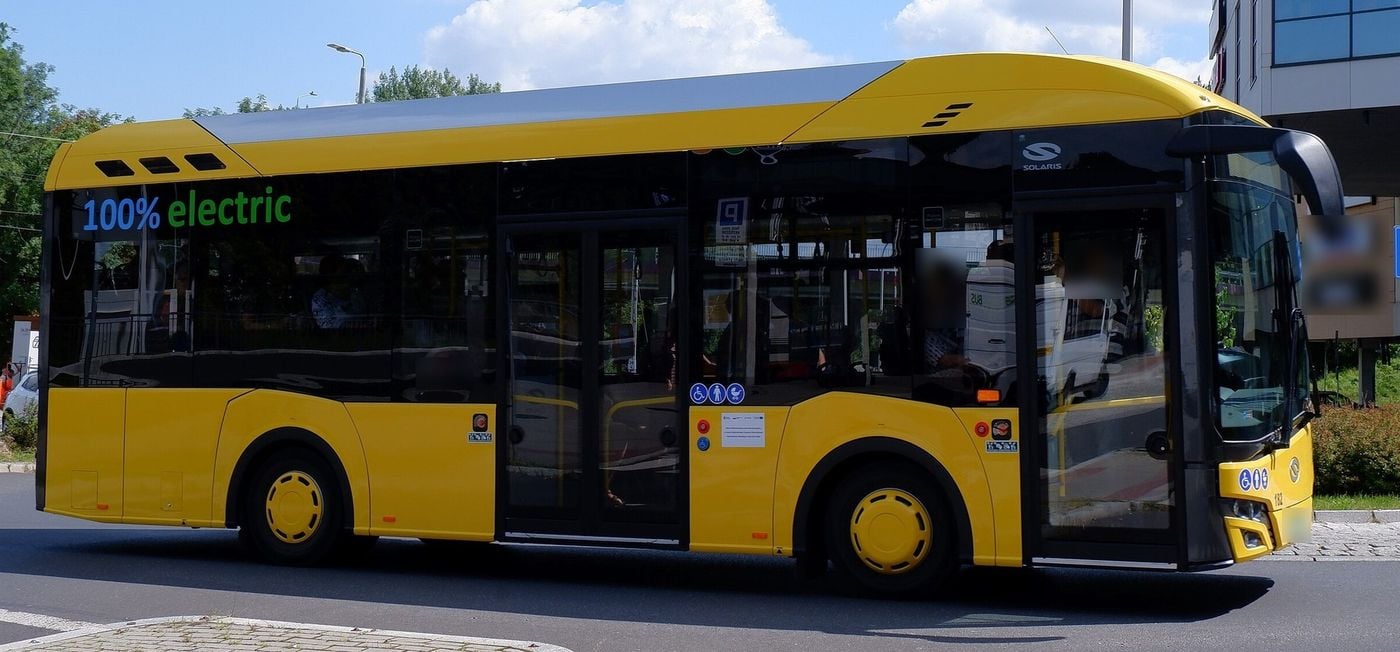
Solaris Urbino 9 LE electric
Solaris's 9,270 mm battery-electric midi-class bus: a central traction motor of 220 kW maximum power, up to 350 kWh, up to 73 passengers, dimensions and equipment.
- 2021—
- 9.27 m
- 16 t

Model overview
- Segment
- Bus
- Produced
- 2021—
- Transmission
- Central traction motor; drive axle G150
- Gross vehicle
- 16 000 kg
- Battery capacity
- 350 kWh
- Electric motor
- 220 kW peak
- Length
- 9 270 mm
- Wheelbase
- 4 480 mm
- Capacity
- Up to 27 seats (max. 31 in II class)
- Doors
- 1-2
The Urbino 9 LE electric is a battery-electric two-axle bus from Solaris, 9,270 mm long. Solaris’s press release of 14 February 2025 calls it “a fully zero-emission midi-class vehicle” and says it has been available on the market since 2021. This page is built from three Solaris documents in English, all read on 9 November 2026: a two-page technical details sheet headed “Solaris Urbino 9 LE electric”, whose file properties are dated 29 September 2021 and which is filed in a Solaris press-office folder dated 30 September 2021; the press release of 14 February 2025 on the model’s first order from the Nordic region; and Solaris’s “Urbino electric” product page. The sheet prints no date and no market.
Market launch and model family
According to the release of 14 February 2025, the Urbino 9 LE electric had by then been chosen by several dozen customers in Poland, Germany, the Czech Republic, Spain, Austria, Romania, Switzerland and Italy. The same release reports an order from Vy Buss, which Solaris describes as Norway’s largest bus operator, for three Urbino 9 LE electric buses to serve routes in Slemmestad, a suburban district of Oslo, with deliveries scheduled for July 2025; Solaris calls it the first order for its 9-metre battery-electric buses from the Nordic region. The buses for Vy Buss, the release says, will be equipped with the so-called Scandinavian package, which includes additional thermal insulation, a snow chain drawer and special anti-elk lights designed to deter wild animals from entering the road. The release also describes the model as the shortest in Solaris’s portfolio.
Solaris’s “Urbino electric” product page lists the Urbino 9 LE electric beside the Urbino 10,5 electric, the Urbino 12 electric, the Urbino 18 electric, the Urbino 15 LE electric and the Urbino 24 electric. Among its videos is one titled “Urbino 8,9 LE electric and its successor Urbino 9 LE electric”. No document opened gives the dates or the technical data of the Urbino 8,9 LE electric.
Electric motor and axles
The technical details sheet gives a “Central traction motor (maximum power 220 kW)”. No document opened gives a continuous power, a torque figure or the maker of the motor. How a battery-electric city bus is built and charged is set out in electric buses explained.
Under “Axles” the sheet lists “Front: RL 55EC” and “Drive: G150”, without naming an axle maker; its first row describes the vehicle as a “Full electric 2 axle bus”. Under “Wheels” it gives “265/70/19,5 (285/70/19,5 II class)”. No document opened gives the suspension, the steering or the brakes.
Dimensions and weights
| Row | Technical details sheet |
|---|---|
| Length | 9,270 |
| Width | 2,450 |
| Height | 3,300 (3,315 II class) |
| Wheelbase | 4,480 |
| Front overhang | 2,200 |
| Rear overhang | 2,590 |
| Minimum turning radius | 9,100 |
| VGW | 16 T |
The two overhangs and the wheelbase add up to the printed length: 2,200 + 4,480 + 2,590 = 9,270. “VGW” and “16 T” are the sheet’s own label and unit for the weight. No document opened gives a kerb weight or axle loads. The release of 14 February 2025 refers to the model as Solaris’s “9-meter battery-electric bus”.
Battery and charging
The sheet lists the batteries as “Solaris High Energy (Solaris High Power as an option)” and the battery capacity as “Up to 350 kWh”. It gives one capacity figure and does not say whether it is installed or usable energy; the difference between the two is explained in installed vs usable battery capacity.
Under “Charging” the sheet lists “Plug-in” and “Pantograph”. No document opened gives a range, a charging power, a connector standard or the position of the charging points. How pantograph charging works is set out in opportunity charging and pantographs.
Doors, seats and capacity
The sheet gives the doors as “1-2” and the passenger capacity as “Up to 73 people depending on configuration and equipment”. It gives two seat counts: “Up to 27 seats (including 8 low floor seats) + dedicated space for passengers with disabilities”, and “Max. 31 seats (II class, without dedicated space for passengers with disabilities)”. No document opened gives a standing-passenger figure. Accessibility provisions for buses are set out in bus accessibility.
The sheet’s first row reads “I class (II class as an option)”. The release of 14 February 2025 says the model “complies with both Class I and Class II homologation requirements”. The classes are set out in bus classes.
Climate control
The sheet lists “Air conditioning in the whole vehicle” and, as an option, “AC with CO2 heat pump heating function”.
Driver-assistance systems
Under driver assistance systems the sheet lists “Mirror Eye”, “Mobileye Shield Plus, detects blind spot”, “Dusk and rain sensor (turns up windshields and lights)”, “Automatic corner lightening” and “Touchscreen”.
Source notes
The figures above are the Solaris technical details sheet for the Urbino 9 LE electric, a two-page PDF whose file properties are dated 29 September 2021 and which is filed in a Solaris press-office folder dated 30 September 2021; it prints no market. The sheet describes a full electric two-axle bus, I class with II class as an option, with a central traction motor of maximum power 220 kW, Solaris High Energy batteries with Solaris High Power as an option, a battery capacity of up to 350 kWh, plug-in and pantograph charging, a front axle RL 55EC and a drive axle G150 with no axle maker named, wheels 265/70/19,5 or 285/70/19,5 for II class, a length of 9,270 mm, a width of 2,450 mm, a height of 3,300 mm or 3,315 mm for II class, a front overhang of 2,200 mm and a rear overhang of 2,590 mm, a minimum turning radius of 9,100 mm, a VGW of 16 T, doors 1-2, up to 73 passengers depending on configuration and equipment, and up to 27 seats, including 8 low floor seats, with a dedicated space for passengers with disabilities, or at most 31 seats in II class without that space. The sheet does not say whether the battery figure is installed or usable energy. Solaris’s press release of 14 February 2025 says the model has been available on the market since 2021 and complies with both Class I and Class II homologation requirements. No Solaris document opened gives a continuous motor power, a torque figure, a charging power, a connector standard, a range, a kerb weight, axle loads, a standing-passenger figure, the suspension or the brakes.
Quick answers
- When did production of the Solaris Urbino 9 LE electric start?
- Production of the Solaris Urbino 9 LE electric started in 2021.
- Which transmission does the Solaris Urbino 9 LE electric use?
- Transmission: Central traction motor; drive axle G150.
- What is the gross vehicle weight of the Solaris Urbino 9 LE electric?
- Gross vehicle weight: 16 000 kg.
- What battery capacity does the Solaris Urbino 9 LE electric have?
- Battery capacity: 350 kWh.
- How long is the Solaris Urbino 9 LE electric?
- Length: 9 270 mm; Wheelbase: 4 480 mm.
- How many passengers does the Solaris Urbino 9 LE electric carry?
- Capacity: Up to 27 seats (max. 31 in II class).
More Solaris on this site
Sources
- Solaris Urbino 9 LE electric — technical details (press assets, 30 September 2021) — Solaris Bus & Coach
- Solaris Urbino 9 LE electric debuts in Nordic markets — Solaris Bus & Coach, 14 Feb 2025
- Urbino electric — Solaris Bus & Coach