Solaris
Solaris Urbino 40 & 60 electric
Solaris's battery-electric transit bus for North America, from its September 2026 data sheet: 40 ft and 60 ft articulated, a 230 kW motor, up to 528 or 704 kWh, CCS1 charging.
- 230/300 kW

Model overview
- Segment
- Bus
- Battery capacity
- 528–704 kWh
- Electric motor
- 230/300 kW
- Capacity
- 41 (40 ft) and 50 (60 ft) on the September 2026 data sheet; maximum total passenger capacity 65 and 123
- Doors
- 2-2 (40 ft), 2-2-2 (60 ft)
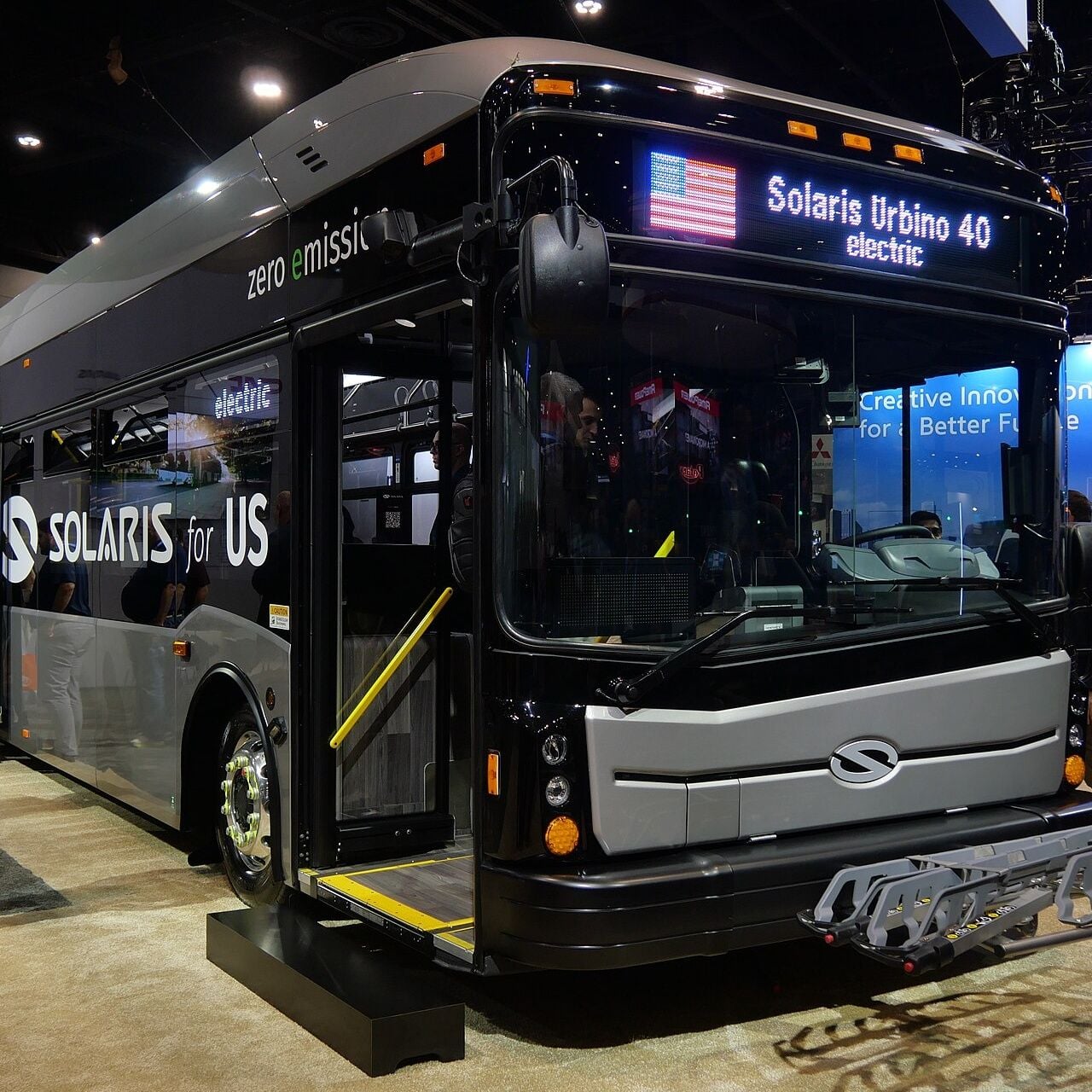
The Urbino 40 electric is a battery-electric transit bus that Solaris developed for the North American market and unveiled at APTA TRANSform & EXPO in Chicago on 5 October 2026. Its data sheet, headed “Urbino 40 & 60 electric”, gives a 60-foot articulated version beside it. This page is built from six Solaris documents in English: the data sheet “Vehicle specifications”, dated September 2026 and issued by Solaris Bus US Inc; the North America page and the Electric page for the North American market on solarisbus.com, both undated and read on 9 November 2026; and three press releases of 28 September, 5 October and 6 October 2026, the last two with the same text. The data sheet gives lengths in feet and inches, heights and overhangs in inches, weights in pounds and motor power in kilowatts; no Solaris document opened gives a millimetre or kilogram figure.
Premiere and North American launch
Solaris’s release of 28 September 2026 announced the premiere for 5 October 2026 and called the Urbino 40 electric “the first bus in the brand’s portfolio designed specifically for the U.S. market”. According to the release of 5 October 2026, Solaris unveiled the bus on the opening day of APTA TRANSform & EXPO, at 3 PM, “marking Solaris’ U.S. debut”. The release gives the show’s dates as October 5 to 7; the North America page gives “October 4 to 7, 2026”. The release of 6 October 2026 repeats the text of 5 October under a heading that adds “New photos & video”.
The North America page says that Solaris offers 40 ft and 60 ft zero-emission buses for the North American market, “developed to meet local requirements, including compliance with FMVSS and ADA standards”, and describes the Urbino 40 electric as “Built on a dedicated electric platform”. The same page says that Solaris manufactures vehicles at the CAF U.S. facility in Elmira, NY; the company boilerplate printed under the three press releases says that “all Solaris buses are produced in Poland”. Solaris has been part of the CAF Group since 2018.
The North America page says that the first deliveries of Solaris battery-electric buses in the United States “will be made” to Seattle and San Francisco; the release of 5 October 2026 names King County Metro Seattle and the San Francisco Municipal Transportation Agency. Both add that Solaris supplies trolleybuses to Vancouver, Canada, where the release names TransLink. No document opened gives a start of series production. Solaris’s battery-electric city buses for Europe have their own pages, among them the Urbino 12 electric.
Electric motor and drive
The data sheet lists a synchronous motor with a maximum power of 230 kW as standard on the 40-foot bus and 300 kW as an option, and “2x 230” kW on the 60-foot bus, whose optional row carries a dash. The Electric page gives the 40-foot bus “a central electric motor” that “enables the vehicle to climb gradients exceeding 20% and reach a top speed of 65 mph”, and the 60-foot bus “Two central electric motors” and a maximum speed of 65 mph. No document opened gives a continuous rating, a torque figure, the motor’s maker or a gearbox.
Axles, suspension, steering and brakes
Under “Chassis components and functional systems” the data sheet lists, as standard on both lengths, a front axle of rigid-beam type, a drive axle described as a “classic axle” and electronic suspension with front kneeling. The 60-foot bus has a third axle, a neutral axle of portal type, which the 40-foot bus does not have. The steering system is listed as “Electric Pump 24V”. The same table lists “No central lubrication point” as standard and a central point with solid lubricating grease as an option. Solaris prints no wheel formula. Both lengths run on 305x70R22.5 tyres.
The braking system rows list an Electronic Braking System (EBS), Automatic Traction Control (ATC), brake pads wear monitoring and Hill Holder as standard on both lengths, and Electronic Stability Control (ESC) as an option.
Dimensions and weights
| Data sheet row | 40-foot bus | 60-foot articulated bus |
|---|---|---|
| Length over body | 40 ft 8 in | 61 ft 0 in |
| Length over bumpers | 41 ft 6 in | 61 ft 10 in |
| Width without mirrors | 102 in | |
| Height with roof charging rails | 135 in | |
| Front overhang, centreline of axle over bumper | 101 in | |
| Rear overhang, centreline of axle over bumper | 113 in | |
| Approach and departure angles | 8.6° and 9° | |
| Tyres | 305x70R22.5 | |
| Entrance height, front door (kneeled / ride) | 10.3 in / 13.6 in | |
| Entrance height, rear doors (kneeled / ride) | 14 in / 14.6 in | |
| Turning radius | 44 ft 0 in | |
| Maximum technically permissible GVWR | 44,753 lb | 70,654 lb |
| Front axle, maximum technically permissible load | 16,093 lb | 16,093 lb |
| Drive axle, maximum technically permissible load | 28,660 lb | 28,660 lb |
| Neutral axle, maximum technically permissible load | none | 25,901 lb |
The sheet prints one figure across both columns for every row from the width to the turning radius, and it gives the height with the roof charging rails fitted. Its weight rows are headed “Maximum technically permissible”; what a gross vehicle weight rating covers in US federal rules is set out in GVWR, GCWR and GAWR explained, and the articulated bus as a type in articulated and bi-articulated buses. No document opened gives a wheelbase or a curb weight.
Battery, charging and range
The data sheet gives a battery capacity of up to 528 kWh for the 40-foot bus and up to 704 kWh for the 60-foot bus. The Electric page says of the 40-foot bus that “Roof-mounted batteries with a capacity exceeding 500 kWh provide a range of over 150 miles”, enabling “full-day route operation without the need for intermediate charging”, and of the 60-foot bus that “batteries with a capacity exceeding 650 kWh provide a range above 150 miles”. No document opened gives a usable capacity or the conditions behind the range figures.
The release of 5 October 2026 describes “a roof-mounted battery system, designed to facilitate demanding daily operations and meet transit agencies’ range requirements”, Solaris-developed solutions for battery integration and vehicle monitoring, and an integrated Battery Thermal Management System (BTMS), which the North America page names as well.
For charging, the data sheet lists a CCS1 plug-in as standard on both lengths, and a “CCS 250A HPC” plug-in and a pantograph with “J3105 roof charging rails” as options. It gives no charging power in kilowatts. SAE J3105 and roof-mounted charging interfaces are described in opportunity charging and pantographs, and the layout of a battery-electric city bus in electric buses explained.
Doors, seats and accessibility
| Item | 40-foot bus | 60-foot articulated bus | Document |
|---|---|---|---|
| Motor, maximum power | 230 kW standard, 300 kW option | 2x 230 kW | Data sheet, September 2026 |
| Battery capacity | up to 528 kWh | up to 704 kWh | Data sheet, September 2026 |
| Battery capacity | exceeding 500 kWh | exceeding 650 kWh | Electric page |
| Range | over 150 miles | above 150 miles | Electric page |
| Top speed | 65 mph | 65 mph | Electric page |
| Maximum seated passengers | 41 | 50 | Data sheet, September 2026 |
| Seats | up to 41, 22 accessible from the low-floor area | up to 51, 33 accessible from the low-floor area | Electric page |
| Maximum total passengers | 65 | 123 | Data sheet, September 2026 |
| Wheelchair spaces | two | two | Electric page |
| Door configuration | 2-2 | 2-2-2 | Electric page |
The data sheet gives the 60-foot bus 50 seats and the Electric page up to 51. The Electric page describes both wheelchair spaces on each length as “fully ADA-compliant”. The data sheet lists a flip-out wheelchair ramp at the first door, electrically operated as standard and hydraulically operated as an option, and gives the entrance height at the front door as 10.3 in kneeled and 13.6 in at ride height, and at the rear doors as 14 in and 14.6 in. For the doors it lists a slide-glide first door and plug-style other doors as standard, slide-glide other doors as an option, an analogue door controller as standard, a digital one as an option, and a voice annunciation system as an option. The release of 5 October 2026 says that “Wide aisles and multifunctional accessible spaces support safe and convenient travel for all passengers”.
Body, glazing and mirrors
The data sheet lists a stainless steel structure and removable side panels as standard, with provision for a bike rack as an option. A one-piece windshield and flush-mount side windows are standard; a two-piece windshield, framed side windows and a heated destination sign window are options. Traditional mirrors, with a low-mount streetside mirror, are standard, and a high-mount streetside mirror and a digital mirrors system are options; mirror replacement systems in general are covered in camera-monitor systems instead of mirrors.
Climate control
Under “Air-conditioning and heating” the data sheet lists conventional air-conditioning with R407c and heating convectors as standard, and air-conditioning with a heat pump, forced-air heating convectors, a secondary electric heater and a ramp heater as options. The North America page and the release of 5 October 2026 call the HVAC system “energy-efficient”.
Safety, driver-assistance and electronic systems
The release of 5 October 2026 says that the bus “features a fully enclosed operator compartment, exterior rear-view cameras, and cornering lights”, with an ergonomic cockpit “designed to ensure driver comfort throughout the workday”. The data sheet lists, under “Assistance Systems”, a collision avoidance system, an exterior rear-view camera, a cornering light function, an automatic refilling coolant system and external speakers as options, and a diagnostics monitor in the rear compartment as standard. Its “Electric and electronic systems” rows list a Continental multiplex system with cybersecurity and interior LED lighting as standard and a blue light behind the operator’s area as an option. The North America page names “advanced driver assistance and vehicle monitoring systems” among Solaris’s own technologies on the bus.
Source notes
Solaris’s data sheet for the Urbino 40 & 60 electric, dated September 2026 and issued by Solaris Bus US Inc, gives the 40-foot and the 60-foot articulated bus side by side, in feet, inches, pounds and kilowatts; no Solaris document opened gives a millimetre or kilogram figure. Length over body 40 ft 8 in and 61 ft 0 in, over bumpers 41 ft 6 in and 61 ft 10 in; one figure for both lengths for the width without mirrors, 102 in, the height with roof charging rails, 135 in, the front overhang, 101 in, the rear overhang, 113 in, the approach and departure angles, 8.6 and 9 degrees, the tyres, 305x70R22.5, the entrance height at the front door, 10.3 in kneeled and 13.6 in at ride height, and at the rear doors, 14 in and 14.6 in, and the turning radius, 44 ft 0 in. Maximum technically permissible GVWR 44,753 lb and 70,654 lb; front axle 16,093 lb and drive axle 28,660 lb on both, and a neutral axle of 25,901 lb on the 60-foot bus only. Synchronous motor, max power 230 kW as standard and 300 kW as an option on the 40-foot bus, 2x 230 kW on the 60-foot bus. Battery capacity up to 528 kWh and up to 704 kWh; plug-in CCS1 as standard, CCS 250A HPC plug-in and a pantograph with J3105 roof charging rails as options. Maximum seated passenger capacity 41 and 50, maximum total passenger capacity 65 and 123. The front axle is a rigid beam and the drive axle a classic axle; the 60-foot bus has a neutral axle of portal type; electronic suspension with front kneeling and an electric pump 24V steering system are standard. The Electric page for the North American market, read on 9 November 2026, gives the 40-foot bus a central electric motor, roof-mounted batteries exceeding 500 kWh, a range of over 150 miles, gradients exceeding 20%, a top speed of 65 mph, up to 41 seats with 22 accessible from the low-floor area, two ADA-compliant wheelchair spaces and a 2-2 door configuration, and the 60-foot bus two central electric motors, batteries exceeding 650 kWh, a range above 150 miles, 65 mph, up to 51 seats with 33 accessible from the low-floor area, two wheelchair spaces and a 2-2-2 door configuration; the data sheet gives the 60-foot bus 50 seats. The North America page dates the world premiere at APTA 2026 TRANSform & EXPO in Chicago to October 4 to 7, 2026, and the press release of 5 October 2026 to October 5 to 7, with the unveiling on 5 October at 3 PM; the release of 28 September 2026 calls the bus the first in the brand’s portfolio designed specifically for the U.S. market. The North America page says Solaris manufactures vehicles at the CAF U.S. facility in Elmira, NY, while the company boilerplate under the press releases says all Solaris buses are produced in Poland. First deliveries are to be made to King County Metro Seattle and the San Francisco Municipal Transportation Agency. The press release describes exterior rear-view cameras and cornering lights on the bus; the data sheet lists both as options. No Solaris document opened gives a wheelbase, a curb weight, a usable battery capacity, a charging power, a wheel formula or a start of series production.
Quick answers
- What battery capacity does the Solaris Urbino 40 & 60 electric have?
- Battery capacity: 528–704 kWh.
- How many passengers does the Solaris Urbino 40 & 60 electric carry?
- Capacity: 41 (40 ft) and 50 (60 ft) on the September 2026 data sheet; maximum total passenger capacity 65 and 123.
More Solaris on this site
Sources
- Urbino 40 & 60 electric — vehicle specifications (data sheet, September 2026) — Solaris Bus US Inc
- North America (Solaris enters North America; world premiere at APTA 2026) — Solaris Bus & Coach
- Electric: Solaris electric bus family for the North American market — Solaris Bus & Coach
- One week to go: world premiere of the Solaris Urbino 40 electric in Chicago — Solaris Bus & Coach, 28 Sept 2026
- Solaris makes its U.S. debut with the world premiere of the Urbino 40 electric at APTA 2026 — Solaris Bus & Coach, 5 Oct 2026
- [New photos & video] Solaris makes its U.S. debut with the world premiere of the Urbino 40 electric at APTA 2026 — Solaris Bus & Coach, 6 Oct 2026