Solaris
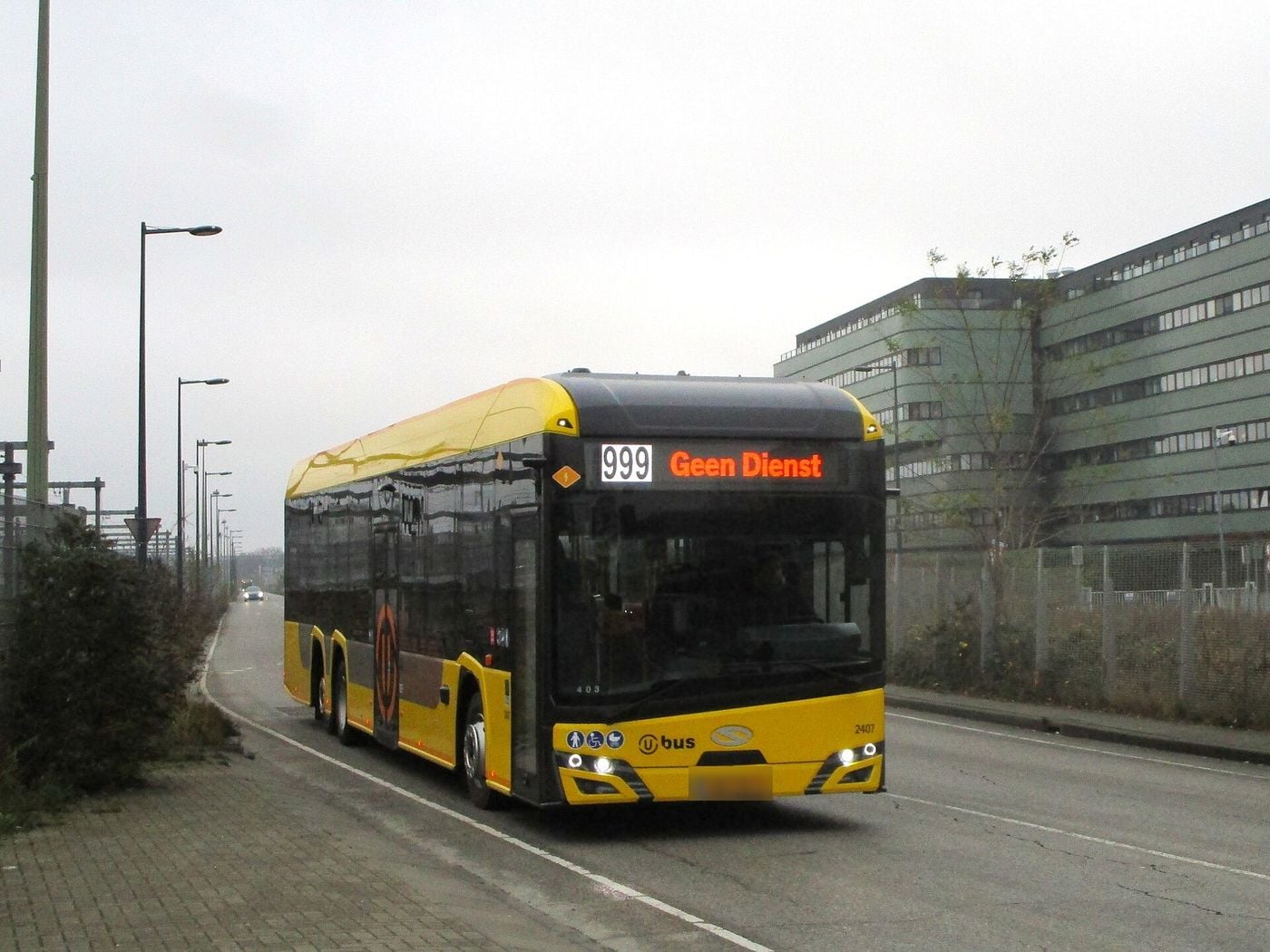
Solaris Urbino 15 LE electric
Solaris's three-axle low-entry electric bus for urban and regional routes: 14,890 mm long, a 240 kW (nominal) motor, 500 kWh Solaris High Energy batteries and up to 100 passengers.
- 240 kW
- 14.89 m
- 25.7 t

Model overview
- Segment
- Bus
- Transmission
- Electric motor with a portal drive axle with stabiliser and a steering tag axle
- Gross vehicle
- 25 700 kg
- Battery capacity
- 500 kWh
- Electric motor
- 240 kW · 280 kW peak
- Length
- 14 890 mm
- Wheelbase
- 7 000 mm
- Capacity
- 51 + 2 folding (up to 65 possible)
- Doors
- 2-2-1
The Urbino 15 LE electric is a three-axle, battery-electric low-entry bus from Solaris, 14,890 mm long, which Solaris describes as designed for operation both in urban traffic and on regional routes. This page is built from five Solaris documents in English, all fetched on 9 November 2026: the technical details sheet headed “Solaris Urbino 15 LE electric – technical details / FIAA Madrid 2026”, filed with Solaris’s press release of 21 September 2026 for the FIAA Madrid trade fair; that release; the press release of 2 June 2026 on the model’s entry in Bus Euro Test 2026; an earlier one-page technical details sheet for the model, which prints no date or market and whose file properties are dated 21 October 2020; and the Urbino electric product page on solarisbus.com.
Model, deliveries and model family
Solaris’s release of 21 September 2026 presents the Urbino 15 LE electric at FIAA Madrid, where Solaris exhibited from 22 to 24 September, at stand 9C09 in Hall 9, as “a three-axle, low-entry bus combining high passenger capacity with solutions designed for operation both in urban traffic and on regional routes”, and calls it “an electric bus designed to serve urban and suburban routes”. The release of 2 June 2026 calls it an intercity vehicle “designed as a flexible solution combining the requirements of urban and regional transport”, and says the bus “has been designed for both urban and intercity operations”.
The September release says “The low-entry front section of the bus facilitates boarding and efficient passenger exchange” and that the rear section “has been designed with passenger comfort in mind, including on longer journeys”. The June release speaks of “The low-floor front section” and a rear section “designed with comfort in mind for longer-distance travel”.
Both releases say Solaris has contracted more than 600 vehicles of the type. The June release gives approximately 320 of them as delivered and the September release around 370, primarily in Sweden and also in the Netherlands, Spain and Poland.
According to the June release, Solaris entered the model in the intercity edition of Bus Euro Test 2026, which the release describes as an international comparative bus testing event organised by the Bus of the Year jury. The same release says Solaris is working on a new generation of dedicated intercity buses. No document opened reports a result of the test.
Solaris’s Urbino electric product page lists the model beside the Urbino 9 LE electric, the Urbino 10,5 electric, the Urbino 12 electric, the Urbino 18 electric and the Urbino 24 electric, and carries a product video and a virtual tour of the Urbino 15 LE electric. The earlier technical details sheet, dated 21 October 2020 in its file properties, gives some figures that differ from the FIAA Madrid 2026 sheet; they are set out section by section below. No document opened gives the date of the model’s launch or of the start of series production.
Electric motor and drive
The FIAA Madrid 2026 sheet gives the electric motor as “240 kW nominal power / 280 kW peak power”, with a torque of 2,100 Nm. It names neither the type nor the position of the motor. The earlier sheet gives an “Asynchronous central traction motor” of 300 kW, with liquid cooling and “SiC technology in driveline area”. The two releases speak of an electric drivetrain and give no motor figures. How a battery-electric city bus is built and charged is set out in electric buses explained.
Axles, wheels and brakes
The FIAA Madrid 2026 sheet describes the front axle as “Independent axle, with stabiliser”, the drive axle as “Portal axle, with stabiliser” and the tag axle as “Steering”. The earlier sheet gives an independent front suspension, a portal drive axle and a tag axle “(active steering as option)”, with wheels of 295/80 R22,5 and, as an option, 275/70 R22,5. Neither sheet names an axle make or a model number, and no document opened prints a wheel formula.
Under “Braking system” the FIAA Madrid 2026 sheet lists acceleration slip regulation (ASR), brake assistance, brake pads wear monitoring, an electronic braking system (EBS) and Hill Holder. Under “Possible braking systems options” it lists the Collision Mitigation System (CMS) and electronic stability control, abbreviated “ECS” on the sheet. The September release names EBS, ASR and ESC “as well as the Collision Mitigation System (CMS)” among the systems supporting vehicle stability and braking performance, and the June release lists the same four as solutions that “have also been implemented”; neither release calls CMS or ESC an option. No document opened describes the wheel brakes.
Dimensions and weights
| Row | FIAA Madrid 2026 sheet | Earlier sheet (file properties 21 October 2020) |
|---|---|---|
| Length | 14,890 | 14,890 |
| Width | 2,550 | 2,550 |
| Height | 3,465 (total height) | 3,400 (3,360 with 275/70 R22,5 wheels) |
| Front overhang | 2,750 | 2,750 |
| Wheelbase | 7,000 / 1,690 | 7,000 / 1,690 |
| Rear overhang | 3,450 | 3,450 |
| Gross weight | GVWR: 25,700 kg | VGW: up to 25 t |
| Minimum turning radius | not given | ~11.9 m |
On both sheets the two overhangs and the two wheelbase figures add up to the printed length: 2,750 + 7,000 + 1,690 + 3,450 = 14,890. The September release calls the model “The 15-metre electric bus”. No document opened gives a kerb weight or axle loads.
Battery, charging and range
The FIAA Madrid 2026 sheet lists the batteries as “Solaris High Energy”, with “500 kWh (possible up to 700 kWh)”. The September release says flexible energy storage and charging solutions allow the vehicle configuration to be tailored to the operator’s requirements. The earlier sheet lists “Solaris High Energy+” and “Solaris High Power” batteries, with a capacity of “Up to 470 kWh”. No document opened says whether a figure is installed or usable energy; the difference between the two is explained in installed vs usable battery capacity.
The FIAA Madrid 2026 sheet gives the charging as “2x Plug-in CCS2 125A + 4 field pantograph”. The September release says the bus can be charged via a CCS2 connector or pantograph, and the June release names “flexible charging options, including CCS2 and pantograph systems”. The earlier sheet gives plug-in charging with a pantograph as an option. No document opened gives a charging power in kilowatts. How pantograph charging works is set out in opportunity charging and pantographs.
Range is given only in the releases. The September release says that, “depending on the specification and operating conditions”, the bus offers “a range of over 600 km according to eSORT test”. The June release gives a range “reaching approximately 600 km (depending on configuration and operating conditions)”. Neither sheet gives a range.
Doors, seats and capacity
The FIAA Madrid 2026 sheet gives bus class “II”, door layout “2-2-1”, “51 + 2 folding (up to 65 possible)” seats, “10 + 2 folding” low-floor seats, a passenger capacity of “77 (possible up to 100)” and an electric wheelchair ramp. Both releases say the bus can carry up to 100 passengers, with up to 65 seats.
The earlier sheet gives class II with class I as an option, the door layouts 2-2-0, 2-2-1, 1-2-0 and 1-2-1, a passenger capacity of “up to 105 people depending on configuration and equipment”, and seats “From 51 seats in III-door configuration”, “Up to 61 seats in II-door configuration (class I)” and “Up to 65 seats in II door configuration (II class)”.
No document opened gives a standing-passenger figure. The bus classes are set out in bus classes, and the difference between low-floor and low-entry in bus accessibility.
Climate control
The FIAA Madrid 2026 sheet says the driver’s cabin is “air-conditioned via AC of the passenger compartment”. The earlier sheet lists “AC + hybrid heating” and, as an option, “AC with CO2 heat pump heating function”.
Safety and driver-assistance systems
The FIAA Madrid 2026 sheet states “GSR2 compliant, R66 Compliant”. Under “Solutions included in mandatory GSR2” it lists AIF (Alcolock Interlock Installation Facilitation), BSIS (Blind Spot Information System), DDAW (Driver Drowsiness and Attention Warning), ESS (Emergency Stop Signal), ISA (Intelligent Speed Assistant), MOIS (Moving Off Information System), RD (Reversing Detection) and TPMS (Tire Pressure Monitoring System). Under “Possible ADAS systems options” it lists AHBC (Automatic High Beam Control), LDW(S) (Lane Departure Warning System), LSM (Left side monitoring), PLCA (Passive Lane Change Assist) and TSR (Traffic Sign Recognition).
The September release says the bus meets the requirements of GSR2 regulations and UN Regulation No. 66, and names driver assistance systems for monitoring blind spots, detecting pedestrians and other vehicles in the vicinity of the bus, and warning of potential hazards. The June release names blind spot monitoring, driver fatigue detection, traffic sign recognition, lane keeping assist and systems supporting vehicle start-off and maneuvering. The September release also says the vehicle is compatible with the eSConnect remote fleet management system, which “provides telemetry, operational data analysis and elements of predictive diagnostics”. Which assistance systems EU rules make mandatory, and from when, is set out in mandatory driver assistance systems.
Source notes
The figures above are the Solaris technical details sheet for FIAA Madrid 2026, filed with the press release of 21 September 2026: an electric motor of 240 kW nominal and 280 kW peak power with a torque of 2,100 Nm, an independent front axle and a portal drive axle, both with stabiliser, and a steering tag axle, with no axle make or model number, Solaris High Energy batteries of 500 kWh, possible up to 700 kWh, charging by 2x plug-in CCS2 125A and a 4 field pantograph, a wheelbase printed as 7,000 / 1,690 mm, a front overhang of 2,750 mm and a rear overhang of 3,450 mm, a total height of 3,465 mm, bus class II, door layout 2-2-1, 51 seats plus 2 folding with up to 65 possible, 10 plus 2 folding of them low-floor seats, a passenger capacity of 77 with up to 100 possible, an electric wheelchair ramp, and a GVWR of 25,700 kg. The sheet lists the Collision Mitigation System and electronic stability control (abbreviated ECS) among the possible braking system options; the press releases of 2 June 2026 and 21 September 2026 name CMS and ESC among the bus’s safety systems, without option wording. An earlier Solaris technical details sheet, whose file properties are dated 21 October 2020, gives other figures: an asynchronous central traction motor of 300 kW, liquid-cooled, with SiC technology in the driveline area, Solaris High Energy+ or Solaris High Power batteries of up to 470 kWh, plug-in charging with a pantograph as an option, wheels 295/80 R22,5 with 275/70 R22,5 as an option, a height of 3,400 mm, or 3,360 mm on the optional wheels, a VGW of up to 25 t, a minimum turning radius of about 11.9 m, class II with class I as an option, doors 2-2-0, 2-2-1, 1-2-0 or 1-2-1, up to 105 passengers depending on configuration and equipment, and from 51 seats with three doors to up to 61 seats with two doors in class I and up to 65 seats with two doors in class II. Range is given as over 600 km according to eSORT test in the release of 21 September 2026 and as approximately 600 km in the release of 2 June 2026, both depending on configuration or specification and operating conditions. Both releases give more than 600 vehicles contracted; the June release gives approximately 320 delivered and the September release around 370, primarily in Sweden and also in the Netherlands, Spain and Poland. No Solaris document opened gives a launch date, a start of series production, a usable battery capacity, a charging power, a standing-passenger figure, a wheel formula, a kerb weight or axle loads.
Quick answers
- Which transmission does the Solaris Urbino 15 LE electric use?
- Transmission: Electric motor with a portal drive axle with stabiliser and a steering tag axle.
- What is the gross vehicle weight of the Solaris Urbino 15 LE electric?
- Gross vehicle weight: 25 700 kg.
- What battery capacity does the Solaris Urbino 15 LE electric have?
- Battery capacity: 500 kWh.
- How long is the Solaris Urbino 15 LE electric?
- Length: 14 890 mm; Wheelbase: 7 000 mm.
- How many passengers does the Solaris Urbino 15 LE electric carry?
- Capacity: 51 + 2 folding (up to 65 possible).
More Solaris on this site
Sources
- Solaris Urbino 15 LE electric — technical details (FIAA Madrid 2026 press assets) — Solaris Bus & Coach
- Urbino 15 LE electric at FIAA Madrid 2026 — Solaris Bus & Coach, 21 Sept 2026
- Solaris Urbino 15 LE electric at Bus Euro Test 2026 — Solaris Bus & Coach, 2 Jun 2026
- Solaris Urbino 15 LE electric — technical details (earlier sheet, file properties 21 October 2020) — Solaris Bus & Coach
- Urbino electric — Solaris Bus & Coach