Double-decker buses: height, length, seats and upper-deck rules
Makers give double-deckers 4.00 to 4.395 m high and 10.5 to 15 m long. The EU 4.00 m and British 4.57 m height limits, capacities, weights and the UN R107 upper-deck rules.
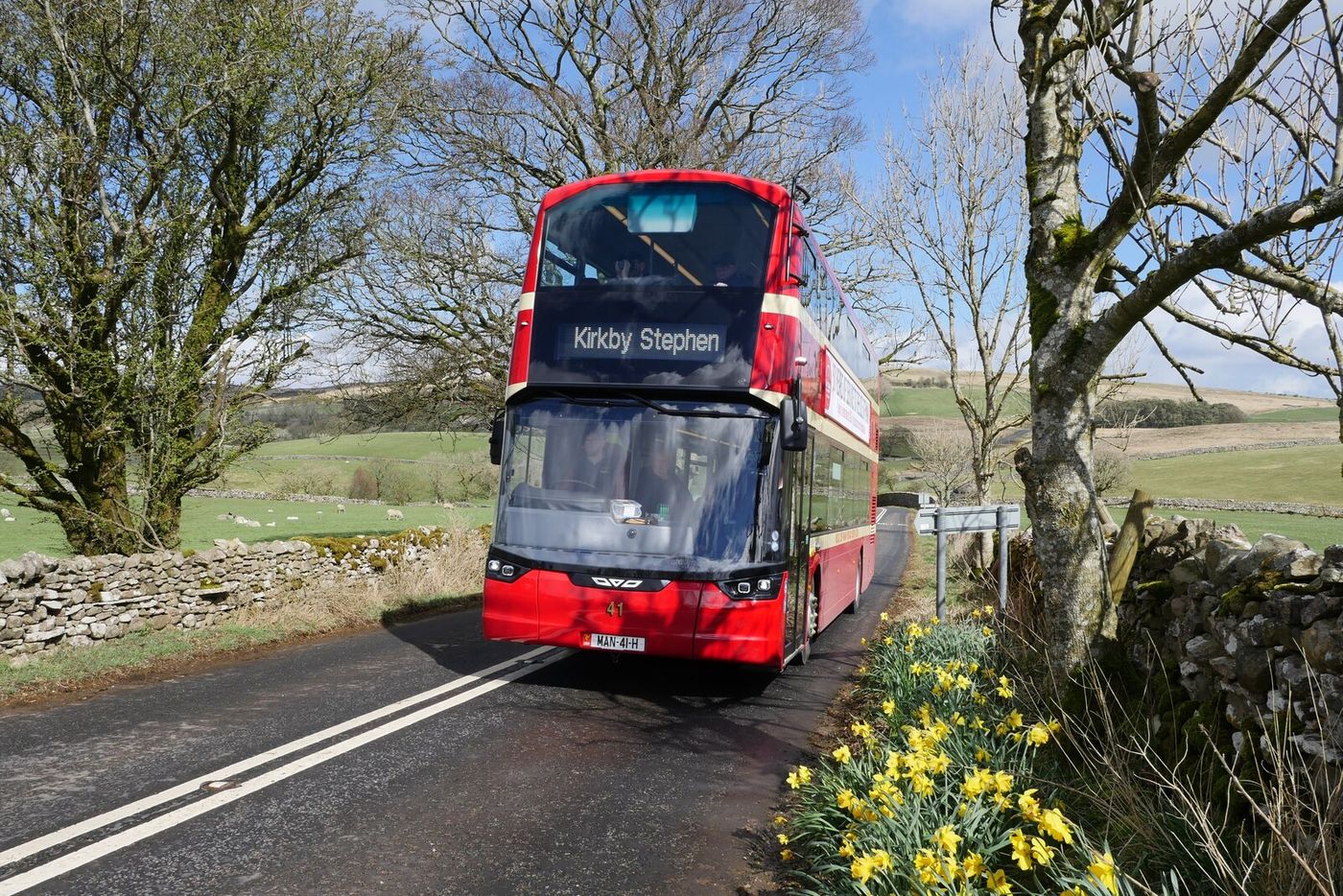
A double-decker bus carries passengers on two levels, one above the other. UN Regulation No. 107 defines a double-deck vehicle as one where the spaces for passengers “are arranged, at least in one part, in two superimposed levels and spaces for standing passengers are not provided in the upper deck”. Makers’ documents give heights from 4,000 mm to 4,395 mm, lengths from 10.5 m for a city bus to 15.0 m for a three-axle coach, and up to 100 passengers on a city bus. The height limit is 4.00 m in Annex I of Directive 96/53/EC, which an EU Member State may relax for national passenger transport, and 4.57 m for a bus in England, Wales and Scotland.
Status as at 5 November 2026. The makers’ pages and data sheets and the British regulations were read on 4 November 2026; the dated data sheets run to November 2026 (Alexander Dennis), and the Volvo data sheet carries no date. UN Regulation No. 107 is the text published in the Official Journal on 29 January 2026, incorporating the 11 series of amendments. Directive 96/53/EC is the consolidated text of 14 August 2019.
What counts as a double-decker
Article 2 of Directive 96/53/EC says a bus “may have one or two decks”; the word appears nowhere else in the Directive, and Annex I sets one set of limits for both. UN Regulation No. 107 applies to “every single-deck, double-deck, rigid or articulated vehicle of category M2 or M3” (paragraph 1.1) and also defines a double-decker articulated vehicle, whose sections intercommunicate “on at least one deck” (paragraph 2.1.3.1). Its gangway table lists double-deck vehicles in Classes I, II and III; the classes themselves are set out in bus classes under R107. The bodywork codes in vehicle categories M, N and O separate double-deck, double-deck articulated, low-floor double-deck and open-top double-deck vehicles.
Not every bus rule reaches the second deck. Paragraph 1.1 of UN Regulation No. 66 on superstructure strength, in the 02-series text, names single-deck vehicles only, as the R66 page sets out.
How tall a double-decker may be
Annex I of Directive 96/53/EC gives one figure, “Maximum height (any vehicle)”, at 4.00 m (point 1.3). The Neoplan Skyliner and the Setra S 531 DT are 4,000 mm high, as bus and coach dimensions records with the rest of the EU rules. Point 1.3 is among the points for which Article 4(2)(b) lets a Member State authorise “vehicles for national passenger transport” that do not conform.
Great Britain has its own figure. Regulation 9(1) of the Road Vehicles (Construction and Use) Regulations 1986 reads: “The overall height of a bus shall not exceed 4.57 m.” It extends to England, Wales and Scotland and has been in force since 11 August 1986. The Alexander Dennis, BYD and Wrightbus heights in the next section, from 4.2 m to 4,395 mm, lie between the two limits.
| Country | Height | Length, two axles / more than two | Width | Source |
|---|---|---|---|---|
| EU Member States | 4.00 m; a Member State may authorise vehicles for national passenger transport that do not conform (Article 4(2)(b)); national rules not verified | 13.50 m / 15.00 m | 2.55 m | Directive 96/53/EC, consolidated text of 14 August 2019, Annex I points 1.1 to 1.3 |
| Great Britain (England, Wales, Scotland) | 4.57 m | 13.5 m / 15 m | 2.55 m | Road Vehicles (Construction and Use) Regulations 1986, regulations 7, 8 and 9 |
| Northern Ireland | Not verified | None read | ||
| Mexico | Not verified | None read | ||
| Russia | Not verified | None read | ||
| Türkiye | Not verified | None read | ||
| United States | Height not verified; the federal length and width rules are in bus and coach dimensions | None read for this row | ||
Countries without a row are not covered.
City double-deckers: size and capacity
| Model | Length | Width | Height | Seats | Total passengers | Gross vehicle weight |
|---|---|---|---|---|---|---|
| Alexander Dennis Enviro400, diesel | 10.5, 10.9 or 11.5 m | 2.55 m | 4.2 or 4.3 m | 74, 82 or 85 | 100 | 18,000 kg |
| Alexander Dennis Enviro400EV, battery-electric, UK | 11.1 m | 2.55 m | 4.2 or 4.3 m | 80 (51 upper, 29 lower) | 96 | 19,500 kg |
| Alexander Dennis Enviro400EV for London | 10.5 m | 2.55 m | 4.3 m | 62 (42 upper, 20 lower) | 87 | 19,500 kg |
| BYD BD11, battery-electric | 10,900 mm | 2,550 mm | 4,300 mm | — | 90 | 19.5 t |
| Wrightbus StreetDeck Ultroliner, diesel | 10,567, 10,990 or 11,467 mm | 2,520 mm | 4,395 mm | 75, 74 or 83; standing 28, 26 or 18 | 100, 96 or 98 | 18,600 kg and 19,500 kg both listed |
| Wrightbus StreetDeck Electroliner, battery-electric | 10,732 mm | 2,520 mm | 4,395 mm | 73; standing 14 | 84 | 19,500 kg |
| Wrightbus StreetDeck Hydroliner, hydrogen fuel cell | 10,985 mm | 2,520 mm | 4,395 mm | 69; standing 24 | 90 | 19,500 kg |
Seats and total capacity. Wrightbus’s maximums do not add up to one another. On the 10.6 m Ultroliner, 75 seats and 28 standing would make 103 against a maximum capacity of 100; on the Electroliner, 73 and 14 make 87 against 84; on the Hydroliner, 69 and 24 make 93 against 90. The Ultroliner page says: “Depending on specification choice, a maximum capacity of up to 100 can be achieved.” Alexander Dennis pairs seats with a total for each specification: the difference between the two is 16 on the UK Enviro400EV and 25 on the London version.
Upper and lower deck. The upper deck has more seats than the lower in every layout in the Alexander Dennis documents listed here. The sample layouts give 46 upper seats against 24 fixed and 5 tip-up seats on the 10.9 m Enviro400, 51 against 33 and 1 on the 11.5 m Enviro400 stock bus, and 47 against 23 and 2 on the 11.1 m Enviro400EV.
Headroom. Alexander Dennis gives 2.01 m on the lower deck and 1.74 m or 1.84 m on the upper. Its single-specification leaflets pair height and headroom: the Enviro400 stock bus is 4.2 m high with 1.74 m on the upper deck, and the Enviro400EV for London 4.3 m high with 1.84 m.
Weight. Alexander Dennis gives unladen weights of approximately 10,800 to 11,500 kg for the Enviro400, approximately 13,650 kg for the UK Enviro400EV and approximately 13,500 kg for the London version. Point 2.3.1 of Annex I to Directive 96/53/EC gives 19.5 tonnes for a two-axle bus, the gross figure of the battery-electric and hydrogen models above; the traffic those weights govern is covered in bus classes under R107. The Ultroliner data sheet lists both 18,600 kg and 19,500 kg under gross vehicle weight, and the model page 18,600 kg.
Double-deck coaches
Neoplan’s brochure says: “In 1967 NEOPLAN created the double-decker touring class”. The coaches in the table all run on three axles: front, drive and a steered trailing or auxiliary axle.
| Model | Length × width × height | Seats and passengers | Gross vehicle weight | Standing height | Luggage compartment |
|---|---|---|---|---|---|
| Neoplan Skyliner | 14,000 × 2,550 × 4,000 mm, including air conditioning | up to 83+1+1 seats; up to 91 interurban | not in the documents read | 1,680 / 1,840 mm | up to 11 m³ |
| Setra S 531 DT | 14,000 × 2,550 × 4,000 mm | 54 to 93 passengers; 83 seats in standard seating | 26,000 kg | 1,685 / 1,828 mm | approx. 8.4 m³ |
| Volvo 9800 Double Decker | 15,000 × 2,600 × 4,201 mm, with air conditioning | up to 68 seats | 24,750 kg | not stated | 8.4 m³ |
Point 1.1 of Annex I gives 15.00 m for a bus with more than two axles, which is the Volvo’s length. Its width and height are above the 2.55 m and 4.00 m of points 1.2 and 1.3. The Volvo data sheet is issued by Volvo Buses México; the specification page names no market. For weight, point 2.3.2 gives three-axle motor vehicles 25 tonnes, or 26 tonnes where the driving axle has twin tyres and air suspension or recognised equivalent suspension, or where each driving axle has twin tyres and no axle exceeds 9.5 tonnes.
The same kinds of figure on a single-deck coach sheet are read against these texts in how to read a coach specification sheet.
What UN R107 requires of a double-decker
The table lists what the Regulation sets for a double-deck vehicle in particular; paragraphs numbered 7 are in Annex 3. Door and exit counts are in bus doors and emergency exits.
| Paragraph | Rule |
|---|---|
| 2.1.6; 7.2.2.2.8 | No spaces for standing passengers in the upper deck; any area of the upper deck is deducted from the surface available for standing passengers |
| Annex 4, Figure 6 | Overall height of the gangway gauge: 1,680 mm on the upper deck and 1,800 mm on the lower deck, against 1,900 mm on a single-deck vehicle of Class I, II or III; the lower-deck and single-deck figures may be reduced in parts of the gangway |
| 7.7.8.6.1 | Free height over a seat: not less than 900 mm from the highest point of the uncompressed cushion, which on the upper deck may be reduced to 850 mm |
| 7.6.1.15 | The upper-deck gangway connects by one or more staircases to the access passageway of a service door, or to the lower-deck gangway within 3 m of a service door; at least one and one-half staircases in Class I above 50 passengers on the upper deck, and in Classes II and III above 30 |
| 2.39 | A half staircase is “a staircase from the upper deck which terminates in an emergency door” |
| 7.7.12.2 | Staircases are designed so that under heavy braking there is no danger of a passenger being projected downwards; met if no part of the staircase is forward descending, or it has guards or a similar provision, or an automatic device prevents its use while the vehicle moves |
| 7.12.3 to 7.12.5 | An enclosed guard at least 800 mm high around the staircase well on the upper deck; a padded guard ahead of the upper-deck front seats, its top edge 800 to 900 mm above the floor; closed step risers |
| 7.6.1.1; 7.6.1.14 | Two doors on the lower deck; everyone on the lower deck can reach the outside in an emergency without entering the upper deck |
| Annex 11, 3.2.3.2.1 | “Double deck vehicles shall not be equipped for the carriage of baggage on the roof” |
The 28-degree tilt. Paragraph 7.4.1 requires that “the point at which overturning occurs would not be passed if the surface on which the vehicle stands were tilted to both sides in turn to an angle of 28 degrees from the horizontal”. The vehicle is at its mass in running order, with loads placed on each passenger seat, “of the upper deck only in the case of double-deck vehicles” (paragraph 7.4.2.1), and the baggage compartments hold no baggage. A crew member who is not seated counts as 75 kg in the upper-deck gangway. Paragraph 7.4.5 allows a calculation method instead of the physical test.
None of the makers’ documents listed here names R107. Wrightbus’s sheets state “Certified to NSSTA requirements” or, on the Ultroliner, “Certified to UK NSSTA”, without defining the term, and the British approval rules for buses were not verified.
Open-top double-deckers
R107 calls this a vehicle without roof: “In the case of a double-decked vehicle this shall be the upper deck”, and “Space for standing passengers shall not be provided on any deck without roof, independently of the class of vehicle” (paragraph 2.1.9). Exits on that deck meet the requirements that are not incompatible with the absence of the roof (Annex 3, paragraph 7.6.1.16), and at least one lighting device is provided as near as practicable to the top of every staircase to that deck (paragraph 7.8.1.6).
Wrightbus’s StreetDeck Open Top Electroliner data sheet gives 11,302 mm in length, 2,520 mm in width and 4,395 mm in height, a maximum capacity of 96 with up to 74 seated and 28 standing, and 19,500 kg gross. It lists a 340 kWh battery and a range of approximately 150 miles, where the model page says “up to 200 miles”. The sheet heads its dimensions column “10.6” above that 11,302 mm length.
Battery, hydrogen and diesel
| Model | Battery or tank | Range as stated |
|---|---|---|
| Alexander Dennis Enviro400 | 200 l or 275 l diesel tank | — |
| Alexander Dennis Enviro400EV | 472 kWh NMC lithium-ion; 354 kWh as an option on the model page | 620 km/385 mi “theoretical range in UK Bus Cycle at beginning of life” (472 kWh) |
| BYD BD11 | up to 532 kWh, LFP Blade Battery | “TBC” |
| Wrightbus StreetDeck Ultroliner | 190 l or 245 l diesel tank | — |
| Wrightbus StreetDeck Electroliner | 442 kWh LFP | approx. 275 miles, “duty-cycle dependent” |
| Wrightbus StreetDeck Hydroliner | 27 kg hydrogen (1,120 litres) at 350 bar filling pressure; 70 kW fuel cell | up to 293 miles on the data sheet; over 300 miles on the model page |
All three battery-electric models charge by CCS plug; Alexander Dennis offers optional roof-mounted rails for pantograph charging, and BYD an optional pantograph with up to 500 kW. How these systems work is covered in electric buses explained and opportunity charging, and the Hydroliner alongside other fuel-cell buses in hydrogen fuel cell buses and coaches. The Clean Vehicles Directive (2009/33/EC) had a lower zero-emission requirement for a Member State where double-deckers made up more than 80 % of the buses under contracts awarded in its first reference period, which ended on 31 December 2025; public bus procurement under the Directive sets it out.
Quick answers
- How tall is a double-decker bus?
- In the makers' documents, from 4,000 mm to 4,395 mm. The Neoplan Skyliner and Setra S 531 DT coaches are 4,000 mm high, the Volvo 9800 Double Decker 4,201 mm with air conditioning, the Alexander Dennis Enviro400 4.2 or 4.3 m, the BYD BD11 4,300 mm and the Wrightbus StreetDeck 4,395 mm. The limit is 4.00 m in Annex I of Directive 96/53/EC, which a Member State may relax for national passenger transport (Article 4(2)(b)), and 4.57 m for a bus in England, Wales and Scotland under regulation 9(1) of the Road Vehicles (Construction and Use) Regulations 1986.
- How long is a double-decker bus?
- The city double-deckers in the makers' documents are 10.5 to 11.5 m long: Alexander Dennis gives 10.5, 10.9, 11.1 and 11.5 m, Wrightbus 10,567 to 11,467 mm and BYD 10,900 mm. The Neoplan Skyliner and Setra S 531 DT coaches are 14,000 mm long and the Volvo 9800 Double Decker 15,000 mm, all on three axles. Directive 96/53/EC and the British Construction and Use Regulations both allow 13.50 m for a bus with two axles and 15.00 m for a bus with more than two.
- How many passengers can a double-decker bus carry?
- The Alexander Dennis Enviro400 is given as up to 100 passengers, with up to 85 seats on the 11.5 m version, and the 10.6 m Wrightbus StreetDeck Ultroliner as up to 100, with up to 75 seats and up to 28 standing. Among coaches, the Setra S 531 DT is given as 54 to 93 passengers, the Neoplan Skyliner as up to 83+1+1 seats or up to 91 interurban, and the Volvo 9800 Double Decker as up to 68 seats. Under the definition in UN Regulation No. 107, spaces for standing passengers are not provided in the upper deck.
- How much does a double-decker bus weigh?
- Alexander Dennis gives an unladen weight of approximately 10,800 to 11,500 kg for the diesel Enviro400 and approximately 13,650 kg for the 11.1 m Enviro400EV, with gross vehicle weights of 18,000 kg and 19,500 kg. The Wrightbus StreetDeck Electroliner and Hydroliner are 19,500 kg gross and the BYD BD11 19.5 t. The Setra S 531 DT coach is 26,000 kg gross and the Volvo 9800 Double Decker 24,750 kg. Annex I of Directive 96/53/EC gives 19.5 tonnes for a two-axle bus and, for three-axle motor vehicles, 25 tonnes or, on the conditions it sets, 26 tonnes.
- How far can a double-decker bus tilt without tipping over?
- UN Regulation No. 107 requires that the point of overturning would not be passed with the surface under the vehicle tilted to both sides in turn to 28 degrees from the horizontal (Annex 3, paragraph 7.4.1). On a double-decker the passenger loads go on the upper-deck seats only, and the baggage compartments stay empty (paragraph 7.4.2.1). A calculation method may be used instead (paragraph 7.4.5).
Models in this article
Sources
- UN Regulation No. 107 — Uniform provisions concerning the approval of category M2 or M3 vehicles with regard to their general construction (OJ L, 2026/139, 29.1.2026), incorporating the 11 series of amendments: paragraphs 1.1, 2.1.1, 2.1.3.1, 2.1.6, 2.1.9, 2.39; Annex 3 paragraphs 7.2.2.2.8, 7.4, 7.6.1.1, 7.6.1.14 to 7.6.1.16, 7.7.8.6.1, 7.7.12, 7.8.1.6, 7.12.3 to 7.12.5; Annex 4 Figure 6; Annex 11 paragraph 3.2.3.2.1 — UNECE / Official Journal of the European Union, 29 Jan 2026
- Council Directive 96/53/EC on the maximum authorised dimensions and weights of certain road vehicles — consolidated text of 14 August 2019: Article 2, Article 4(2)(b), Annex I points 1.1 to 1.3, 2.3.1 and 2.3.2 — EUR-Lex, European Union
- UN Regulation No 66 — Uniform provisions concerning the approval of large passenger vehicles with regard to the strength of their superstructure (OJ L 84, 30.3.2011), incorporating all valid text up to the 02 series of amendments: paragraph 1.1 — UNECE / Official Journal of the European Union
- Directive 2009/33/EC on the promotion of clean road transport vehicles in support of low-emission mobility, consolidated text of 20 May 2024: Annex, Table 4 with its footnote — EUR-Lex, Publications Office of the European Union
- The Road Vehicles (Construction and Use) Regulations 1986 (S.I. 1986/1078), regulation 9, Height — latest available revised version, read on 4 November 2026 — legislation.gov.uk, The National Archives
- The Road Vehicles (Construction and Use) Regulations 1986 (S.I. 1986/1078), regulation 7, Length — Table items 4A and 4B, latest available revised version — legislation.gov.uk, The National Archives
- The Road Vehicles (Construction and Use) Regulations 1986 (S.I. 1986/1078), regulation 8, Width — Table item 3, latest available revised version — legislation.gov.uk, The National Archives
- Enviro400 — technical specifications, United Kingdom (leaflet 11/2026, v1) — Alexander Dennis
- Enviro400 — technical specifications, United Kingdom stock (leaflet 11/2026, stock v1) — Alexander Dennis
- Enviro400EV — technical specifications, United Kingdom (leaflet 06/2026, v3) — Alexander Dennis
- Enviro400EV for London — technical specifications (leaflet 09/2026, v1) — Alexander Dennis
- Enviro400EV — model page: battery options and specification table, read on 4 November 2026 — Alexander Dennis
- StreetDeck EU6 Ultroliner 2.0 — data sheet (QCD Apr 2026) — Wrightbus
- StreetDeck EU6 Ultroliner — model page, read on 4 November 2026 — Wrightbus
- StreetDeck BEV Electroliner 2.0 — data sheet (QCD Apr 2026) — Wrightbus
- StreetDeck FCEV Hydroliner 2.0 — data sheet (QCD Apr 2026) — Wrightbus
- StreetDeck Hydroliner FCEV — model page, read on 4 November 2026 — Wrightbus
- StreetDeck Open Top Electroliner — data sheet (QCD Apr 2026) — Wrightbus
- StreetDeck Open Top Electroliner — model page, read on 4 November 2026 — Wrightbus
- BYD eBus BD11 — model page with technical specifications, read on 4 November 2026 — BYD Europe
- Volvo 9800 Double Decker specifications, read on 4 November 2026 — Volvo Buses
- Volvo 9800 DD EU6 — data sheet issued by Volvo Buses México — Volvo Buses
- Skyliner — brochure, technical data (brochure code Sky_0923_en) — NEOPLAN / MAN Truck & Bus SE
- Skyliner — model page, technical data, read on 4 November 2026 — NEOPLAN / MAN Truck & Bus SE
- TopClass S 531 DT — technical data and equipment (data sheet, legal notices 10/2026) — Setra / Daimler Buses