Temsa
Temsa Avenue Electron
Temsa's 12,095 mm battery-electric city bus: a 250 kW TM4 motor with 2,700 Nm, 280 to 420 kWh or up to 510 kWh, CCS2 charging and up to 35 seats.
- 12.1 m
- 18 t
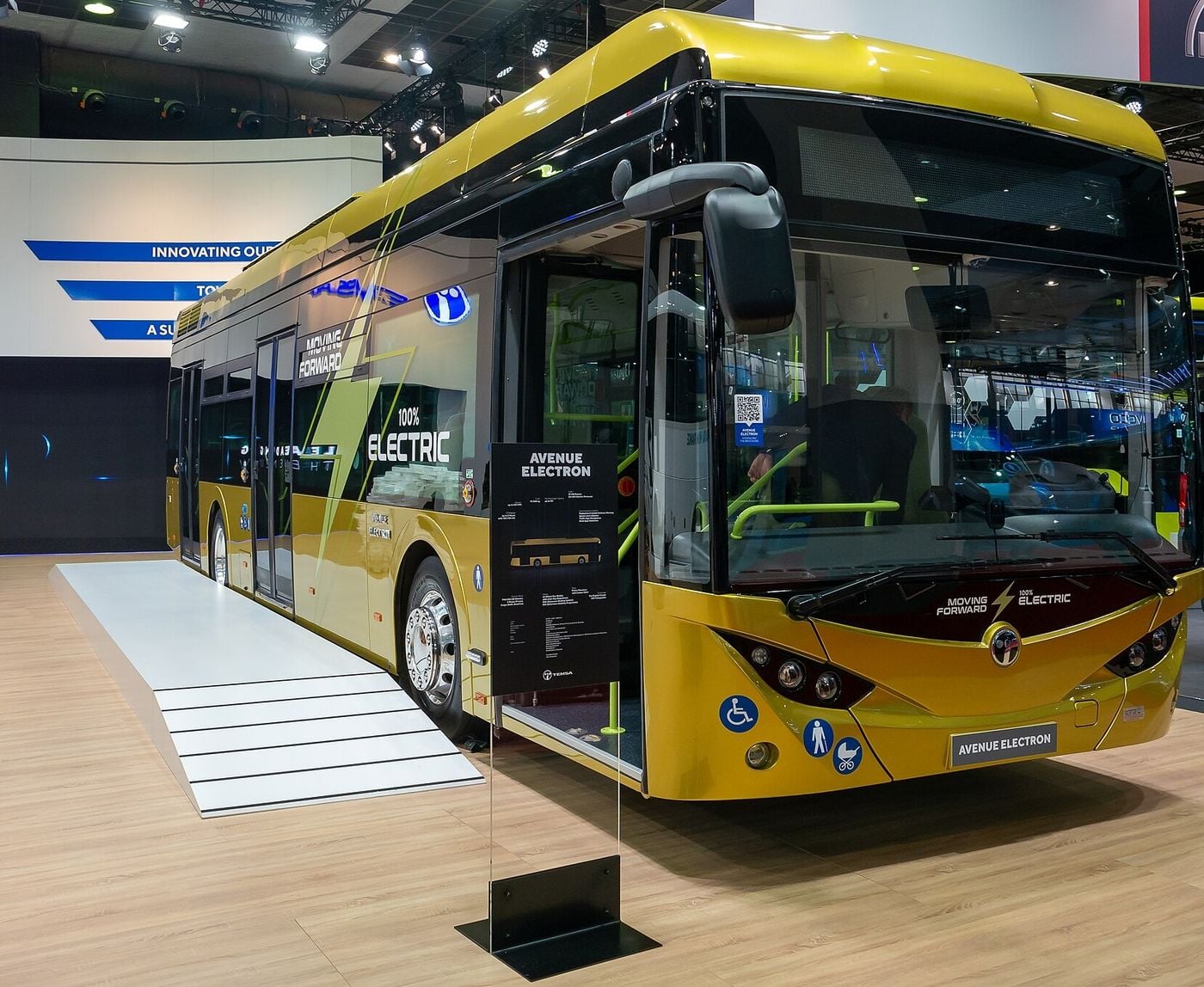

Model overview
- Segment
- Bus
- Gross vehicle
- 18 000 kg
- Battery capacity
- 280–420 kWh
- Range
- 600 km
- Charging
- 300 kW (CCS2)
- Electric motor
- 250 kW peak
- Length
- 12 095 mm
- Wheelbase
- 5 805 mm
- Capacity
- 31 to 35
The Temsa Avenue Electron is a battery-electric city bus, 12,095 mm long. Temsa’s international site lists it in its “City” range beside the Avenue Neo 9e, the Avenue LF 12, the MD9 LE and the MD9 electriCITY, and the brochure calls it “a TEMSA Tech product”. The figures on this page come from two Temsa documents: the English Avenue Electron brochure, whose imprint says its information is “accurate as of its publication date (09/2026)” and that “Specification may differ per country”; and the Avenue Electron product page of Temsa’s international site in English, read on 9 November 2026, which gives no publication date. The two differ on gross vehicle weight, battery capacity and charging, and each figure below is given with its document. No document opened gives the year the Avenue Electron was introduced or names an earlier version. The Avenue Neo 9e is described in Temsa Avenue Neo 9e, and the vehicle type in electric buses explained.
Body and dimensions
The product page describes “black-bodied LED headlights” in the front fascia, “A continuous character line along the side” and “Glossy piano black accents framing the entire body”; the brochure speaks of “LED headlights framed in black” on the front mask and “piano black sections surrounding the vehicle”. An opaque-white exterior colour is standard and a metallic colour an option. Body lifting, body kneeling and body side kneeling are standard.
| Row | Brochure, 09/2026 | Product page |
|---|---|---|
| Length | 12,095 | 12,095 |
| Width | 2,550 | 2,550 |
| Height, with air conditioner | 3,237 | 3,237 |
| Wheelbase | 5,805 | – |
| Front overhang | 2,757 | – |
| Rear overhang | 3,533 | – |
| Turning radius, curb to curb | 8,750 | – |
| Approach / departure angle | 7° | – |
| Interior height, front / rear | – | 2,420 / 2,290 |
| Gross vehicle weight | 18,000 | 20,000 |
| Front axle capacity | 8,200 | 8,200 |
| Rear axle capacity | 13,000 | 13,000 |
The brochure prints its figures with a point as the thousands separator (“12.095 mm”, “18.000 kg”). Both documents add a note to the gross vehicle weight: the brochure’s footnote reads “Gross Vehicle Weight may vary depending on country regulations.”, the product page “(May vary by country regulations)”. No document opened gives an unladen weight or a wheel formula.
Electric motor and drive
The brochure’s “POWER” table gives a maximum motor power of 250 kW, a maximum torque of 2700 Nm and a gradeability of 18%. Its text pages speak of a “3-phase x 3 efficient permanent magnet and electrical motor” and read: “Its 2,700 Nm @ 200 rpm motor generates 250 kW of power”. The product page, under the heading “Engine”, gives the model as “TM4”, the type as “9-phase permanent magnet motor”, 250 kW and 2700 Nm. The brochure gives the differential ratio as 7.36. The product page names “Regenerative Braking Technology”; the principle is covered in regenerative braking in trucks and buses. No document opened names a gearbox or gives a continuous power rating or a maximum speed.
Battery and range
The brochure lists the battery as “Li-Ion NMC” with a capacity of “up to 510 kWh”, located on the “Roof”. The product page gives “4/5/6 Packgages 280 kWh, 350 kWh and 420 kWh” (spelt as printed), and its FAQ says that “4/5/6 pack options are available, offering capacities of 280 kWh, 350 kWh, and 420 kWh respectively.” The brochure says that “Batteries with effective capacity and the Battery Management System – designed by TEMSA Tech – offer alternative range options”, and the product page names a “Battery Thermal Management System (BTMS)”. No Temsa document opened says whether these figures are installed or usable capacity; the difference is explained in installed vs usable battery capacity.
The brochure gives a range of “up to 600 km”, with the footnote “Range may vary depending on many parameters such as battery warranty, driving styles, topography, outside temperature, air conditioning systems, etc.” No test cycle is named, no document opened says which battery capacity the range belongs to, and the product page gives no range.
Charging
The brochure gives the charging system as “CCS Type 2”, with “Multiple Charging Locations” as an option, and two charging times: “1.5-2 hours with 300 kW DC Charger” and “2-3 hours with 150 kW DC Charger”. The product page gives “CCS2 150kW” under “Charging Options”, and its FAQ answers that “150 kW fast charging is available, enabling full charge in 3 to 5 hours.” No document opened names the battery capacity these charging times refer to. Charging standards and power levels are covered in charging electric trucks and buses.
Axles, brakes, steering and tyres
Both documents give a ZF independent front axle rated at 8,200 kg and a ZF rigid rear axle rated at 13,000 kg. No document opened names the axle models or the type of suspension.
Under “BRAKES” the brochure lists a service brake, a parking brake, ASR (anti-slip regulation) and EBS (electronic braking system), all as standard; ESP (electronic stability programme) is listed as an option. The brochure says that EBS “is integrated into an electronic system that combines the brake control system, ABS and ASR”; the product page says that the “integrated Electronic Braking System (EBS) combines ABS and ASR” and that ESP “applies individual brake pressure to each wheel under challenging conditions”. The brochure’s EBS paragraph also speaks of “lower levels of disc wear”; neither document’s specification list gives the type of brakes.
The brochure lists electro-hydraulic steering and a tilting and telescopic steering wheel as standard; the product page lists “Hydraulic Steering” and “Height and Tilt Adjustment” as standard, and its text describes an “electro-hydraulic steering system” offering “soft and precise maneuverability at low speeds and firmer control at higher speeds”. The brochure says the steering wheel “offers maximum softness when the vehicle is stationary or manoeuvring and gets harder as the speed of the vehicle increases”.
Both documents give 8.25 x 22.5 rims with 275/70 R22.5 tyres.
Passengers and access
The brochure’s table gives a maximum seat capacity of “up to 35” and a maximum passenger capacity of “up to 98”, with the footnote “This may vary depending on seating arrangement. Passenger capacity may also vary depending on battery capacity, seating configuration, gross vehicle weight, and selected equipment.” Its interior page gives seats “ranging between 31 and 35”, and the product page “Up to 35”, with the FAQ answer “flexible seating layout allows customization between 31 and 35 seats.” No document opened gives a number of standing places or the number and type of doors.
The brochure names “multifunctional information displays” for passengers. A manual ramp is standard and a hybrid ramp an option; the brochure describes a “Wheelchair Ramp with both manual and electric operation functions”. The accessibility rules for buses are set out in bus accessibility under UN Regulation 107.
Safety and driver-assistance systems
The brochure’s “SECURITY” list gives a reversing information system (ReIS), a tyre pressure monitoring system (TPMS), intelligent speed assistance (ISA), driver drowsiness and attention warning (DDAW), a pedestrian and cyclist collision warning (MOIS), an emergency stop signal (ESS), a blind spot information system (BSIS), cyber security, a software update management system (SUMS) and advanced driver distraction warning (ADDW) as standard, each marked with two asterisks. Among the footnotes under the table, the one marked with two asterisks is the range note quoted above, and one marked with a single asterisk reads “Standard for GSR regions, optional for non-GSR regions.” A lane departure warning system (LDWS) and an alcohol interlock are options, and an alcohol interlock preparation is standard. The product page names “Intelligent Speed Assistance, Driver Fatigue Warning, Dual-Side Blind Spot Detection, and Pedestrian/Cyclist Recognition” and a “Cybersecurity-compliant electronic infrastructure”. The systems and their dates are covered in mandatory driver assistance systems.
Safety hammers, a fire extinguisher, a low voltage warning, a “Temporary Bus Stop” function and a “Circuit Separator on Battery” are standard. A reverse gear buzzer and electrically adjustable exterior mirrors are standard; a rear parking sensor is an option.
Driver’s area, climate and equipment
The product page describes a “customizable digital dashboard” showing “speed, RPM, mileage, battery voltage, outside temperature, and charging time”; the brochure names a “multifunctional digital dashboard” whose content drivers can customise. A sun visor, an interior mirror for the driver, a sliding front heated driver window and a three-point safety belt for the driver seat are standard; left and right armrests for the driver seat are options. The electrical system runs at 24 V, with two 12 V batteries of 240 Ah (“2 x 12 V 240Ah”).
Air conditioning, a preheater and a driver’s defroster are standard; double-glazed side windows and a turbofan are options. The brochure gives the air conditioner 37 kW: “The 37 kW air conditioner keeps the interior of the vehicle cool and fresh even in the hottest weather conditions.” Fog lights, front destination plates, a random coded lock, an electrical horn and a ticket machine preparation are standard; a monitor, WiFi and a video record system are options.
Source notes
The figures above are from Temsa’s English Avenue Electron brochure, whose imprint says its information is accurate as of 09/2026, except the battery capacity, which is from Temsa’s English product page. The brochure gives a permanent magnet motor with 250 kW maximum power and 2,700 Nm maximum torque at 200 rpm, a gradeability of 18% and a differential ratio of 7.36; a Li-ion NMC battery of up to 510 kWh, located on the roof; a range of up to 600 km, with no test cycle or battery size named; CCS Type 2 charging, 1.5 to 2 hours with a 300 kW DC charger or 2 to 3 hours with a 150 kW DC charger; length 12,095 mm, width 2,550 mm, height 3,237 mm including the air conditioner, wheelbase 5,805 mm, front overhang 2,757 mm, rear overhang 3,533 mm, a turning radius of 8,750 mm curb to curb and an approach/departure angle of 7 degrees; a gross vehicle weight of 18,000 kg; a ZF independent front axle rated at 8,200 kg and a ZF rigid rear axle rated at 13,000 kg; 8.25 x 22.5 rims with 275/70 R22.5 tyres; up to 35 seats, between 31 and 35 depending on the layout, and up to 98 passengers; a 24 V system with two 12 V 240 Ah batteries; and a 37 kW air conditioner. The product page names the motor TM4, a 9-phase permanent magnet motor, with the same power and torque; it gives battery capacities of 280, 350 and 420 kWh from 4, 5 or 6 packages, which neither document splits into installed and usable capacity; CCS2 charging at 150 kW, with a full charge in 3 to 5 hours; a gross vehicle weight of 20,000 kg; and an interior height of 2,420 mm at the front and 2,290 mm at the rear, with the same length, width, height, axles, rims and tyres.
Quick answers
- What is the gross vehicle weight of the Temsa Avenue Electron?
- Gross vehicle weight: 18 000 kg.
- What battery capacity does the Temsa Avenue Electron have?
- Battery capacity: 280–420 kWh; Range: 600 km; Charging: 300 kW (CCS2).
- How long is the Temsa Avenue Electron?
- Length: 12 095 mm; Wheelbase: 5 805 mm.
- How many passengers does the Temsa Avenue Electron carry?
- Capacity: 31 to 35.
More Temsa on this site
Sources
- Avenue Electron brochure (English, information as of 09/2026) — Temsa Skoda Sabancı Ulaşım Araçları A.Ş.
- Avenue Electron — product page (international site, English) — TEMSA