Temsa
Temsa LD SB Plus
Temsa's two-axle intercity and school bus, 12,365 or 13,080 mm long with 59 to 63 seats, on a 270 kW DAF MX11 or a 235 kW FPT N67 diesel engine.
- 235–270 kW
- Euro 6
- 12.37 m
- 18 t
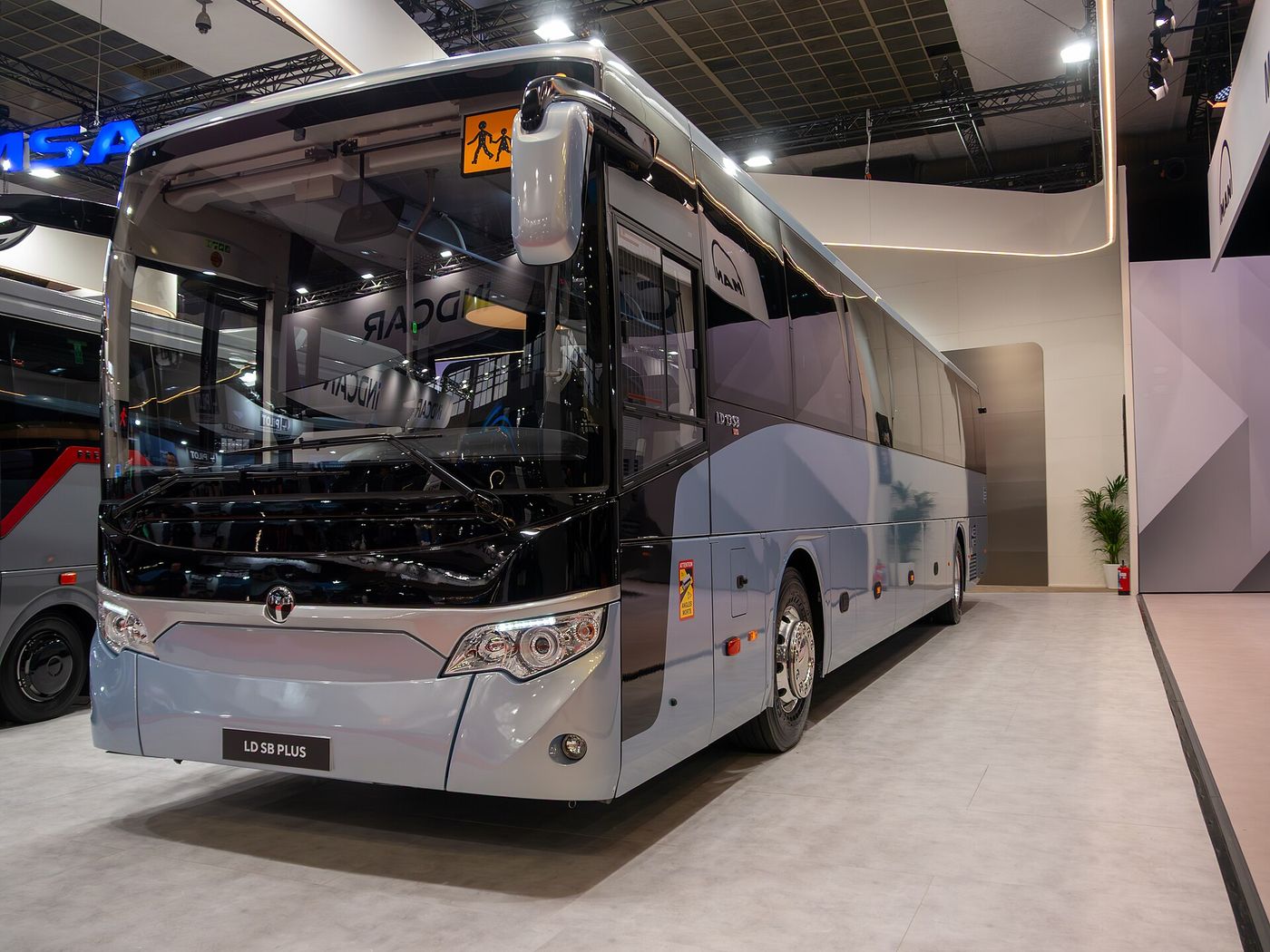

Model overview
- Segment
- Bus
- Emission
- Euro 6
- Transmission
- ZF Ecolife automatic, 6 forward + 1 reverse (DAF MX-11); ZF Ecoshift manual, 6 forward + 1 reverse, or Allison automatic as an option (FPT N67)
- Gross vehicle
- 18 000 kg
- Length
- 12 365 mm
- Wheelbase
- 6 335 mm
- Turning circle
- 22 920 mm
- Capacity
- 59-63
Engine families
- Power
- 270 kW
- Torque
- 1950 Nm
- Rated speed
- 1600 rpm
- Power
- 235 kW
- Torque
- 1100 Nm
- Rated speed
- 2500 rpm
The LD SB Plus is a two-axle diesel bus that TEMSA lists under “Intercity” in the product menu of its international site, beside the LD SB E; its coaches, among them the Maraton, are listed under “Coaches”. Temsa’s brochure describes the LD SB Plus as “specialized in intercity transportation” and presents it for “both school and intercity transport”. It is offered in two lengths, 12,365 mm and 13,080 mm, with a choice of two six-cylinder diesel engines, a DAF MX11 and an FPT N67.
This page is built from three Temsa documents in English, all read on 27 October 2026: the LD SB Plus brochure, which the product page links as “Download Brochure” and whose imprint says its information is accurate as of 10/2025 (the PDF file was created on 26 September 2025 and last modified on 9 February 2026); the LD SB Plus product page of Temsa’s international site, undated, with the footer “Copyright © 2025”; and Temsa’s release on Busworld Europe 2025, dated 3 October 2025. No document opened gives a launch date, an earlier version of the model, an unladen weight, a wheel formula, a door arrangement, a standing-passenger figure or a retarder.
Dimensions and weights
The brochure prints each row once for both lengths, as a pair of figures where they differ and with a point as the thousands separator (“12.365 mm / 13.080 mm”). The product page prints most of the same rows.
| Row | Brochure, 10/2025 | Product page |
|---|---|---|
| Length | 12,365 mm / 13,080 mm | 12,365 mm / 13,080 mm |
| Wheelbase | 6,335 mm / 7,050 mm | – |
| Front overhang | 2,730 mm | – |
| Rear overhang | 3,300 mm | – |
| Width | 2,550 mm | 2,550 mm |
| Height, including air conditioning | 3,350 mm | 3,350 mm |
| Floor to ceiling (product page: interior height) | 2,240 mm front, 2,000 mm rear | 2,240 mm front, 2,000 mm rear |
| Luggage volume | 4 m³ / 5 m³ | 4 m³ / 5 m³ |
| Turning diameter | 22,920 mm / 24,840 mm | – |
| Gross vehicle weight | 18,000 kg / 19,000 kg (“GVWR”) | 18,000 kg / 19,000 kg |
| Passengers | “59/ 63”, with the note “based on country regulations” | “Number of Seats 59-63” |
The product page gives the front axle a capacity of 7,500 kg and the rear axle a capacity of 13,000 kg. Both documents give the fuel tank as 321 litres and the AdBlue (urea) tank as 30 litres.
Engines
The brochure lists the engines under “Standard equipments” in two columns, “Model 1” and “Model 2”, each with its own transmission and rear axle. The product page names them “Euro 6 DAF MX11 / Euro 6 FPT N67” and gives one entry for both in its type row, “Diesel, 4-Stroke; Water cooled; Direct injection”, and in its cylinder row, “6-cylinder in-line type engine”.
| Row | DAF MX11 | FPT N67 |
|---|---|---|
| Column in the brochure | Model 2 | Model 1 |
| Emission class | Euro 6 (“E6”) | Euro 6 (“E6”) |
| Displacement (product page) | 10.8 l | 6.7 l |
| Power | 270 kW (367 hp) at 1,600 rpm | 235 kW (320 hp) at 2,500 rpm |
| Torque, brochure | 1,950 Nm at 900–1,125 rpm | 1,100 Nm at 1,250–1,890 rpm |
| Torque, product page | 1,950 Nm at 900–1,125 rpm | 1,950 Nm at 900–1,125 rpm |
| Transmission | ZF Ecolife automatic | ZF Ecoshift manual; Allison automatic as an option (“Opt.”) |
| Front axle | “ZF-Independent” | “ZF-Independent” |
| Rear axle | “ZF Dif 4,18” | “Dif 4,77 / 5,12” |
The two documents differ on the FPT N67’s torque: the brochure gives 1,100 Nm at 1,250–1,890 rpm, while the product page prints 1,950 Nm at 900–1,125 rpm for both engines. Both give the same power figures. Temsa writes the DAF engine “DAF MX11” in its data rows and “DAF MX-11” in the brochure’s text, which speaks of “engine options like the DAF MX-11 and FPT N67”. The engine family is described in the PACCAR MX-11 engine.
Gearboxes, axles, suspension and steering
The product page lists two gearbox types, each with “6 Forward + 1 Reverse”: “ZF - Automatic (DAF Engine)” and “ZF - Manual / Allison - Automatic (FPT Engine)”. The brochure names the gearbox of the DAF engine “ZF Ecolife Automatic” and lists, for the FPT engine, “ZF Ecoshift Manual” and “Allison Automatic ( Opt.)”.
The product page gives the front axle type as independent and the rear axle type as rigid. The brochure lists “Suspension with Air Bags and Shock Absorbers” and “Full Body Lifting and Kneeling”, and its text speaks of an air suspension system and, among the accessibility features, of “a wheelchair lift and adjustable body height”. How an air-suspended bus raises, lowers and kneels is set out in ECAS air suspension.
Steering is hydraulic, with a steering wheel that adjusts for tilt and reach (“Steering Wheel Tilt and Telescopic”); the product page marks both as standard. The brochure’s wheel row lists 22.5-inch aluminium alloy wheels and a 22.5-inch steel rim, with 295/80 R22.5 tyres; the product page gives the rim as 22.5 x 8.25. The mirror rows read “Electrical Class 2 Sidewalk” and “Electrical Class 5&6”.
Brakes, safety and driver assistance
Under “Safety” the brochure lists a service brake, ABS (Anti-Lock Braking System), ASR (Anti-Slip Regulation) and EBS (Electronic Braking System), with a blind spot information system, pedestrian and cyclist collision warning, driver drowsiness and attention warning, intelligent speed assistance, a reverse information system, a tyre pressure monitoring system, an emergency stop signal, an alcohol interlock and “Cyber Security Compliance”. The list headed “Optional” begins with the lane departure warning system, “AEBS (Advanced Emergency Braking System)” and the parking brake. Which of these systems the EU General Safety Regulation requires, and from when, is set out in mandatory driver assistance systems.
Electrics, passenger area and driver’s area
The electrical system is 24 volt, with a Continental multiplex system and a digital cluster, and two 12 V batteries of 225 Ah. The lighting row lists LED daytime running lights and fog lights, with exterior and interior lighting, and the diagnostics row “Real Time Diagnostic of Engine, Transmission, Multiplex and A/C System”.
The brochure’s interior column lists single-glazed side windows; seating with a “2 Point Seat Belt, Armrest for Aisle and Handle for Standing Passengers”; two USB type A sockets at the passenger seats (“2xA type USB on Passenger Seats”); passenger modules with adjustable air vents, reading lights and a speaker; a Gramer driver’s seat; a dashboard row reading “Full LCD Digital Cluster, Rear View”; an AM/FM/DVD/MP3/BT infotainment system; a row headed “Durable & Cleanable Interior” that names the ceiling; and two manual roof hatches as emergency exits (“2x Roof Hatch Manual”). Heating and cooling are a driver’s defroster, roof cooling and roof and convector heating, listed with “42kW, Max Cooling 143.000 BTU, Max Heating 221.000 BTU” (42 kW; 143,000 and 221,000 BTU).
The brochure’s text describes “adjustable multisets and dedicated area for wheelchairs” and says that “The vehicle offers wheelchair accessibility through an integrated lift system and designated space”; its equipment page lists a “Handicapped Lift” among the options. The rules for wheelchair access to buses are set out in bus accessibility.
Options and school use
Listed as options, besides the three items above, are double-glazed side windows; a seat belt, armrest, magazine net, tray table and wastebasket for the passenger seats; leather and fabric alternatives for the seats; a ski box (“Skibox”); rim covers; a heater for the driver’s seat; an air conditioner; an air-conditioning defroster; a preheater; a monitor; a spare tyre; the handicapped lift; LED front fog lights; LED daytime running lights; an alcohol meter (“Alcoholmeter”); a school bus sign; a bottle cooler in the dashboard; a heated windscreen; a rear-view camera; a rear parking sensor; and an infotainment system.
The brochure’s text also speaks of use “as a school bus or for intercity travel”. How European rules treat buses used for school runs is set out in school transport vehicles.
The LD SB at Busworld Europe 2025
Temsa’s release on Busworld Europe 2025 in Brussels, dated 3 October 2025, says that its stand also featured the LD SB, which “is presented with a refreshed exterior design, streamlined GSR system, available in three versions including two diesel driveline alternatives and a fully electric version with battery capacities ranging from 280 to 350 kWh.” The release names the model “LD SB”; Temsa’s product menu lists the LD SB Plus and the LD SB E under “Intercity”.
Source notes
The grid above gives the first figure of each pair that Temsa’s brochure of 10/2025 prints: 12,365 mm long on a 6,335 mm wheelbase, with a 22,920 mm turning diameter and a gross vehicle weight rating of 18,000 kg. The second figures are 13,080 mm, 7,050 mm, 24,840 mm and 19,000 kg. The brochure gives one width of 2,550 mm, one height of 3,350 mm including the air conditioning, a front overhang of 2,730 mm and a rear overhang of 3,300 mm; the luggage volume is 4 m³ / 5 m³ and the passenger capacity “59/ 63”, based on country regulations. Two Euro 6 engines are listed: a DAF MX11 of 270 kW (367 hp) at 1,600 rpm with 1,950 Nm at 900-1,125 rpm and a ZF Ecolife automatic gearbox, and an FPT N67 of 235 kW (320 hp) at 2,500 rpm with 1,100 Nm at 1,250-1,890 rpm and a ZF Ecoshift manual or optional Allison automatic gearbox. Temsa’s product page prints 1,950 Nm at 900-1,125 rpm for both engines.
Quick answers
- Which engines are available in the Temsa LD SB Plus?
- The record for the Temsa LD SB Plus covers these engine families: DAF MX-11 (10.8 l), FPT N67 (6.7 l). Output spans 235–270 kW and 1100–1950 Nm.
- What emission standard does the Temsa LD SB Plus meet?
- Euro 6.
- Which transmission does the Temsa LD SB Plus use?
- Transmission: ZF Ecolife automatic, 6 forward + 1 reverse (DAF MX-11); ZF Ecoshift manual, 6 forward + 1 reverse, or Allison automatic as an option (FPT N67).
- What is the gross vehicle weight of the Temsa LD SB Plus?
- Gross vehicle weight: 18 000 kg.
- How long is the Temsa LD SB Plus?
- Length: 12 365 mm; Wheelbase: 6 335 mm.
- How many passengers does the Temsa LD SB Plus carry?
- Capacity: 59-63.
Articles that mention the Temsa LD SB Plus
More Temsa on this site
Sources
- TEMSA LD SB PLUS brochure (English, information as of 10/2025) — Temsa Skoda Sabancı Ulaşım Araçları A.Ş.
- LD SB Plus — product page (international site, English) — TEMSA
- Temsa Unveils Avenue Neo, Its New Electric City Bus At Busworld 2025, Highlighting Its Motto “Designed To Lead Your Journey” — TEMSA, 3 Oct 2025