Temsa
Temsa Avenue Neo 9e
Temsa's battery-electric city bus, 9,496 mm long: a 265 kW TM4 Sumo MD motor, 192, 288 or 384 kWh, up to 600 km, 300 kW CCS2 charging and up to 75 passengers.
- 9.5 m
- 15.7 t
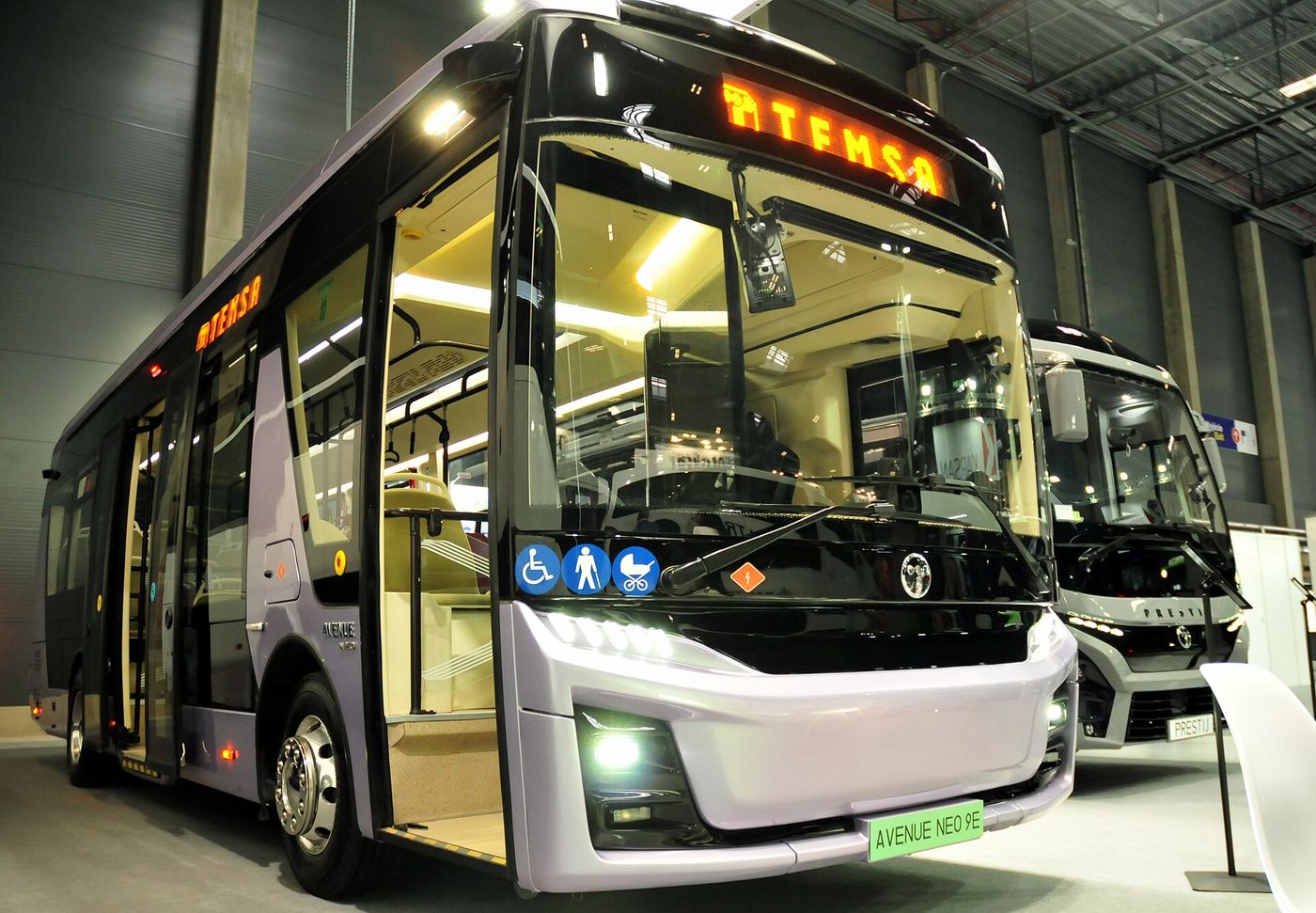

Model overview
- Segment
- Bus
- Gross vehicle
- 15 700 kg
- Battery capacity
- 192–384 kWh
- Range
- 600 km
- Charging
- 300 kW (CCS2)
- Electric motor
- 265 kW peak
- Length
- 9 496 mm
- Wheelbase
- 4 600 mm
- Capacity
- Class I: 30; Class II: 33 (without wheelchair area)
- Doors
- 2 doors (standard) or 3 doors (option)
The Temsa Avenue Neo 9e is a battery-electric city bus of about nine and a half metres. Temsa’s press release of 23 September 2026 calls it “its 9-metre all-electric city bus”; the brochure prints a length of 9,496 mm. The figures on this page come from Temsa’s own documents: the English Avenue Neo 9e brochure, whose imprint says its information is “accurate as of its publication date (05/2026)” and that “Specification may differ per country”; the Avenue Neo 9e product page of Temsa’s international site in English, read on 27 October 2026, which carries no date; and the press release of 23 September 2026. Temsa’s two-axle coach is described in Temsa Maraton.
Classes, body and dimensions
The brochure gives the bus in two classes: it prints a seating capacity and a tyre size for “Class I” and “Class II”, and its page headed “R66 Body” says that “The robust body structure of Avenue Neo 9e, ensures passenger protection and structural integrity in both Class 1 and Class 2 options.” Class I and Class II under UN Regulation No 107 are set out in bus classes, and the rollover rule in bus rollover strength under UN R66.
The brochure describes a “new front and rear design” and “Fully LED lightings”; the product page speaks of a “redesigned front and rear” and “LED lighting”. The equipment list gives an LED lighting group, a fog lamp and solid white paint as standard and metallic paint as an option. The brochure also names a two-piece windshield and electrical hanging mirrors.
| Row | Brochure, 05/2026 | Product page |
|---|---|---|
| Length | 9,496 | 9,500 |
| Width | 2,450 | 2,400 |
| Height, with air conditioner | 3,235 | 3,250 |
| Wheelbase | 4,600 | – |
| Front overhang | 2,056 | – |
| Rear overhang | 2,840 | – |
| Turning radius | 7,070 | – |
| Approach / departure angles | 7° / 7° | – |
| Gross vehicle weight | 15,700 | 15,700 |
| Front axle capacity | 5,000 | 5,750 |
| Rear axle capacity | 10,700 | 10,700 |
The brochure prints its figures with a point as the thousands separator (“9.496 mm”, “15.700 kg”). The press release gives the same turning radius, “7,070 millimetres”. The product page’s “Interior Height” row carries a dash. No document opened gives an unladen weight or a wheel formula.
Electric motor and drive
The brochure’s “POWER” table gives the type as “TM4 Sumo MD”, a maximum motor power of 265 kW, a maximum torque of 2,760 Nm (“2760Nm”), a gradeability of 21.9% and a maximum speed of 90 km/h. The product page prints the same motor, 265 kW and 2,760 Nm under the heading “Engine”, and the brochure’s feature pages read “Electric Motor TM4 265 kW” and “With up to 21.9% gradeability”. One-pedal driving is standard. No document opened names a gearbox or gives a continuous power rating.
Battery and range
The battery is listed as “Li – Ion NMC” with a capacity of “192/288/384kWh”, its location as “Rear and Roof”, and a liquid-cooled battery thermal management system (“Liquid Cooling BTMS”) as standard. The product page gives “4/6/8 Packgages 192kWh/288kWh/384kWh” (spelt as printed), and its FAQ names “three battery capacity options”. The brochure’s performance page prints “8x48 kWh TemsaTech Batteries”, and a feature page “Battery up to 384 kWh”. No Temsa document opened says whether these figures are installed or usable capacity; the difference is explained in installed vs usable battery capacity.
The brochure gives a range of “up to 600 km” (“600km Range” on its performance page), with the footnote “Range may vary depending on many parameters such as battery warranty, driving styles, topography, outside temperature, air conditioning systems, etc.” The press release gives “a range of up to 600 kilometres”. No test cycle is named, and no document opened says which battery capacity the range belongs to.
Charging
The brochure lists “Charging Technology … CCS2” and, as “Charging Technology 2”, an “Inverted Pantograph”, which its feature pages also call an “Inverted Pantograph Option” and describe as “Designed for fast and efficient overhead charging”. The charging time is printed as “Charging Time (300 kW DC) … 1 hour 15 minutes”. The product page says that “With 300 kW DC fast charging, the vehicle reaches full charge in just 1 hour and 15 minutes”, and the press release that the bus’s “300-kW DC fast-charging capability enables a full charge in 75 minutes”. No document opened names the battery capacity this charging time refers to.
A front right charge plug is standard; a front left plug, a rear right plug and plugs at front left and right are options. The brochure says that with these “Alternative Charge Plug Positions” there are “options available for front right, front left, and rear right plug-in positions”. Pantograph charging of buses is covered in opportunity charging for electric buses.
Axles, brakes, steering and tyres
The front axle is a ZF RL 55 EC, independent, rated at 5,000 kg in the brochure and 5,750 kg on the product page; the rear axle is a Dana G150, rigid, rated at 10,700 kg in both. The brochure’s equipment list gives body lifting, body side kneeling, body kneeling and “ESAC” as standard; no document opened names the type of suspension.
Under “BRAKES” the brochure lists ABS, EBS, ASR, a “Temporary Bus Stop” function, an electronic parking brake and ESC (electronic stability control), all as standard; no document opened gives the type of brakes. The product page lists hydraulic steering with height and tilt adjustment as standard (“Standart”).
The rims are 7.5 x 19.5; steel rims are standard, aluminium rims and rim covers are options. The brochure gives 265/70 R19.5 tyres for Class I and 285/70 R19.5 tyres for Class II (printed “265/70/R19.5” and “285/70/R19.5”); the product page gives one size, 265/70 R19.5.
Passengers, doors and access
The brochure’s table gives “Seating Capacity … Class I: 30 Class II: 33*”, the asterisk reading “without wheelchair area”; its interior page speaks of “30+3(Foldable) seats”, and the product page gives “Seating Capacity 31–33”. The brochure and the press release give a passenger capacity of up to 75. No document opened gives a number of standing places.
The brochure speaks of “Ergonomic handrails, wide aisle space and new side windows”, the product page of “wide corridors, ergonomic handrails, and expansive glass surfaces” and a “foldable seat layout”. Three-point seat belts, a parcel rack for Class II and a skibox preparation are options.
Pneumatic inward doors and two doors are standard; an electric outward door and a third door are options, and the product page names “2/3 door configurations”. An electromagnetic lock is standard. A manual ramp (“Manual Disabled Ramp”) is standard and a hybrid ramp an option, which the brochure describes as a “Wheelchair Ramp with both manual and electric operation functions”. A wheelchair safety belt and a wheelchair backrest are standard, and wheelchair fixing equipment is an option. The accessibility rules for buses are set out in bus accessibility under UN Regulation 107.
Safety and driver-assistance systems
The product page lists “Smart Speed Assist”, “ESS Emergency Brake Warning”, “TPMS Tire Pressure Monitoring”, “Driver Fatigue Warning”, “Blind Spot Detection”, “Cybersecurity Protection”, “Pedestrian/Cyclist Detection”, “Rearview Camera”, “Alcohol Interlock” and “Lane Departure Warning”. The brochure’s safety page describes a system that “detects posted speed limits and alerts the driver in case of an exceedance”, a DDAW/ADDW system that “identifies early signs of fatigue or loss of concentration”, a front-mounted camera system that warns the driver “if pedestrians or cyclists are detected” as the vehicle begins to move, ESS that activates “flashing brake and hazard lights” during emergency braking, side cameras that detect blind spots, a rear camera shown on the digital cluster, tyre pressure monitoring, secure software updates, protection of the electronic systems “against cyber threats”, an alcohol interlock and lane departure warning. The page carries the footnote “Standard for GSR regions, optional for non-GSR regions”. The systems and their dates are covered in mandatory driver assistance systems.
A 6 kg fire extinguisher, a safety hammer, a central test point, a low voltage warning, an “Engine Room Lid Open Warning”, a “Circuit Seperator on Battery” (spelt as printed) and a reverse gear buzzer are standard; an AVAS system and an alcoholmeter are options. Pipe-type side mirrors are standard, and coach-type mirrors and camera mirrors are options; the brochure says its “Digital Mirror” “Enhances visibility and reduces blind spots in all conditions.”
Driver’s area, climate and equipment
The brochure names a “Digital Driver Information Display” and a “Fully Ergonomic Driver Area” that “Offers semi-closed and fully-closed cabin options”. A swivel driver seat and an electric sun visor are options. A telematic system is standard; the brochure says it “Enables real-time vehicle monitoring and diagnostics to support efficient fleet management”. The electrical system runs at 24 V, with two 12 V batteries of 180 Ah (“2x12V 180 Ah”).
Single-glazed side and rear windows are standard and double glazing an option. Air conditioning, a defroster and heat blowers at the first door and in the aisle are standard; an AC defroster and a rear heat blower are options. The brochure gives the air conditioner a cooling capacity of 33 kW. An electric preheater, which the brochure rates at 20 kW, and a diesel preheater with a 45 L tank are options; the brochure says these “Ensure cabin comfort and component protection even in the coldest conditions.”
FIAA 2026 and the MD9 Electricity
Temsa showed the Avenue Neo 9e at FIAA 2026 in Madrid, according to its press release of 23 September 2026 (dateline “Madrid, 22 September 2026”). A subheading of the release calls the model “the symbol of TEMSA’s electric mobility ambitions in Europe”, and the release says that “it is designed for both dense city operations and longer suburban routes”. It adds: “The model builds on TEMSA’s experience with the MD9 Electricity, which has covered more than five million kilometres in service across different markets since 2016.” No document opened names an earlier version of the Avenue Neo 9e or gives the year it was introduced.
Source notes
The figures above are from Temsa’s English Avenue Neo 9e brochure, whose imprint says its information is accurate as of 05/2026: a TM4 Sumo MD electric motor with 265 kW maximum power and 2,760 Nm maximum torque, a maximum speed of 90 km/h and a gradeability of 21.9%; a Li-ion NMC battery of 192, 288 or 384 kWh, which the brochure also prints as 8 x 48 kWh TemsaTech batteries and which Temsa does not split into installed and usable capacity, liquid-cooled and located at the rear and on the roof; a range of up to 600 km, with no test cycle named; CCS2 charging, 1 hour 15 minutes at 300 kW DC, with a front right charge plug as standard and an inverted pantograph as a second charging technology; length 9,496 mm, width 2,450 mm, height 3,235 mm including the air conditioner, wheelbase 4,600 mm, front overhang 2,056 mm, rear overhang 2,840 mm, turning radius 7,070 mm, approach and departure angles 7 degrees; gross vehicle weight 15,700 kg; an independent ZF RL 55 EC front axle rated at 5,000 kg and a rigid Dana G150 rear axle rated at 10,700 kg; 7.5 x 19.5 rims with 265/70 R19.5 tyres in Class I and 285/70 R19.5 in Class II; 30 seats in Class I and 33 in Class II without a wheelchair area, and up to 75 passengers; a 24 V system with two 12 V 180 Ah batteries; a 33 kW air conditioner, and as options a 20 kW electric preheater or a diesel preheater with a 45 L tank. Temsa’s English product page gives a length of 9,500 mm, a width of 2,400 mm, a height of 3,250 mm with air conditioning, a front axle capacity of 5,750 kg, 31 to 33 seats and one tyre size, 265/70 R19.5, with the same gross vehicle weight, rear axle capacity, motor, battery and charging figures. Temsa’s press release of 23 September 2026 gives the turning radius as 7,070 mm and the 300 kW DC charging time as 75 minutes.
Quick answers
- What is the gross vehicle weight of the Temsa Avenue Neo 9e?
- Gross vehicle weight: 15 700 kg.
- What battery capacity does the Temsa Avenue Neo 9e have?
- Battery capacity: 192–384 kWh; Range: 600 km; Charging: 300 kW (CCS2).
- How long is the Temsa Avenue Neo 9e?
- Length: 9 496 mm; Wheelbase: 4 600 mm.
- How many passengers does the Temsa Avenue Neo 9e carry?
- Capacity: Class I: 30; Class II: 33 (without wheelchair area).
Articles that mention the Temsa Avenue Neo 9e
More Temsa on this site
Sources
- Avenue Neo 9e brochure (English, information as of 05/2026) — Temsa Skoda Sabancı Ulaşım Araçları A.Ş.
- Avenue Neo 9e — product page (international site, English) — TEMSA
- TEMSA captures over 30% of the European midi market — TEMSA, 23 Sept 2026