Temsa
Temsa HD
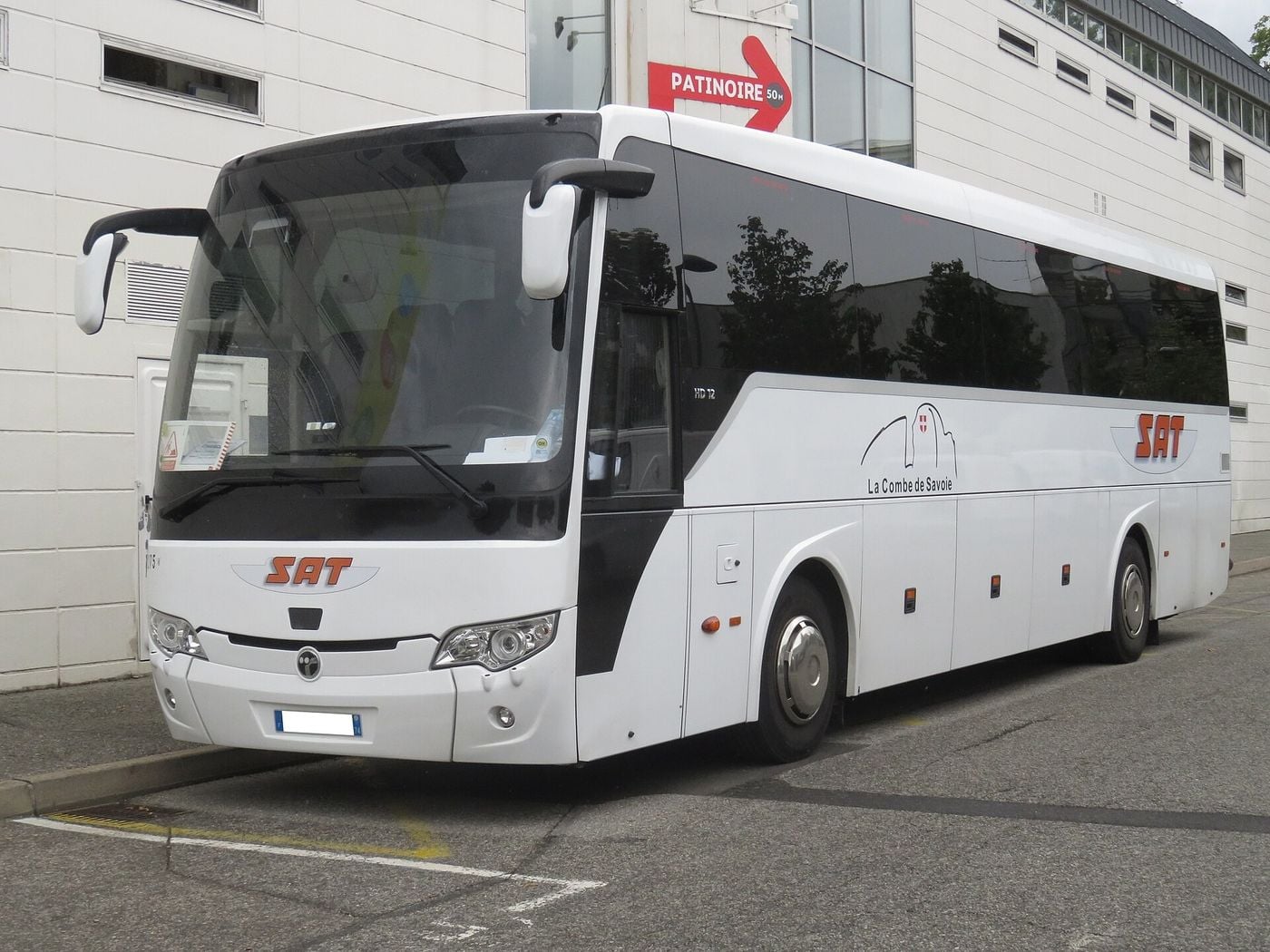
Temsa's HD coach in two lengths, the HD 12 at 12,276 mm and the HD 13 at 13,076 mm, with a 10.8-litre DAF MX11 of 300 or 330 kW and ZF manual or automatic gearboxes.
- 300–330 kW
- Euro VI
- 12.28 m
- 19 t

Model overview
- Segment
- Bus
- Emission
- Euro VI
- Transmission
- ZF Ecoshift manual, 6 forward (standard); ZF Traxon automatic, 12 forward, or ZF Ecolife automatic, 6 forward (optional)
- Gross vehicle
- 19 000 kg
- Length
- 12 276 mm
- Wheelbase
- 6 100 mm
- Turning circle
- 22 399 mm
- Capacity
- 50+1+1 (HD 12, Temsa brochure and product page)
Engine families
- Power
- 300–330 kW
- Torque
- 2100–2300 Nm
- Rated speed
- 1600 rpm
The HD is a coach that TEMSA offers in two lengths, the HD 12 and the HD 13, each also listed in a right-hand-drive version, the HD 12 RHD and the HD 13 RHD. The product menu of Temsa’s international site lists all four under “Coaches”, together with the Maraton 12 and 13, the Safir Plus, the MD9 and the TS models. Temsa describes the HD Series as “designed for versatile use” and names “charter services, tourism, as well as intercity and international travel”. Its brochure names a DAF engine, ZF gearboxes and ZF axles, and gives the address of the TEMSA factory in Adana, Türkiye.
This page is built from Temsa’s English HD brochure on temsa.com, whose imprint says that its information is accurate as of its publication date, 02/2026, and which also carries the line “Copyright © 2024 TEMSA”; from the HD 12, HD 13, HD 12 RHD and HD 13 RHD product pages of Temsa’s international site in English, undated, with the footer “Copyright © 2025”; and from Temsa news items dated 25 September 2017, 28 March 2019, 18 October 2019 and 4 November 2026. All were read on 9 November 2026. The brochure gives the HD 12 and the HD 13 a data page each. No document opened gives a launch date, an unladen weight, a door count, a standing-passenger figure, a wheel formula or a suspension type.
Two lengths: HD 12 and HD 13
The brochure prints its figures with a point as the thousands separator. The two lengths share the width, the height, the interior height, both overhangs, the approach angle and the gross vehicle weight, and differ in wheelbase, length, turning diameter, seating capacity and luggage volume.
| Row in the brochure | HD 12 | HD 13 |
|---|---|---|
| Length | 12,276 mm | 13,076 mm |
| Wheelbase | 6,100 mm | 6,900 mm |
| Front overhang | 2,766 mm | 2,766 mm |
| Rear overhang | 3,410 mm | 3,410 mm |
| Width | 2,550 mm | 2,550 mm |
| Height (incl. air conditioner) | 3,644 mm | 3,644 mm |
| Floor-to-ceiling height | 2,000 mm | 2,000 mm |
| Turning diameter | 22,399 mm | 24,546 mm |
| Approach angle | 8° | 8° |
| Seating capacity | 50+1+1 | 41+1+1 |
| Gross vehicle weight | 19,000 kg | 19,000 kg |
| Total luggage volume | 9 m³ | 11 m³ |
The product pages give some of these rows differently. The HD 12 page gives the same 50+1+1 seats and 9 m³ of luggage capacity as the brochure. The HD 13 page gives “Number of Seats 55” and a luggage capacity of 10 m³. The right-hand-drive pages give “53+1+WC” seats and 9 m³ for the HD 12 RHD and “57+1+ WC” seats and 11 m³ for the HD 13 RHD. All four pages give the gross vehicle weight as 19,000 kg, the width as 2,550 mm, the air-conditioned height as 3,644 mm and the interior height as 2,000 mm, and the lengths as 12,276 mm and 13,076 mm.
Engine
The brochure’s data pages list two ratings of the DAF MX11 as “Model 1” and “Model 2”, with one bore and stroke, one volume and one emission standard for both.
| Row | Model 1 | Model 2 |
|---|---|---|
| Model | DAF MX11-330 kW | DAF MX11-300 kW |
| Maximum power | 330 kW / 449 HP at 1,600 rpm | 300 kW / 408 hp at 1,600 rpm |
| Maximum torque | 2,300 Nm at 900–1,125 rpm | 2,100 Nm at 900–1,125 rpm |
| Bore/stroke | 123 x 152 mm | |
| Volume | 10,800 cc | |
| Engine emission standard | Euro VI | |
The brochure’s text describes the 10.8-litre engine with 2,100 Nm at 900–1,125 rpm and 300 kW (408 hp), and “the option of a 330 kW (449 hp) engine” with 2,300 Nm at 900–1,125 rpm. It calls it a six-cylinder engine and its emission values “Euro 6-compliant”. The right-hand-drive product pages describe the engine as “Diesel, 4-stroke; Water cooled; Direct injection” and as a “6-cylinder in-line type engine” of 10,800 cc. The engine family is described in the PACCAR MX-11 engine, and the Euro VI stages in Euro 6 and Euro 7 explained.
Each product page prints a single rating. The HD 12 and HD 13 pages name the engine “DAF MX11” and give 330 kW/449 HP at 1,600 rpm with 2,300 Nm at 900–1,125 rpm. The HD 12 RHD page gives “DAF MX11-300 Kw”, at 300 kW/408 hp at 1,600 rpm with 2,100 Nm at 900–1,125 rpm. The HD 13 RHD page gives “E6 DAF 271kW MX11”, at 271 kW/368 HP at 1,650 rpm with 1,580 Nm at 1,000–1,650 rpm, a rating that the brochure does not list. In a release of 28 March 2019 Temsa gave the HD 13 “435 bhp and 2,100 Nm maximum torque” from its DAF MX-11 engine.
Gearboxes, axles, steering and brakes
The brochure lists a ZF Ecoshift manual gearbox with 6 forward gears as standard, and a ZF Traxon automatic with 12 forward gears and a ZF Ecolife automatic with 6 forward gears as options (“ZF Ecoshift 6 Forward Manuel”, “ZF Traxon 12 Forward Automatic”, “ZF Ecolife 6 Forward Automatic”). The HD 12 and HD 13 product pages list two gearbox types, a ZF manual with 6 forward gears and 1 reverse and a ZF automatic with 12 forward gears and 1 reverse; the right-hand-drive pages list one, a ZF automatic with 6 forward gears and 1 reverse. The TraXon family is described in the ZF TraXon transmission.
| Row | Front axle | Rear axle |
|---|---|---|
| Type | ZF RL 75 E, independent | ZF A 133, rigid |
| Capacity | 7,500 kg | 11,500 kg |
| Differential ratio | – | 2.00/2.76/3.36 |
The product pages give the same capacities and describe the front axle as independent and the rear axle as rigid, without the ZF type designations. The wheels are 22.5 x 9 rims, listed as “Steel/Aluminium Rim”, with 295/80 R22.5 tyres; the brochure’s HD 13 page lists a spare tyre as standard, and its HD 12 page has no spare-tyre row. Body lifting and body kneeling are standard on both models. The product pages speak of “a finely tuned suspension system”. Steering is hydraulic, with a steering wheel that adjusts for tilt and reach (“Steering Wheel Tilt and Telescopic”), both standard.
Under “Brakes” the brochure lists as standard a service brake, a parking brake, an engine brake, an exhaust valve brake, ABS, ASR, EBS, AEBS and an intarder. Its text describes the EBS as “integrated into an electronic system combining the brake controls, ABS and ASR”. How these brakes share the work is set out in retarders and engine braking.
Fuel, climate and electronic equipment
The fuel tank holds 527 litres and is listed with a heated fuel filter and water separator (“527 L Heated Fuel Filter Water Separator”); the urea (AdBlue) tank holds 50 litres. The right-hand-drive pages give the same 527 L and 50 L.
Air conditioning is standard, with a cooling capacity of 39 kW, together with an additional heating system, convector heating, a preheater with a timer and double glazing; a defroster is an option. The heated windscreen is standard on the HD 12 page of the brochure and an option on the HD 13 page.
Standard electronic equipment is a reverse-gear buzzer, a rear-view camera, a bottle cooler in the dashboard and a tachograph; a rear parking sensor, a fridge, destination plates and a school-bus sign are options. A monitor is an option on the HD 12 page and standard on the HD 13 page.
Passenger area, driver’s area and exterior
The brochure says that the HD “comes with 2+2 and 2+1 seating configurations”, with seats “available in textile, leather or a combination of both materials”, and that the parcel racks “come in two variations, with either lids or plastic stripes”. Its equipment pages list as standard a parcel rack, curtains, an assistant seat, reclining passenger seats, a service tray for the passenger seats and a USB charger, and as options a kitchen unit, a WC and a sleeping compartment. The product pages describe seating with “dual USB-A and USB-C power outlets, cup holder for driver, magazine nets, footrests”, and the release of 28 March 2019 said that a Wi-Fi connection and USB ports were standard on the HD 13.
The brochure describes a driver’s seat with armrests, back support and “a weight-sensitive pneumatic suspension system”, which moves forwards, backwards, up and down. The driver’s area list has as standard a front microphone, an electrical sun visor, a 3-point seat belt for the driver’s seat and electrical exterior mirrors, and as options an alcohol meter (“Alcoholmeter”) and a heater for the driver’s seat.
The exterior is opaque white as standard, with metallic and other opaque colours as options, and rim covers are standard. Halogen headlights and fog lights are standard and xenon headlights an option; the HD 13 page adds LED daytime running lights as standard. Further options are an air horn, a camera mirror, a camera at the middle door steps and courtesy manoeuvring lights. The brochure’s text speaks of “special uninterrupted chrome lines” and “darkened wide windows”.
Safety and driver assistance
The brochure’s safety page describes six systems: ABS, ASR, EBS, ESP, AEBS and the lane departure warning system (LDWS), which it says “warns the driver with an audible and vibrating alert when the coach moves out of its lane”. Its text says that the adaptive cruise control (ACC) “automatically adjusts the vehicle speed and maintains a safe tracking distance”.
The safety list on both data pages marks as standard ESP, LDWS and ACC, the blind spot information system, pedestrian and cyclist collision warning, intelligent speed assistance, a tyre pressure monitoring system, a reverse information system, an emergency stop signal, alcohol interlock preparation and “Cyber Security Compliance”, together with safety hammers, a fire warning system for the engine room, a low-voltage warning, a circuit separator on the battery, a fire extinguisher, an engine-room-lid-open warning and an immobilizer.
The HD 12 and HD 13 product pages list ACC, LDWS, a collision mitigation system, pedestrian and cyclist collision warning, driver drowsiness and attention monitoring and intelligent speed assistance, followed by “And many more”; the right-hand-drive pages list ACC, LDWS and the collision mitigation system. Which of these systems the EU General Safety Regulation requires, and from when, is set out in mandatory driver assistance systems.
Right-hand drive: HD 12 RHD and HD 13 RHD
| Row on the product page | HD 12 RHD | HD 13 RHD |
|---|---|---|
| Number of seats | 53+1+WC | 57+1+ WC |
| Length | 12,276 mm | 13,076 mm |
| Luggage capacity | 9 m³ | 11 m³ |
| Gross vehicle weight | 19,000 kg | 19,000 kg |
| Engine | DAF MX11-300 Kw | E6 DAF 271kW MX11 |
| Maximum power | 300 kW/408 hp at 1,600 rpm | 271 kW/368 HP at 1,650 rpm |
| Maximum torque | 2,100 Nm at 900–1,125 rpm | 1,580 Nm at 1,000–1,650 rpm |
| Gearbox | ZF automatic, 6 forward + 1 reverse | ZF automatic, 6 forward + 1 reverse |
| Fuel / urea tank | 527 L / 50 L | 527 L / 50 L |
Both pages say: “For operations in the UK and beyond, the HD is also fully PSVAR compliant, ensuring accessibility for all passengers and meeting the latest regulatory standards”. They also describe a “Luggage-Style PSVAR Preparation”, in which “the lift area is initially used as additional luggage space”, and say that the vehicle “is designed from the outset to be easily convertible to PSVAR or PSVAR Ready specifications with minimal modifications”. Temsa’s release of 4 November 2026 on Euro Bus Expo in Birmingham, held from 3 to 5 November, says that Temsa showed the HD RHD there, speaks of “Available configurations addressing PSVAR requirements”, and names improvements to the driver’s working environment and the passenger areas, among them enhanced seat comfort. What PSVAR asks of a coach is set out in bus accessibility.
The HD in Temsa documents, 2017 to 2026
| Date | What the document says | Document |
|---|---|---|
| 25 September 2017 | Preview of Busworld Kortrijk, 20–25 October 2017: among its 7 vehicles Temsa will exhibit the “HD for intercity passengers and tourist buses”. | Temsa news, 25 September 2017 |
| 28 March 2019 | The HD 13 “long range bus” recently exhibited at the Bus2Bus fair in Berlin, where Germany’s Federal Minister of Transport and Digital Infrastructure, Andreas Scheuer, examined it; “435 bhp and 2,100 Nm maximum torque” from the DAF MX-11; Wi-Fi and USB ports standard. | Temsa news, 28 March 2019 |
| 18 October 2019 | The HD among the five Temsa buses at Busworld Europe, 18 to 23 October; Temsa’s marketing chief said Temsa was “proud to introduce the HD, MD9 and MD7”. | Temsa news, 18 October 2019 |
| 02/2026 | Brochure with a data page each for the HD 12 and the HD 13 and two DAF MX11 ratings, 300 and 330 kW. | Temsa HD brochure |
| 4 November 2026 | The HD RHD on Temsa’s stand at Euro Bus Expo in Birmingham, 3 to 5 November. | Temsa news, 4 November 2026 |
Source notes
The grid above describes the HD 12 as Temsa’s brochure with information as of 02/2026 prints it: 12,276 mm long on a 6,100 mm wheelbase, with a 22,399 mm turning diameter, 50+1+1 seats, 9 m³ of luggage space and a gross vehicle weight of 19,000 kg. The HD 13 is 13,076 mm long on a 6,900 mm wheelbase, with a 24,546 mm turning diameter, 41+1+1 seats, 11 m³ and the same 19,000 kg. Both are 2,550 mm wide and 3,644 mm high including the air conditioner, with a front overhang of 2,766 mm and a rear overhang of 3,410 mm. The brochure lists two ratings of the 10.8-litre DAF MX11, both at 1,600 rpm: 330 kW (449 hp) with 2,300 Nm and 300 kW (408 hp) with 2,100 Nm, at 900-1,125 rpm. Temsa’s HD 13 RHD product page gives 271 kW (368 hp) at 1,650 rpm with 1,580 Nm at 1,000-1,650 rpm.
Quick answers
- Which engines are available in the Temsa HD?
- The record for the Temsa HD covers these engine families: DAF MX-11 (10.8 l). Output spans 300–330 kW and 2100–2300 Nm.
- What emission standard does the Temsa HD meet?
- Euro VI.
- Which transmission does the Temsa HD use?
- Transmission: ZF Ecoshift manual, 6 forward (standard); ZF Traxon automatic, 12 forward, or ZF Ecolife automatic, 6 forward (optional).
- What is the gross vehicle weight of the Temsa HD?
- Gross vehicle weight: 19 000 kg.
- How long is the Temsa HD?
- Length: 12 276 mm; Wheelbase: 6 100 mm.
- How many passengers does the Temsa HD carry?
- Capacity: 50+1+1 (HD 12, Temsa brochure and product page).
More Temsa on this site
Sources
- TEMSA HD brochure (English, information as of 02/2026) — Temsa Skoda Sabancı Ulaşım Araçları A.Ş.
- HD 12 — product page (international site, English) — TEMSA
- HD 13 — product page (international site, English) — TEMSA
- HD 12 RHD — product page (international site, English) — TEMSA
- HD 13 RHD — product page (international site, English) — TEMSA
- Temsa Promotes 7 Buses In Total at The Busworld Exhbition, 2 of Which is New — TEMSA, 25 Sept 2017
- German Minister Of Transportation Examines TEMSA “HD 13” Closely — TEMSA, 28 Mar 2019
- TEMSA has introduced the new Battery Pack and five buses in the Busworld Expo — TEMSA, 18 Oct 2019
- TEMSA Showcases HD and MD9 at Euro Bus Expo — TEMSA, 4 Nov 2026