Temsa
Temsa MD9
Temsa's MD9 in two versions: the coach, 9,480 mm long with an FPT N67 of 235 kW and 39+1 seats, and the MD9 LE city bus, 9,536 mm long with a Cummins ISB E6 of 182 kW.
- 182–235 kW
- Euro 6
- 9.48 m
- 14.4 t
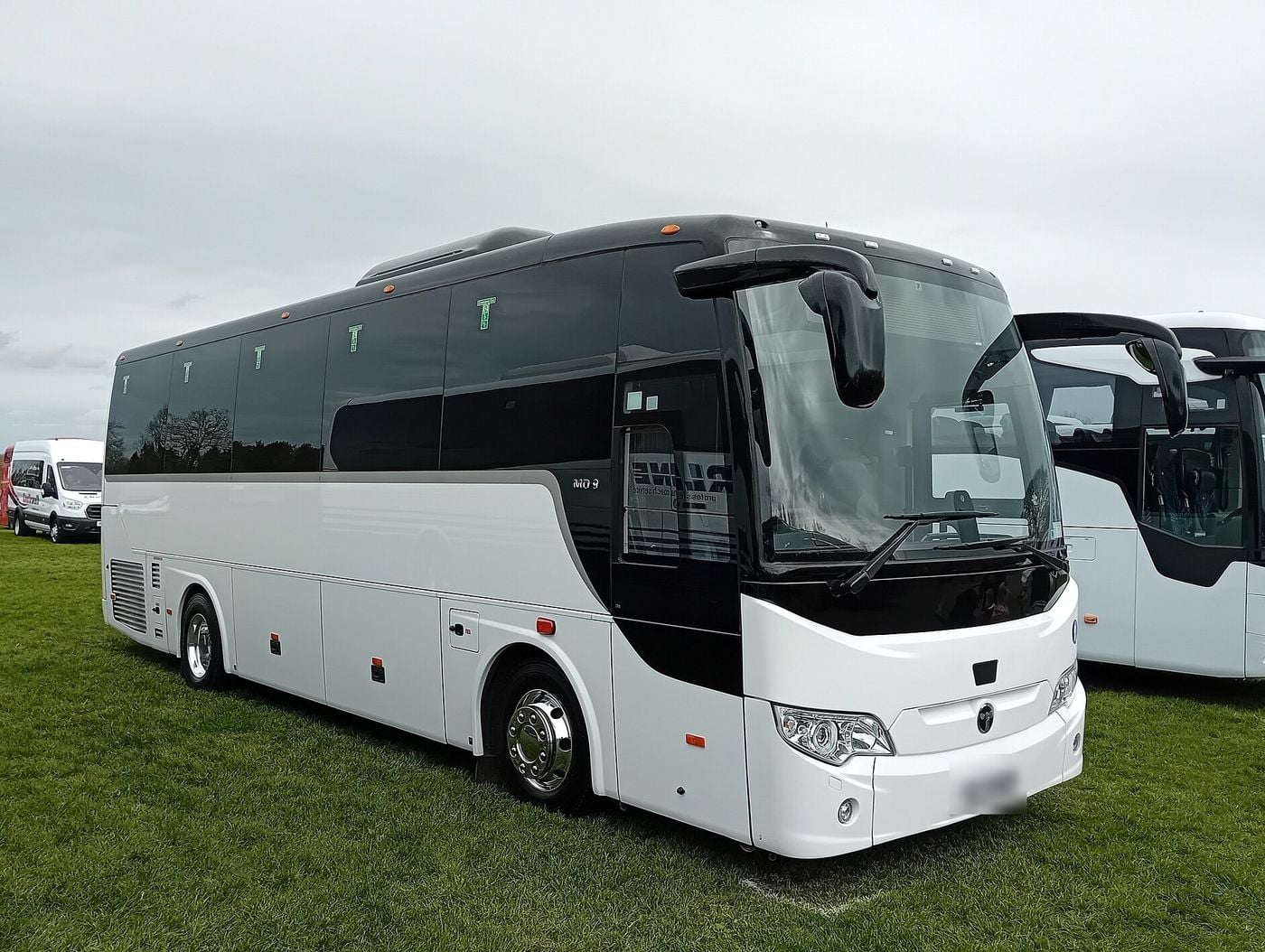

Model overview
- Segment
- Bus
- Emission
- Euro 6
- Transmission
- MD9: ZF manual (standard) or Allison automatic (optional), 6 forward + 1 reverse; MD9 LE: Allison T280R automatic, 6 forward + 1 reverse
- Gross vehicle
- 14 400 kg
- Length
- 9 480 mm
- Wheelbase
- 4 600 mm
- Turning circle
- 17 200 mm
- Capacity
- 39+1 (MD9); 25–36 (MD9 LE) + MD9 LE: 40 with 30 seats (two doors), 44 with 26 seats (three doors)
- Doors
- MD9 LE: two or three doors
Engine families
- Power
- 235 kW
- Torque
- 1100 Nm
- Rated speed
- 2500 rpm
- Power
- 182 kW
- Torque
- 982 Nm
- Rated speed
- 2100 rpm
The MD9 is TEMSA’s compact coach; the imprints of its brochures name Temsa Skoda Sabancı Ulaşım Araçları A.Ş. as the holder of the TEMSA marks. The product menu of Temsa’s international site lists the MD9 under “Coaches”, beside an “MD9 RHD” and the Maraton, and the MD9 LE under “City”, beside the Avenue Neo 9e; the same menu also lists an MD9 electriCITY under “City”. Temsa heads the MD9 product page “Compact in Size, Big on Performance” and says the coach is “Designed for operators who seek the performance of a full-size coach in a smaller, more agile package”; the MD9 LE page is headed “The Privileged Face of Urban Transportation”. Both versions are 2,400 mm wide on a 4,600 mm wheelbase and carry a six-cylinder in-line diesel of 6.7 litres: an FPT N67 in the coach and a Cummins ISB E6 in the MD9 LE.
The figures for the coach come from Temsa’s English MD9 brochure, whose imprint says its information is accurate as of 09/2025 (the PDF was created on 15 September 2025), and from the MD9 product page of Temsa’s international site in English. The figures for the MD9 LE come from Temsa’s two-page English MD9 LE data sheet, whose information is dated 04/2025 (the PDF was created on 7 May 2025), and from the MD9 LE product page. All four were read on 9 November 2026. Both PDFs print a point as the thousands separator (“9.480 mm”) and add that specifications “may differ per country”; the MD9 LE sheet notes that the gross vehicle weight “may vary depending on country regulations”. What the rows of a coach data sheet stand for is set out in how a coach specification sheet is read.
MD9 coach
The product page describes an integral chassis, independent front suspension and “a precisely tuned air suspension system”.
Dimensions and weights
| Row | Figure | Document |
|---|---|---|
| Length | 9,480 mm | brochure, product page |
| Width | 2,400 mm | brochure, product page |
| Height, including the air conditioner | 3,345 mm | brochure, product page |
| Floor-to-ceiling height | 1,910 mm | brochure; “Interior Height” on the product page |
| Wheelbase | 4,600 mm | brochure |
| Front overhang | 1,916 mm | brochure |
| Rear overhang | 2,964 mm | brochure |
| Turning diameter | 17,200 mm | brochure |
| Approach angle | 8° | brochure |
| Seating capacity | 39 + 1 | brochure, product page |
| Gross vehicle weight | 14,400 kg | brochure, product page |
| Luggage volume | 5 m³ | brochure, product page |
The brochure offers seat layouts with a maximum of 39 passengers, 34 seats with a WC, or 32 seats with a WC and a kitchen; its equipment list marks the “32 or 34 Seat Layouts”, the WC and the kitchen unit as options. No document opened gives an unladen weight.
Engine and gearboxes
| Row | Figure |
|---|---|
| Model | “Euro 6 FPT”; the brochure text names the FPT N67 |
| Type | diesel, four-stroke, turbocharged, direct injection (brochure); water-cooled (product page) |
| Cylinders | 6, in line |
| Bore × stroke | 104 × 132 mm (brochure) |
| Displacement | printed “6.728 L” (brochure) and “6,728 L” (product page) |
| Maximum power | 235 kW (320 HP) at 2,500 rpm |
| Maximum torque | 1,100 Nm at 1,250–1,890 rpm |
The brochure text calls the FPT N67 a “6.7-liter engine”. Temsa lists it as Euro 6 without a sub-stage; the stages are set out in Euro 6 and Euro 7 explained.
The brochure gives a ZF manual gearbox as standard and an Allison automatic as the option, each with 6 forward gears and 1 reverse. The product page lists the same two types, “Manual” and “Automatic”, each “6 Forward + 1 Reverse”, without naming their makers. Allison’s range is covered in Allison automatic transmissions.
Axles, wheels, steering and brakes
| Row | Figure |
|---|---|
| Front axle | independent, 5,000 kg |
| Rear axle | rigid, 9,440 kg |
| Differential ratio | 3.73 (brochure) |
| Rims | 19.5 x 7.5 |
| Tyres | 265/70 R19.5 |
Steering is hydraulic, with a steering wheel that adjusts for tilt and reach (“Tilt and Telescopic”; “Height and Tilt Adjustment” on the product page). The brochure lists as standard the service brake, the parking brake, ABS, ASR, EBS, the advanced emergency braking system (AEBS) and a “Retarder/Intarder”, together with a spare tyre. How a retarder works beside the service brakes is covered in retarders and engine braking.
Fuel, urea and electrical system
The fuel tank holds 280 litres and the urea tank 30 litres. The electrical system runs at 24 V on two 12 V batteries of 180 Ah (“2 x 12V, 180 Ah”), with a circuit separator on the battery as standard.
Body, interior and driver’s area
Body lifting and kneeling, rim covers, fog lights, a random coded lock and an electric horn are standard; xenon lights, a ski box and an air horn are optional. The standard paint is opaque white and a metallic paint is optional. The brochure text describes headlights followed by a chrome line around the body, rear wings, a wide luggage space and “a ski port at the back”.
For the passengers the brochure lists as standard the “Multiset”, curtains, a parcel rack, reclining seats with a sliding mechanism and a dashboard handle; an assistant seat, service trays, seat pockets, USB chargers and three-point seat belts are optional. The product page says each seat is “equipped with magazine nets, footrests, and A/C-type power outlets”. Double-glazed side windows, the air conditioner, an additional heating system, an air-conditioning defroster and a convector are standard.
The driver’s area has a manual sun visor, an interior mirror, an electrically operated driver’s window and a three-point belt for the driver’s seat as standard; an electric sun visor, left and right armrests, a heated driver’s seat and a heated windscreen are optional. The brochure text adds lumbar support for the driver’s seat. A radio and MP3 player, electrically adjustable exterior mirrors, a reverse-gear buzzer and a tachograph are standard; a monitor, a front microphone, a bottle cooler in the dashboard, a rear-view camera, rear parking sensors, a school bus sign, destination plates and an alcoholmeter are optional.
Safety and driver assistance
The brochure’s safety list marks as standard the electronic stability programme (ESP), the lane departure warning system (LDWS), a collision mitigation system, pedestrian and cyclist collision warning, driver drowsiness and attention monitoring and intelligent speed assistance, together with a fire warning system and a fire extinguishing system for the engine room and a fire extinguisher; an additional extinguisher is optional. The brochure says the LDWS “warns the driver with an audible and vibrating alert whenever the vehicle moves out of its lane”. The product page says that in an unavoidable impact “MD9’s high-strength body structure helps safeguard passenger safety by maintaining structural integrity”. Which of these systems the EU General Safety Regulation requires, and from when, is set out in mandatory driver assistance systems.
MD9 LE
Temsa lists the MD9 LE under “City”. The product page describes a three-door version that “speeds up passenger circulation” and a “low-floor design” that “maximizes accessibility”; the data sheet lists two or three doors (“2/3 Doors”) and a Class 2 version as options. The bus classes are set out in bus classes under UN R107.
Dimensions and weights
| Row | Data sheet | Product page |
|---|---|---|
| Length | 9,536 mm | 9,536 mm |
| Width | 2,400 mm | 2,400 mm |
| Height, including the air conditioner | 3,132 mm | 3,132 mm |
| Floor-to-ceiling height | “Rear: 1.840/Front: 2.520 mm” | “Front: 1,840 mm / Rear: 2,520 mm” |
| Wheelbase | 4,600 mm | not printed |
| Front overhang | 2,056 mm | not printed |
| Rear overhang | 2,880 mm | not printed |
| Turning radius | 8,300 mm | not printed |
| Approach angle | 9°/8° | not printed |
| Seats | maximum 30 (Class I) / 36 (Class II) | 25–36 |
| Gross vehicle weight | 14,440 kg | 14,440 kg |
The two documents give the interior heights the other way round: the data sheet puts 1,840 mm at the rear and 2,520 mm at the front, the product page 1,840 mm at the front and 2,520 mm at the rear. The product page’s text gives an interior height “ranging from 1,840 to 2,520 mm” and a seating capacity “between 26 and 36”, and in its questions and answers says the number of seats “can be customized from 26-36”. The same answers give a total of 70 passengers with either door arrangement: 30 seated and 40 standing with two doors, 26 seated and 44 standing with three doors. The data sheet gives a turning radius, where the coach brochure gives a turning diameter.
Engine and gearbox
| Row | Figure |
|---|---|
| Model | “ISB E6 Cummins” (data sheet); “E6 Cummins” (product page) |
| Type | diesel, four-stroke, turbocharged, direct injection |
| Cylinders | 6, in line |
| Displacement | 6.7 L |
| Maximum power | 182 kW (250 HP) at 2,100 rpm |
| Maximum torque | 982 Nm at 1,200–1,400 rpm |
| Gearbox | Allison automatic, 6 forward + 1 reverse |
The product page names the engine and gearbox as “the Cummins ISB E6 engine and Allison T280R transmission” and describes “a 30-liter AdBlue tank compliant with Euro 6 standards” and a “lightweight chassis”. The data sheet prints no bore and stroke. In its questions and answers the product page says: “According to SORT2 values, MD9 LE offers a range of 545 km.”
Axles, wheels, steering and brakes
| Row | Data sheet | Product page |
|---|---|---|
| Front axle | independent, 5,000 kg | “ZF Independent”, 5,000 kg |
| Rear axle | rigid, 9,440 kg | “HANDE, Rigid”, 9,500 kg |
| Differential ratio | “5,125/4,10/3,7” (5.125, 4.10 or 3.7) | not printed |
| Rims | 7.5 x 19.5 | 7.5 X 19.5 |
| Tyres | 265/70 R19.5 | 265/70 R19.5 |
The two documents differ on the rear axle capacity: 9,440 kg on the data sheet, 9,500 kg on the product page. Steering is hydraulic and the steering wheel adjusts for tilt and reach; the product page says the independent front suspension “minimizes vibrations under all road conditions”. The data sheet lists as standard the service brake, the parking brake, ABS, ASR, an intarder and a “Temporary Bus Stop” function; EBS is optional.
Fuel, urea and electrical system
The fuel tank holds 200 litres and the urea tank 30 litres. The electrical system runs at 24 V on two 12 V batteries of 180 Ah (“2 x 12 V 180Ah”); a low-voltage warning and a circuit separator on the battery are standard and automatic fuses optional.
Body, interior and driver’s area
Body lifting, body kneeling and side kneeling, a manual ramp, fog lights, a random coded lock, an electric horn and a dashboard handle are standard; rim covers, a ski box, a spare tyre, wheelchair fixing equipment and a ticket machine preparation are optional. The standard paint is opaque white and a metallic paint is optional. The air conditioner and an additional heating system are standard; double-glazed side windows, an air-conditioning defroster and a preheater are optional.
The data sheet lists for the driver a sun visor, an interior mirror, a sliding, heated front driver’s window and a three-point belt as standard, and a heated windscreen and left and right armrests as options; the product page describes “a height-adjustable seat” and “A wide driver cabin and ergonomic dashboard”. A reverse-gear buzzer and a tachograph are standard; a radio and MP3 player, electrically adjustable exterior mirrors, destination plates, rear parking sensors, a school bus sign, a rear-view camera and an alcoholmeter are optional.
Safety and driver assistance
The data sheet’s safety list marks as standard a fire warning system for the engine room, a fire extinguisher, safety hammers, a circuit separator on the battery, a low-voltage warning and the preparation for an alcohol interlock; the alcohol interlock itself, the electronic stability programme (ESP) and the lane departure warning system (LDWS) are optional. A further group is marked “Standard for GSR regions, optional for non-GSR regions”: the reversing information system (ReIS), tyre pressure monitoring (TPMS), intelligent speed assistance (ISA), driver drowsiness and attention warning (DDAW), pedestrian and cyclist collision warning (MOIS), the emergency stop signal (ESS), the blind spot information system (BSIS) and cyber security.
In its questions and answers the product page gives the MD9 LE “The 2-year/200,000 km warranty and 24/7 roadside assistance”.
The MD9 in Temsa documents
| Date | What the document says | Document |
|---|---|---|
| 13 October 2015 | A news item with “MD 9” in its title. | TEMSA World news list |
| 04/2025 | Information date of the English MD9 LE data sheet; the PDF was created on 7 May 2025. | Temsa data sheet |
| 09/2025 | Information date of the English MD9 brochure; the PDF was created on 15 September 2025. | Temsa brochure |
| 4 November 2026 | News item “TEMSA Showcases HD and MD9 at Euro Bus Expo”. | TEMSA World news list |
No document opened gives the year the MD9 or the MD9 LE was introduced, or describes earlier versions of either.
Source notes
The grid above describes the MD9 coach as Temsa’s English brochure (information as of 09/2025) and its product page give it: 9,480 mm long, 2,400 mm wide and 3,345 mm high including the air conditioning, on a 4,600 mm wheelbase, with a 17,200 mm turning diameter, 39+1 seats, 5 m³ of luggage space and a gross vehicle weight of 14,400 kg. Its engine is the FPT N67, a six-cylinder in-line Euro 6 diesel of 6.728 litres, at 235 kW at 2,500 rpm and 1,100 Nm at 1,250-1,890 rpm, with a ZF manual gearbox as standard and an Allison automatic as an option, both with 6 forward gears and 1 reverse. The second engine row, the second seat entry and the standee and door entries belong to the MD9 LE, which Temsa’s English data sheet (information as of 04/2025) and its product page give at 9,536 mm long, 2,400 mm wide and 3,132 mm high on the same 4,600 mm wheelbase, with a gross vehicle weight of 14,440 kg: a Cummins ISB E6 of 6.7 litres at 182 kW at 2,100 rpm and 982 Nm at 1,200-1,400 rpm, with an Allison automatic gearbox, 6 forward gears and 1 reverse.
Quick answers
- Which engines are available in the Temsa MD9?
- The record for the Temsa MD9 covers these engine families: FPT N67 (6.728 l), Cummins ISB E6 (6.7 l). Output spans 182–235 kW and 982–1100 Nm.
- What emission standard does the Temsa MD9 meet?
- Euro 6.
- Which transmission does the Temsa MD9 use?
- Transmission: MD9: ZF manual (standard) or Allison automatic (optional), 6 forward + 1 reverse; MD9 LE: Allison T280R automatic, 6 forward + 1 reverse.
- What is the gross vehicle weight of the Temsa MD9?
- Gross vehicle weight: 14 400 kg.
- How long is the Temsa MD9?
- Length: 9 480 mm; Wheelbase: 4 600 mm.
- How many passengers does the Temsa MD9 carry?
- Capacity: 39+1 (MD9); 25–36 (MD9 LE); Standing places: MD9 LE: 40 with 30 seats (two doors), 44 with 26 seats (three doors).
More Temsa on this site
Sources
- TEMSA MD9 brochure (English, information as of 09/2025) — Temsa Skoda Sabancı Ulaşım Araçları A.Ş.
- TEMSA MD9 LE data sheet (English, information as of 04/2025) — Temsa Skoda Sabancı Ulaşım Araçları A.Ş.
- MD9 — product page (international site, English) — TEMSA
- MD9 LE — product page (international site, English) — TEMSA
- News — TEMSA World (list with the item of 4 November 2026, “TEMSA Showcases HD and MD9 at Euro Bus Expo”) — TEMSA