Allison automatic transmissions: series, vocational models and retarder
Allison's torque-converter automatics for trucks and buses: the series up to the 9000, what HS, RDS, PTS and EVS mean in model names, the 9-Speed ratios and the integral retarder.
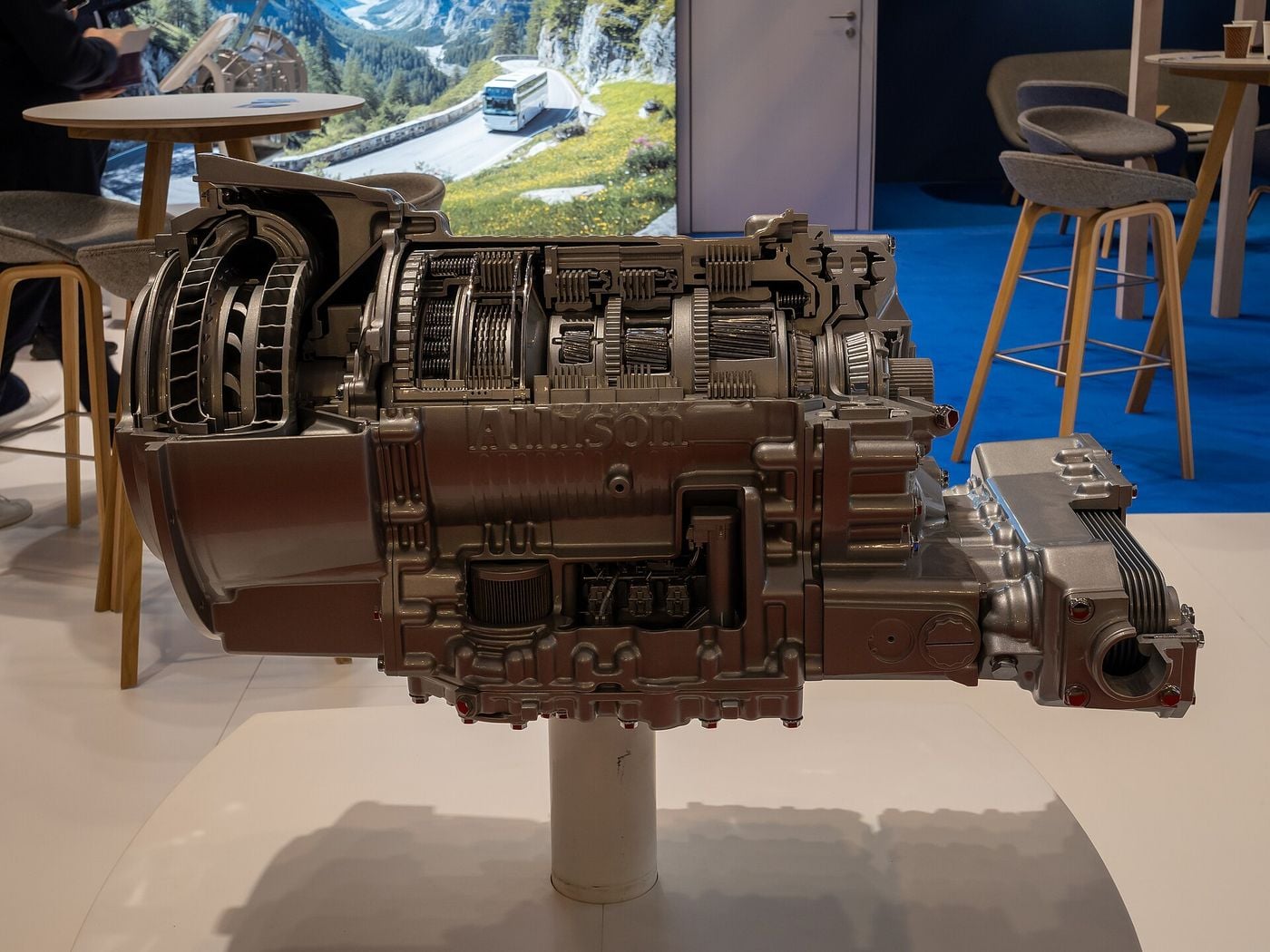
Allison automatic transmissions are the fully automatic gearboxes of Allison Transmission, a maker based in Indianapolis, Indiana, whose 2024 coach brochure defines them in one sentence: “A hydraulic torque converter couples the engine to a planetary-geared transmission providing uninterrupted, continuous power shifts.” Allison sells them in series, from the 1000 and 2000 Series for light- and medium-duty trucks and buses to the 9000 Series for mining vehicles, oil field equipment and cranes, and in its Vocational Model Guide each model carries the letters of the vocational series it is rated for: a 3000 HS belongs to the Highway Series, a 3000 RDS to the Rugged Duty Series. The guide, updated on 20 January 2026, names manufacturing plants in Hungary and India besides the Indianapolis headquarters and about 1,600 Allison authorised distributors and dealers worldwide. On the model pages of this site an Allison is named in European city and distribution trucks such as the Volvo FE and the Iveco Eurocargo, in North American medium-duty and vocational trucks, in a hydrogen fuel cell truck and in Turkish midibuses and an intercity bus.
Status as at 9 November 2026. Read on that day: Allison Transmission’s product pages for each series, its pages on the torque converter, the integral retarder, eGen Flex and eGen Power, its transit and coach bus page, the Vocational Model Guide in version 1.20.26 of 20 January 2026, and seven Allison brochures, from the 3414 Regional Haul Series brochure of October 2019 to the torque converter brochure of October 2024.
The torque converter and the shift
Allison’s torque converter page says the converter “smoothly multiplies high engine torque, delivering more power to the vehicle’s wheels”. Allison’s name for shifting without a break in traction is Continuous Power Technology. How the EU’s CO2 rules define the automatic powershifting transmission and the torque converter beside the synchronised manual, the automated manual and the dual-clutch gearbox is set out in truck gearbox types and automated manual transmissions.
The 9-Speed page gives a worked launch example. A turbine torque of 750 lb-ft multiplied by the close-ratio first range of 4.26 gives an output torque of 3,195 lb-ft, and with an axle ratio of 4.53 a wheel torque at launch of 14,473 lb-ft; with the wide-ratio first range of 4.82 the output torque is 3,615 lb-ft. The torque converter brochure of October 2024 writes the chain as launch torque × torque converter multiplication × first gear ratio × rear axle ratio = wheel torque at launch, and adds: “Equation is a representation.” The part the axle ratio plays is covered in axle ratios and final drive.
Shifts are commanded electronically. The 9-Speed page describes the Transmission Control Module as “an onboard micro-computer that receives input for various vehicle systems to control automatic shift schedules”; on the 9-Speed it is mounted externally on the chassis and the transmission is shift-by-wire. Allison’s product pages present its 6th generation controls platform as including “enhanced technology, cybersecurity and functional safety”.
History in two dates
The Vocational Model Guide begins its introduction of the company with “Since 1915”. Allison’s transit and coach page dates its bus business to 1947, “when we introduced the ‘V’ transmission for the GM Coach Division”, whose buses, it says, “transported millions of passengers in North America for more than 30 years”. Its city bus brochure of August 2020 calls the 1947 transmission “the world’s first fully automatic transmission for buses”.
The series by duty
The guide sorts the series by weight class: “Our 1000 and 2000 Series transmissions are appropriate for light- and medium-duty vehicles”, “The 3000 and 4000 Series transmissions are designed for medium- and heavy-duty vehicles” and “6000, 8000 and 9000 Series transmissions are compatible with heavy-duty applications.” The ratings Allison lists for the 1000 and 2000 Series, the 9-Speed and the 3000, 4000 and 6000 Series, with their numbers of forward gears and the applications Allison names, are tabulated in truck gearbox types.
Allison’s pages present the 8000 and 9000 Series as transmissions built for energy and mining vehicles. The 8000 Series accommodates engines of 850 to 1,200 hp (634 to 895 kW) and up to 3,600 lb-ft (4,881 Nm), with six or seven forward gears depending on the model. The 9000 Series has eight forward and two reverse speeds and ratings of up to 3,200 hp (2,386 kW) and 9,000 lb-ft (12,200 Nm); its page gives the range as 1,350 to 3,200 hp (1,007 to 2,386 kW). Allison names mining vehicles, oil field equipment and cranes for both. Its product list also carries the FracTran, purpose-designed for hydraulic fracturing, with up to 3,300 hp (2,460 kW) and 10,600 lb-ft (14,372 Nm), and the X Models for tracked combat vehicles.
Vocational series: the letters after the number
The Vocational Model Guide lists every transmission model under one or more vocational series, and in each series it gives the model its own ratings: gross input power and torque, net turbine torque, and maximum gross vehicle and gross combination weight. A base model therefore appears several times: the 3000 is listed as a 3000 EVS, HS, MH, ORS, PTS, RDS and SP, and as a 3000 TRV. The meaning of the weight terms is explained in GVWR, GCWR and GAWR.
| Series | Letters | Models listed | Typical vehicle applications in the guide |
|---|---|---|---|
| Bus Series | B before the number | B 210, B 220, B 295, B 300, B 400, B 3400 xFE, B 500 | Revenue-generating/FTA transit bus applications, transit bus, intercity bus under 53,000 lb GVW, tour coach, shuttle bus over 33,000 lb GVW |
| Emergency Vehicle Series | EVS | 1000, 1350, 2100, 2200, 2350, 2500, 2550, 3000, 3500, 4000, 4500, 4700, 4800, 4850, 4900, 4970 | Aerial ladder platform, aircraft rescue and fire-fighting vehicle, ambulance, fire truck pumper with and without split-shaft PTO, hazardous material vehicle, mobile command center, support vehicle |
| Highway Series | HS | 1000, 1350, 2100, 2200, 2300, 2350, 2500, 2550, 3000, 4000, 4500 | Nineteen uses, among them distribution, beverage delivery, food distribution, general freight, line haul, automobile transporter, livestock hauler, flatbed, moving and storage, and walk-in van |
| Motorhome Series | MH | 1000, 1350, 2100, 2200, 2350, 2500, 2550, 3000, 4000 | Type A and bus conversion motorhomes (Class 5 to 8), Type C motorhomes (Class 4 to 5), entertainer travel coaches |
| Truck RV Series | TRV | 3000, 3200, 4000 | Truck-based recreational vehicles, Class 6 to 8 Type C motorhomes |
| Oil Field Series | OFS | 3500, 4430, 4500, 4700, 4750, 4800, 4870, 6620, 8610, 9832 (also as 9832 OFSD), FracTran | Drilling, cementing, fracturing, hoisting, pumping |
| Off Road Series | ORS | 3000, 3200, 3500, 4000, 4200, 4430, 4500, 4600, 4700, 4800, 6620, 6625, 8610, 9610 | Articulated dump, rigid dump, rigid rear dump |
| Pupil Transport/Shuttle Series | PTS | 1000, 1350, 2100, 2200, 2300, 2350, 2500, 2550, 2575, 3000 | Class 5 to 8 school bus; church, private academy, prison and work buses; Class 5 to 7 shuttle bus up to 33,000 lb GVW |
| Regional Haul Series | RHS | 3414 | Beverage delivery, distribution, dry bulk, food distribution, general freight, regional haul |
| Rugged Duty Series | RDS | 1000, 1350, 2100, 2200, 2300, 2350, 2500, 2550, 3000, 3500, 4000, 4500, 4700, 4900, 4970 | Twenty-four uses, among them refuse front and side loaders, rear loaders, roll-on/roll-off, concrete mixer and pumper, dump truck, wrecker, sewer and septic vacuum, snow removal vehicle, yard tractor and airport support |
| Specialty Series | SP | 1000, 1350, 2100, 2200, 2350, 2500, 2550, 3000, 3200, 3500, 3700, 4000, 4430, 4500, 4700, 4800, 4900, 4970, 6620, 6625, 8610, 9610 | Military, crane carrier, equipment hauler with escort or permit, molten metal and slag hauler, power plant generator hauler, heavy equipment hauler |
The guide ties some uses to one series in its footnotes. “Any vehicle that operates on-highway and does not need a PTO requires an Allison Highway Series transmission.” “Any vehicle equipped with emergency signaling (such as a siren, light bar, grill signal, porter light, etc.) that allows the vehicle to ignore general traffic laws in emergency situations requires an Allison Emergency Vehicle Series transmission.” For school and shuttle buses: “Buses requiring PTO must use Bus Series models. All shuttle applications greater than 33,000 lbs. GVW require B 300 or B 400 transmissions”, and “Revenue-generating/FTA transit bus applications are excluded from Pupil Transport/Shuttle Series usage.” For motorhomes: “Class 6-8 Type C Motorhomes require a Truck RV Series transmission.”
The guide’s feature table sets the series against features that include a power take-off, a dual power take-off, a park pawl, a second reverse, a deep oil pan, additional speeds, xFE and a retarder. Allison’s 1000 and 2000 Series page explains the two ratio sets of those models: “Close ratio is available for optimized fuel economy and wide ratio is available for optimized startability.” The Mack MD page shows the naming in use: its three Allison gearboxes are a 2500 HS, a 2500 RDS and a 3000 RDS.
The 3414 Regional Haul Series
Allison’s 3000 Series page calls the 3414 Regional Haul Series “an uprated variant” of the 3000 Series, for engines of up to 410 hp (306 kW) and with torque of up to 1,450 lb-ft (1,966 Nm). Its brochure of October 2019 adds a turbine torque of 1,700 lb-ft (2,305 Nm), an engine-driven power take-off, diesel and CNG compatibility, and “Same form, fit, function and connections as a 3000 Series”. The two documents differ on the weight: the 2019 brochure gives a gross combined weight of 80,000 lb (36,287 kg), the January 2026 guide a maximum GCW of 82,000 lb (37,194 kg). The guide lists beverage delivery, distribution, dry bulk, food distribution, general freight and regional haul as its applications.
The 9-Speed
The 9-Speed is built on the 2000 Series; Allison’s brochure says it has “significant parts commonality” with the 2000 Series 6-speed transmission. It has nine forward ranges, three of them overdrive ranges, and ratings of up to 380 hp (283 kW), 900 lb-ft (1,220 Nm) of input torque and 57,000 lb GVW; the brochure of May 2024 adds up to 3,600 lb-ft of output torque for the wide-ratio version only, a dry weight of 383 lb (173.8 kg) and a length of 821.7 mm. Allison calls the first, third and ninth ranges new.
| Range | Close ratio (CR) | Wide ratio (WR) |
|---|---|---|
| 1st | 4.26 | 4.82 |
| 2nd | 3.10 | 3.51 |
| 3rd | 2.60 | 2.85 |
| 4th | 1.81 | 1.90 |
| 5th | 1.41 | 1.44 |
| 6th | 1.00 | 1.00 |
| 7th | 0.71 | 0.74 |
| 8th | 0.61 | 0.64 |
| 9th | 0.54 | 0.57 |
| Reverse | 4.49 | 5.09 |
On this site the Otokar Sultan page names an Allison nine-speed automatic, and the Freightliner M2 page records the 9-Speed in the M2 106 Plus brochure.
Integral retarder
Allison’s retarder brochure of August 2021 describes the unit as “Essentially a vaned flywheel in the transmission housing” that uses the transmission’s oil to provide resistance, absorbs the vehicle’s energy through the drive shaft and delivers braking power to the driving wheels; the energy is converted to heat and dissipated through the vehicle’s cooling system. “Allison models are available with output retarders mounted on the output shaft, behind the gearing. They generate the greatest braking at high drive shaft RPM and work independent of engine speed or gear ratio.” As ways of applying it the brochure and Allison’s retarder page list a switch on the dash or a hand lever, a separate foot pedal, or automatic application when the accelerator is released or the brake pedal is pressed. It calls the retarder compatible with anti-lock and electronic braking systems and states: “A retarder is not a replacement for service brakes”.
The guide’s feature table has a retarder row, and the 6000 Series page lists “optional retarder capability”. The Scania L-series page records 6-speed Allison automatics with or without retarder, and the Renault Trucks D page an Allison hydraulic retarder. The retarder types, how UN Regulation No 13 tests endurance braking and where a retarder sits in the driveline are covered in retarders and engine braking; the power take-off openings on Allison 3000 and 4000 Series gearboxes, and PTO makers’ ratings for Allison gearboxes, are in power take-off explained.
Electric hybrid drive and electric axles
Allison’s page on eGen Flex says it introduced its first electric hybrid propulsion system for transit buses “more than 20 years ago”. eGen Flex, which Allison calls its next-generation solution, has a drive unit with “a multispeed gearbox with two fully integrated electric motors and a disconnect clutch to enable full EV operation”, an inverter and a lithium-titanate battery, which the guide gives as 26 kWh; Allison states that the bus can run up to 50 % of its route with the engine off, with the electric-only mode switched by geofencing. The ratings are up to 330 hp (246 kW), 1,050 lb-ft (1,424 Nm) and 70,000 lb (31,752 kg) GVW.
eGen Power is a family of electric axles which, in Allison’s description, fit between the wheels of medium- and heavy-duty trucks and buses and replace the vehicle’s traditional powertrain. The brochure of November 2023 lists the single-motor 85S, 100S and 130S and the dual-motor 100D and 130D, with gross axle weight ratings of 8,500 kg for the 85S, 10,433 kg (23,000 lb) for the 100S and 100D and 13,000 kg for the 130S and 130D. The eGen Power page gives the 100S 225 kW continuous and 325 kW peak power with 26,000 Nm of torque at the wheels and a two-speed parallel axis gear architecture, and the 100D “greater than 450 kilowatts of continuous power, with peak power of 650 kilowatts”; the 130S and 130D are the variants for Europe and Asia Pacific. Allison’s transit and coach bus page gives the family’s rating as up to 450 kW and its product list as up to 650 kW. The page reports the 85S integrated in Anadolu Isuzu’s Novo VOLT fully electric midibus. The propulsion types of city buses, hybrid among them, are set out in city bus propulsion.
Model pages on this site that name an Allison
| Model page | Allison named |
|---|---|
| Anadolu Isuzu Grand Toro | Allison T3270R xFE automatic in the catalogue |
| DAF XB | 5-speed fully automatic Allison for special applications |
| Freightliner M2 | Allison 1000, 2000 and 3000 Series on the M2 106 Plus; 3000 and 4000 Series on the M2 112 Plus |
| Hyundai Xcient Fuel Cell | Allison ATM 4500 R, 5 forward gears |
| International MV Series | Allison 2000 and 3000 Series in HS, EVS, RDS and MH versions |
| Iveco Eurocargo | 6-speed Allison automatic |
| Mack MD | Allison 2500 HS, 2500 RDS and 3000 RDS |
| Mercedes-Benz Atego | Allison fully automatic in the defence table |
| Otokar Sultan | Allison nine-speed automatic |
| Peterbilt 537 and 548 | Allison 2000, 3000 and 4000 Series, 6-speed |
| Renault Trucks D | Allison 3200, 6 gears; Allison hydraulic retarder |
| Scania L-series | 6-speed Allison fully automatic, with or without retarder |
| Tatra Phoenix | Allison fully automatic on request |
| Temsa LD SB Plus | Allison automatic as an option with the FPT engine |
| UD Trucks Quester | Allison 3000/3200 with the GH8E, Allison 4000 with the GH11E |
| Volvo FE | Allison AL306 6-speed automatic, an option on the rigid data sheets |
| Volvo FL | Allison AL306 6-speed automatic on the FL816 and FL818 sheets |
| Western Star 49X | Allison 4000, 4500 and 4700 |
Several of these designations, such as the T3270R, the ATM 4500 R and the AL306, do not appear in the Vocational Model Guide; they are recorded as the truck and bus makers print them.
Quick answers
- What is an Allison automatic transmission?
- A fully automatic gearbox from Allison Transmission of Indianapolis, which describes it in its 2024 coach brochure this way: "A hydraulic torque converter couples the engine to a planetary-geared transmission providing uninterrupted, continuous power shifts." Allison lists series from the 1000 and 2000 Series, for light- and medium-duty vehicles, through the 3000 and 4000 Series to the 6000, 8000 and 9000 Series for heavy-duty applications. Its Vocational Model Guide of 20 January 2026 names manufacturing plants in Hungary and India besides the Indianapolis headquarters.
- What do HS, RDS, PTS and EVS mean on an Allison transmission?
- They name the vocational series the model belongs to in Allison's Vocational Model Guide: HS is the Highway Series, RDS the Rugged Duty Series, PTS the Pupil Transport/Shuttle Series and EVS the Emergency Vehicle Series. The guide also has the Motorhome (MH), Truck RV (TRV), Oil Field (OFS), Off Road (ORS), Regional Haul (RHS) and Specialty (SP) Series, and a Bus Series whose models carry a B before the number, such as the B 300. The same base model can appear in several series, so the guide lists a 3000 HS, a 3000 RDS and a 3000 PTS.
- What are the gear ratios of the Allison 9-Speed?
- Allison's 9-Speed brochure of May 2024 gives the close-ratio version 4.26, 3.10, 2.60, 1.81, 1.41, 1.00, 0.71, 0.61 and 0.54 with a reverse of 4.49, and the wide-ratio version 4.82, 3.51, 2.85, 1.90, 1.44, 1.00, 0.74, 0.64 and 0.57 with a reverse of 5.09. Allison describes the 9-Speed as built on the 2000 Series, with nine forward ranges and three overdrive ranges and ratings of up to 380 hp (283 kW), 900 lb-ft (1,220 Nm) and 57,000 lb GVW.
- How does the Allison integral retarder work?
- Allison's retarder brochure of August 2021 describes it as "Essentially a vaned flywheel in the transmission housing" that uses the transmission's oil to provide resistance; the absorbed energy is converted to heat and dissipated through the vehicle's cooling system. Allison's output retarders are mounted on the output shaft, behind the gearing, and work independent of engine speed or gear ratio. The brochure states that a retarder is not a replacement for service brakes.
- What is the Allison 3414 Regional Haul Series?
- An uprated variant of the 3000 Series for regional haul and distribution trucks. Allison gives ratings of up to 410 hp (306 kW) and 1,450 lb-ft (1,966 Nm); its 2019 brochure adds a turbine torque of 1,700 lb-ft (2,305 Nm) and the same form, fit, function and connections as a 3000 Series. The brochure gives a gross combination weight of 80,000 lb (36,287 kg) and the Vocational Model Guide of January 2026 a maximum GCW of 82,000 lb (37,194 kg).
Models in this article
Sources
- Vocational Model Guide, version 1.20.26, updated on 20 January 2026: introduction, Features + Advantages, Allison Product Specifications, and the Bus, Hybrid/eGen Flex, Emergency Vehicle, Highway, Motorhome, Truck RV, Oil Field, Off Road, Pupil Transport/Shuttle, Regional Haul, Rugged Duty and Specialty Series sections — Allison Transmission, 20 Jan 2026
- Products: transmission models and their ratings capability (read on 9 November 2026) — Allison Transmission
- 1000 Series and 2000 Series (read on 9 November 2026) — Allison Transmission
- 3000 Series, with the 3414 Regional Haul Series (read on 9 November 2026) — Allison Transmission
- 6000 Series (read on 9 November 2026) — Allison Transmission
- 8000 Series (read on 9 November 2026) — Allison Transmission
- 9000 Series (read on 9 November 2026) — Allison Transmission
- 9-Speed, with the launch torque table (read on 9 November 2026) — Allison Transmission
- 9-Speed: brochure SA9188EN, edition 2024/05, ratings and gear ratios — Allison Transmission
- 3414 Regional Haul Series: brochure SA8557EN, edition 2019/10, ratings — Allison Transmission
- Torque Converter (read on 9 November 2026) — Allison Transmission
- Torque Converter: brochure SA9229EN, edition 2024/10 — Allison Transmission
- Coach Applications: brochure SA9215EN, edition 2024/09, transmission definition — Allison Transmission
- Integral Retarder (read on 9 November 2026) — Allison Transmission
- Integral Retarder: brochure SA7766EN, edition 2021/08 — Allison Transmission
- Propulsion solutions for transit and coach buses (read on 9 November 2026) — Allison Transmission
- City Bus: brochure SA8571EN, edition 2020/08 — Allison Transmission
- eGen Flex (read on 9 November 2026) — Allison Transmission
- eGen Power (read on 9 November 2026) — Allison Transmission
- eGen Power: brochure SA9128EN, edition 2023/11, ratings — Allison Transmission