Hyundai
Hyundai Xcient
Hyundai's Xcient diesel heavy truck from the maker's own documents: the XCIENT (QZ) cab, Q, H and Powertec engines, and tractor, cargo, dump and mixer sheets with weights.
- 4 configurations
- Euro I to Euro V, by engine
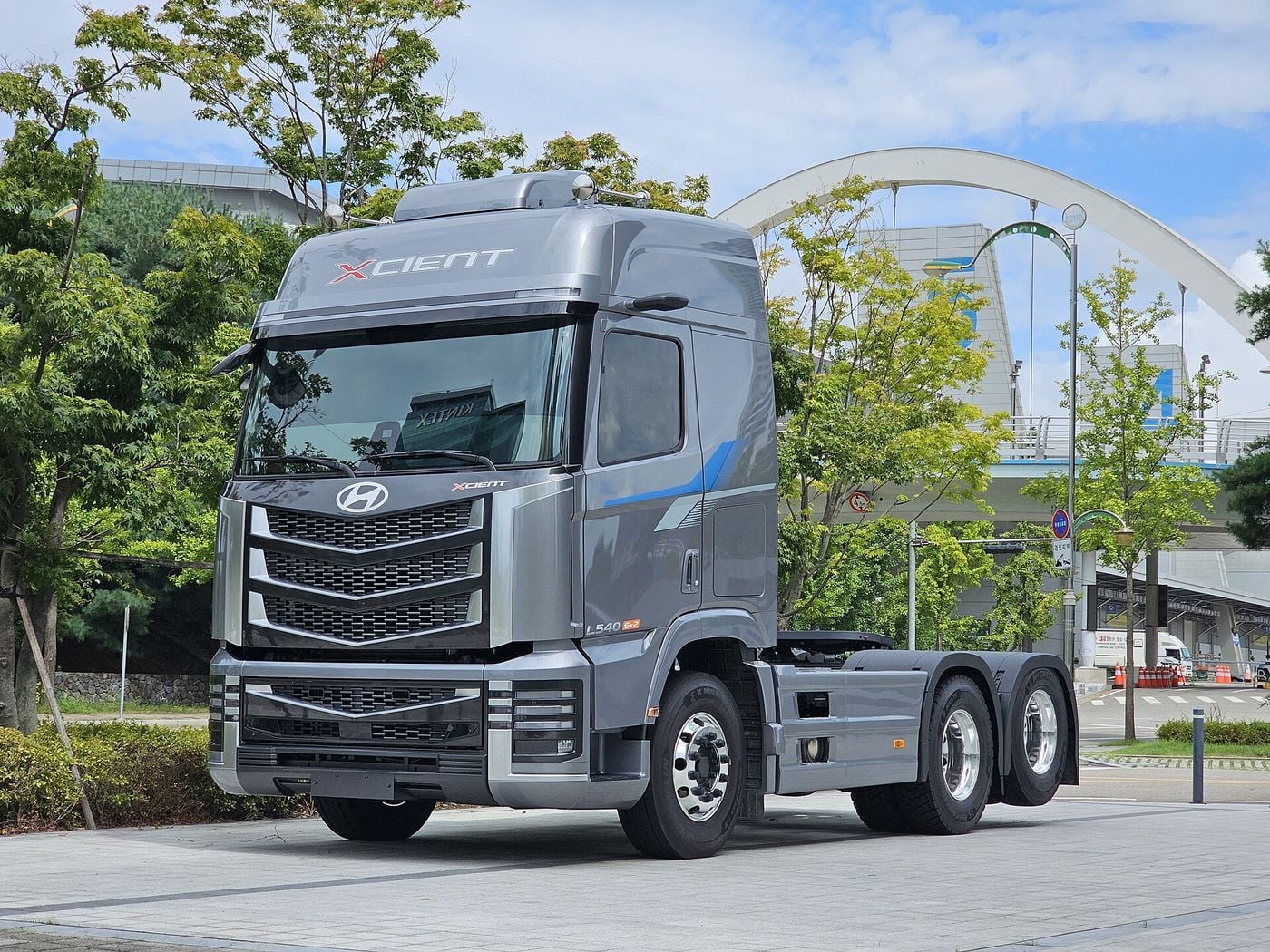

Model overview
- Segment
- Long-haul tractor
- Axle configurations
- 4 (4x2…)
- Emission
- Euro I to Euro V, by engine
- Transmission
- Manual M12S6 and H160S6 (6 forward, 1 reverse), M12S 2x5 and H160S 2x5 (10 forward, 2 reverse), FSO10309 (9 forward, 1 reverse), ZF16S1830 and ZF16S2330 (16 forward, 2 reverse); ZF12AS2540 automated manual (12 forward, 2 reverse); by engine and sheet
- Gross combination
- 70 t (64 Tractor (6x4); 42 Tractor (4x2) 50,000 kg)
Axle configurations: 4x2 · 6x2 · 6x4 · 8x4
| Variant | Axle configurations | Wheelbase (mm) | Kerb weight (kg) | Gross vehicle (kg) | Gross combination (kg) | Sheet |
|---|---|---|---|---|---|---|
| 42 Tractor, high chassis, medium wheelbase | 4x2 | 3,600 | 6,890 / 7,040 | 18,300 | 50,000 | Xcient Tractor sheet p. 29 (undated; file of 12 Dec 2017): "Tractor Weight" 6,890 to 7,040 by engine |
| 42 Tractor, high chassis, long wheelbase | 4x2 | 3,900 | 6,810 / 7,060 | 18,300 | 50,000 | Xcient Tractor sheet p. 30 (undated; file of 12 Dec 2017): "Tractor Weight" 6,810 to 7,060 by engine |
| 42 Tractor, low chassis, medium wheelbase | 4x2 | 3,600 | 7,130 / 7,280 | 21,000 | 50,000 | Xcient Tractor sheet p. 31 (undated; file of 12 Dec 2017): "Tractor Weight" 7,130 and 7,280 by engine |
| 42 Tractor, low chassis, long wheelbase | 4x2 | 3,900 | 7,130 / 7,280 | 21,000 | 50,000 | Xcient Tractor sheet p. 32 (undated; file of 12 Dec 2017): "Tractor Weight" 7,130 and 7,280 by engine |
| 64 Tractor, short wheelbase | 6x4 | 4,650 | 8,315 / 8,540 | 31,700 | 70,000 | Xcient Tractor sheet p. 36 (undated; file of 12 Dec 2017): wheelbase "4,650 (3,300+1,350)"; weight 8,315 to 8,540 by engine |
| 310 Cargo, short wheelbase | 6x4 | 5,650 | 8,420 / 8,685 | 30,700 | Xcient Cargo sheet p. 3 (undated; file of 12 Dec 2017): wheelbase "5,650 (4,300 + 1,350)"; chassis cab weight 8,420 to 8,685 by engine | |
| 310 Cargo, medium wheelbase | 6x4 | 6,100 | 8,455 / 8,715 | 30,700 | Xcient Cargo sheet p. 4 (undated; file of 12 Dec 2017): wheelbase "6,100 (4,750 + 1,350)"; chassis cab weight 8,455 to 8,715 by engine | |
| 310 Cargo, long wheelbase | 6x4 | 7,050 | 8,615 / 8,890 | 30,700 | Xcient Cargo sheet p. 5 (undated; file of 12 Dec 2017): wheelbase "7,050 (5,700 + 1,350)"; chassis cab weight 8,615 to 8,890 by engine | |
| 380 Cargo, short wheelbase | 8x4 | 7,470 | 10,250 / 10,350 | 38,200 | Xcient Cargo sheet p. 9 (undated; file of 12 Dec 2017): wheelbase "7,470 (1,990+4,130+1,350)"; chassis cab weight 10,250 and 10,350 by engine | |
| 380 Cargo, extra long wheelbase | 8x4 | 8,300 | 10,330 / 10,580 | 38,200 | Xcient Cargo sheet p. 10 (undated; file of 12 Dec 2017): wheelbase "8,300 (1,990 + 4,960 + 1,350)"; chassis cab weight 10,330 to 10,580 by engine | |
| 310 Dump, short wheelbase | 6x4 | 4,590 | 8,560 / 8,730 | 32,300 | Xcient Dump sheet p. 14 (undated; file of 12 Dec 2017): wheelbase "4,590 (3,240 + 1,350)"; chassis cab weight 8,560 to 8,730 by engine and day or sleeper cab | |
| 400 Dump, long wheelbase | 6x4 | 5,650 | 9,145 / 9,465 | 40,000 | Xcient Dump sheet p. 15 (undated; file of 12 Dec 2017): wheelbase "5,650 (4,300 + 1,350)"; chassis cab weight 9,145 to 9,465 by engine and day or sleeper cab | |
| 430 Dump, short wheelbase | 8x4 | 6,240 | 9,990 / 10,180 | 43,200 | Xcient Dump sheet p. 19 (undated; file of 12 Dec 2017): wheelbase "6,240 (1,990 + 2,900 + 1,350)"; chassis cab weight 9,990 to 10,180 by engine | |
| 310 Mixer, short wheelbase | 6x4 | 4,590 | 8,340 / 8,400 | 32,300 | Xcient Mixer sheet p. 23 (undated; file of 12 Dec 2017): chassis cab weight 8,340 and 8,400 by engine | |
| 400 Mixer, long wheelbase | 6x4 | 5,650 | 9,310 / 9,355 | 40,000 | Xcient Mixer sheet p. 24 (undated; file of 12 Dec 2017): chassis cab weight 9,310 and 9,355 by engine | |
| 430 Mixer, short wheelbase | 8x4 | 4,890 | 9,990 | 43,200 | Xcient Mixer sheet p. 25 (undated; file of 12 Dec 2017): chassis cab weight 9,990 |
| Cab | Engine tunnel (mm) | Width (mm) | Length (mm) | Standing height (mm) |
|---|---|---|---|---|
| XCIENT (QZ), standard roof / high roof | 190 | 2,490 | 2,340 | 1,490 / 1,895 |
The Hyundai Xcient is Hyundai’s heavy truck range with six-cylinder diesel engines, built as a tractor and as cargo, dump and mixer chassis. This page is built from three kinds of Hyundai document, all from Hyundai’s global English truck site and read on 8 November 2026: the Xcient product page, which prints no date; the Xcient catalogue linked from it, which carries the code “GEN. LHD 1306 ENG” and a 2013 copyright line; and the four specification sheets linked from the same page, Xcient Tractor, Cargo, Dump and Mixer, which print no date and whose PDF files were created on 12 December 2017. The product page notes that “Actual models and specifications may be different by region”, and every sheet says that the specifications may differ per country and are subject to change without prior notice. Hyundai’s hydrogen truck of the same name has its own page: Hyundai XCIENT Fuel Cell.
Overview and line-up
The product page heads the Xcient “The completion of the advanced style” and gives its gross vehicle weight as 30.7~43.2t. It lists the chassis as 4X2, 6X4 and 8X4, and its line-up section has four tabs, Tractor, Cargo, Dump and Mixer. The catalogue’s line-up pages show a 4x2 tractor with a high roof, a 6x2 tractor with a standard roof, 6x4 and 8x4 dumps, a 6x4 cargo chassis and a mixer. How these wheel formulas are written is covered in axle configurations explained.
The specification sheets give each version a model name: Q340.42, H380.42, H420.42 and P410.42 for the 4x2 tractor; Q340.64, H380.64, P410.64, P500.64 and P520.64 for the 6x4 tractor; Q340.310, H380.310 and H400.310 for the 6x4 cargo and dump; Q340.380, H380.380 and P410.380 for the 8x4 cargo; Q340.400, H380.400, H420.400 and P410.400 for the 6x4 dump with the long wheelbase; H380.430 and H420.430 for the 8x4 dump; and H380.310, H400.310, H380.400, H420.400 and H380.430 for the mixers. On the 380 Cargo sheet the model columns Q340.380, H380.380 and P410.380 stand over the D6AC, the D6HB38, and the D6CB41 and D6CC41 engines. The product page’s line-up also names a P380, a model name the 2017 sheets do not print.
Both the catalogue and the product page measure the Xcient cab against an earlier Hyundai cab, which the catalogue labels “CURRENT (EG)” and the product page “CURRENT (HD Series HDT)”; its figures are in the cab table below. No document opened gives a launch date for the Xcient or the production period of that earlier cab.
Cab
Hyundai calls the cab “XCIENT (QZ)” and states that it has a “higher full height (+225mm) and longer full length (+175mm)” than the earlier cab. The catalogue names four cab versions: D for day cab, S for standard cab, H for high roof and L for low roof. It gives the tractor as S or H, the cargo as S, the dump as D, S or L, and the mixer as S or L, notes the day cab “for various upper body” and the low roof “for unique upper body”, and says that a day cab with a low roof is not available. How day cabs, sleeper cabs and roof heights differ in general is set out in truck cabs explained.
| Cab | Length | Width | Height (standard / high roof) | Internal height (standard / high roof) | Engine tunnel | Bed size |
|---|---|---|---|---|---|---|
| XCIENT (QZ) | 2,340 | 2,490 | 3,230 / 3,650 | 1,490 / 1,895 | 190 | 800 |
| CURRENT (EG), “HD Series HDT” on the product page | 2,165 | 2,495 | 3,005 | 1,100 | 395 | 650 |
The catalogue lists a sleeper bed of 2,180 mm by 800 mm as an option and a second-floor bed for the high-roof cab only. Its storage figures are 150 litres for the overhead console, 320 litres for the rear overhead console of the high roof, 16 litres for the lower crash pad console and 120 litres for the lower bed console; it also lists a cooler and warmer, which Hyundai calls a world first for its refrigerant and electric coil method. Hyundai says the stair-type steps are lowered by 105 mm and are the widest in their class.
The catalogue counts a total of about 100 functions, including a crash pad with hand-reach switches, audio, a multi-display, Bluetooth, a hands-free system and a cruise switch. The multi-display shows driving information, fault diagnosis and axle weight with air suspension, and the Q800 audio unit is listed as radio, USB, Aux., CD, i-pod and Bluetooth. The driver’s seat has cold and warm air ventilation, leather covering, a belt-in-seat and air suspension, and a function listed as “Seat operating on the bed”; the passenger seat has a belt-in-seat, with air suspension and a folding seat as options. The equipment pages of the catalogue and the product page list a remote-controllable air-conditioner, a steering wheel with pneumatic tilt and telescopic adjustment (heated, on the product page), an ion generator for odour removal and sterilisation, a T.G.S knob, a roll-type sun visor (electric on the product page; automatic at the front and manual at the side in the catalogue), a sun-roof, a bedroom lamp, a three-step expandable table at the passenger seat, pull-down door glass with water-repellent glass, and LED mood lighting.
The cab tilts to a maximum of 61°, and the product page describes a cab suspension with integrated springs and shock absorbers and a lateral shock absorber. On the outside, the catalogue lists corner vanes to reduce side contamination, low-drag European mirrors, a large front grille integrated with the corner vanes and a wide bumper, and a roof visor and roof spoiler with height adjustment; Hyundai says it integrated the colour of the side-view mirrors, roof visor, side garnish and mud guards. Hyundai also lists folding steps integrated in the front bumper.
Engines
The sheets list twelve engine codes, all six-cylinder in-line, four-stroke, water-cooled, direct-injection diesel engines with a turbocharger and intercooler, a single overhead valve design and two valves per cylinder. The catalogue’s engine page names a Q Engine (D6AC), an H Engine (D6HB3H and D6HB38) and a Powertec Engine (D6CC41, D6CC3H, D6CB41 and D6CA41). Hyundai gives power in PS and torque in kg·m, and footnotes that maximum power and torque may vary according to each country.
| Engine | Displacement (cc) | Bore x stroke (mm) | Emission level | Max. power (PS / rpm) | Max. torque (kg·m / rpm) |
|---|---|---|---|---|---|
| D6AC | 11,149 | 130 x 140 | Euro I | 340 / 2,200 | 140 / 1,400 |
| D6HB38 | 9,960 | 122 x 142 | Euro III | 380 / 2,000 | 160 / 1,200 |
| D6HB3H | 9,960 | 122 x 142 | Euro III | 380 / 2,000 | 173 / 1,200 |
| D6HA38 | 9,960 | 122 x 142 | Euro IV | 380 / 1,900 (Cargo sheet); 380 / 2,000 (Dump and Mixer sheets) | 160 / 1,200 |
| D6HA3H | 9,960 | 122 x 142 | Euro IV | 380 / 1,900 (Tractor sheet); 380 / 2,000 (Dump sheet) | 173 / 1,200 |
| D6HA40A | 9,960 | 122 x 142 | Euro V | 400 / 1,800 | 178 / 1,100 |
| D6HA42 | 9,960 | 122 x 142 | Euro V | 420 / 1,800 | 200 / 1,100 |
| D6CA41 | 12,920 | 133 x 155 | Euro II | 410 / 1,900 | 188 / 1,500 |
| D6CB41 | 12,344 | 130 x 155 | Euro III | 410 / 1,900 | 188 / 1,200 |
| D6CC41 | 12,344 | 130 x 155 | Euro IV | 410 / 1,900 | 188 / 1,200 |
| D6CE50 | 12,344 | 130 x 155 | Euro V | 500 / 1,700 | 225 / 1,200 |
| D6CE52 | 12,344 | 130 x 155 | Euro V | 520 / 1,700 | 255 / 1,200 |
The compression ratio is 16.5 : 1 for the D6AC and 17 : 1 for the others. The D6AC has an in-line injection pump with an all-speed governor; the other engines have an EUI system with electronic control. The D6CE50 and D6CE52 appear only on the 6x4 tractor sheet. The sheets give no kilowatt figures for engine power; the catalogue gives three, as 340ps(247kw) at 2,200 rpm with 140kgm(1333Nm) at 1,400 rpm for the D6AC, 380ps(280kw) at 2,000 rpm with 160kgm(1568Nm) at 1,200 rpm for the D6HB38, and 410ps(302kw) at 1,900 rpm with 188kgm(1844Nm) at 1,200 rpm for the D6CC41. How PS, kilowatts and torque figures relate is set out in reading truck power figures.
The catalogue also lists a D6CC3H (Euro 4) of 380 PS, printed in its 6x4 cargo table as 380ps(280kw) at 1,900 rpm and 160kgm(1588Nm) at 1,200 rpm; the 2017 sheets do not list this engine. The catalogue gives two displacements for the same engines: its engine page prints 12.920cc for the D6CC41, D6CC3H and D6CB41, while its tables give 12,344 cc for the D6CC41 and D6CC3H, as the 2017 sheets do for the D6CB41 and D6CC41. Both documents give 12,920 cc for the D6CA41. Hyundai’s catalogue claims a 7% improvement in fuel efficiency and does not say what it is measured against.
On the Tractor and Dump sheets the alternator is listed as 24 V and 60 A with the D6AC, 70 A with the 9,960 cc engines and 90 A with the 12,920 and 12,344 cc engines; the Cargo sheets give 80 A for the engines other than the D6AC. The starter is 5.5 kW with the D6AC and 6.0 kW with the others. The batteries are two 12 V units of 150 AH.
Transmission and clutch
| Transmission | Gears as printed | Where the sheets list it |
|---|---|---|
| M12S6 | 6 forward and 1 reverse | Standard with the D6AC on the 310 Cargo and the 310/400 Dump |
| H160S6 | 6 forward and 1 reverse | Standard with the D6HB38 and D6HA38 on the 310 Cargo, the 310/400 Dump and the 310 Mixer |
| M12S 2x5 | 10 forward and 2 reverse | Standard with the D6AC on the 4x2 and 6x4 tractors and the 380 Cargo; optional with the D6AC on the 310 Cargo |
| H160S 2x5 | 10 forward and 2 reverse | Standard with the D6HB38 on the 4x2 and 6x4 tractors, the 380 Cargo and the 430 Mixer; optional with the D6HB38 and D6HA38 on the 310 Cargo, the 310/400 Dump and the 310 Mixer, and with the D6AC on the 310/400 Dump |
| FSO10309 | 9 forward and 1 reverse | Standard with the D6HA40A on the 310 Cargo, the 310/400 Dump and the 310 Mixer |
| ZF16S1830 | 16 forward and 2 reverse | Standard with the D6HB3H, D6HA3H, D6CA41, D6CB41 and D6CC41 on the tractors, the 380 Cargo, the Dump and the 400 Mixer |
| ZF16S2330 | 16 forward and 2 reverse | Standard with the D6HA42 on the 4x2 tractor, the 400 Dump and the 400 Mixer, and with the D6CE50 on the 6x4 tractor |
| ZF12AS2540 (AMT) | 12 forward and 2 reverse | Optional with the D6HA42 on the 4x2 tractor; standard with the D6CE52 on the 6x4 tractor |
The 430 Dump sheet lists the ZF16S1830 and the ZF16S2330 for its three engines. Gear selection is listed as floor shift with mechanical remote control. The ZF12AS2540 is the only automated manual gearbox on the sheets; how manual, automated manual and automatic gearboxes differ is set out in truck gearbox types. The clutch is a single dry plate with hydraulic control and air pressure assistance, a diaphragm spring (a coil spring on the Dump sheet) and a pre-damper, with a non-asbestos facing of ø430 x ø242 mm.
Axles, suspension, steering and brakes
The rear axles are of the full floating type, with single reduction and hypoid gears, except the hub reduction axles of the 400 Dump and 400 Mixer. The front axles are of the reverse Elliot “I” beam type.
| Sheet | Front axle | Rear axle |
|---|---|---|
| 42 Tractor (4x2), high chassis | 6,500 | 11,800 |
| 42 Tractor (4x2), low chassis | 8,000 | 13,000 |
| 64 Tractor (6x4) | 6,500 | 13,000 x 2 |
| 310 Cargo (6x4) | 8,000 | 11,800 x 2 |
| 380 Cargo (8x4) | 6,500 x 2 | 13,000 x 2 |
| 310 Dump and 310 Mixer (6x4) | 8,000 | 13,000 x 2 |
| 400 Dump and 400 Mixer (6x4) | 8,000 | 16,000 x 2 (hub reduction) |
| 430 Dump and 430 Mixer (8x4) | 9,000 x 2 | 13,000 x 2 |
The 4x2 tractor sheet gives final reduction ratios of 3.909, 4.333 and 4.875 for the high chassis and 3.909 and 4.333 for the low chassis; the other sheets print ratios from 3.083 on the 6x4 tractor to 6.676 for the hub reduction axle. What these ratios express is set out in axle ratios and final drive explained. Tyres are single at the front and dual at the rear: 12R22.5-16PR on 22.5 x 8.25 wheels on most versions, 315/70R22.5-16PR on 22.5 x 9.00 wheels on the low-chassis 4x2 tractor, 12.00R24-18PR on 24 x 8.5v wheels on the 400 Dump and 400 Mixer, and 385/65R22.5-20PR on 22.5 x 11.75 wheels at the front of the 430 versions.
Suspension is by leaf springs on most sheets: multi leaf, with parabolic taper springs optional, on the tractors (the 6x4 tractor sheet adds a line “4-Bag” below this entry); parabolic taper leaf springs at the front and multi leaf springs at the rear of the cargo chassis; and laminated multi leaf springs on the dump, with parabolic springs as an alternative on the 310 Dump except with the D6AC. The low-chassis 4x2 tractor has taper springs at the front and air suspension at the rear, and the product page describes the rear air suspension of the 4x2 tractor as an automatic (ECAS) four-bag system. The catalogue says the Xcient was the first truck in Korea to use front-wheel air suspension, which Hyundai says lowers the vibration frequency from 1.9Hz to 1.1Hz. The cargo, dump and mixer sheets list hydraulic double-acting telescopic shock absorbers on the front axle, and on the rear axles as well on the 430 Dump.
Steering is listed on the sheets as ball-nut type with a tilt and telescopic column, a tilting angle of 9° and turning angles of 49° inner and 35° outer on the tractors and mixers (39° outer on the cargo sheets); the Dump sheets print the turning angles by front axle, 44° and 34° for the first and 29° and 24° for the second. The sheets call the steering wheel 2-spoke, while the catalogue lists a 4-spoke wheel with a horn button and describes the steering as recirculating ball with integral power assistance by oil.
The service brakes are full air, dual circuit, with fixed S-cam drums and spring-loaded chambers: ø410 x 156 x 19 mm at the front and ø410 x 220 x 19 mm at the rear (drum diameter x lining width x lining thickness), and ø419 x 178 x 19 mm at the front of the 430 Dump and 430 Mixer. The low-chassis 4x2 tractor has full air disc brakes of ø430 x 45 mm. The parking brake uses spring-loaded chambers on the front wheel and the rear wheels (on the rear wheel only with the disc brakes of the low-chassis 4x2 tractor), and the exhaust brake is an air-operated butterfly valve. The catalogue’s tractor tables list the auxiliary brake as an exhaust brake with the D6AC, a Jake with the D6HB38 and a retarder with the D6CC41; the product page lists the retarder as an option and says it increases the life of the brake linings by four times. How these auxiliary brakes work is set out in retarders and engine braking explained.
Frame and fuel tanks
The sheets describe an “H” type frame with channel-section side rails and cross members, the side rail measuring 300 x 90 x 8 mm (280 x 90 x 8 mm on the low-chassis 4x2 tractor); on the dump and mixer the side rail is reinforced with outer stiffeners, given on the Mixer sheet as 316 x 97 x 7 mm over a 302 x 90 x 8 mm rail. The catalogue lists the frame as a ladder type with a single channel. The product page says the high-tensile frame is roll formed and that the length between the frames was increased by up to 60 mm.
The sheets list a 400 litre steel fuel tank on the tractors, the 310 Cargo and the 310/400 Dump; 380 litres in aluminium or 350 litres in steel on the 380 Cargo; 380 litres in aluminium on the 430 Dump and 430 Mixer; and 300 litres on the 310 and 400 Mixer. The catalogue’s tractor tables list larger aluminium tanks, up to AL 930+450 on the 4x2 tractor with the D6CC41. The Dump sheet gives a steel dump body of 15.67 m³ (5,220 x 2,300 x 1306 mm) with a telescopic tipping mechanism and a dumping angle of 53.5°.
Dimensions and weights
The sheets give a tractor or chassis cab weight for each engine, which Hyundai says is subject to a 3.5% variation for production tolerance and includes oil, fuel, coolant and the spare tyre with its carrier. The maximum gross vehicle weights are footnoted as including the front and rear axle loads based on the permissible tyre load. What the weight terms mean is set out in truck weights, GVW and GCW.
| Sheet | Wheelbase | Overall length | Tractor weight | Max. GVW (front / rear) | Max. GCW | Min. turning radius (m) |
|---|---|---|---|---|---|---|
| 42 Tractor (4x2), high chassis, medium wheelbase | 3,600 | 6,135 | 6,890–7,040 | 18,300 (6,500 / 11,800) | 50,000 | 6.5 |
| 42 Tractor (4x2), high chassis, long wheelbase | 3,900 | 6,435 | 6,810–7,060 | 18,300 (6,500 / 11,800) | 50,000 | 7.0 |
| 42 Tractor (4x2), low chassis, medium wheelbase | 3,600 | 5,920 | 7,130–7,280 | 21,000 (8,000 / 13,000) | 50,000 | 6.5 |
| 42 Tractor (4x2), low chassis, long wheelbase | 3,900 | 6,435 | 7,130–7,280 | 21,000 (8,000 / 13,000) | 50,000 | 7.0 |
| 64 Tractor (6x4), short wheelbase | 4,650 (3,300+1,350) | 7,010 | 8,315–8,540 | 31,700 (6,500 / 25,200) | 70,000 | 7.1 |
All tractor sheets list a sleeper cab and an overall width of 2,490 mm, with left- or right-hand drive. The height is given as 3,220 mm (3,810 mm in brackets) with the standard roof and 3,635 mm (3,915 mm) with the high roof on the high-chassis 4x2 tractor, 3,155 mm (3,745 mm) and 3,575 mm (3,855 mm) on the low chassis, and 3,220 mm (3,810 mm) and 3,640 mm (3,920 mm) on the 6x4 tractor. The tractor sheets add 50 kg at the front and 10 kg at the rear for the high roof. The fifth wheel is a one-axis coupler with a capacity of 20,000 kg and a 2-inch king pin. Its height is 215 mm on the high chassis and the 6x4 tractor and 165 mm on the low chassis, and its ground height is 1,300 mm on the high chassis, 1,315 mm on the 6x4 tractor and 1,140 mm on the low chassis.
| Sheet | Wheelbase | Overall length | Chassis cab weight | Max. GVW | Min. turning radius (m) |
|---|---|---|---|---|---|
| 310 Cargo (6x4), short | 5,650 (4,300 + 1,350) | 9,665 | 8,420–8,685 | 30,700 | 8.1 |
| 310 Cargo (6x4), medium | 6,100 (4,750 + 1,350) | 10,345 | 8,455–8,715 | 30,700 | 8.1 |
| 310 Cargo (6x4), long | 7,050 (5,700 + 1,350) | 11,905 | 8,615–8,890 | 30,700 | 10.4 |
| 380 Cargo (8x4), short | 7,470 (1,990 + 4,130 + 1,350) | 11,440 | 10,250–10,350 | 38,200 | 10.4 |
| 380 Cargo (8x4), extra long | 8,300 (1,990 + 4,960 + 1,350) | 12,410 | 10,330–10,580 | 38,200 | 11.6 |
| 310 Dump (6x4), short | 4,590 (3,240 + 1,350) | 7,450 | 8,560–8,730 | 32,300 | 6.4 |
| 400 Dump (6x4), long | 5,650 (4,300 + 1,350) | 9,820 | 9,145–9,465 | 40,000 | 8.9 |
| 430 Dump (8x4), short | 6,240 (1,990 + 2,900 + 1,350) | 8,680 | 9,990–10,180 | 43,200 | 9.8 |
| 310 Mixer (6x4), short | 4,590 | 7,630 | 8,340–8,400 | 32,300 | 6.4 |
| 400 Mixer (6x4), long | 5,650 | 9,935 | 9,310–9,355 | 40,000 | 8.9 |
| 430 Mixer (8x4), short | 4,890 | 8,780 | 9,990 | 43,200 | 9.8 |
The overall width is 2,490 mm on these sheets, except 2,565 mm on the 400 Dump and 400 Mixer, which also give a minimum ground clearance of 365 mm against 265 mm on the others. The 310 and 400 Dump are listed with day or sleeper cabs and the 430 Dump with a day cab; the cargo and mixer sheets list sleeper cabs. The 380 Cargo and the 430 versions are listed with left-hand drive only. The 310 Dump sheet also gives a dump weight of 10,810 and 10,910 kg with the sleeper cab. For the 43t mixer the product page’s line-up gives a wheelbase of 6,240 mm, where the 430 Mixer sheet gives 4,890 mm.
The catalogue of 2013 prints its own tables, each with three engine columns: the 4x2 tractor (wheelbases 3,600 and 3,900 mm, kerb weights 6,975 to 7,295 kg, permissible GVW 18,300 and 20,500 kg), the 6x4 tractor (4,650 and 4,950 mm, 8,480 to 8,930 kg, 31,700 kg), the 6x4 dump (4,590 and 5,650 mm, 7,995 to 9,815 kg, 30,700 and 40,000 kg), the 6x4 cargo (5,650, 6,100 and 7,050 mm, 8,265 to 8,835 kg, 30,700 kg) and the 8x4 cargo (7,470 and 8,300 mm, 10,090 to 10,465 kg, 38,200 kg). It also prints permissible payloads, from 11,120 kg on the 4x2 tractor with the D6HB38 to 30,185 kg on the 6x4 dump with the D6CA41.
Safety and durability
The product page and the catalogue describe ABS with ASR (Anti-Slip Regulator), with which, Hyundai says, the driver can maintain full directional stability of the vehicle, an advantage on slippery roads. Hyundai says the cab is a structured cab built with high-tensile steel, and that the Xcient completed extreme low-temperature tests in Ivalo, Finland; the catalogue captions them as a test under 40° below zero in the Arctic with a 4x2 tractor.
Source notes
Hyundai’s Xcient product page (global English site, undated, read 8 November 2026), the Xcient catalogue (GEN. LHD 1306 ENG, copyright 2013) and the Xcient Tractor, Cargo, Dump and Mixer specification sheets (undated; files created 12 December 2017). The sheets list twelve six-cylinder diesel engines: the D6AC of 11,149 cc (Euro I, 340 PS); the D6HB38, D6HB3H, D6HA38, D6HA3H, D6HA40A and D6HA42 of 9,960 cc (Euro III to Euro V, 380 to 420 PS); the D6CA41 of 12,920 cc (Euro II, 410 PS); and the D6CB41, D6CC41, D6CE50 and D6CE52 of 12,344 cc (Euro III to Euro V, 410 to 520 PS). Kilowatt figures appear only in the catalogue, for three ratings: 340 PS (247 kW), 380 PS (280 kW) and 410 PS (302 kW). The catalogue’s engine page prints 12.920cc for the D6CC41, D6CC3H and D6CB41, while its tables give 12,344 cc for the D6CC41 and D6CC3H. Sheet weights: 4x2 tractor GVW 18,300 or 21,000 kg with a GCW of 50,000 kg; 6x4 tractor GVW 31,700 kg with a GCW of 70,000 kg; 6x4 cargo 30,700 kg and 8x4 cargo 38,200 kg; dump and mixer 32,300, 40,000 and 43,200 kg. The product page gives the GVW as 30.7 to 43.2 t. No Hyundai document opened gives a launch date or kilowatt figures for the other ratings.
Quick answers
- What axle configurations does the Hyundai Xcient come in?
- 4x2, 6x2, 6x4, 8x4.
- What emission standard does the Hyundai Xcient meet?
- Euro I to Euro V, by engine.
- Which transmission does the Hyundai Xcient use?
- Transmission: Manual M12S6 and H160S6 (6 forward, 1 reverse), M12S 2x5 and H160S 2x5 (10 forward, 2 reverse), FSO10309 (9 forward, 1 reverse), ZF16S1830 and ZF16S2330 (16 forward, 2 reverse); ZF12AS2540 automated manual (12 forward, 2 reverse); by engine and sheet.
- What is the gross combination weight of the Hyundai Xcient?
- Gross combination weight: 70 t (64 Tractor (6x4); 42 Tractor (4x2) 50,000 kg).
- How much does the Hyundai Xcient weigh?
- Kerb weight: 6 890–7 040 kg (42 Tractor, high chassis, medium wheelbase); 6 810–7 060 kg (42 Tractor, high chassis, long wheelbase); 7 130–7 280 kg (42 Tractor, low chassis, medium wheelbase); 7 130–7 280 kg (42 Tractor, low chassis, long wheelbase).
Articles that mention the Hyundai Xcient
More Hyundai on this site
Sources
- Xcient | HYUNDAI Truck & Bus (product page, global English site) — Hyundai Motor Company