Terminal tractors and yard trucks: the shunters of ports, terminals and yards
Terminal tractors, also sold as yard trucks or shunt trucks, move trailers inside ports, terminals and yards. Makers' figures on lift, weights and electric models, and the EU rule.
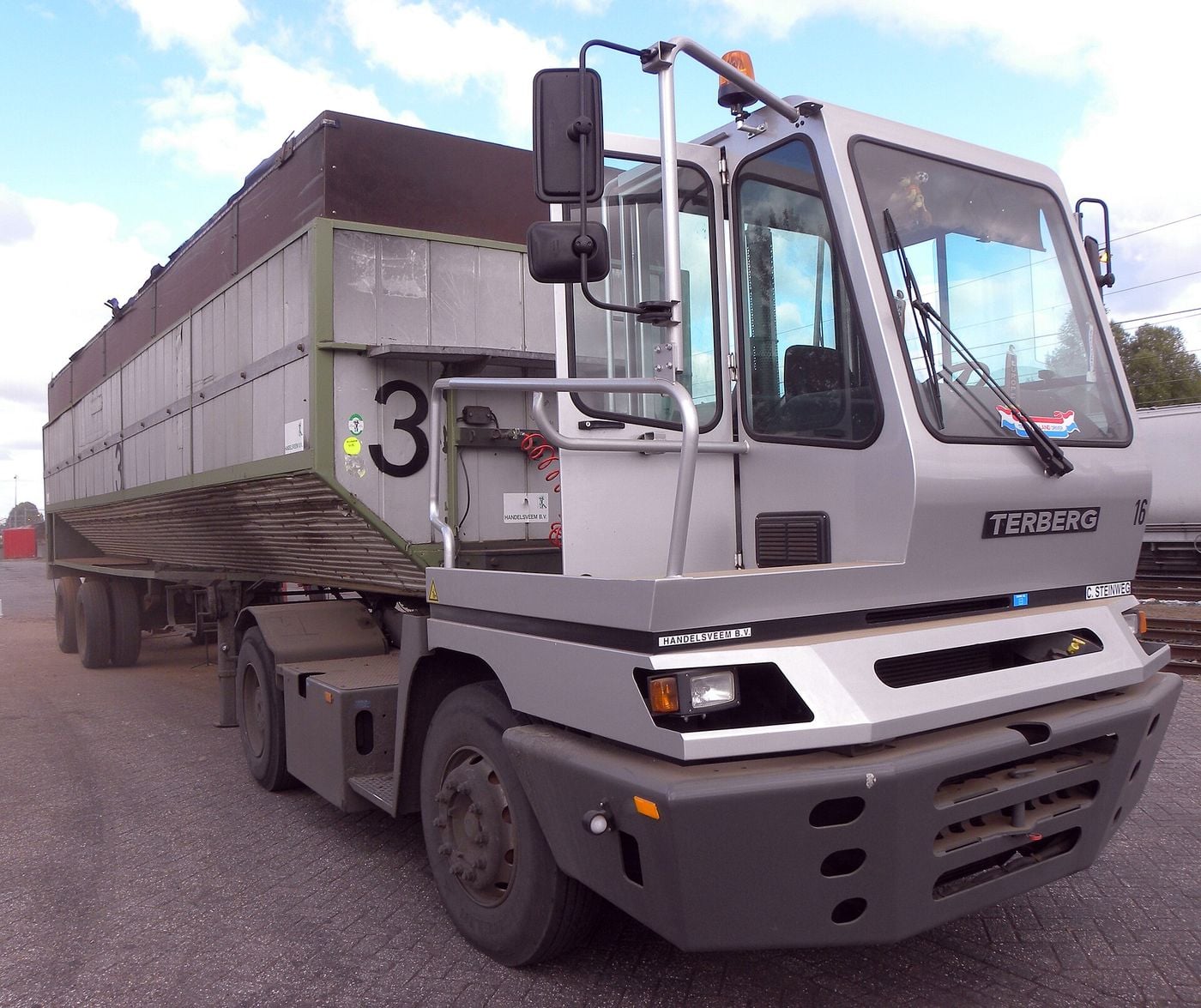
A terminal tractor is a tractor unit built to move trailers and containers over short distances inside ports, container and intermodal terminals, distribution centres and industrial sites. Makers sell the same vehicle as a yard tractor, yard truck, shunt truck or yard spotter. Terberg’s YT models and Kalmar’s TT7 are 4x2 tractors with a fifth wheel that lifts the trailer; Terberg’s four-wheel-drive RT models are designed for RoRo ships with steep ramps and for industrial yards, and Terberg and Kalmar list battery-electric models beside diesel ones. The EU’s vehicle approval regulation does not name the type.
Status as at 9 November 2026. Read on 8 and 9 November 2026: the terminal tractor, RoRo tractor, electrification and ports pages of Terberg Special Vehicles and two of its releases of July and August 2026; Kalmar’s terminal tractor overview and its TT7 page; the TJ Series pages of Capacity Trucks; the home page of Orange EV; and Regulation (EU) 2018/858 in its Official Journal text.
One vehicle, several names
The makers use different words for the same job:
- Terminal tractor and yard tractor: Terberg sells its 4x2 YT models as “Terminal & Yard Tractors”, and its ports page says they are “also called shunt trucks”.
- Shunt truck, shunter and yard spotter: Kalmar calls its range “Terminal Tractors & Shunt Trucks” and describes the vehicles as “also known as shunt trucks or yard spotters”.
- Yard truck, terminal truck and yard jockey: Capacity Trucks, of Longview, Texas, uses all three for its TJ Series, which it calls the “Original” Trailer Jockey.
- Yard dog: Orange EV, of Kansas City, Kansas, sells its electric e-TRIEVER and HUSK-e models as “Yard Dogs” and its trucks as yard trucks and terminal trucks.
- RoRo tractor: Terberg’s 4x4 RT models for roll-on/roll-off ships; a Terberg release of 29 July 2026 calls the electric RT253EV a “Tugmaster”.
How the makers describe the vehicle
The lifting fifth wheel. The YT and RT models on Terberg’s pages and Kalmar’s TT7 models all list a fifth-wheel lifting capacity. Terberg gives “up to 36t” for its YT models and a lowest fifth-wheel height of 935 mm where it states one. Kalmar gives a lifting height of 430 mm for the TT7 and a lifting capacity of 20,000 kg for the TT770, 28,000 kg for the TT785 and 32,000 kg for the TT795, with “Lifting capacity 36,000 kg as an option”. Terberg’s page for the YT220 states: “The YT220 eliminates the time-consuming task of manually cranking trailer legs.” The coupling itself, kingpin and fifth wheel, is covered in kingpin and fifth wheel.
Axle ratings. Terberg rates the axles of the YT193, YT223, YT203EV and YT201EV at 20 km/h: 11 t on the front axle and 30 t to 38 t on the rear. For the RT403 it gives two ratings, 20 t front and 45 t rear at 20 km/h, and 25 t front and 48 t rear at 10 km/h. Capacity gives its rear axles a “Terminal Rating”: 30,000 lbs on the TJ 5000, 40,000 lbs on the tandem axle of the TJ 6500 and 70,000 lbs on the TJ 9000. The YT220 data list a maximum speed of 40 km/h.
Cab and seat. The YT193, YT223 and YT220 have a “Seat forward facing”, and the YT193, YT223 and YT203EV are available in left-hand and right-hand drive. The YT220 has a hi-rise cab with a full-height door, with a rear or side door as options. Terberg’s 4x4 RT models have an Ergoturn® 180° swivelling seat; Terberg’s release of 12 August 2026 says that its RoRo tractors have “a swivelling seat so the driver always looks in the driving direction”. Terberg also offers a 4x2 model with the swivelling seat, the TT223.
Engines and transmissions. The diesel models in the table below all have Cummins engines. Terberg gives the power of the YT193 and YT223 in kW with “Stage V” in the engine designation, and Kalmar that of the TT7 in kW with “EU stage 5”; the YT220 and Capacity’s TJ Series are given in horsepower. Terberg names an Allison 3000 transmission for its diesel YT models and Kalmar an Allison 3000RDS for the TT7. Kalmar states that TT7 tractors with a Cummins engine are certified to use HVO100 fuel.
Figures from the makers’ pages: diesel models
| Model | Engine, as the maker writes it | Gross combination weight | Fifth wheel |
|---|---|---|---|
| Terberg YT193 | Cummins B6.7-142 kW Stage V | 75 t | capacity 36 t, lifting up to 36 t |
| Terberg YT223 | Cummins B6.7 - 168 kW Stage V | 90 t | capacity 36 t, lifting up to 36 t |
| Terberg YT220 (built in Malaysia) | Cummins QSB 6.7L 225-hp | 85 t | capacity 38 t, lifting up to 36 t |
| Kalmar TT770 | Cummins B6.7 (EU stage 5), 129 kW @ 2200 rpm | 70,000 kg | lifting 20,000 kg |
| Kalmar TT785 | Cummins B6.7 (EU stage 5), 168 kW @ 2200 rpm | 85,000 kg | lifting 28,000 kg |
| Kalmar TT795 | Cummins B6.7 (EU stage 5), 168 kW @ 2200 rpm | 95,000 kg | lifting 32,000 kg, 36,000 kg as an option |
| Capacity TJ 5000 | Cummins ISB6.7L 200 Horsepower; Cummins 6.7 TF4 164 Horsepower | 81,000 lbs | SAF Holland FW35TT rated for 80,000 lbs |
| Capacity TJ 6500 | Cummins ISB6.7L 200 Horsepower; Cummins 6.7 TF4 173 Horsepower | 121,000 lbs | SAF Holland FW35TT rated for 80,000 lbs |
| Capacity TJ 9000 | Cummins ISB6.7L 200 Horsepower; Cummins 6.7 TF4 173 Horsepower | 180,000 lbs | SAF Holland FW35TT rated for 80,000 lbs |
Some pages give two figures for the same item. Kalmar’s TT7 page gives the wheelbase as “3250mm or 3450mm” in its technical information and as 3450 mm for the TT770 and TT785 and 3200 mm for the TT795 in its model table. Capacity’s TJ 5000 page gives a GCVW of 81,000 lbs in its specifications and also states “Moves up to 242,000 lbs.” What gross combination weight means, and how it differs from the weight of one vehicle, is explained in GCW, GVW and axle loads; the US terms GCWR and GVWR are in GVWR, GCWR and GAWR explained.
RoRo and heavy industrial tractors
Terberg’s RT series has four-wheel drive. The maker describes the RT223, RT283 and RT323 as “designed for operating in RoRo vessels with steep ramps and in industrial yards”. On the English page their Volvo Stage V engines give 160, 210 and 235 kW and their gross combination weights are 75 to 150 t, 130 to 165 t and 165 t; the Dutch edition of the same page gives 150 t for the RT223 and 165 t for the RT283 and RT323. The fifth wheel has a lifting capacity of up to 35 t and a lowest height of 962 mm.
The RT403 is for steelworks and other industrial plants. Its fifth wheel lifts up to 45 t, its Volvo engine gives 315 kW and its specifications give a gross combination weight of 200 t; the text above them says the GCW “can reach up to 375 tonnes” depending on the application and operating environment.
The electric RT253EV entered CLdN’s RoRo operations at the Port of Zeebrugge on 29 July 2026, according to Terberg’s release of that day. Terberg’s release of 12 August 2026 says that Gothenburg RoRo Terminal, jointly owned by DFDS and CLdN, has ordered six, for delivery in the fourth quarter of 2026, and that the terminal already runs more than 70 Terberg RoRo tractors. Kalmar’s overview also lists a “Heavy Terminal Tractor & RoRo Tractor” range.
Electric terminal tractors
Terberg dates its electric terminal tractor work to 2014, when it developed its first, and describes the RT253EV as built on its third generation of electric technology. Its electric models are listed below.
| Model | Driveline | Battery system | Charging | Gross combination weight |
|---|---|---|---|---|
| YT203EV | 4x2 | 310 kWh or 155 kWh, LFP | CCS1 / CCS2 | 50–90 t |
| YT201EV | 4x2 | 310 kWh or 155 kWh, LFP | CCS2.0; GB/T as per customer’s requirement | 80 t |
| RT253EV | 4x4 | 300 kWh or 200 kWh | CCS2.0 | 60–80 t |
| BC203EV | 4x2 | 157 kWh | CCS2.0 | not given |
Terberg states that “The batteries and complete vehicle comply with the ECE-R100 rev. 3 regulation (YT203EV)”, and that the YT203EV, RT253EV and BC203EV use DC chargers with a CCS2.0 connector. The electric YT models have regenerative braking and a thermal management system for the batteries; the RT253EV has a transmission-free electric drive.
Kalmar’s overview lists a TT7 EV, “fully electric”, and the Kalmar Ottawa T2 EV; its TT7 page says that the TT7 series “will soon be expanded to include two new zero emission EV models”. Kalmar’s pages give no figures for them. Orange EV, founded in 2012 by its own account, builds its Class 8 heavy-duty electric yard trucks in Kansas City, Kansas; its home page gives no specification figures. The drivetrain and batteries of electric trucks in general are covered in electric trucks explained.
Kalmar also lists an AutoTT. It states that in March 2024 it announced a partnership with Forterra to develop its first fully autonomous terminal tractor, meant to work in yards “in mixed traffic without having a driver onboard”.
Where they work
Terberg’s ports page says its terminal tractors “are primarily used for transporting containers between quay cranes and storage yards”, and that the company also provides “solutions for multi-trailer trains from 4 to 10 TEU”. The same page names inland ports and rail terminals; transport that combines road and rail is covered in combined and intermodal transport. Kalmar names ports, container terminals, warehouses, distribution centres, industrial sites and intermodal applications. Capacity describes the TJ 5000 as designed “to move trailers within protected facilities, especially warehousing environments”. At distribution hubs Terberg’s BC203EV moves swap bodies.
Who builds them
| Maker | Country on the maker’s pages | Ranges named on the pages |
|---|---|---|
| Terberg Special Vehicles | Netherlands: headquarters in Benschop; the YT220 is manufactured at Pasir Gudang, Malaysia | YT, YT-EV, TT223, RT, RT-EV, BC-EV |
| Kalmar | Finland: the Kalmar Head Office is in Helsinki | TT7, TT7 EV, T2i, Ottawa T2, Ottawa T2 EV, Heavy Terminal Tractor & RoRo Tractor, Essential TL2, AutoTT |
| Capacity Trucks | United States: Longview, Texas; the site’s copyright line names Terex Corporation | TJ 5000, TJ 6500, TJ 9000 |
| Orange EV | United States: headquarters in Kansas City, Kansas; Canada headquarters in Oakville, Ontario | e-TRIEVER, HUSK-e |
Kalmar’s overview dates its terminal tractor work to 1958 and states a track record of “delivering over 80,000 units of shunt trucks”. Its TT7 is “available only in Europe”, according to its page.
What EU vehicle approval law says
Regulation (EU) 2018/858 sets the rules for approving motor vehicles and their trailers in the EU and has applied since 1 September 2020 (Article 91). Article 2(1) states: “This Regulation applies to motor vehicles of categories M and N and their trailers of category O, that are intended to be used on public roads”. Article 2(3) adds that “the manufacturer may apply for type-approval or individual vehicle approval under this Regulation, provided that those vehicles fulfil the requirements of this Regulation” for, among others, “vehicles designed and constructed for use principally on construction sites or in quarries, port or airport facilities”. Article 3(31) defines a special purpose vehicle as “a vehicle of category M, N or O having specific technical features that enable it to perform a function that requires special arrangements or equipment”.
The Regulation does not name terminal tractors, and Terberg’s and Kalmar’s pages do not state an approval category for their models. In the United States, Capacity states that “All Capacity yard jockey models can be engineered for off-road use or for DOT-certified on-highway use.”
Quick answers
- What is a terminal tractor?
- A tractor unit built to move trailers and containers over short distances inside ports, container and intermodal terminals, distribution centres, warehouses and industrial sites. Makers also sell it as a yard tractor, yard truck, shunt truck or yard spotter. Terberg's YT models and Kalmar's TT7 range are 4x2 tractors with a fifth wheel that lifts the trailer: up to 36 t on the YT models, and 20,000 to 32,000 kg on the TT7, with 36,000 kg as an option.
- How much can a terminal tractor pull?
- The makers give gross combination weights. Terberg lists 75 t for the YT193, 85 t for the YT220 and 90 t for the YT223, depending on operating conditions; Kalmar 70,000, 85,000 and 95,000 kg for the TT770, TT785 and TT795; Capacity 81,000, 121,000 and 180,000 lbs for the TJ 5000, TJ 6500 and TJ 9000. Terberg's 4x4 RT403 is listed at 200 t, and the same page says its GCW can reach up to 375 tonnes depending on the application.
- Are there electric terminal tractors?
- Yes. Terberg lists the YT203EV and YT201EV with a 310 kWh or 155 kWh LFP battery system, the 4x4 RT253EV with 300 kWh or 200 kWh and the BC203EV body carrier with 157 kWh, charged through CCS connectors, with GB/T also offered on the YT201EV. Kalmar names the TT7 EV and the Ottawa T2 EV, and Orange EV in Kansas City builds pure electric yard trucks, its e-TRIEVER and HUSK-e.
- What is a RoRo tractor?
- A terminal tractor for roll-on/roll-off ships and terminals. Terberg's RT models have four-wheel drive for RoRo vessels with steep ramps and an Ergoturn 180° swivelling seat, so that the driver always looks in the driving direction. Their fifth wheels lift up to 35 t, and up to 45 t on the RT403.
- Does EU vehicle type-approval cover terminal tractors?
- Regulation (EU) 2018/858 applies to vehicles of categories M, N and O intended to be used on public roads. For vehicles designed and constructed for use principally on construction sites or in quarries, port or airport facilities, Article 2(3)(a) lets the manufacturer apply for approval under the Regulation, provided they fulfil its requirements. The Regulation does not name terminal tractors.
Sources
- Terminal Tractors: YT193/YT223, YT203EV, YT201EV and YT220 specifications, read on 9 November 2026 — Terberg Special Vehicles
- RoRo & Industrial Tractors: RT223/RT283/RT323, RT253EV and RT403 specifications, read on 9 November 2026 — Terberg Special Vehicles
- RoRo trekkers (Dutch edition of the RoRo and industrial tractor page), read on 8 November 2026 — Terberg Special Vehicles
- Electrification: Terberg EV solutions, YT203EV, RT253EV and BC203EV, read on 9 November 2026 — Terberg Special Vehicles
- Markets: Ports, read on 8 November 2026 — Terberg Special Vehicles
- CLdN introduces its first electric Terberg 4x4 RoRo Tugmaster into RoRo operations (news, 29 July 2026) — Terberg Special Vehicles, 29 Jul 2026
- Gothenburg RoRo Terminal orders six Terberg electric 4x4 RoRo tractors (news, 12 August 2026) — Terberg Special Vehicles, 12 Aug 2026
- Terminal Tractors & Shunt Trucks: range overview, read on 9 November 2026 — Kalmar
- Kalmar TT7 Terminal Tractor: technical information and TT770, TT785 and TT795 model table, read on 9 November 2026 — Kalmar
- TJ Series: TJ 5000, TJ 6500 and TJ 9000 yard trucks, read on 9 November 2026 — Capacity Trucks
- TJ 5000 specifications, read on 9 November 2026 — Capacity Trucks
- TJ 6500 specifications, read on 9 November 2026 — Capacity Trucks
- TJ 9000 specifications, read on 9 November 2026 — Capacity Trucks
- Pure Electric Terminal Trucks: home page, read on 9 November 2026 — Orange EV
- Regulation (EU) 2018/858 of the European Parliament and of the Council of 30 May 2018 on the approval and market surveillance of motor vehicles and their trailers — Official Journal text: Articles 2, 3(31) and 91 — EUR-Lex, European Union, 30 May 2018