AFIR charging payment and prices: card readers, price display and data
Article 5 of AFIR, Regulation (EU) 2023/1804: ad hoc charging, card payment at points of 50 kW or more along the TEN-T road network from 1 January 2027, price display and the Article 20 data.
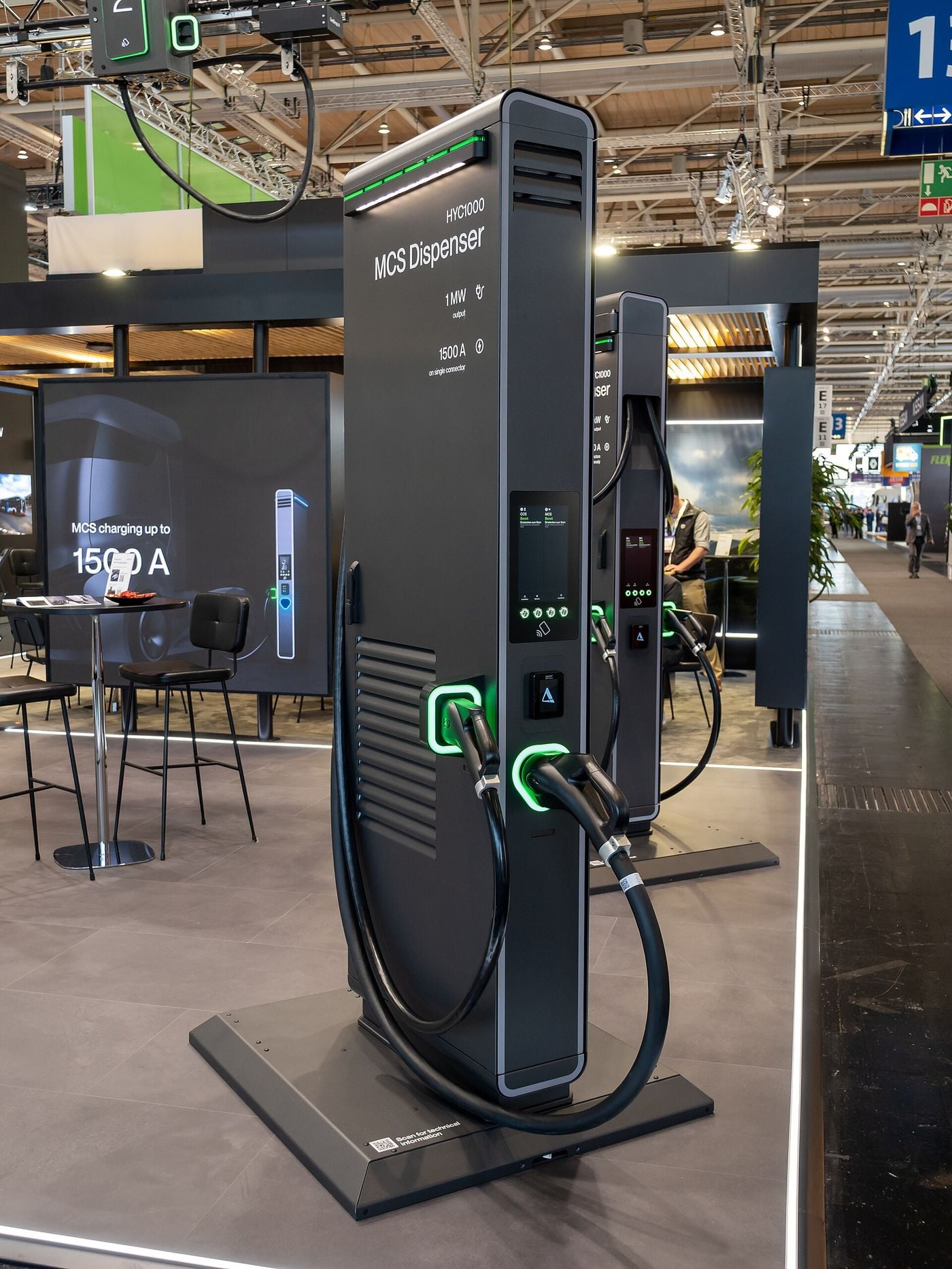
Under Article 5 of Regulation (EU) 2023/1804, the Alternative Fuels Infrastructure Regulation (AFIR), the operator of a publicly accessible recharging point in the EU must let end users recharge “on an ad hoc basis”, without having to register or conclude a written agreement; Article 5(4) sets how the ad hoc price is shown at the recharging station before a session starts. Points deployed from 13 April 2024 must accept electronic payment with a payment instrument “widely used in the Union”. From 1 January 2027, every publicly accessible point of 50 kW or more along the TEN-T road network or on a safe and secure parking area, including points deployed before 13 April 2024, must have a payment card reader or a contactless device that can read payment cards. Article 20 sets the data that operators must make available on the publicly accessible infrastructure they operate, the ad hoc price among them. The Regulation has applied since 13 April 2024 and is “binding in its entirety and directly applicable in all Member States” (Article 26).
Status as at 27 October 2026. Read on that day: the consolidated text of Regulation (EU) 2023/1804 of 8 January 2026 (CELEX 02023R1804-20260108) in its English, German, Spanish, French, Italian and Polish versions. It incorporates Commission Delegated Regulations (EU) 2025/656 and (EU) 2025/671, both of 2 April 2025 and published in the Official Journal on 18 June 2025; the second replaced Article 20(2). The consolidated text states that it “is meant purely as a documentation tool and has no legal effect”; the authentic texts are those published in the Official Journal.
Where Article 4 requires recharging infrastructure dedicated to heavy-duty electric vehicles, and by when, is set out in AFIR truck-charging targets, article by article. This page covers how charging is paid for and priced, and which data is made available, under Articles 2, 5, 19(3) and 20.
The terms used
Article 2 defines the terms that Articles 5 and 20 rely on (point numbers in brackets).
- End user (24): “a natural or legal person purchasing an alternative fuel for direct use in a vehicle”.
- Recharge on an ad hoc basis (47): “a recharging service purchased by an end user without the need for that end user to register, conclude a written agreement or enter into a commercial relationship with the operator of that recharging point that goes beyond the mere purchase of the recharging service”. The ad hoc price (2) is the price the operator charges for that.
- Operator of a recharging point (39): “the entity that is responsible for the management and operation of a recharging point and that provides a recharging service to end users, including in the name and on behalf of a mobility service provider”.
- Mobility service provider (36): “a legal person that provides services in return for remuneration to an end user, including the selling of recharging or refuelling services”.
- Publicly accessible infrastructure (45) is located at a site or premises “open to the general public”, irrespective of whether it is on public or private property, whether limitations or conditions apply to access, and of the applicable use conditions.
- Recharging point (48): an interface that “is capable of recharging only one electric vehicle at a time”; devices with a power output of 3.7 kW or less whose primary purpose is not the recharging of electric vehicles are excluded. A recharging pool (51) is “one or more recharging stations at a specific location”, and a recharging session (54) runs “from the moment the vehicle is connected to the moment the vehicle is disconnected”.
- Along the TEN-T road network (3)(a), for recharging stations: “located on the TEN-T road network or within 3 km driving distance from the nearest exit of a TEN-T road”.
- Safe and secure parking area (63): “a parking area accessible to drivers engaged in the carriage of goods or passengers which has been certified in accordance with Commission Delegated Regulation (EU) 2022/1012”.
Ad hoc charging and how it is paid: Article 5(1)
Paragraph 1 opens: “Operators of recharging points shall, at the publicly accessible recharging points operated by them, provide end users with the possibility to recharge their electric vehicle on an ad hoc basis.” At points deployed from 13 April 2024, ad hoc recharging “shall be possible using a payment instrument that is widely used in the Union”, and operators “shall accept electronic payments at those points through terminals and devices used for payment services, including at least one of the following”:
- (a) “payment card readers”;
- (b) “devices with a contactless functionality that is at least able to read payment cards”;
- (c) “for publicly accessible recharging points with a power output below 50 kW, devices using an internet connection and allowing for secure payment transactions such as those generating a specific Quick Response code”.
The third subparagraph adds the rule that applies from 1 January 2027: “From 1 January 2027, operators of recharging points shall ensure that all publicly accessible recharging points operated by them, with a power output equal to or more than 50 kW deployed along the TEN-T road network or deployed on a safe and secure parking area, including recharging points deployed before 13 April 2024, comply with the requirements set out in points (a) or (b).” It names points deployed before 13 April 2024, which the second subparagraph does not cover; point (c) is open only to points below 50 kW in any case.
| Recharging points | Requirement | From |
|---|---|---|
| All publicly accessible points | Possibility to recharge on an ad hoc basis | No date in the paragraph; the Regulation applies from 13 April 2024 |
| Points deployed from 13 April 2024 | Ad hoc recharging with a payment instrument widely used in the Union; electronic payment accepted through at least one of (a) payment card reader, (b) contactless device able at least to read payment cards, (c) below 50 kW only, an internet-connected device for secure payment, such as one generating a QR code | Deployment |
| Points of 50 kW or more along the TEN-T road network or on a safe and secure parking area, including those deployed before 13 April 2024 | (a) or (b) | 1 January 2027 |
| Points that do not require payment for the recharging service | The requirements of paragraph 1 do not apply | – |
Two further subparagraphs complete paragraph 1: “A single payment terminal or device referred to in the second subparagraph may serve a number of publicly accessible recharging points within a recharging pool”, and “The requirements laid down in this paragraph shall not apply to publicly accessible recharging points that do not require payment for the recharging service.”
Automatic authentication: Article 5(2)
Where an operator offers automatic authentication at a publicly accessible recharging point, end users “always have the right to not make use of the automatic authentication and instead either to recharge their vehicle on an ad hoc basis, as provided for in paragraph 1, or to use another contract-based recharging solution offered at that recharging point”. Operators “shall clearly show that option to end users and offer it to them in a convenient manner” at each such point.
Prices and how they are shown: Article 5(3) and 5(4)
Article 5(3) sets the principle for the prices that operators charge: they “shall be reasonable, easily and clearly comparable, transparent and non-discriminatory”. Operators “shall not discriminate, through the prices charged, between end users and mobility service providers or between different mobility service providers”; the level of prices “may be differentiated, but only if the differentiation is proportionate and objectively justified”.
Article 5(4) sets how the ad hoc price is built and displayed, with 50 kW as the dividing line.
| Power output of the point | Basis of the ad hoc price | What is shown, where and when |
|---|---|---|
| 50 kW or more | The price per kWh for the electricity delivered; the operator may add an occupancy fee as a price per minute “to discourage long occupancy of the recharging point” | At the recharging stations: the ad hoc price per kWh and any occupancy fee per minute, known to end users before they initiate a recharging session |
| Less than 50 kW | Not set by the paragraph | At the recharging stations: the ad hoc price with all its price components, before the session, in this order: price per kWh; price per minute; price per session; any other price component that applies |
In both cases the information is to be available “so that that information is known to end users before they initiate a recharging session and price comparison is facilitated”. The last sentence of the paragraph reads: “The first and second subparagraphs shall apply to all recharging points deployed from 13 April 2024.” The first and second subparagraphs are the two on points of 50 kW or more; the sentence does not name the third, on points below 50 kW. How a tariff per kWh relates to a diesel price per litre, and on what tax basis published tariffs are stated, is on What it costs to run a tractor unit.
Mobility service providers: Article 5(5) and 5(6)
Article 5(5) says that prices charged by mobility service providers to end users “shall be reasonable, transparent and non-discriminatory”, and requires the providers to make available to end users, “prior to the start of an intended recharging session, all price information specific to that recharging session, through freely available, widely supported electronic means, clearly distinguishing all price components, including applicable e-roaming costs and other fees or charges applied by the mobility service provider”. Their fees “shall be reasonable, transparent and non-discriminatory”, and “Mobility service providers shall not apply any extra charges for cross-border e-roaming.”
Under Article 5(6) Member States ensure that their authorities “regularly monitor the recharging infrastructure market”, in particular the compliance of operators and mobility service providers with paragraphs 3 and 5, and “seek to ensure” that they monitor “possibly unfair commercial practices affecting consumers”.
Connection, smart recharging and cables: Article 5(7) to 5(11)
- Digitally connected by 14 October 2024 (paragraph 7): all publicly accessible recharging points. Article 2(17) defines a digitally-connected recharging point as one that can “send and receive information in real time, communicate bi-directionally with the electricity grid and the electric vehicle”, and that “can be remotely monitored and controlled, including in order to start and stop the recharging session and to measure electricity flows”.
- Smart recharging (paragraph 8): points “built after 13 April 2024 or renovated after 14 October 2024” must be capable of it.
- Signposting (paragraph 9): within parking and rest areas along the TEN-T road network where alternative fuels infrastructure is deployed, Member States ensure that its exact location “is adequately signposted”.
- Fixed cable by 14 April 2025 (paragraph 10): all direct current (DC) publicly accessible recharging points “have a fixed recharging cable installed”.
- Owner and operator (paragraph 11): where the operator is not the owner, the owner makes available a point with the technical characteristics that let the operator comply with paragraphs 2, 7, 8 and 10.
The data operators must make available: Article 20
Article 20(1) has each Member State appoint an Identification Registration Organisation (IDRO), which “shall issue and manage unique identification (‘ID’) codes to identify at least operators of recharging points and mobility service providers, by 14 April 2025”.
Article 20(2), in the wording substituted by Delegated Regulation (EU) 2025/671, reads: “By 14 April 2025, operators of publicly accessible recharging points and refuelling points for alternative fuels, or, in accordance with the arrangements between them, the owners of those points, shall ensure the availability of static data and dynamic data concerning alternative fuels infrastructure operated by them, or services inherently linked to such infrastructure that they provide or they outsource, at no cost.” The consolidated text does not state from which date the replaced wording applies, and Delegated Regulation (EU) 2025/671 itself was not among the texts read for this page. The data types for recharging are:
| Group | Data types |
|---|---|
| Static data, recharging and refuelling infrastructure (point (a)) | Legal name of the recharging or refuelling point operator or owner; commercial name of the recharging or refuelling point operator or owner; number of recharging or refuelling points; service support; helpdesk telephone; facilities offering associated services to the user; global navigation satellite system (GNSS) geographic location information; additional geographic location information; country; region; city or town; postal code; address name; opening time; time zone; vehicle-type compatibility; vehicle specifications permitted; number of parking spaces; number of parking spaces for people with disabilities; payment device with bank card reader; payment device with a contactless functionality that is at least able to read payment cards; other ad hoc payment option; additional information about payment providers accepted; contract-based (subscription) payment option |
| Further static data, recharging infrastructure (point (b)) | Recharging point ID code (connector); number of connectors; type of connector (plug); type of current; recharging station maximum power; recharging point maximum power; mobility service providers offering contract-based recharging; plug-and-charge; smart recharging services; electricity supplied is 100 % renewable |
| Dynamic data (point (f)) | Operational status; availability; ad hoc price |
Points (c), (d), (e) and (g) of the same paragraph list further data for hydrogen and liquefied methane refuelling infrastructure and, for refuelling infrastructure for alternative fuels, the type of connector (dispenser).
The rest of Article 20 sets how the data travels:
- API (paragraph 3): each operator, or the owner under their arrangements, sets up an Application Programme Interface “that provides free and unrestricted access” to the data and submits information on it to the national access points; the API must comply with common technical requirements laid down in delegated acts.
- National access points by 31 December 2024 (paragraph 4): Member States ensure that the data are accessible “on an open and non-discriminatory basis to all data users” through their national access points, in accordance with Delegated Regulation (EU) 2022/670.
- Common European access point by 31 December 2026 (paragraph 5): “the Commission shall establish a common European access point to function as a data gateway facilitating the access to the data referred to in paragraph 2 from the different national access points”, easily accessible and usable by all data users, “for example through the creation of a dedicated web portal”.
- Further acts (paragraphs 6 to 8): the Commission may add data types and lay down common technical requirements for a common API by delegated acts, and lay down specifications complementary to Delegated Regulation (EU) 2022/670 on data format, frequency and quality by implementing acts, with “reasonable transitional periods” before they bind operators or owners.
What applies to trucks and buses
Article 2(30) defines a “heavy-duty vehicle” as a motor vehicle of category M2, M3, N2 or N3 of Regulation (EU) 2018/858 (the categories are explained in Vehicle categories M, N and O). Articles 5 and 20 contain no rule written for heavy-duty vehicles alone: they apply to publicly accessible recharging points whatever vehicle uses them.
The 1 January 2027 card rule names two places, the TEN-T road network and safe and secure parking areas. These are two of the three kinds of location for which Article 4 sets heavy-duty targets; the third, urban nodes, is not named in that subparagraph. In the data of Article 20(2), “Vehicle-type compatibility”, “Vehicle specifications permitted” and “Number of parking spaces” are static data types for publicly accessible recharging and refuelling infrastructure. Power classes, connectors and the public networks for heavy vehicles are described in Charging electric trucks and buses.
For refuelling stations, Article 19(3) provides: “When fuel prices are shown at a refuelling station, Member States shall ensure that a comparison of the relevant unit prices is shown, where appropriate, and in particular for hydrogen, for information purposes following the common methodology for alternative fuels unit price comparison referred to in point 10.3 of Annex II.” Annex II point 10.3 names the methodology “set out by Commission Implementing Regulation (EU) 2018/732”. Payment and prices at hydrogen refuelling points, under Article 7, are on Hydrogen refuelling for trucks in Europe.
Article 24(2) requires a review: “By 31 December 2026 and every five years thereafter, the Commission shall review this Regulation.” The review is described on the targets page.
Quick answers
- Can I charge at a public charging point without registering or signing a contract?
- Yes. Article 5(1) of Regulation (EU) 2023/1804 obliges operators to give end users at their publicly accessible recharging points the possibility to recharge on an ad hoc basis, which Article 2(47) defines as buying the recharging service without having to register, conclude a written agreement or enter into a commercial relationship with the operator beyond the purchase itself. At points deployed from 13 April 2024 this must be possible with a payment instrument widely used in the Union, and the operator must accept electronic payment through at least one of: a payment card reader, a contactless device that can at least read payment cards or, at points below 50 kW only, an internet-connected device for secure payment, such as one generating a QR code. Points that do not require payment are exempt.
- Which charging points must accept payment cards from 1 January 2027?
- Every publicly accessible recharging point with a power output of 50 kW or more deployed along the TEN-T road network or on a safe and secure parking area, including points deployed before 13 April 2024. From 1 January 2027 its operator must ensure it has a payment card reader or a device with a contactless functionality that is at least able to read payment cards (Article 5(1), third subparagraph). Along the TEN-T road network means on the network or within 3 km driving distance of the nearest exit (Article 2(3)). Under the same paragraph, a single payment terminal or device referred to in its second subparagraph may serve several points within a recharging pool, and points that do not require payment for the recharging service are exempt.
- How must prices be shown at a public charging point?
- At points of 50 kW or more the ad hoc price is based on the price per kWh for the electricity delivered, and the operator may add an occupancy fee as a price per minute. The price per kWh and any occupancy fee per minute must be shown at the recharging station so that end users know them before starting a session; these rules apply to points deployed from 13 April 2024 (Article 5(4)). Below 50 kW the ad hoc price must be made available with all its components, in the order price per kWh, price per minute, price per session and any other component. Article 5(3) requires prices to be reasonable, easily and clearly comparable, transparent and non-discriminatory.
- What price information must a mobility service provider give?
- Under Article 5(5) a mobility service provider must give end users, before an intended recharging session starts, all price information specific to that session, through freely available, widely supported electronic means, distinguishing every price component, including e-roaming costs and its own fees. Its prices and fees must be reasonable, transparent and non-discriminatory, and it may not apply extra charges for cross-border e-roaming. Member State authorities monitor compliance (Article 5(6)).
- Are there special payment rules for electric trucks and buses?
- Articles 5 and 20 contain no rule for heavy-duty vehicles alone; they apply to publicly accessible recharging points whatever vehicle uses them. The 1 January 2027 card rule covers points of 50 kW or more along the TEN-T road network and on safe and secure parking areas, two of the three location types for which Article 4 sets heavy-duty targets. Among the static data that operators must make available under Article 20(2) are vehicle-type compatibility, the vehicle specifications permitted and the number of parking spaces. A heavy-duty vehicle is one of category M2, M3, N2 or N3 (Article 2(30)).
Sources
- Regulation (EU) 2023/1804 on the deployment of alternative fuels infrastructure (AFIR) — consolidated text of 8 January 2026: Articles 2, 4, 5, 7, 19(3), 20, 24 and 26 and Annex II point 10.3 (Article 20(2) as replaced by Delegated Regulation (EU) 2025/671) — EUR-Lex, Publications Office of the European Union