HABAŞ
HABAŞ ComfortCity
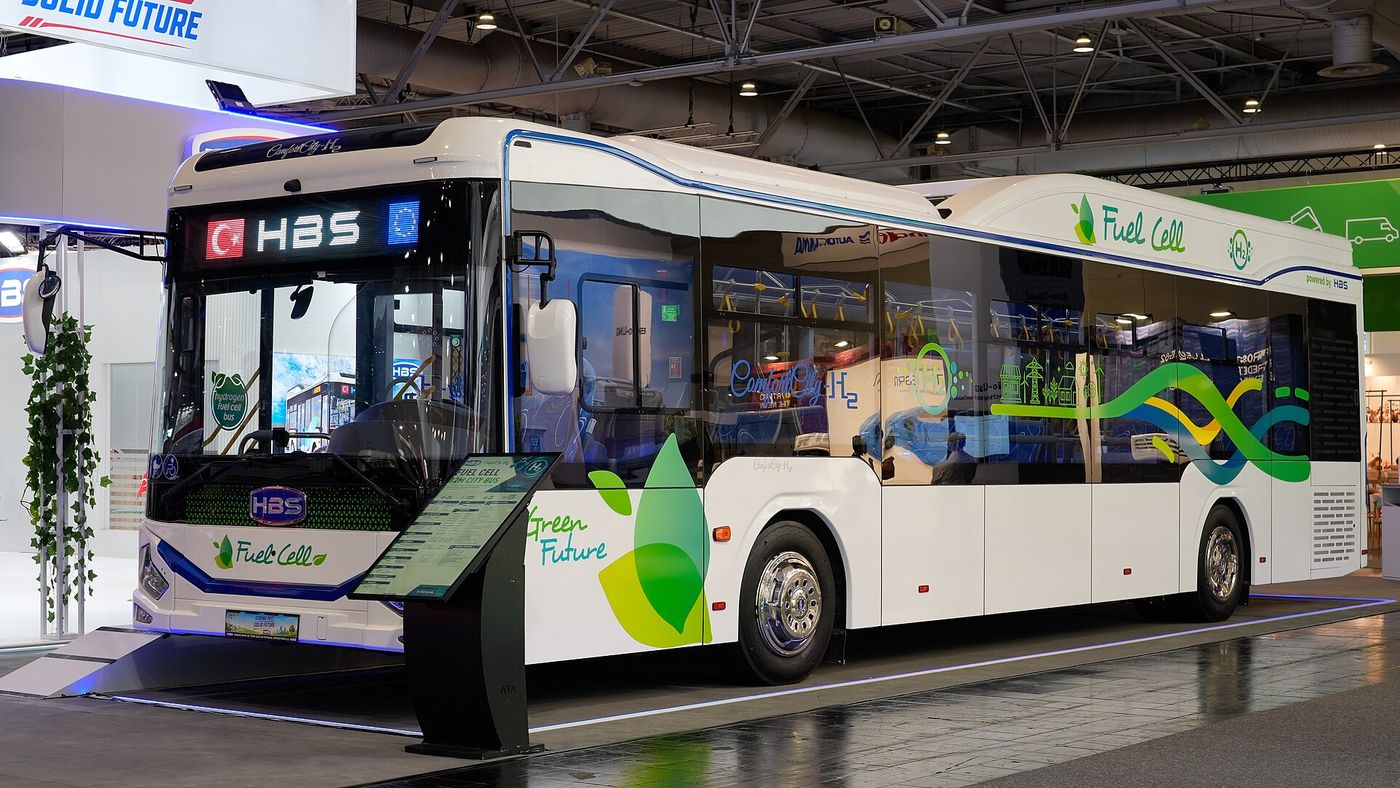
HABAŞ's ComfortCity city bus on its three data sheets: a 220 kW Daimler OM936 diesel, the 410 kW ComfortCity-e with 282 kWh and the ComfortCity-H2 with an 80 kW fuel cell.
- 220 kW
- Euro 6e
- 12 m
- 18 t

Model overview
- Segment
- Bus
- Emission
- Euro 6e
- Transmission
- ZF ECOLIFE 2 automatic, 6 forward and 1 reverse
- Gross vehicle
- 18 000 kg
- Length
- 12 000 mm
- Wheelbase
- 5 900 mm
Engine families
- Power
- 220 kW
- Torque
- 1200 Nm
- Rated speed
- 1800 rpm
The ComfortCity is a city bus of HABAŞ, whose full company name, HABAŞ SINAİ VE TIBBİ GAZLAR İSTİHSAL ENDÜSTRİSİ A.Ş., heads each of its data sheets. HABAŞ offers it with three drives: a diesel, the battery-electric ComfortCity-e and the fuel-cell ComfortCity-H2. The figures on this page come from HABAŞ’s three English technical data sheets, one per version, from the English bus page in the automotive section of HABAŞ’s website, which links each version to its sheet, and from the Turkish editions of the electric and fuel-cell sheets; all were read on 27 October 2026. None of the sheets carries a printed date, and the bus page has only a “© 2024” footer. The PDF files of the English sheets record creation dates of 4 September 2024 for the electric and fuel-cell sheets and 10 April 2026 for the diesel sheet. How diesel, battery-electric and fuel-cell drives are arranged on city buses in general is covered in city bus propulsion.
The three versions
HABAŞ’s bus page names the diesel “ComfortCity” and calls it “the 12-meter diesel city bus model”; it calls the ComfortCity-e “the 12-meter electric city bus model” and the ComfortCity-H2 “a Fuel Cell, 12 meter low-floor city bus model”. The sheets are headed “DIESEL 12M CITY BUS”, “PURE ELECTRIC CITY BUS” and “FUEL CELL 12 M. CITY BUS”; the model name, ComfortCity, ComfortCity-e or ComfortCity-H2, appears on each only as a logo in its top corner. The diesel sheet gives an overall length of 12,000 mm; the electric and fuel-cell sheets give 11,880 mm.
| ComfortCity (diesel) | ComfortCity-e | ComfortCity-H2 | |
|---|---|---|---|
| Sheet heading | DIESEL 12M CITY BUS | PURE ELECTRIC CITY BUS | FUEL CELL 12 M. CITY BUS |
| Drive | Daimler OM936 diesel, 220 kW, 1,200 Nm | Voith HD electric motor, 410 kW, 3,100 Nm | Voith HD electric motor, 410 kW, 3,100 Nm |
| Energy on board | 250 l fuel tank | 282 kWh LFP battery | 140 kWh LFP battery, 80 kW fuel cell, 35 kg of hydrogen |
| Transmission | ZF ECOLIFE 2 automatic, 6 forward, 1 reverse | no transmission row | no transmission row |
| Overall length | 12,000 mm | 11,880 mm | 11,880 mm |
| Maximum permissible weight | 18,000 kg | 19,500 kg | 19,500 kg |
| Passengers | 106 (26+80), 100 (26+1+73), 93 (26+2+65) | 106 (26+80), 100 (26+1+73), 93 (26+2+65); Turkish sheet: 90 (26+64) | 90 (26+64) |
No document opened gives a launch date, a start of production, a plant or an earlier generation of the ComfortCity.
Diesel engine and transmission
The diesel sheet gives the engine as “Daimler EURO 6E, OM936”, of the type “Turbocharged, Intercooler, Diesel”, with a total displacement of 7.7 litres. Maximum power is 220 kW at 1,800 rpm and maximum torque 1,200 Nm at 1,200-1,600 rpm. The sheet gives no cylinder count. HABAŞ’s bus page describes the engine as Euro 6e and “300PS”. What the Euro 6e step covers is set out in Euro 6 and Euro 7 explained.
The gearbox is a ZF ECOLIFE 2 automatic with 6 forward gears and 1 reverse. The sheet lists the retarder type as “Hydraulic, Intarder”, and the bus page names an Intarder among the standard equipment; retarders as a class of brake are described in retarders and engine braking explained.
The fuel tank holds 250 litres and its material is given as “Aluminum / Steel”. In the electrical system, the battery row reads “2x12V 240 Ah” and the alternator row “24V, 2x150A”.
Electric motor and battery: ComfortCity-e
The ComfortCity-e and ComfortCity-H2 sheets give the same traction motor: make and model “VOITH HD”, type “IPMSM Electric”, maximum power 410 kW and maximum torque 3,100 Nm. The bus page describes the ComfortCity-e as using “a 410 kW electric VOITH engine providing 3100 Nm torque”. Neither electric sheet has a transmission row; both give an axle ratio of 5.30.
The battery is listed as “HABAS / LFP” with a capacity of “282 kWh (Changeable Depending on Specification )”. The sheet does not say whether 282 kWh is installed or usable capacity. The bus page speaks of “lightweight and durable batteries adapted by HABAŞ R&D center” and describes the bus as “environmentally friendly with 0 emission”. The LFP chemistry is described in battery chemistries in heavy trucks. No document opened gives a range, a charging power, a charging connector or a charging time for the ComfortCity-e.
The brake row of the electric sheet includes a “Regenerative Brake” beside the disc brakes.
Fuel cell and hydrogen: ComfortCity-H2
The ComfortCity-H2 sheet has a section headed “HYDROGEN SYSTEM”: “Capacity of the tanks” 1,424 litres, “Capacity of hydrogen” 35 kg and “Fuel Cell Capacity kW” 80 kW; the Turkish edition gives the same three figures. The battery is “HABAS / LFP” at 140 kWh, and the motor is the same Voith HD of 410 kW and 3,100 Nm as on the ComfortCity-e. The bus page gives the same battery, tank and hydrogen figures but writes the fuel cell in a different unit: “the fuel cell is 80 kWh”. The data sheet gives 80 kW.
The bus page describes the drive in these words: the bus “generates electricity by combining hydrogen, a gas that can be obtained from renewable energy and water, with oxygen in the fuel cell on the vehicle” and “recharges its batteries with the electricity generated with only water vapor as its byproduct”. It adds that the ComfortCity-H2 “has flexible operating modes and can also operate with hybrid technology, increasing the vehicle’s range”, gives a filling time of “less than 10 minutes” and states that “the vehicle’s range exceeds 1000 km”. It attaches no test conditions, load or consumption figure to the range. No document opened gives the storage pressure, the number of tanks, the fuel-cell supplier or a charging connection. Fuel-cell buses as a type are described in hydrogen fuel-cell buses and coaches.
Axles, suspension, steering and brakes
All three sheets give a ZF AV133/87 rear axle with a capacity of 13,000 kg. The diesel sheet gives the front axle as “ZF RL 82EC, 8200 kg” and an axle ratio of 6.2; the electric and fuel-cell sheets give “ZF RL 82A, 8.200 kg” and a ratio of 5.30.
The suspension is air springs with shock absorbers, two of each at the front axle and four of each at the rear axle. The diesel sheet adds “Side kneeling” to the suspension rows, the electric and fuel-cell sheets “Kneeling”. Steering is a HEMA 8098, given as “Servocom, hydraulic”, on all three.
The diesel brake row reads “Disk Brakes (front&rear), EBS, ABS, ASR, ESC, ESP, parking brake - rear brake chamber”. The electric and fuel-cell rows read “Disc Brakes (front&rear) EBS,ESC, ASR, Spring Parking Brake-Rear Axle, Regenerative Brake”. The standard-feature list of all three sheets carries “EBS / ABS / ASR / ESC / ESP”.
Each version runs on 6 tyres of size 275/70 R 22.5. The rims are given as “8.25x22.5’‘” on the English electric and fuel-cell sheets and as “8.25x22.5’’ /10” on the diesel sheet and on the Turkish electric and fuel-cell sheets.
Dimensions and weights
| ComfortCity (diesel) | ComfortCity-e | ComfortCity-H2 | |
|---|---|---|---|
| Wheelbase | 5,900 mm | 5,900 mm | 5,900 mm |
| Front overhang | 2,830 mm | 2,777 mm | 2,777 mm |
| Rear overhang | 3,270 mm | 3,203 mm | 3,203 mm |
| Overall length | 12,000 mm | 11,880 mm | 11,880 mm |
| Overall width | 2,520 mm | 2,520 mm | 2,520 mm |
| Overall height, with / without A/C | 3,100 / 2,800 mm | 3,100 / 2,800 mm | 3,100 / 2,800 mm |
| Front track | 2,090 mm | 2,090 mm | 2,090 mm |
| Rear track | 1,840 mm | 1,840 mm | 1,840 mm |
| Angles, as labelled | Approach / ramp / departure: 7 / 7 / 7 degrees | Approach angle / ramp / clearance: 7 / 6 / 7, no unit | Approach angle / ramp / clearance: 7 / 6 / 7, no unit |
| Front axle capacity | 8,200 kg | 8,200 kg | 8,200 kg |
| Rear axle capacity | 13,000 kg | 13,000 kg | 13,000 kg |
| Maximum permissible weight | 18,000 kg | 19,500 kg | 19,500 kg |
The Turkish editions label the angle row differently: the electric sheet “Yaklaşma / Rampa / Uzaklaşma Açısı” (approach / ramp / departure angle), 7 / 6 / 7, and the fuel-cell sheet “Yaklaşma / Uzaklaşma Açısı” (approach / departure angle), 7 / 7. The sheets give no turning circle, no kerb weight and no top speed.
Body, passengers and access
All three sheets give the body type as “Stainless Steel, Monocoque” and list “Stainless Steel Body & Chassis” among the standard features; the bus page, in its ComfortCity-e passage, speaks of a “lightweight monocoque body structure”. In its passage on the diesel ComfortCity, the bus page describes the low-floor design, the kneeling feature and the ramp as letting all passengers, “including wheelchairs and strollers”, get on and off. A “Wheelchair Access Ramp” and a “Kneeling System” are standard on all three sheets. Low-floor access and the ramp rules are set out in bus accessibility explained.
The diesel sheet and the English electric sheet give the passenger capacity as “106(26+80), 100(26+1+73), 93(26+2+65)”. The fuel-cell sheet, in both editions, and the Turkish edition of the electric sheet give “90 (26+64)”. The sheets do not label the parts of each sum, and they print no door count; the side view in the dimension drawing of each English sheet shows three doors, and the text mentions the front door only in “Heated Front Door Glazing” and the optional “Remote Control for Front Door”.
Equipment
Standard on all three English sheets: “EBS / ABS / ASR / ESC / ESP”, an electronic cluster, a multiplex system, a tachograph, LED daytime running lamps, LED illumination, a steering column and dashboard adjustable longitudinally and vertically (on the fuel-cell sheet “Longitudinally & Vertically Adjustable Steering”, with no dashboard named), a driver cabin, a pneumatic driver’s seat with longitudinal adjustment, plastic and textile passenger seats, tinted glass, a heated driver’s side window, heated front door glazing, electrically operated and heated side mirrors, digital destination boards and USB sockets. The air conditioning is listed as “A/C (42 kW)” on the diesel sheet and “A/C (32 kW)” on the electric and fuel-cell sheets, and the audio as “Audio System + 4 speakers” on the diesel sheet and “Audio Station + 4 speakers” on the other two. The electric and fuel-cell sheets add a rearview camera and an interior camera.
Optional on all three sheets: air conditioning for the driver cabin, a remote control for the front door, an independent heating system, a heated windshield, double-glazed side windows, an LCD monitor, a passenger information system (audio and video), camera monitored side mirrors (CMS), a passenger counting system, an electrically controlled roof hatch, a tyre pressure monitoring system (TPMS), a parking sensor, automatic fuses, alloy rims and a spare tyre.
For the diesel ComfortCity, the bus page also names as standard LED daytime running lights, air conditioning, USB ports, the Intarder and a hill holder (“Hillholder”). In the next sentence, without calling them standard, it lists keyless entry and start, a digital dashboard with configurable controls, a steering wheel with height and depth adjustment, and a driver’s seat with lumbar support, armrests and a high headrest. It names as options rear-view mirrors with cameras, driver’s cabin air conditioning, an automatic central lubrication system, a passenger information system, a passenger counting system and an electric ventilation hatch.
Source notes
The figures above are the diesel ComfortCity as its English data sheet gives them. HABAŞ publishes two more versions on sheets of their own, both 11,880 mm long on the same 5,900 mm wheelbase, with a maximum permissible weight of 19,500 kg and a Voith HD motor of 410 kW maximum power and 3,100 Nm maximum torque. The battery-electric ComfortCity-e has an LFP battery of 282 kWh, which its sheet says can change with the specification; its passenger figure is 106 (26+80), 100 (26+1+73) and 93 (26+2+65) on the English sheet and 90 (26+64) on the Turkish one. The fuel-cell ComfortCity-H2 has a 140 kWh LFP battery, an 80 kW fuel cell, tanks of 1,424 litres holding 35 kg of hydrogen, and a passenger figure of 90 (26+64). HABAŞ’s bus page writes the fuel cell as 80 kWh and gives the ComfortCity-H2 a range exceeding 1,000 km and a filling time of less than 10 minutes, with no test conditions. None of the English or Turkish data sheets carries a printed date, and none of the documents gives a turning circle, a kerb weight, a production start, or a range or charging data for the ComfortCity-e.
Quick answers
- Which engines are available in the HABAŞ ComfortCity?
- The record for the HABAŞ ComfortCity covers these engine families: Daimler OM936 (7.7 l). Output spans 220 kW and 1200 Nm.
- What emission standard does the HABAŞ ComfortCity meet?
- Euro 6e.
- Which transmission does the HABAŞ ComfortCity use?
- Transmission: ZF ECOLIFE 2 automatic, 6 forward and 1 reverse.
- What is the gross vehicle weight of the HABAŞ ComfortCity?
- Gross vehicle weight: 18 000 kg.
- How long is the HABAŞ ComfortCity?
- Length: 12 000 mm; Wheelbase: 5 900 mm.
Articles that mention the HABAŞ ComfortCity
More HABAŞ on this site
Sources
- ComfortCity — DIESEL 12M CITY BUS, Technical Datasheet (English) — HABAŞ Sınai ve Tıbbi Gazlar İstihsal Endüstrisi A.Ş.
- ComfortCity-e — PURE ELECTRIC CITY BUS, Technical Datasheet (English) — HABAŞ Sınai ve Tıbbi Gazlar İstihsal Endüstrisi A.Ş.
- ComfortCity-H2 — FUEL CELL 12 M. CITY BUS, Technical Datasheet (English) — HABAŞ Sınai ve Tıbbi Gazlar İstihsal Endüstrisi A.Ş.
- BUS — ComfortCity, ComfortCity-e and ComfortCity-H2 (English automotive page) — HABAŞ Sınai ve Tıbbi Gazlar İstihsal Endüstrisi A.Ş.
- ComfortCity-e — TAM ELEKTRİKLİ OTOBÜS, Teknik Araç Özellikleri (Turkish data sheet) — HABAŞ Sınai ve Tıbbi Gazlar İstihsal Endüstrisi A.Ş.
- ComfortCity-H2 — YAKIT HÜCRELİ 12 M. ŞEHİRİÇİ OTOBÜS, Teknik Araç Özellikleri (Turkish data sheet) — HABAŞ Sınai ve Tıbbi Gazlar İstihsal Endüstrisi A.Ş.