International
International eMV
International's battery-electric medium-duty truck from its US page and 2024–25 documents: the MV60E, a 210 kWh LFP battery, 342 hp peak, four wheelbases, ePower and ePTO body power.
- 2021—
- 4x2
- 190 kW

Model overview
- Segment
- Distribution
- Produced
- 2021—
- Axle configurations
- 1 (4x2…)
- Transmission
- Direct drive electric motor with a push-button gear selector
- Battery
- 189 kWh
- Battery installed
- 210 kWh
- Charging
- 125 kW (SAE J1772 CCS1)
- Electric motor
- 190 kW · 255 kW peak
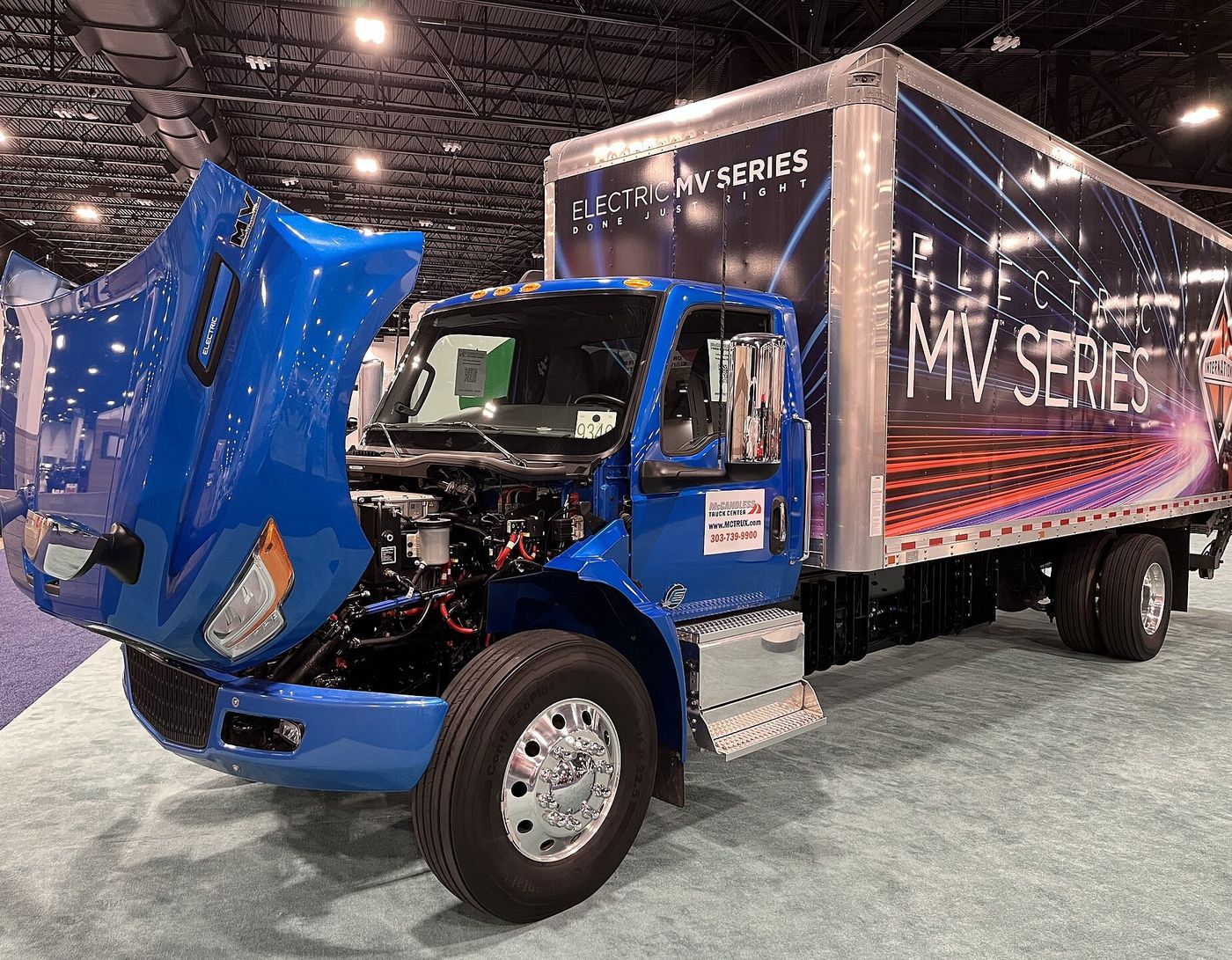
The eMV Series is International’s battery-electric medium-duty truck, which the maker says is built on the same foundation as the diesel MV Series. This page is built from International’s eMV Series page on its U.S. and Canada website, read on 4 November 2026; the eMV spec sheet (TAD21006, April 2025, headed 2024–25); the eMV brochure (TAD21007, September 2024, also headed 2024–25); the Body Power Options sheet (TAD23005, September 2024); and five news releases dated from 31 August 2021 to 1 May 2023, all of which name Navistar as the maker, while the 2024 and 2025 documents carry the name International Motors, LLC.
Launch and production
Navistar announced the eMV on 31 August 2021 at the ACT Expo in Long Beach, California, in a release headed “Now in Production and Available to Order”. A release of 7 July 2022 says the series has been “In full production since August 2021”. A release of 11 October 2021 says the five trucks for Penske Truck Leasing “will be manufactured on the same assembly lines that currently produce International diesel-powered vehicles”. No International document opened names a plant or an earlier generation of the eMV.
Model and configurations
The page, the sheet and the brochure list one model, the MV60E, with a 107.9-inch BBC (bumper to back of cab) and a 40-inch BA, and one axle configuration, 4x2. The cab listings differ. The eMV page and the brochure’s table give a day cab, and the April 2025 spec sheet gives “Day Cab, Crew Cab”. The brochure’s text on roof strength names “regular, crew and extended cab” configurations.
The spec sheet and the brochure give a GVWR of “25,999 and 33,000 lbs.”; the eMV page prints the same two figures as “25,999 - 33,000 lb.” Navistar’s releases of April and May 2023 call the eMV a Class 6 and 7 truck. The US weight ratings are explained in GVWR, GCWR and GAWR. No International document opened gives a kerb weight, a payload, or an overall length, width or height.
The page, the sheet, the brochure and the 2021 launch release list wheelbases of 217, 236, 254 and 272 in. The eMV page sets them out by body, each dry-van entry with a second figure followed by “typical” and a box length. The page does not label the second figure.
| Body | Wheelbase, in | Second figure, in | Box length, ft |
|---|---|---|---|
| Dry van | 217 | 100 | 20 |
| Dry van | 236 | 100 | 22 |
| Dry van | 254 | 106 | 24 |
| Dry van | 272 | 112 | 26 |
| Service body | 217 | – | – |
Electric motor and drive
International lists a “Direct Drive Electric Motor”, and the eMV page names a Dana motor under “Drive System”. The rear axle ratio is 6.83. The page also lists a push-button gear selector.
| Rating | Power | Torque |
|---|---|---|
| Peak | 342 hp, 255 kW | 1,737 lb-ft |
| Continuous | 255 hp, 190 kW | 730 lb-ft |
The eMV page gives the peak 342 hp and both torque figures; the brochure gives the two torque figures and no power row. The 2021 launch release gives other figures, with its units as printed: “peak power of over 335 horsepower or 250 kilowatt hours, with continuous power of 215 HP or 160 kWh”. No International document opened gives a newton-metre figure or a number of motors.
Battery and range
The traction battery is a 210 kWh lithium iron phosphate (LFP) pack, which the sheet and the brochure describe as “fully enclosed inside frame rails”. All four current documents give the usable capacity as approximately 189 kWh, and the eMV page adds that the 210 kWh figure carries “a reserve held for base charge protection”. A footnote in the brochure names “current production CATL LFP batteries”. LFP and the other cell chemistries are covered in battery chemistries in heavy trucks, and the two capacity figures in installed vs usable battery capacity.
The nominal operating voltage is 609 V. The eMV page lists a Battery Thermal Management System (BTMS) “using standard red coolant”; the spec tables of the sheet and the brochure give the battery a “dedicated BTMS”, while the ePower and ePTO blocks on the page and on the brochure’s body power pages give it a “dedicated HVAC system”.
The eMV page gives a typical range of 135 miles, with the footnote “Actual range is based on environmental conditions, driving behaviors, diminishing loads and maximum use of regenerative braking, etc.” The 2021 launch release gives “a 135-mile range when fully charged”. No document opened names a test cycle for the figure. How makers state such figures is covered in how electric-truck range is declared.
Charging
The sheet and the brochure give the charging standard as SAE J1772 CCS1, for AC and DC, which they say “ensures charging compatibility with most public chargers”. Both print the DC figure as “Up to 125 kWh capable with a DC charger”; the 2021 launch release gives “up to 125kW of power” from a DC fast charge station and says that at its highest input the station “can provide a full charge to the eMV in under two hours”. The same release lists AC and DC charging as standard equipment and gives a Level 2 AC station as providing “roughly 19.2kW of power”. Charging types in general are covered in charging electric trucks and buses.
The brochure describes two charging stations with an estimated time for the 189 kWh usable capacity, from a 20% to a 100% state of charge at room temperature.
| Item | Level 2 AC, 80 amps | ICE 30 kW DC fast charger |
|---|---|---|
| Max. power output | 19.2 kW | 30 kW |
| Output | 80 A at 240 V AC | 150 to 1,000 V DC |
| Connector | SAE J1772 | CCS1, 16 ft or 25 ft cable |
| Facility power | 208 / 240 V single phase, 100 A | 480 V three-phase, 50 A |
| Estimated charge time | 12 hours | 6 hours |
Body power: ePower and ePTO
Navistar announced factory-installed ePower and electric power take-off (ePTO) options on 1 May 2023. Both draw on the propulsion battery at the 609 V nominal operating voltage. The release says ePower “is the foundation for electric transport refrigeration unit (eTRU) applications” and that ePTO “utilizes an electric motor to convert power for other systems on the truck, such as a boom or concrete mixer”. The brochure describes the range of the options as running from “a simple plug-in to an electric motor with an SAE B flange”.
| Item | ePower | ePTO |
|---|---|---|
| Connection | Dual | Single |
| Connectors | Two TE HVA280 | Amphenol PowerLok Gen2 |
| Continuous power | 13.5–14.2 kW per connector | 40 kW minimum, assuming a 3,000 rpm hydraulic system limit |
| Peak power | 19.7 kW, fused | 60 kW maximum |
| Typical applications | Refrigerator, shredder | Utility, dump |
Cab and interior
International describes the cab as a “high-strength, low-alloy (HSLA) reinforced, cold-rolled steel construction” with air- and water-tight seals, and says that all eMV configurations pass the SAE J2422 roof strength test. The brochure also lists reinforced B-pillars. The eMV page lists the cab’s corrosion protection in six steps: stamped steel with a 60G/60G galvanised coating on both sides, standard on the dash, toe and floor panels; a caustic and surfactant cleaning; a tri-metal phosphate of nickel, zinc and manganese; an epoxy-based electrodeposition primer (e-coat) that covers and seals the entire exposed metal surface of the cab; an acrylic basecoat; and a urethane clear coat. The floor and toe-kick panels carry InterCoat ChemGuard, a chrome-zinc phosphate coating that International calls “a self-healing layer of skin on our galvanized steel”, and a spray-on polyurethane and polyurea floor coating is optional.
Outside, the documents name a sloped hood, door-mounted and breakaway mirrors, and standard LED headlamps, for which the page and the brochure also describe heating against snow and ice.
| Feature | Classic | Diamond |
|---|---|---|
| Cab trim panels | Easy-to-clean plastic | Easy-to-clean plastic |
| Door trim | Single-piece door panel with integrated door pocket | Single-piece door panel with integrated door pocket |
| Trim inserts | Neutral | Mineral Teak |
| Instrument panel | Black | Black |
| Gauge cluster | Digital full-colour cluster | Digital full-colour cluster |
| Accent colour | Neutral | Dark Neutral |
| Sun visors | Two | Three |
| Lighting | LED | LED |
| Window controls | Power | Power |
| Lock controls | Manual or power | Power |
| Cup and bottle holders | Four | Four |
| Overhead console | Moulded plastic with retainer nets and CB radio housing | Moulded plastic with retainer nets and CB radio housing |
| USB accessory ports | Up to 5 available | Up to 5 available |
The standard instrument panel is flat, with a centre-mounted vent for the middle passenger. The steering wheel carries back-lit, laser-etched function labels, and International says all the cab controls are designed to be operated while wearing gloves. The instrument cluster shows power against regeneration, propulsion load as a percentage, a range estimate, primary and secondary air system gauges, a vehicle-ready indicator, battery and drive motor temperature indicators, the regenerative braking level and a 12-volt battery gauge. The switch panel has as standard 3-level regenerative braking, off-road traction control, suspension dump and lift gate switches, with warning lights in any of seven colours and blank windows for custom labels; the eMV page says any switch can be moved by the customer without wiring changes, using Diamond Logic.
Axles, suspension, frame and brakes
| Item | Specification |
|---|---|
| Front axle | Dana Spicer I-Beam, 12,000 lb |
| Rear axle | Single rear axle (4x2), Dana Spicer, 23,000 lb |
| Front suspension | Spring, parabolic taper leaf, 12,000 lb |
| Rear suspension | IROS air suspension, 21,000 lb single axle with shocks |
| Frame | Heat-treated alloy steel, 120,000 psi |
| Brakes | Air brakes with ABS, 4-channel Electronic Stability Program with traction control |
| Tyres | Continental |
The steering listings differ: the sheet and the brochure give TRW/Ross power steering, and the eMV page gives a Sheppard M100 steering gear. The page also names Huck Bolt chassis fasteners.
Regenerative braking can be switched on or off and has three levels, which the sheet gives as 30%, 60% and 100%. The sheet describes a “One” pedal style of driving, “except for a complete stop”, and the brochure and the page say that most eMV non-emergency braking is done through regenerative braking. Levels and their rules are covered in regenerative braking in trucks and buses.
Safety systems
The spec sheet names “standard Bendix ABS, ESC and ATC safety features”. The brochure describes Bendix Electronic Stability Control as a full stability system offering roll and yaw stability, built on the ABS. It says Automatic Traction Control intervenes at lower speeds by applying braking pressure to a spinning wheel and transferring power to the other drive wheels. The brochure also says indirect visibility has been optimised so that drivers “turn their heads 15% less on the driver side and 5% less on the passenger side”. No International document opened lists collision mitigation, adaptive cruise control or lane departure warning for the eMV.
Electrical system and connected services
The 2021 launch release gives the Diamond Logic electrical system as standard equipment. The eMV page lists two 12-volt AGM auxiliary batteries, recharged through the high-voltage system.
The brochure says factory-installed telematics and five years of connected vehicle services are standard on new eMV trucks, and the sheet lists “OCC standard for 5 years with enhanced eMobility features”. The brochure’s EV Health Reporting shows charging activity, state of charge and estimated range in real time.
Applications and first deliveries
The spec sheet lists dry van, refrigerated van, utility, construction dump and landscape bodies; the eMV page describes delivery, service, landscaping, construction and refrigeration applications. A release of 1 May 2023 quotes Navistar as saying the original box truck application had been expanded “into electric bucket trucks, mini mixers, stake dumps, utility vehicles and more”.
| Release | Company | What the release says |
|---|---|---|
| 11 October 2021 | Penske Truck Leasing | First U.S. fleet to take delivery, five trucks; the release of 7 July 2022 says they were delivered in April 2022 |
| 7 July 2022 | Terex Utilities | All-electric bucket truck on an eMV chassis, announced on 6 June |
| 7 July 2022 | Morgan Truck Body | Prototype dry freight cargo van body |
| 7 July 2022 | ENMAX (Canada) | Two trucks bought for a pilot programme |
| 7 July 2022 | Altec | Chassis upfitted with an Altec TA-60 body |
| 7 July 2022 | Knapheide, TBEI Rugby | Stake body (Knapheide) and stake dump body (TBEI Rugby) |
| 28 April 2023 | Sysco | First eMV with ePower; Thermo King as refrigeration unit partner, Morgan Truck Body as body builder |
| 1 May 2023 | Altec | First eMV with a factory-installed ePTO, for a pilot distribution bucket truck |
Source notes
International’s US eMV Series page, read on 4 November 2026, its eMV spec sheet (TAD21006, April 2025) and its 2024-25 brochure (TAD21007, September 2024) describe one model, the MV60E, with a 107.9-inch BBC and a 40-inch BA, a 4x2 layout and wheelbases of 217, 236, 254 and 272 in. Cab: day cab on the page and in the brochure, day cab and crew cab on the sheet. GVWR 25,999 and 33,000 lb. Direct drive electric motor: peak 342 hp (255 kW) and 1,737 lb-ft, continuous 255 hp (190 kW) and 730 lb-ft, rear axle ratio 6.83. Battery: 210 kWh lithium iron phosphate, usable capacity approx. 189 kWh, 609 V nominal, typical range 135 miles. Charging: SAE J1772 CCS1, AC and DC, with a DC figure of up to 125, printed as kWh on the sheet and as kW in the 2021 launch release. Axles: Dana Spicer, 12,000 lb front and 23,000 lb rear. Factory-installed options: ePower, two connectors at 13.5-14.2 kW continuous each and a fused peak of 19.7 kW, and ePTO, 40 kW minimum continuous and 60 kW maximum peak. Navistar announced the eMV on 31 August 2021, and a release of 7 July 2022 says it has been in full production since August 2021. No International document opened gives a kerb weight, a payload, an overall length, width or height, or kilogram, millimetre or newton-metre figures.
Quick answers
- What axle configurations does the International eMV come in?
- 4x2.
- When did production of the International eMV start?
- Production of the International eMV started in 2021.
- Which transmission does the International eMV use?
- Transmission: Direct drive electric motor with a push-button gear selector.
- What battery capacity does the International eMV have?
- Battery: 189 kWh; Battery installed: 210 kWh; Charging: 125 kW (SAE J1772 CCS1).
More International on this site
Sources
- eMV Series (product page) — International Motors
- eMV Series spec sheet 2024–25 (TAD21006, April 2025) — International Motors
- eMV Series truck product brochure 2024–25 (TAD21007, September 2024) — International Motors
- eMV Series Body Power Options sheet (TAD23005, September 2024) — International Motors
- Navistar Launches New Electric International eMV Series, Now in Production and Available to Order — International Motors, 31 Aug 2021
- Penske First U.S. Fleet to Run International eMV Series — International Motors, 11 Oct 2021
- Navistar Serves Customer and Industry Partner Electrification Needs with International eMV Series — International Motors, 7 Jul 2022
- Navistar Delivers First International eMV Series with ePower to Sysco — International Motors, 28 Apr 2023
- Navistar demonstrates continued support of customer electrification journeys — International Motors, 1 May 2023