Wide-base single tyres ('super singles'): the term and the 'twin tyres' wording in weight rules
Wide-base single tyres ('super singles') run in place of a pair of twin tyres. What the EU, German and US federal weight texts say about twin tyres, and one maker's figures.
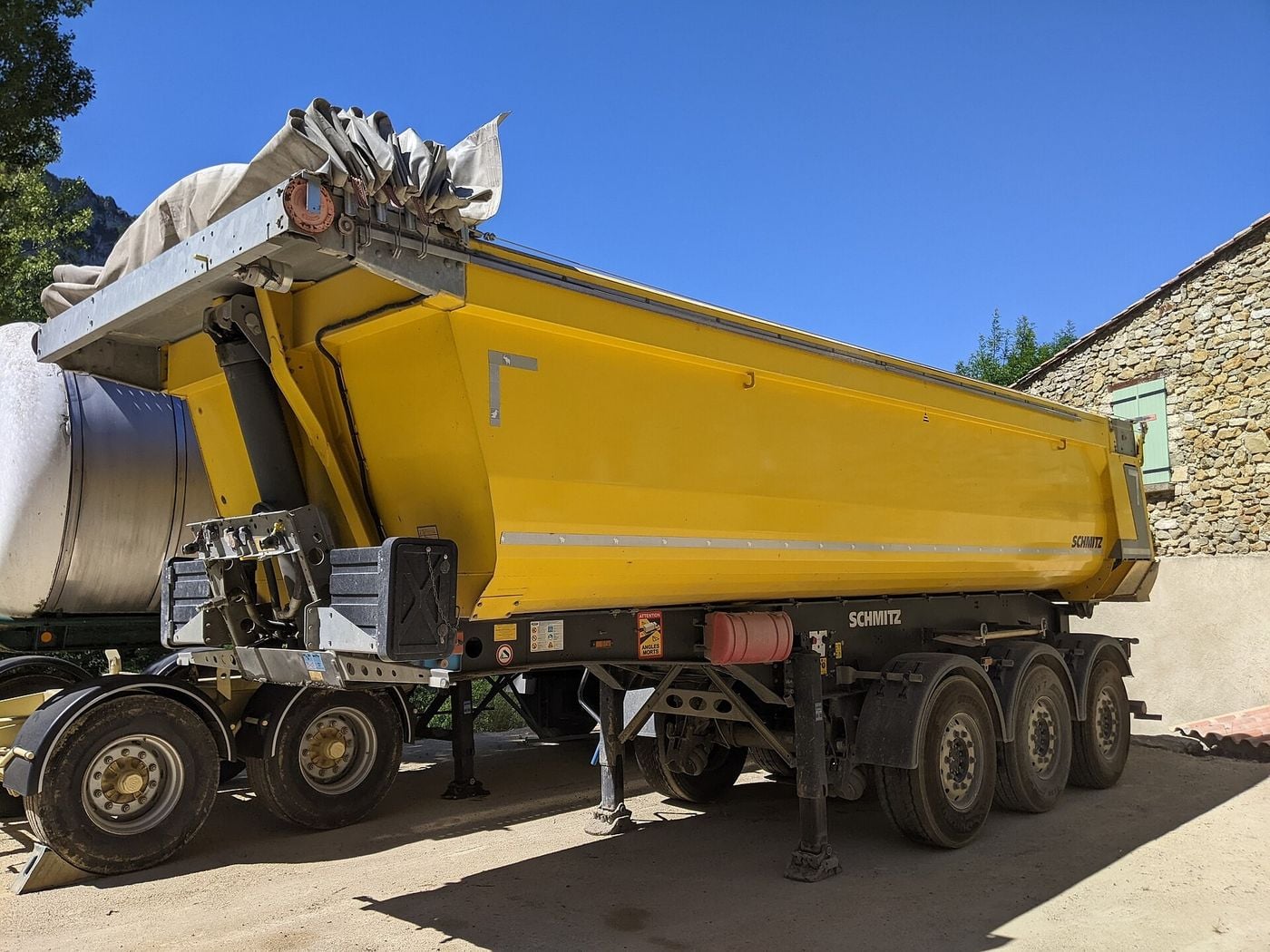
A wide-base single tyre, also called a “super single”, is one wide tyre fitted at a wheel position where a truck or trailer would otherwise run two tyres side by side, the twin or dual fitment. None of the weight texts read for this page uses the term: neither the European Union’s Directive 96/53/EC, nor § 34 of the German StVZO, nor the US federal weight regulation. Two of those texts, the EU Directive and § 34 StVZO, tie some of their maximum weights to the words “twin tyres” (in German, “Doppelbereifung”); the US federal text instead bars States from limiting tire loads below a figure per inch of tire or tread width.
Status as at 13 November 2026. Read on that day: the consolidated text of Directive 96/53/EC of 14 August 2019 in six language versions (no later consolidation was read), § 34 StVZO on Gesetze im Internet, 23 CFR 658.17 and 49 CFR 393.75 in their 2023 annual editions on GovInfo, and Michelin Canada’s product page for the X One Multi T.
Jurisdictions at a glance
| Jurisdiction | Text read | Tyre wording tied to a weight | Wide-base singles named |
|---|---|---|---|
| European Union | Directive 96/53/EC, Annex I (consolidated text of 14 August 2019) | “twin tyres”, points 2.2.4.2, 2.3.2, 2.3.3 and 3.5.3 | No |
| Germany | StVZO § 34 | “Doppelbereifung”, paragraph 4 No 2 d and paragraph 6 No 3 b | No |
| United States (federal, Interstate System) | 23 CFR 658.17 (edition of 1 April 2023) | tire loads per inch of tire or tread width, paragraph (f) | No |
| United Kingdom | national text not read | not verified | not verified |
| France | national text not read | not verified | not verified |
| Italy | national text not read | not verified | not verified |
| Spain | national text not read | not verified | not verified |
| Poland | national text not read | not verified | not verified |
| Türkiye | national text not read | not verified | not verified |
| Russia | national text not read | not verified | not verified |
| US states | state laws not read | not verified | not verified |
The term
The weight texts read for this page give no definition of the term. Michelin’s product page for the X One Multi T, a trailer tyre of its X One line, shows the idea in the maker’s own terms: it lists “Carry more payload vs dual tires” and bases the figure on “replacing (8) MICHELIN XTE tires with Alcoa Ultra ONE wheels with (4) MICHELIN X One MULTI T Tires with Alcoa Ultra ONE wheels” (trademark symbols omitted). In Michelin’s example, four wide tyres take the place of eight tyres in dual fitment.
The tyre’s size, 445/50R22.5, is written in the ordinary designation explained in how to read truck tyre markings: the first number is the nominal section width in millimetres, the second the aspect ratio, R the radial construction and 22.5 the rim diameter code. The same page shows how a load index can carry two numbers, one for single and one for dual fitment. How twin tyres count as one wheel position in an axle formula such as 4×2 or 6×2 is covered in truck axle configurations explained.
Directive 96/53/EC: where “twin tyres” appears
Directive 96/53/EC sets, in its title, “the maximum authorized weights in international traffic” for vehicles circulating in the EU. In four places Annex I ties a weight to a condition on the driving axle, and each time the condition uses the words “twin tyres”:
| Point | Vehicle or axle | Weight without the condition | Weight with the condition |
|---|---|---|---|
| 2.2.4.2 | Four-axle articulated vehicle (two-axle motor vehicle, two-axle semi-trailer), semi-trailer axle spacing greater than 1.8 m | 36 tonnes | 36 tonnes + 2 tonnes margin |
| 2.3.2 | Three-axle motor vehicle | 25 tonnes | 26 tonnes |
| 2.3.3 | Four-axle motor vehicle with two steering axles | none given | 32 tonnes |
| 3.5.3 | Tandem axle of a motor vehicle, spacing 1.3 m to less than 1.8 m | 18 tonnes | 19 tonnes |
At points 2.3.2, 2.3.3 and 3.5.3 the condition has two alternatives. Point 2.3.2 reads: “where the driving axle is fitted with twin tyres and air suspension or suspension recognised as being equivalent within the Union as defined in Annex II, or where each driving axle is fitted with twin tyres and the maximum weight of each axle does not exceed 9,5 tonnes.” At point 2.2.4.2 there is one route only: the 2-tonne margin applies “when the maximum authorized weight (MAW) of the motor vehicle (18 tonnes) and the MAW of the tandem axle of the semi-trailer (20 tonnes) are respected and the driving axle is fitted with twin tyres and air suspension or suspension recognized as being equivalent within the Community as defined in Annex II”. Under point 2.3.2 the same twin-tyre wording carries over to three-axle alternatively fuelled and zero-emission motor vehicles, whose 25 or 26 tonnes are increased by the additional weight of the technology, up to 1 tonne and 2 tonnes respectively.
The single-axle limits carry no tyre condition: 10 tonnes for a single non-driving axle (point 3.1) and 11.5 tonnes for a driving axle (point 3.4). The EU gross and axle limits as a whole are covered in gross combination weight, GVW and axle loads and truck axle configurations explained, and the Annex I dimensions of semi-trailers in semi-trailer dimensions.
The consolidated text read does not use the words “wide tyre”, “wide-base” or “super single”, and outside “twin tyres” it names no type of tyre in Annex I. It does not say whether a wide single tyre counts as twin tyres or not.
The same words in other language versions
The EU’s language versions of Annex I, all in the consolidation of 14 August 2019, word the twin-tyre condition as follows:
| Language | Wording | Points |
|---|---|---|
| English | twin tyres | 2.2.4.2, 2.3.2, 2.3.3, 3.5.3 |
| German | Doppelbereifung | 2.2.4.2, 2.3.2, 2.3.3, 3.5.3 |
| French | doubles pneus | 2.2.4.2, 2.3.2, 2.3.3, 3.5.3 |
| Italian | doppi pneumatici | 2.2.4.2, 2.3.2, 2.3.3, 3.5.3 |
| Spanish | neumáticos dobles; neumáticos gemelos | dobles at 2.2.4.2, 2.3.3, 3.5.3; gemelos at 2.3.2 |
| Polish | podwójne opony | 2.2.4.2, 2.3.2, 2.3.3, 3.5.3 |
Germany: § 34 StVZO
The German Road Vehicles Registration and Licensing Regulation sets axle loads and gross weights in § 34. Its paragraph 4 No 2 d allows 19.00 t on a tandem axle of a motor vehicle with an axle spacing of 1.3 m to less than 1.8 m “wenn die Antriebsachse mit Doppelbereifung und Luftfederung oder einer als gleichwertig anerkannten Federung nach Anlage XII ausgerüstet ist oder jede Antriebsachse mit Doppelbereifung ausgerüstet ist und dabei die höchstzulässige Achslast von 9,50 t je Achse nicht überschritten wird” (where the driving axle has twin tyres and air suspension or a suspension recognised as equivalent under Annex XII, or each driving axle has twin tyres and the maximum permissible axle load of 9.50 t per axle is not exceeded). Without that condition the same tandem axle is allowed 18.00 t.
Two gross weights in paragraph 5 build on that tandem axle: 26.00 t for a motor vehicle with more than two axles (No 2 b) and 32.00 t for a motor vehicle with more than three axles and two steered axles (No 3 b). Paragraph 6 No 3 b sets 38.00 t for a two-axle tractor with a two-axle semi-trailer whose axle spacing is more than 1.8 m, “wenn die Antriebsachse mit Doppelbereifung und Luftfederung oder einer als gleichwertig anerkannten Federung nach Anlage XII ausgerüstet ist”; with a semi-trailer axle spacing of 1.3 m or more, No 3 a sets 36.00 t. Single axles carry 10.00 t, driven single axles 11.50 t (paragraph 4 No 1). § 34 does not mention Breitreifen (wide tyres) or Einzelbereifung (single fitment).
United States: federal rules
The federal weight rule for the Interstate System, 23 CFR 658.17, sets 20,000 pounds on any one axle and 34,000 pounds on tandem axles (paragraphs (c) and (d)), with no condition on twin tires. Its paragraph (f) adds a rule tied to tire width: “States may not limit tire loads to less than 500 pounds per inch of tire or tread width, except that such limits may not be applied to tires on the steering axle.” The section does not mention wide-base or single tires by name.
The Federal Motor Carrier Safety Administration’s tire rule, 49 CFR 393.75, does not name wide-base tires either. Its paragraph (g) says that no motor vehicle, manufactured homes aside, “shall be operated with tires that carry a weight greater than that marked on the sidewall of the tire”, unless it runs under a special State permit at a reduced speed of no more than 80 km/h (50 mph).
A maker’s example: Michelin X One Multi T
Michelin’s Canadian product page for the X One Multi T describes it as a tyre for the trailer position, for long-distance and regional transport, and lists one size. Its technical specifications:
| Item | Michelin’s figure |
|---|---|
| Size | 445/50R22.5 L |
| Position | Trailer |
| Max load per tire, single | 10,200 lbs / 4,625 kg |
| Max speed | 75 mph / 121 km/h |
| Overall diameter | 39.8 inch / 1,011 mm |
| Loaded radius | 18.4 inch / 468.035 mm |
| Tread depth | 18/32 inch / 14.3 mm |
| Recommended wheels | 14.00 |
| Seat diameter | 22.5 |
Michelin’s payload claim for the tyre is “289 pounds or 131 kilograms” more than with dual tires, on the basis quoted above: eight XTE tyres replaced by four X One Multi T tyres, both sets on Alcoa Ultra ONE wheels. The page marks the tyre as retreadable and lists a retread for it, the X One Multi Energy T 445/50R22.5 with a tread depth of 15/32 inch; the rules for retreaded truck tyres are covered in retreaded truck and bus tyres, and the EU label classes for truck tyres in truck tyre labelling explained.
Quick answers
- What is a wide-base single tyre?
- A single wide tyre fitted where a pair of twin tyres would otherwise run, also called a super single. None of the weight texts read for this page, Directive 96/53/EC, German StVZO § 34 and 23 CFR 658.17, uses either term. Michelin's X One Multi T is one example: a trailer tyre in size 445/50R22.5, whose payload figure Michelin bases on replacing eight XTE tyres with four X One Multi T tyres.
- Does Directive 96/53/EC mention wide-base single tyres?
- No. The consolidated text of 14 August 2019 uses the words twin tyres in four points of Annex I: the 2-tonne margin for a four-axle articulated vehicle (2.2.4.2), 26 tonnes for a three-axle motor vehicle (2.3.2), 32 tonnes for a four-axle motor vehicle with two steering axles (2.3.3) and 19 tonnes for a tandem axle of a motor vehicle (3.5.3). It names no other kind of tyre for these weights, and wide-base or single wide tyres are not mentioned at all.
- What does the German StVZO say about twin tyres?
- § 34 StVZO allows 19.00 t on a tandem axle of a motor vehicle with an axle spacing of 1.3 m to less than 1.8 m where the driving axle has Doppelbereifung (twin tyres) and air suspension or an equivalent suspension, or where each driving axle has twin tyres and no axle exceeds 9.50 t. Paragraph 6 No 3 b allows 38.00 t for a two-axle tractor with a two-axle semi-trailer whose axle spacing is more than 1.8 m, where the driving axle has twin tyres and air suspension or an equivalent suspension. The section does not mention wide tyres.
- Is there a US federal rule on wide-base tires?
- 23 CFR 658.17 does not name wide-base tires. Its paragraph (f) says that States may not limit tire loads to less than 500 pounds per inch of tire or tread width, except that such limits may not be applied to tires on the steering axle. The federal axle limits in the same section, 20,000 pounds on a single axle and 34,000 pounds on a tandem axle, carry no condition on twin tires.
- How much load does a Michelin X One Multi T carry?
- Michelin's product page gives a maximum load of 10,200 lbs, or 4,625 kg, per tire in single fitment for the 445/50R22.5 size, a maximum speed of 75 mph (121 km/h), an overall diameter of 1,011 mm and lists 14.00 under "Recommended Wheels". Michelin states 131 kg (289 pounds) more payload against dual tires, based on replacing eight XTE tires with four X One Multi T tires, all on Alcoa Ultra ONE wheels.
Sources
- Council Directive 96/53/EC of 25 July 1996 laying down for certain road vehicles circulating within the Community the maximum authorized dimensions in national and international traffic and the maximum authorized weights in international traffic — consolidated text of 14 August 2019 (version 004.002), Annex I points 2.2.4.2, 2.3.2, 2.3.3, 3.1, 3.4 and 3.5.3; English, German, Spanish, French, Italian and Polish versions — Publications Office of the European Union, 14 Aug 2019
- Straßenverkehrs-Zulassungs-Ordnung (StVZO), § 34 Achslast und Gesamtgewicht, paragraphs 4, 5 and 6 — Bundesministerium der Justiz, Gesetze im Internet
- 23 CFR 658.17 Weight — Code of Federal Regulations, Title 23, annual edition revised as of 1 April 2023, paragraphs (c), (d) and (f) — U.S. Government Publishing Office, GovInfo, 1 Apr 2023
- 49 CFR 393.75 Tires — Code of Federal Regulations, Title 49, annual edition revised as of 1 October 2023, paragraph (g) — U.S. Government Publishing Office, GovInfo, 1 Oct 2023
- MICHELIN X One Multi T tire, product page with technical specifications and legal notices (read on 13 November 2026) — Michelin, business.michelin.ca (Canada)