Low-emission zones for trucks and buses in Europe: the national rules
How Germany, France, Spain, Italy, the Netherlands and Belgium frame low- and zero-emission zones for trucks and buses: criteria, stickers, foreign registration and fines.
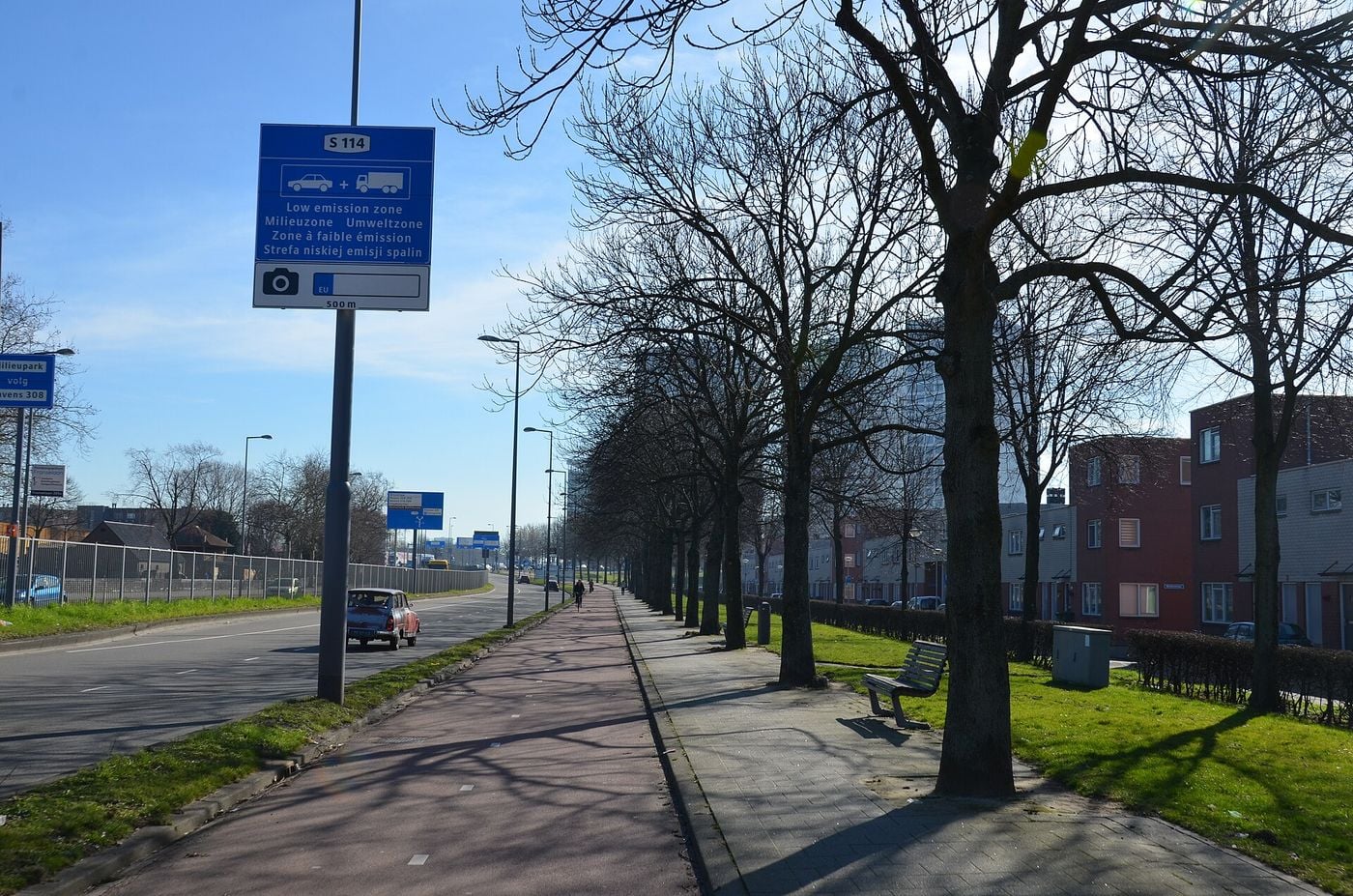
Low-emission zones in the European Union are created by cities and regions within a national legal frame. In Germany a windscreen sticker exempts a vehicle from a traffic ban insofar as the traffic sign at the zone provides for it. In France each zone à faibles émissions mobilité (ZFE-m) restricts vehicles by their Crit’Air class, and 24 of the 25 zones the environment ministry lists restrict heavy goods vehicles. Spanish municipalities of more than 50,000 inhabitants had to set up zonas de bajas emisiones before 2023, using the national vehicle classification. In Dutch milieuzones marked purple, trucks and buses need at least emission class 6, and since 1 January 2025 some Dutch cities have run zero-emission zones for vans and trucks. In the Brussels-Capital Region, EURO 5 diesel buses and lorries have no longer met the access criteria since 1 January 2026, and every vehicle registered abroad except in the Netherlands has to be registered there. The Italian transport ministry’s guidelines leave the vehicle categories a zona a traffico limitato bans to each municipality. Poland, Austria and Antwerp are listed as not verified.
Status as of 9 November 2026. Read on that day: §§ 1, 2, 3 and 6 and Annex 2 of the German sticker ordinance (35. BImSchV); Ley 7/2021 and Real Decreto 1052/2022 in their consolidated texts on the BOE, last updated on 30 June 2026 and 6 November 2026; the French environment ministry’s pages on the ZFE (last updated 13 August 2025) and on Crit’Air (last updated 2 February 2026) and its regulatory vademecum on the ZFE in its October 2024 version; the Italian transport ministry’s guidelines on ZTL of 28 June 2019; the Dutch government pages on Ondernemersplein and Rijksoverheid and the RDW’s page on emission classes; the LEZ pages of the Brussels-Capital Region and of the City of Ghent. The French codes on Légifrance, the Austrian federal legal information system RIS and Antwerp’s own LEZ pages could not be opened, and the current consolidated text of the Polish act was not opened. Rules differ from city to city; this page gives the national frameworks and the two Belgian zones whose own pages were read.
The national frameworks side by side
| Country | Legal frame | Criterion for trucks and buses | Vehicles registered abroad | Penalty as stated | Source of the row |
|---|---|---|---|---|---|
| Germany | 35. BImSchV: exemptions from traffic bans under § 40(1) BImSchG, tied to the traffic sign at the zone | Sticker of the pollutant group the sign admits: red 2, yellow 3, green 4 | Group presumed, mainly from the date of first registration, if no proof is presented; toll documents accepted for heavy vehicles under the motorway toll law | Not stated in the texts read | 35. BImSchV §§ 1–3, 6 and Annex 2, gesetze-im-internet.de |
| France | ZFE-m created by the local authority under Art. L. 2213-4-1 CGCT; Crit’Air classification of 21 June 2016 | Crit’Air class set by each zone; 24 zones restrict heavy goods vehicles, from unclassified to Crit’Air 3 | Crit’Air certificate required; the order site has a section for foreign vehicles | Fourth-class contravention for M2, M3, N2, N3: €135 | Ministry pages on ZFE and Crit’Air; ZFE vademecum, October 2024 |
| Spain | Ley 7/2021 Art. 14.3; Real Decreto 1052/2022; zones regulated by the municipality | Set by the municipality using the classification in Annex II.E of the General Vehicle Regulation | Not addressed in the texts read | Serious infringement under Art. 76 z3) of the Traffic Law; amount not in the texts read | BOE consolidated texts |
| Italy | Zona a traffico limitato under Art. 7 of the Codice della strada, established by resolution of the municipal executive (delibera di Giunta Comunale) | A ZTL may ban vehicles of certain environmental classes; criteria set by each municipality, not verified | Not verified | Not verified | Transport ministry ZTL guidelines, 28 June 2019 |
| Netherlands | Municipal milieuzones and zero-emission zones; RVV 1990, Chapter VB (named, not opened) | Purple milieuzone: trucks and buses emission class 6 or higher; zero-emission zone: emission-free trucks, class 6 transition to 2028 or 2030 | Not stated in the pages read | Not stated in the pages read | Ondernemersplein, Rijksoverheid, RDW |
| Belgium: Brussels-Capital Region | Regional LEZ since 1 January 2018, all 19 municipalities | Since 1 January 2026 EURO 5 diesel and EURO 2 petrol buses and lorries no longer meet the criteria | Must be registered, except Dutch vehicles: free, valid five years, up to five days after entering | €350; €150 for an unregistered foreign vehicle; €25 for incorrect information | lez.brussels |
| Belgium: Ghent | City LEZ inside the ring road | Diesel Euro 5/V and 6/VI free; Euro 4/IV after payment; older with a day pass | Must be registered, except Dutch vehicles: free, at the latest the day after entering | Amount not stated on the pages read | stad.gent |
| Belgium: Antwerp | Not verified | Not verified | Not verified | Not verified | The city’s LEZ pages could not be read |
| Poland | Strefy czystego transportu under the Act of 11 January 2018 on electromobility and alternative fuels | Not verified | Not verified | Not verified | Current consolidated text not opened |
| Austria | Not verified | Not verified | Not verified | Not verified | RIS could not be read |
The categories M2, M3, N2 and N3 used in these texts are explained in vehicle categories M, N and O, and what each Euro stage means for a heavy engine in Euro VI and Euro 7 for trucks.
Germany: the Umweltzone and the sticker
The 35th Ordinance implementing the Federal Immission Control Act (35. BImSchV) governs exemptions from traffic bans under § 40(1) of that Act (BImSchG) and the assignment of motor vehicles to pollutant groups (Schadstoffgruppen); it applies to vehicles of classes M and N (§ 1(1)). The bans themselves rest on § 40(1) BImSchG, which was not among the texts read.
A vehicle carrying a sticker is exempt from such a ban, § 2(1) says, “soweit ein darauf bezogenes Verkehrszeichen dies vorsieht” — insofar as a traffic sign referring to it so provides. Vehicles are assigned to pollutant groups 1 to 4 (§ 2(2)), and groups 2 to 4 receive a sticker: red for group 2, yellow for group 3 and green for group 4 (§ 3(1)). The issuing office writes the vehicle’s registration number on it, and the sticker is fixed clearly visible on the inside of the windscreen and must destroy itself when removed (§ 3(2)). Vehicles listed in Annex 3 are exempt from the bans even without a sticker (§ 2(3)); Annex 3 was not read.
For diesel vehicles within Directive 88/77/EEC on emissions from compression-ignition engines, Annex 2 ties the groups to the rows of the limit tables of that directive’s amendments:
- group 2: row B of Directive 91/542/EEC and row B of Directive 96/1/EC;
- group 3: row A (2000) of tables 1 and 2 of Directive 1999/96/EC or Directive 2001/27/EC;
- group 4: rows B 1 (2005), B 2 (2008) and C (EEV) of the same tables, and vehicles within Directive 2005/55/EC “in der jeweils zuletzt geänderten, im Amtsblatt der Europäischen Union veröffentlichten Fassung”.
Annex 2 also assigns groups to vehicles fitted with a particulate reduction system meeting the stages of Annexes XIV and XXVI of the German road vehicle licensing regulation (StVZO). Under Annex 2(3), vehicles without a combustion engine, “z. B. Elektromotor, Brennstoffzellenfahrzeuge”, belong to group 4.
§ 6 deals with vehicles registered abroad. Where no proof of compliance with Directive 70/220/EEC or 88/77/EEC can be presented, the group is presumed under § 6(3) and (4), mainly from the date of first registration. A diesel vehicle within Directive 88/77/EEC is presumed to be in group 2 if first registered after 30 September 1996 and before 1 October 2001, in group 3 if first registered after 30 September 2001 and before 1 October 2006, and in group 4 if first registered after 30 September 2006 (§ 6(3)). A vehicle registered abroad that falls under the German motorway toll law for heavy commercial vehicles may prove its group with the documents of §§ 8 and 9 of the truck toll ordinance (LKW-Maut-Verordnung) of 24 June 2003 (§ 6(1)), which the paragraph cites in that version.
Under § 1(2), the competent authority, and in urgent cases the police, may allow vehicles affected by a ban to drive to and from certain facilities where this is in the public interest, in particular to supply the population with vital goods and services, or where overriding and urgent interests of individuals require it, in particular where manufacturing and production processes cannot otherwise be maintained. The texts read state no fine.
France: ZFE-m and the Crit’Air certificate
French zones are created by the local authority that holds the traffic police powers for the zone, under Article L. 2213-4-1 of the Code général des collectivités territoriales (CGCT), as the ministry’s vademecum sets out. The ministry’s page names the mobility orientation law of 2019 and the climate and resilience law of 2021 as the laws that frame the zones. A zone is compulsory where the air-quality standards are regularly not met and, in metropolitan France, in agglomerations of more than 150,000 inhabitants, for which the vademecum gives 31 December 2024 as the deadline; a decree of 23 December 2022 sets exemptions from that obligation. The ministry’s page lists 25 zones in metropolitan France and names Paris and Lyon as the two agglomerations still regularly exceeding the limits.
Where a territory regularly fails the limit values, the vademecum says, the authority decides “complètement”, within the law, the calendar, the perimeter, the vehicle categories, the hours, the classes excluded and the exemptions, with three exceptions: the zone covers at least 50 % of the population of the most populous intercommunal body (EPCI) of the agglomeration living within the agglomeration, its restrictions include cars and light commercial vehicles, and a minimum calendar applies, for cars only. For the other agglomerations of more than 150,000 inhabitants, the 50 % coverage is the only rule it names. For heavy goods vehicles, the ministry’s page gives the level of restriction in force in 24 zones:
- vehicles with no Crit’Air class: Angers, Annecy, Annemasse, Bordeaux, Clermont-Ferrand, Dijon, Le Havre, Lille, Nantes, Nîmes, Rennes and Pau;
- Crit’Air 5: Nancy;
- Crit’Air 4: Aix-Marseille, Reims, Rouen, Saint-Étienne and Toulouse;
- Crit’Air 3: Grenoble, Lyon, Montpellier, Nice, Paris and the Métropole du Grand Paris, and Strasbourg.
Several of these are marked as in an educational period (“période pédagogique”) or as restricting only on certain days and hours. That page was last updated on 13 August 2025.
The Crit’Air certificate, the “certificat qualité de l’air”, is a round sticker of six types: E, for electric “zéro émission moteur” vehicles, and 1 to 5. The oldest vehicles under the least strict standards are not classified and receive none. The classification covers “véhicules lourds dont autobus et autocars”, depends on the vehicle type, its engine and the Euro standard it meets, is set by the arrêté of 21 June 2016 under Article R. 318-2 of the Code de la route, and holds for the vehicle’s life. The ministry gives the price as €3.11 plus postage. The certificate is compulsory to drive in a ZFE-m and when a prefect orders differentiated traffic during a pollution episode. The vademecum adds that there is a single classification valid throughout France and that the order site has a section for vehicles registered abroad, in English and German. The arrêté’s table, which assigns heavy vehicles to the classes, was not among the texts read.
Article R. 411-19-1 of the Code de la route, quoted in the vademecum, punishes driving in a zone in breach of its restrictions, or with a vehicle not identified under Article L. 318-1, with the fine of a fourth-class contravention “lorsque le véhicule relève des catégories M2, M3, N2 ou N3”, and a third-class fine for categories M1, N1 and L. The vademecum gives €68 for the third class, which it says concerns cars, vans and two-wheelers, and €135 for the fourth, which concerns heavy goods vehicles, buses and coaches, €90 if reduced and €375 if increased; the ministry’s Crit’Air page gives the same €135 for heavy goods vehicles and for displaying a certificate that does not match the vehicle. These offences can lead to the vehicle being immobilised under Article L. 325-1.
Vehicles of regular public transport services keep a temporary exception once their class is banned in a zone: under the arrêté of 28 June 2019, as the vademecum summarises it, three years for Crit’Air 5, four years for Crit’Air 4 and 3, and five years for Crit’Air 2 and 1. Access may not be refused to vehicles of general interest as defined in Article R. 311-1 of the Code de la route, to defence ministry vehicles, to vehicles displaying a disabled person’s parking card or to low-emission public transport vehicles within the meaning of Article L. 224-8 of the Code de l’environnement.
Spain: zonas de bajas emisiones
Article 14.3 of Ley 7/2021 on climate change and energy transition required municipalities of more than 50,000 inhabitants and island territories to adopt, before 2023, sustainable urban mobility plans including the establishment of “zonas de bajas emisiones antes de 2023”. The same applies to municipalities of more than 20,000 inhabitants where the limit values of Real Decreto 102/2011 on air quality are exceeded. The law defines a low-emission zone as a continuous area delimited by a public administration “en el que se aplican restricciones de acceso, circulación y estacionamiento de vehículos” to improve air quality and mitigate greenhouse gas emissions, according to the classification of vehicles by their emissions in the General Vehicle Regulation in force. Any measure that rolls back an existing zone needs a prior report from the regional environmental authority.
Real Decreto 1052/2022, in force since 29 December 2022, sets the minimum requirements, and regulating the zones is for the local authorities (Article 2.2). Restrictions on access, circulation and parking follow the polluting potential of vehicles, using the classification in Annex II.E of the General Vehicle Regulation, Real Decreto 2822/1998 (Article 5.2); that annex was not among the texts read. Where motor vehicles may enter, zero-emission vehicles have priority. For urban goods transport, Article 5.1 has local authorities promote zero-emission vehicles and “ciclologística” “con el fin de garantizar que dicha actividad es cero emisiones”. Zones are signed with the sign of the traffic directorate’s Instrucción MOV 21/3 of 2 June 2021 (Article 14). Each municipality reports the zone’s outline, any hours and the vehicles permitted to the Dirección General de Tráfico within a month, and the DGT makes these data available through the National Access Point for traffic and mobility (Article 10.2).
Not respecting the restrictions is the serious (“grave”) infringement of Article 76 z3) of the consolidated Traffic Law, Real Decreto Legislativo 6/2015, with the penalties of its Title V (Article 15); the amount is not stated in the texts read. Real Decreto 953/2026 of 4 November amends Article 10.3 with effect from 26 November 2026: municipalities then have to send the environment ministry and the regional environmental authority documentation including proof that penalties are applied, “que excluirá cualquier sistema transitorio de avisos”, and until it is received a zone is not considered correctly implemented. Neither text deals with vehicles registered abroad.
Italy: the zona a traffico limitato
No Italian national text setting emission criteria for zones was read. The transport ministry’s guidelines of 28 June 2019, addressed to municipalities, deal with the zona a traffico limitato (ZTL) as defined in Article 3 of the Codice della strada and established under its Article 7 by a resolution of the municipal executive (delibera di Giunta Comunale). Among the categories of vehicle a ZTL may ban, given as examples, they list “veicoli di massa superiore a determinate soglie” and “veicoli con determinate classi ambientali”. Which classes are banned, which vehicles, how vehicles registered abroad are treated and what fines apply are set by each municipality; no municipal act was read.
The Netherlands: milieuzones and zero-emission zones
A Dutch municipality may set up a milieuzone or a zero-emission zone (ZE-zone), marked by the signs and plates at its boundaries, according to the government’s business portal Ondernemersplein, which names Chapter VB of the traffic rules regulation RVV 1990 as the legislation. Milieuzones come at levels shown by coloured discs on the signs: green ones admit only cars and vans of emission class 4 or higher, blue ones class 5 or higher, and in purple ones “vrachtwagens en autobussen moeten minstens een emissieklasse van 6 of hoger hebben”. The government’s own page states that national rules apply to municipalities with milieuzones, that petrol cars, buses and trucks may always enter, and that municipalities may exclude older diesel cars, trucks and buses.
The emission class is the RDW’s. It is derived from the “Milieuklasse EG” in field V.9 of the registration certificate: EURO V and EEV become class 5, EURO 6W class 6 and an electric vehicle class Z. Where V.9 is unknown, the date of first admission decides; for commercial vehicles and buses in the heaviest of the RDW’s three mass bands, class 4 runs from 1 October 2005, class 5 from 1 October 2008 and class 6 from 31 December 2012. The emission class, the RDW states, decides access to a milieuzone; the separate CO2 emission class it records for heavy trucks sets the level of the Dutch heavy vehicle tax and, later, of the truck charge. Such CO2 classes are covered in EU road tolls and CO2 emission classes.
For milieuzones, a vehicle 40 years old or older is exempt automatically, and so are special vehicles with a specific body code, such as fire engines and aerial work platforms, until they are more than 13 years old. Removal vans, vehicles with a heavy loader crane and exceptional transport need a permit (ontheffing) from the municipality.
A ZE-zone admits only vans and trucks that emit no harmful substances, such as vehicles running on electricity or hydrogen, and covers at least the city centre. Ondernemersplein says that between 2025 and 2030 such zones come into force in 28 cities and at Schiphol. The ministry reported in March 2025 that the first 14 municipalities had introduced one on 1 January 2025 and that some 15 others would follow; in November 2024 the government had counted 29 municipalities that had decided to introduce one by 2030. Trucks first admitted from 1 January 2025 may enter only if they are emission-free, and trucks from before 2017 may not enter. Class 6 trucks have transitional access:
| Truck | First admitted | Access until |
|---|---|---|
| Rigid truck (bakwagen), emission class 6 | 1 January 2017 to 31 December 2019 | 1 January 2028 |
| Rigid truck (bakwagen), emission class 6 | 1 January 2020 to 31 December 2024 | 1 January 2030 |
| Tractor unit (oplegtrekker), emission class 6 | 1 January 2017 to 31 December 2024 | 1 January 2030 |
Exemptions follow automatically from the registration number; a permit is applied for at the RDW. In March 2025 municipalities, trade associations and the ministry agreed that each municipality would set a fine-free period of at least six months after a zone starts. The pages read state neither the fines nor how vehicles registered abroad are treated in Dutch zones.
Belgium: Brussels, Ghent and Antwerp
The Brussels-Capital Region’s LEZ has applied since 1 January 2018 and covers all 19 municipalities of the region, but not the Ring (R0) and certain roads leading to transit car parks. It covers minibuses and coaches (M2 and M3) and heavy goods vehicles (N2 and N3), whether registered in Belgium or abroad. Since 1 January 2026, following the Constitutional Court’s ruling of 11 September 2025, which cancelled a two-year postponement, “EURO 5 diesel and EURO 2 petrol vehicles (cars, vans, buses, lorries, motorbikes) no longer meet the access criteria”. Vehicles running on CNG, LNG, LPG or bioethanol count as petrol vehicles, and electric and hydrogen vehicles are exempt automatically. The region’s timetable separates N2 heavy goods vehicles by a reference mass of 2,610 kg from 2035, and city buses of classes I, II and A from coaches of classes III and B from 2036. The registration certificate fields the region points to are discussed in buying a used coach.
Every vehicle registered abroad, except in the Netherlands, has to be registered, even if it meets the criteria. Registration is free, valid for five years and possible before entering or within five days after, and companies with more than 20 foreign-registered vehicles can register them as a group. A vehicle that does not meet the criteria can enter with an exemption or a day pass: €50 for a heavy goods vehicle and €35 for a car, van, bus or coach, at most 24 a year per number plate, valid for the calendar day until 06:00 the next day. 353 cameras check the plates. The fine is €350 for a non-compliant vehicle without a valid day pass or exemption, €150 for a foreign vehicle that is not registered, even if it complies, and €25 for incorrect information given at registration; at most one fine is issued per vehicle every three months, up to four a year. For the vehicles excluded from 1 January 2026, a first offence brings a warning letter, and a fine can follow from three months after it. From 1 July 2026, the region states, a fine for such a vehicle covers a period of 12 months; its amount, €350, corresponds to the price of an annual pass that the government intends to introduce.
Ghent’s LEZ covers the inner city inside the ring road. It applies to categories M1 to M3 and N1 to N3, among others, running on diesel, petrol, LPG, CNG or LNG; electric and hydrogen vehicles are outside it, but with a foreign number plate they too must be registered. The city’s conditions for diesel vehicles:
- Euro 6/VI and Euro 5/V: free access; for trucks over 3.5 tonnes, the city notes, the designation EEV is equivalent to Euro 5/V;
- Euro 4/IV: “access after payment”; the city sells temporary permits for certain vehicles;
- Euro 3/III and older: access only with a day pass, available up to 12 times a year.
Petrol, LPG, CNG and LNG vehicles enter freely from Euro 2. The city states that the Flemish Government decided not to tighten the zone, so that Euro 5 diesel and Euro 2 petrol vehicles keep access, and that it will evaluate air quality in 2027 and then decide. A vehicle with a foreign number plate is registered once, free of charge, at the latest the day after entering the zone; Dutch vehicles need no registration because their data are retrieved from the RDW’s register. Processing can take up to 14 days. The pages read do not give the amount of the fine.
Antwerp’s own LEZ pages could not be read, so its criteria are listed as not verified. The Brussels region’s FAQ states that Antwerp has had a LEZ since 1 February 2017 and that the access criteria in Flanders are not quite the same as in Brussels.
Poland and Austria: not verified
Poland’s clean transport zones, strefy czystego transportu, are provided for in the Act of 11 January 2018 on electromobility and alternative fuels. Only the act as published in 2018 was opened, not its current consolidated text, so the present criteria, exemptions and fines are not given. For Austria, the federal legal information system RIS could not be read on 9 November 2026, so no Austrian text is given.
What this page does not cover
- Great Britain: England’s Clean Air Zones, London’s Low Emission Zone and Scotland’s zones are in Clean Air Zones and lorries in Great Britain.
- London’s Direct Vision Standard and HGV Safety Permit, a separate scheme: London’s Direct Vision Standard.
- Bans by day, hour or road section, such as weekend, holiday, night and sectoral bans: truck driving bans in Europe.
- Road tolls that vary with Euro or CO2 class: EU road tolls and CO2 emission classes.
- The boundaries, hours, local exemptions and fines of individual zones, which each city or region publishes.
Quick answers
- Do foreign trucks have to register for low-emission zones in Europe?
- In Brussels and Ghent, yes. Brussels requires every vehicle registered abroad, except in the Netherlands, to be registered even if it meets the criteria: registration is free, valid for five years and possible up to five days after entering, and an unregistered foreign vehicle is fined €150. Ghent requires vehicles with a foreign number plate, Dutch ones excepted, to be registered free of charge at the latest the day after entering. Germany works with a windscreen sticker and France with the Crit'Air certificate, which can be ordered for vehicles registered abroad.
- Can a Euro V diesel truck still enter the Brussels LEZ?
- No. Since 1 January 2026, following a ruling of the Constitutional Court of 11 September 2025, EURO 5 diesel and EURO 2 petrol vehicles, buses and lorries included, no longer meet the access criteria of the Brussels-Capital Region. Such a vehicle can enter with an exemption or a day pass, €50 for a heavy goods vehicle and €35 for a bus or coach, at most 24 a year per plate. Otherwise a first offence brings a warning letter, a €350 fine can follow from three months after it, and from 1 July 2026 such a fine covers a period of 12 months. Ghent still admits Euro 5/V diesel vehicles freely.
- Which sticker does a truck need for a German Umweltzone?
- The one the traffic sign at the zone admits: under § 2(1) of the 35. BImSchV a sticker exempts a vehicle from the traffic ban only insofar as the sign provides for it. The stickers are red for pollutant group 2, yellow for group 3 and green for group 4. For heavy diesel engines, group 4 covers the limits of rows B 1 (2005), B 2 (2008) and C (EEV) of Directive 1999/96/EC and vehicles within Directive 2005/55/EC, and every vehicle without a combustion engine belongs to group 4.
- How much is the fine for a truck in a French ZFE?
- Driving a vehicle of category M2, M3, N2 or N3 in a ZFE in breach of its restrictions, or without the Crit'Air certificate, is a fourth-class contravention under Article R. 411-19-1 of the Code de la route, as quoted in the environment ministry's vademecum. The vademecum gives €135, reduced to €90 or increased to €375. Cars, vans and two-wheelers fall under the third class, €68.
- Can diesel trucks still enter Dutch zero-emission zones?
- Only some, and for a limited time. Trucks first admitted from 1 January 2025 may enter only if they are emission-free, and trucks from before 2017 may not enter. Emission class 6 rigid trucks first admitted from 2017 to 2019 keep access until 1 January 2028; class 6 rigid trucks of 2020 to 2024 and class 6 tractor units of 2017 to 2024 until 1 January 2030. Municipalities agreed in March 2025 to set a fine-free period of at least six months.
Sources
- Fünfunddreißigste Verordnung zur Durchführung des Bundes-Immissionsschutzgesetzes (35. BImSchV), § 1 Anwendungsbereich — Bundesministerium der Justiz, gesetze-im-internet.de
- 35. BImSchV, § 2 Zuordnung von Kraftfahrzeugen zu Schadstoffgruppen — Bundesministerium der Justiz, gesetze-im-internet.de
- 35. BImSchV, § 3 Kennzeichnung — Bundesministerium der Justiz, gesetze-im-internet.de
- 35. BImSchV, § 6 Nachweis der Schadstoffgruppe für im Ausland zugelassene Fahrzeuge — Bundesministerium der Justiz, gesetze-im-internet.de
- 35. BImSchV, Anhang 2 Zuordnung der Kraftfahrzeuge zu den Schadstoffgruppen — Bundesministerium der Justiz, gesetze-im-internet.de
- Zones à faibles émissions (ZFE) (page published 6 July 2023, last updated 13 August 2025) — Ministère de la Transition écologique, France
- Certificats qualité de l'air : Crit'Air (page last updated 2 February 2026) — Ministère de la Transition écologique, France
- Vademecum réglementaire de la mise en œuvre d'une ZFE, version October 2024 — summary, sections 1, 2.1, 2.2, 4.3, 5.1 and 8.1 and the list of resources — Ministère de la Transition écologique, France
- Ley 7/2021, de 20 de mayo, de cambio climático y transición energética — consolidated text, last update published 30 June 2026, Article 14 — Agencia Estatal Boletín Oficial del Estado, Spain, 20 May 2021
- Real Decreto 1052/2022, de 27 de diciembre, por el que se regulan las zonas de bajas emisiones — consolidated text, last update published 6 November 2026, Articles 1, 2, 5, 10, 14 and 15 and final provision four — Agencia Estatal Boletín Oficial del Estado, Spain, 27 Dec 2022
- Linee Guida sulla regolamentazione della circolazione stradale e segnaletica nelle zone a traffico limitato (prot. 5050, 28 June 2019) — Ministero delle Infrastrutture e dei Trasporti, Italy, 28 Jun 2019
- Milieuzones en zero-emissiezones in Nederland — Ondernemersplein, overheid.nl
- Zero-emissiezones in veel steden — Ondernemersplein, overheid.nl
- Emissieklasse van uw voertuig — RDW, the Netherlands
- Overheid stimuleert milieuvriendelijker rijden — Rijksoverheid, the Netherlands
- Kabinet komt ondernemers tegemoet: uitstel zero-emissiezones voor schoonste dieselbusjes en inzet op langere boetevrije periode (news, 22 November 2024) — Rijksoverheid, the Netherlands, 22 Nov 2024
- Gemeenten, brancheorganisaties en ministerie maken afspraken over zero-emissiezones (news, 14 March 2025) — Ministerie van Infrastructuur en Waterstaat, Rijksoverheid, 14 Mar 2025
- Low Emission Zone: practical information, access criteria, controls and fines — Brussels Taxation, Brussels-Capital Region
- Low Emission Zone: register my vehicle — Brussels Taxation, Brussels-Capital Region
- Low Emission Zone: a day pass to drive in the LEZ — Brussels Taxation, Brussels-Capital Region
- Low Emission Zone: contact and help (FAQ) — Brussels Taxation, Brussels-Capital Region
- Low-emission zone in Ghent — City of Ghent
- Conditions for entering the low-emission zone — City of Ghent
- Registration for the LEZ: vehicle with a foreign number plate — City of Ghent
- Ustawa z dnia 11 stycznia 2018 r. o elektromobilności i paliwach alternatywnych (Dz. U. 2018 poz. 317), text as published — Sejm of the Republic of Poland, ELI, 11 Jan 2018