Volvo
Volvo FL Electric
Volvo FL Electric 4x2 rigid: one motor and a two-speed gearbox, 175–565 kWh installed, up to 450 km of range, 150 kW DC charging, GB sheets for 14 and 16 tonnes.
- 4x2 rigid
- 180 kW
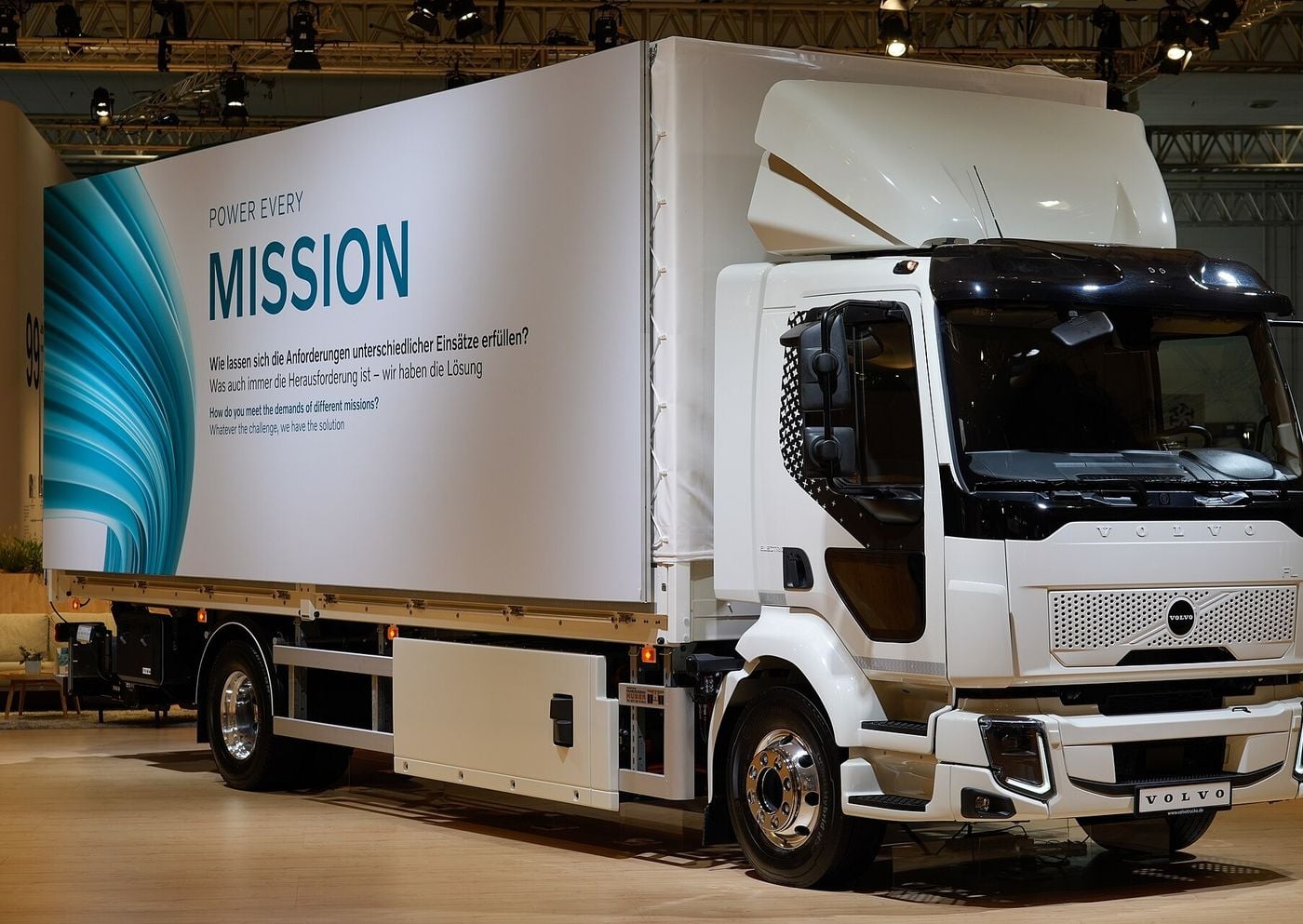

Model overview
- Segment
- Distribution
- Axle configurations
- 1 (4x2 rigid…)
- Transmission
- 2-speed gearbox, single electric motor
- Gross combination
- 18.6 t
- Battery
- up to 452 kWh
- Battery installed
- 175–565 kWh
- Range
- 450 km
- Charging
- 150 kW
- Electric motor
- 180 kW · 1×
| Variant | Axle configurations | Wheelbase (mm) | Kerb weight (kg) | Gross vehicle (kg) | Gross combination (kg) | Sheet |
|---|---|---|---|---|---|---|
| FL 42 R E 14 | 4x2 | 3,800 / 4,100 / 4,400 / 4,700 / 5,000 / 5,300 / 5,600 / 5,900 / 6,200 / 6,500 | 5,990 / 6,005 / 6,015 / 6,055 / 6,105 / 6,140 / 6,165 / 6,205 / 6,225 / 6,245 | 14,000 (design) | 16,000 (design) | FL 42 R E 14 GBR 2026-10-05 |
| FL 42 R E 16 | 4x2 | 5,000 / 5,300 / 5,600 / 5,900 / 6,200 / 6,500 | 7,925 / 7,990 / 7,975 / 8,015 / 8,035 / 8,025 | 16,000 (design) | 16,000 (design) | FL 42 R E 16 GBR 2026-10-05 |
The Volvo FL Electric is the battery-electric version of Volvo’s FL distribution truck. Volvo Trucks UK’s FL page offers the FL with the words “Choose between fully electric or diesel power” and lists the electric truck for “Delivery transports, urban construction, rescue and recovery”; Volvo’s global page names door-to-door deliveries and waste collection. This page is built from Volvo’s global FL Electric page, Volvo Trucks UK’s FL Electric page and its FL model and specification pages (all undated; the versions online on 8 November 2026), and from two Great Britain model-range data sheets dated 5 October 2026: FL 42 R E 14, a 14-tonne rigid, and FL 42 R E 16, a platform titled “16/18 tonne”. The diesel FL is described on its own page, Volvo FL, and rigid distribution trucks in general in box trucks and rigid distribution trucks.
Overview and generations
Volvo lists one axle configuration, a 4x2 rigid, with all axles air suspended, a range of up to 450 km and a gross combination weight of “12–18.6 tonnes” on the global page and “Up to 18.6 tonnes” on the UK pages. Volvo’s own pages differ on two headline figures, the power rating and the installed battery capacity; both versions are given below with the page each comes from.
No document opened gives a launch or production date for the FL Electric. The 14-tonne data sheet of 5 October 2026 is titled “NEW FL Battery Electric 4x2 Rigid 14 tonne”; the 16/18-tonne sheet of the same date carries no such word.
Cab
The model pages list a day cab and a short sleeper cab; Volvo Trucks UK’s FL model page puts it as “Day cab or sleeper cab”. On both GB data sheets the standard cab is FL-DAY2, “Short day (1.6m)”, and the option FL-SSLP2, “Comfort (2.0m)”. The sheets add that the front-axle-to-back-of-cab measure grows by 149 mm with the sleeper cab, and their drawings carry the label “Cab 2282”. Right-hand drive is standard on both sheets.
Volvo Trucks UK’s specification page, a single page for the electric and the diesel FL, gives the day cab and the short sleeper cab an interior height of 1,605 mm, and says the short sleeper cab “can be equipped with a bed for one person or be used as office space with extra storage compartments”.
Electric motor and gearbox
Volvo’s global and UK FL Electric pages both describe a single electric motor driving through a 2-speed gearbox.
The power rating differs between Volvo’s own pages. The global FL Electric page gives “Up to 180 kW continuous power (240 hp)”, and Volvo Trucks UK’s specification page and FL model page give 180 kW as well. Volvo Trucks UK’s FL Electric page gives “Up to 130 kW continuous power (175 hp)” and repeats it in its text as “up to 130 kW/175 hp”. No page reconciles the two figures, and none gives a peak rating or a torque figure for the motor.
Battery and charging
Installed capacity is given as 175–565 kWh, from 3 to 8 batteries, on the global page, and as 280–565 kWh, from 3 to 6 batteries, on Volvo Trucks UK’s FL Electric page and specification page.
The GB data sheets list the batteries by code. The 14-tonne rigid has one, as standard: ESS175K, “Total Energy 175kWh LFP - beginning of life”. The 16/18-tonne platform has five: 280 kWh NCA, 350 kWh LFP as standard, and 375, 470 and 565 kWh NCA, each given as total energy at the beginning of life. The two chemistries are described in battery chemistries in heavy trucks.
The same sheets list options named “Maximum Usable Battery Energy”: 145 kWh on the 14-tonne rigid, and 196, 224, 263, 290, 300, 329, 376, 396 and 452 kWh on the 16/18-tonne platform. The sheets do not pair these options with particular batteries. The difference between the two kinds of figure is explained in installed vs usable battery capacity.
Range is given as up to 450 km on every Volvo page opened. The global page links battery count and payload: where a lower range is enough, it says, fewer batteries can be fitted to “increase your load capacity substantially”.
Charging time for a full charge, quoted for 4 battery packs, is 8 h on AC at 43 kW and 2.3 h on DC at 150 kW; the global and UK pages give the same two figures. No document opened names a connector or charging standard. Charging methods in general are covered in charging electric trucks and buses.
Axles, suspension and brakes
Volvo lists the FL Electric as a 4x2 rigid with all axles air suspended. On the GB sheets, titled “Full Air Suspension”, the standard items are air front and rear suspension, the RAD-A2V two-bag rear air suspension and a remote suspension control with two sensors, on the medium chassis height, which Volvo Trucks UK’s specification page gives as approx 860 mm. The frame is listed as 8 mm web and flange.
The 14-tonne rigid has a 5.0-tonne front axle and a 9.5-tonne rear axle; the 16/18-tonne platform a 5.8-tonne front axle and a 10.9-tonne rear axle. Both sheets list two single-reduction rear axles with a differential lock: the RSS1125A, “design load 11 tonne, GCW 25 tonne”, standard on the 14-tonne rigid, and the RSS1132A, “design load 11 tonne, GCW 32.5 tonne”, standard on the 16/18-tonne platform; each is the option on the other sheet. The UK specification page’s rear-axle table gives both axles 1,050 Nm and a maximum axle load of 11.5 t, and its powertrain-combination table pairs them with the diesel ratings only.
Tyres are 265/70R19.5 front and drive on the 14-tonne sheet and 285/70R19.5 on the 16/18-tonne sheet.
Both sheets list as standard an EBS medium “including traction control & hill hold”. Volvo Trucks UK’s specification page, which covers the electric and the diesel FL together, says “The Volvo FL has pneumatic brakes with ventilated discs both front and rear”.
Versions, wheelbases and weights
Volvo Trucks UK links two FL Electric data sheets, both dated 5 October 2026 and both for Great Britain. FL 42 R E 14 is a 4x2 rigid of 14 tonnes in ten wheelbases from 3,800 to 6,500 mm; FL 42 R E 16 is a 4x2 platform titled “16/18 tonne” in six wheelbases from 5,000 to 6,500 mm.
Each sheet prints plated and design weights side by side. The 14-tonne rigid is 14,000 kg gross vehicle weight in both columns, with a front axle plate of 5,000 kg in both and a rear axle plate of 9,440 kg plated against 9,500 kg design. The 16/18-tonne platform is 16,000 kg gross vehicle weight in both columns, with 5,800 kg front and 10,900 kg rear in both; the sheet has no 18-tonne row. For gross combination weight both sheets print 0 in the plated column and 16,000 kg in the design column, while the model pages give “12–18.6 tonnes” (global) and “Up to 18.6 tonnes” (UK). The weight terms are explained in truck weights, GVW and GCW.
| Sheet | Wheelbase | Overall chassis length | Kerb weight | Payload | Turning circle, kerb to kerb |
|---|---|---|---|---|---|
| FL 42 R E 14 | 3,800 mm | 8,015 mm | 5,990 kg | 8,010 kg | 13,300 mm |
| FL 42 R E 14 | 4,100 mm | 8,315 mm | 6,005 kg | 7,995 kg | 14,200 mm |
| FL 42 R E 14 | 4,400 mm | 8,615 mm | 6,015 kg | 7,985 kg | 15,100 mm |
| FL 42 R E 14 | 4,700 mm | 8,915 mm | 6,055 kg | 7,945 kg | 16,000 mm |
| FL 42 R E 14 | 5,000 mm | 9,215 mm | 6,105 kg | 7,895 kg | 16,900 mm |
| FL 42 R E 14 | 5,300 mm | 9,515 mm | 6,140 kg | 7,860 kg | 17,800 mm |
| FL 42 R E 14 | 5,600 mm | 9,815 mm | 6,165 kg | 7,835 kg | 18,700 mm |
| FL 42 R E 14 | 5,900 mm | 10,115 mm | 6,205 kg | 7,795 kg | 19,600 mm |
| FL 42 R E 14 | 6,200 mm | 10,415 mm | 6,225 kg | 7,775 kg | 20,500 mm |
| FL 42 R E 14 | 6,500 mm | 10,715 mm | 6,245 kg | 7,755 kg | 21,400 mm |
| FL 42 R E 16 | 5,000 mm | 8,665 mm | 7,925 kg | 8,075 kg | 16,900 mm |
| FL 42 R E 16 | 5,300 mm | 9,915 mm | 7,990 kg | 8,010 kg | 17,800 mm |
| FL 42 R E 16 | 5,600 mm | 9,265 mm | 7,975 kg | 8,025 kg | 18,700 mm |
| FL 42 R E 16 | 5,900 mm | 9,565 mm | 8,015 kg | 7,985 kg | 19,600 mm |
| FL 42 R E 16 | 6,200 mm | 9,865 mm | 8,035 kg | 7,965 kg | 20,500 mm |
| FL 42 R E 16 | 6,500 mm | 10,165 mm | 8,025 kg | 7,975 kg | 21,400 mm |
Both sheets read “Chassis weight includes oil, water, AdBlue, 0 litres fuel and without driver. Kerb weight can vary ± 3%.” and “Legal weights can differ from country to country.” The 16/18-tonne sheet prints the 5,300 mm wheelbase with an overall chassis length of 9,915 mm and a rear overhang of 2,895 mm minimum and 3,295 mm maximum, against 2,345 mm on its other five wheelbases; the 14-tonne sheet gives 2,895 mm throughout. The turning circle wall to wall runs from 14,600 to 22,700 mm on the 14-tonne sheet and from 18,200 to 22,700 mm on the 16/18-tonne sheet.
Safety and driver-assistance systems
Both GB sheets list as standard a Driver Alert Support Warning with driver attention monitoring and an intelligent speed assist with road sign recognition, together with a Continental VDO 4.1 smart tachograph version 2. Volvo Trucks UK’s FL model page, which presents the electric and the diesel FL together, names a front looking radar, a front looking camera and side radars, which it says are used by the driver support systems, a rear camera, and Front Short Range Assist and Side Collision Avoidance Support; it does not say which of them are standard on the FL Electric.
Equipment and bodybuilding
Volvo’s global page lists “Suitability for body-work. Electric PTO” under applications, and Volvo Trucks UK’s FL model page says that with electric or diesel power “there are power take-offs available” for pumps, tippers, compactors and lifts. How a power take-off is mounted and rated is covered in what is a power take-off.
The GB sheets list as standard lower front body attachments for a “torsionally semi-flexible body - box or curtainsider” and divided rear body attachments, with front attachments for a platform body, frame rail free space and a taillift preparation kit as options. Further standard items are 2 x 170 Ah batteries on the left-hand side, one towing pin, brushed Howmet Alcoa aluminium rims and Whole Vehicle Type Approval. Options include the Drive and Visibility packages, a sunvisor, roof deflector and cab extensions package, a DAB radio, a second towing pin, an ADR-certified 15-pin connector, Dura-Bright aluminium or steel rims, a tyre pressure gauge and two amber LED beacons.
Volvo’s global and UK FL Electric pages describe constant truck monitoring and predictive service planning, and route planning and positioning with real-time energy status through Volvo Connect.
Source notes
Volvo’s documents give two continuous power ratings. The global FL Electric page gives “Up to 180 kW continuous power (240 hp)” and describes “delivered power of up to 180 kW/240 hp”; Volvo Trucks UK’s FL specification page gives “Up to 180 kW (240 hp) continuous power” and its FL model page “Power: 180 kW”. Volvo Trucks UK’s own FL Electric page gives “Up to 130 kW continuous power (175 hp)” and “up to 130 kW/175 hp”. The documents do not reconcile the two, and none gives a peak rating. The global and UK FL Electric pages describe a single electric motor with a 2-speed gearbox. Installed battery capacity is 175–565 kWh from 3 to 8 batteries on the global page, and 280–565 kWh from 3 to 6 batteries on the UK FL Electric page and the UK specification page. The GB model-range data sheets dated 5 October 2026 list one battery for the 14-tonne rigid, FL 42 R E 14: “Total Energy 175kWh LFP - beginning of life”, standard, with an optional maximum usable battery energy of 145 kWh. For the 16/18-tonne platform, FL 42 R E 16, they list five: 280 kWh NCA, 350 kWh LFP (standard), 375 kWh NCA, 470 kWh NCA and 565 kWh NCA, all “beginning of life”, with optional maximum usable battery energies of 196, 224, 263, 290, 300, 329, 376, 396 and 452 kWh. Range is up to 450 km on every Volvo page opened. Charging time for a full charge with 4 battery packs is 8 h with AC at 43 kW and 2.3 h with DC at 150 kW; no document opened names a connector or charging standard. Gross combination weight is “12–18.6 tonnes” on the global page and “Up to 18.6 tonnes” on the UK pages. The GB sheets give plated and design weights, in kilograms: FL 42 R E 14, gross vehicle 14000 / 14000, gross combination 0 / 16000, front axle 5000 / 5000, rear axle 9440 / 9500; FL 42 R E 16, gross vehicle 16000 / 16000, gross combination 0 / 16000, front axle 5800 / 5800, rear axle 10900 / 10900. The second sheet’s title reads “16/18 tonne”; its weights table has no 18-tonne row. Kerb weights run from 5990 to 6245 kg on the 14-tonne sheet across ten wheelbases from 3800 to 6500 mm, and from 7925 to 8035 kg on the 16/18-tonne sheet across six wheelbases from 5000 to 6500 mm. Both sheets read “Chassis weight includes oil, water, AdBlue, 0 litres fuel and without driver. Kerb weight can vary ± 3%.” and “Legal weights can differ from country to country.” Overall chassis length is 8015 to 10715 mm on the 14-tonne sheet, with a rear overhang of 2895 mm throughout, and 8665 to 10165 mm on the 16/18-tonne sheet, where the 5300 mm wheelbase is printed at 9915 mm with a rear overhang of 2895 (min.) and 3295 mm (max.) against 2345 mm on the other five. Turning circle diameter kerb to kerb is 13300 to 21400 mm (14 tonnes) and 16900 to 21400 mm (16/18 tonnes); wall to wall 14600 to 22700 mm and 18200 to 22700 mm. Tyres are 265/70R19.5 front and drive on the 14-tonne sheet and 285/70R19.5 on the 16/18-tonne sheet. Axles: front 5.0 tonne and rear 9.5 tonne on the 14-tonne sheet, 5.8 tonne and 10.9 tonne on the 16/18-tonne sheet. The RSS1125A rear axle, “Single reduction with diff lock - design load 11 tonne, GCW 25 tonne”, is standard on the 14-tonne sheet and optional on the 16/18-tonne sheet; the RSS1132A, the same with “GCW 32.5 tonne”, is the reverse. The UK specification page’s rear-axle table gives both axles 1050 Nm and a maximum axle load of 11.5 t, and its powertrain-combination table pairs them with the diesel ratings only. All axles are air suspended; the sheets list air front and rear suspension, the RAD-A2V 2-bag rear air suspension and remote suspension control (2 sensor) as standard, with the medium chassis height, which the UK specification page gives as approx 860 mm. Cabs: day cab and short sleeper cab on the model pages; on the sheets the “Short day (1.6m)” cab FL-DAY2 is standard and the “Comfort (2.0m)” cab FL-SSLP2 optional, with “Front Axle to Back of Cab: +149 mm for CAB-SSLP”, and the drawings read “Cab 2282”. The UK specification page, which covers the electric and diesel FL together, gives the day cab and the short sleeper cab an interior height of 1605 mm. Further standard equipment on both sheets: EBS medium including traction control and hill hold; an 8 mm web and flange frame; 2 x 170 Ah batteries on the left-hand side; one towing pin; brushed Howmet Alcoa aluminium rims; right-hand drive; a Continental VDO 4.1 smart tachograph version 2; Driver Alert Support Warning with driver attention monitoring; intelligent speed assist and road sign recognition; Whole Vehicle Type Approval; lower front body attachments for a box or curtainsider body and divided rear body attachments. Options include the Drive and Visibility packages, a sunvisor, roof deflector and cab extensions package, a DAB radio, a taillift preparation kit, two towing pins, an ADR-certified 15-pin connector, Dura-Bright aluminium or steel rims, a tyre pressure gauge and amber LED beacons. The global page lists “Suitability for body-work. Electric PTO” under applications. No document opened gives a launch or production date for the FL Electric.
Quick answers
- What axle configurations does the Volvo FL Electric come in?
- 4x2 rigid.
- Which transmission does the Volvo FL Electric use?
- Transmission: 2-speed gearbox, single electric motor.
- What is the gross combination weight of the Volvo FL Electric?
- Gross combination weight: 18.6 t.
- What battery capacity does the Volvo FL Electric have?
- Battery: up to 452 kWh; Battery installed: 175–565 kWh; Range: 450 km; Charging: 150 kW.
- How much does the Volvo FL Electric weigh?
- Kerb weight: 5 990–6 245 kg (FL 42 R E 14); 7 925–8 035 kg (FL 42 R E 16).
Articles that mention the Volvo FL Electric
- Box trucks and rigid distribution trucks: 7.5 to 26 t chassis, bodies and EU rules
- Refuse collection vehicles: rear, side and front loaders, chassis and EN 1501
- Sewer-cleaning and vacuum trucks: combination units, ADR vacuum tanks, chassis and body builders
- Volvo D5K engine: 5.1-litre four-cylinder diesel, ratings and vehicles
More Volvo on this site
Sources
- Volvo FL Electric — model page and specifications — Volvo Trucks
- Volvo FL Electric — model page and specifications (UK & Ireland) — Volvo Trucks UK
- Volvo FL specifications (UK & Ireland) — Volvo Trucks UK
- Volvo FL — model page (UK & Ireland) — Volvo Trucks UK
- Model range data sheet — NEW FL Battery Electric 4x2 Rigid 14 tonne, full air suspension (FL 42 R E 14, GBR, 5 October 2026) — Volvo Trucks, 5 Oct 2026
- Model range data sheet — FL Battery Electric 4x2 Platform 16/18 tonne, full air suspension (FL 42 R E 16, GBR, 5 October 2026) — Volvo Trucks, 5 Oct 2026