BYD
BYD eBus B12.b
BYD's eBus B12.b is a 12-metre low-floor electric bus with the Blade Battery in its chassis and two 150 kW wheel hub motors; BYD's page and brochure give different battery figures.
- 12.13 m
- 20 t

Model overview
- Segment
- Bus
- Gross vehicle
- 20 000 kg
- Electric motor
- 150 kW peak · 2×
- Length
- 12 130 mm
- Wheelbase
- 5 950 mm
The eBus B12.b is a 12-metre low-floor battery-electric bus in BYD Europe’s range, with the lithium iron phosphate (LFP) Blade Battery built into the structure of the chassis and two wheel hub motors in the drive axle. This page is built from four BYD Europe documents: the B12.b product page, undated and read on 8 November 2026; the 16-page B12.b brochure, undated (reference 0929-BPS-V3) and read on the same day; BYD’s press release on Busworld 2023, dated 11 October 2023; and its press release on the BD11 double-decker, dated 21 May 2024.
Overview and status
| Item | Product page | Brochure |
|---|---|---|
| Body type | Low Floor | Low Floor |
| Length, width, height | 12130/2550/3200 mm | 12,130 mm, 2,550 mm, 3,200 mm |
| Wheelbase | 5950 mm | 5,950 mm |
| Max G.V.W | 20 T | 20 T |
| Passenger numbers | Up to 105 | Up to 105 |
| Battery | BYD LFP Blade Battery, up to 500 kWh | BYD LFP Blade Battery, up to 565 kWh |
| Range | Up to 600 km | Up to 720 km (estimated) |
| Motors | Hairpin motor, max. motor power 150 kW×2 | BYD wheel hub motor, 150 kW×2 |
| Charging, single gun | 200 kW | Up to 350 kW |
| Charging, pantograph | 500 kW maximum | Up to 550 kW (optional) |
BYD’s press release of 11 October 2023 says that the 12-metre “BYD eBus B12” made its European debut at Busworld 2023, held from 7 to 12 October at Brussels Expo, on stand 705 in Hall 7, and describes it as the first bus to use BYD’s Blade Battery Chassis. The release gives the Blade Battery “a maximum capacity of 500kWh” and a range of 600 km on one charge, and speaks of BYD’s “latest generation of 12-metre electric buses” without naming an earlier one. BYD’s press release of 21 May 2024 on the BD11 double-decker says that the year before, the company had introduced new eBus innovations for the European market “with the launch of the B12”.
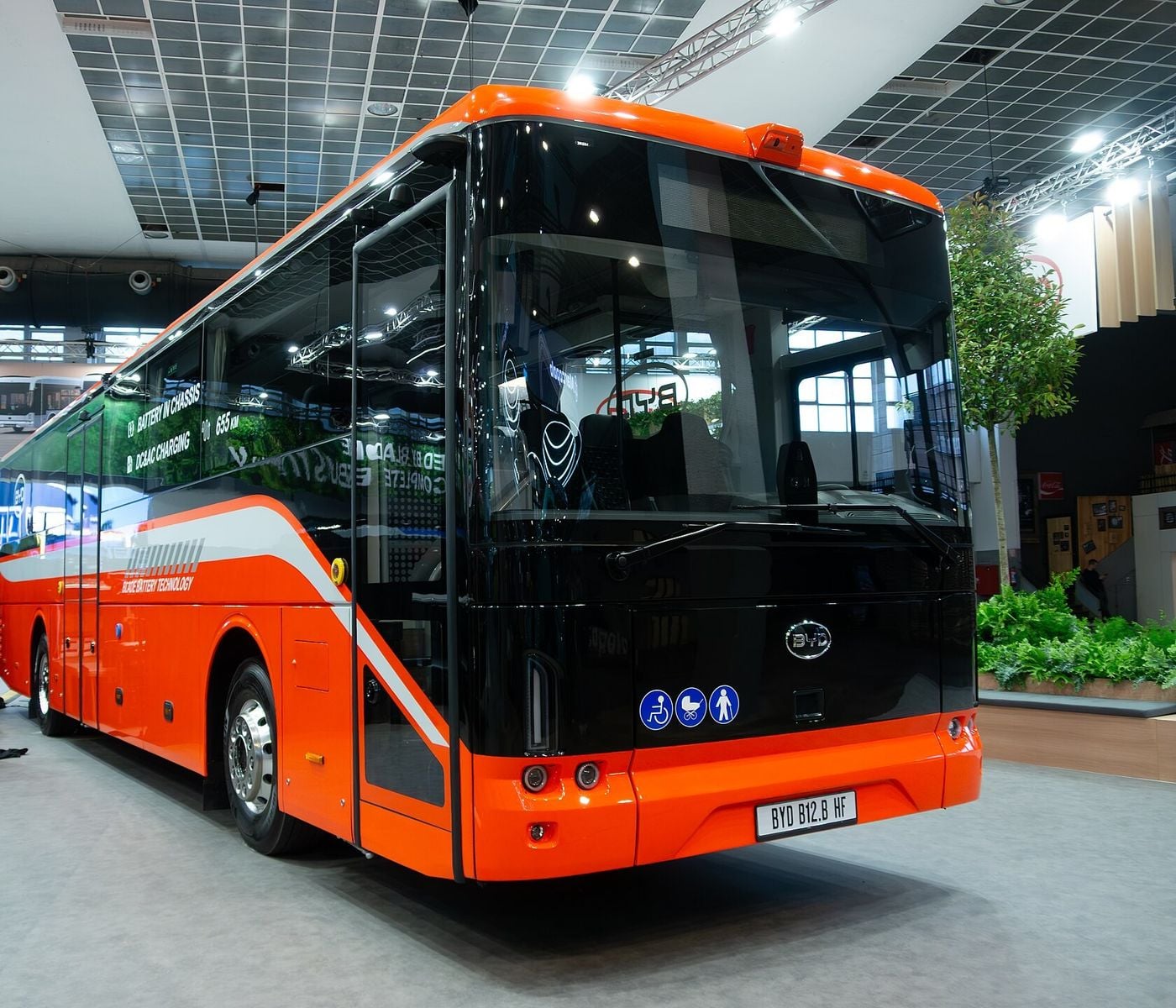
The product page and the brochure name the bus B12.b. The product page lists it beside the B11, B13, B15, B18, B19, K9UD and BD11, and, under jointly manufactured buses, a BYD-Castrosua B12. No document opened gives a start of series production. The bus in the cover photograph, on a stand at Busworld Europe 2025, carries a plate reading “BYD B12.B HF”; no BYD document opened describes an HF version, and the product page and the brochure give one body type, “Low Floor”.
Blade Battery chassis
BYD describes the battery integration as the batteries forming part of the structure of the vehicle. The product page and the brochure give the same figures for it: a torsional stiffness of “55,000+N.m/°”, a centre of gravity lowered by 40%, a vehicle tilt angle increased by 47%, and an overall bus weight reduced by 10%, which BYD says increases the range and reduces the energy consumption. The 2023 release describes a chassis that integrates the Lithium Iron Phosphate Blade Battery “within the chassis structure”.
The brochure says that the Blade Battery has passed the Nail Penetration Test without emitting fire or smoke, that each cell in the pack serves as a structural beam, and that the battery carries “a 15 year – 80% SOH guarantee”. The brochure’s table gives the battery management system as “BYD integrated BTMS”. The chemistry, LFP, is covered in battery chemistries in heavy trucks.
Electric drive
The B12.b has no combustion engine. Both documents give two BYD wheel hub hairpin motors of 150 kW each; the product page heads the figure “Max. motor power”. The brochure’s table gives the drive axle as a “BYD axle with integrated BYD wheel hub hairpin motors”. BYD says the motors combine flat wire with an oil-free solution, for a 15% weight reduction, operate at 95.5% efficiency with very low motor noise levels, and offer “a power boost of up to 600 N·m torque”. No document opened says whether the 600 N·m is per motor or for both, or gives a continuous power, a gearbox, an axle ratio or a top speed.
The motors are run by what BYD calls its 6-in-1 controller. The brochure lists the six elements it combines in one plug-and-play set: 2 electric motor control units, 1 steering control unit, 1 air compressor controller, 1 DC-DC converter and 1 power distributor unit. The controller uses silicon carbide (SiC) modules, for which BYD gives 99.5% efficiency and a 15% weight reduction against traditional controllers.
BYD’s Integrated Thermal Management System combines drive cooling, battery cooling, battery heat pump heating and drive waste heat recovery. BYD says it raises the battery heating speed by 30 to 80% and reduces energy consumption by 10 to 50%.
Battery, range and charging
Both documents give the battery as a BYD LFP Blade Battery and state its capacity as a maximum (“up to”), with different figures. No document opened says whether these are installed or usable capacities, or states a test cycle, load or temperature for the range.
| Item | Product page | Brochure |
|---|---|---|
| Battery capacity | Up to 500 kWh | Up to 565 kWh |
| Range | Up to 600 km | Up to 720 km (estimated) |
| Single charging gun | 200 kW | Up to 350 kW |
| Pantograph | 500 kW maximum (optional) | Up to 550 kW (optional) |
| Charging system | Plug charging (CCS) (Standard), Pantograph (Optional) | DC Charging – CCS Combo 2, Pantograph (Optional) |
| Charging time | 0% to 100% in one hour | 0% to 100% in one hour (text); under 3 h by DC and under 10 min by pantograph (table) |
BYD’s 2023 release gives the Blade Battery a maximum capacity of 500 kWh and a range of 600 km, the figures of the product page. The product page and the brochure both say the B12.b can be charged from 0% to 100% in one hour; the brochure’s table gives a charging time of under 3 h by DC and under 10 min by the optional pantograph, and no document ties the one hour to a charging method.
BYD lists charging port positions at the front, rear, left, right and top, and the brochure says that multiple combinations of charging ports are available. The brochure names the plug standard as CCS Combo 2, the product page as CCS; the pantograph is optional in both documents. How depot and pantograph charging work on city buses is covered in opportunity charging and pantographs and electric buses explained.
Chassis, suspension, steering and brakes
The brochure’s chassis table gives a ZF independent suspension at the front axle and the BYD drive axle with its integrated hub motors. The standard suspension is ECAS (Electronic-Controlled Air Suspension) with a kneeling function and PCV (Premium Comfort Valve) shock absorbers; optional is ESAC (Electronic Shock Absorber Control) active suspension, also with a kneeling function, with CDC (Continuous Damping Control) shock absorbers. The text of both documents describes BYD’s Active Suspension Control System, with electronically controlled CDC shock absorbers that provide lower damping and a suspension that can be adjusted in real time based on the vehicle’s motion status. How an electronically controlled air suspension sets the ride height is covered in ECAS air suspension.
Steering is standard as an Electro-Hydraulic Steering System with a steering control unit and an electric motor, with EHPS (Electric Hydraulic Power Steering) as an option. The brochure lists ESC (Electronic Stability Control System), and for the brakes EBS (Electronic Braking System) with ASR (Acceleration Slip Regulation) and AEBS. The tyre size is 275/70R22.5. No document opened gives the brake type or a turning circle.
Body, dimensions and weights
| Item | As printed |
|---|---|
| Vehicle length | 12,130 mm |
| Vehicle width | 2,550 mm |
| Vehicle height | 3,200 mm |
| Wheelbase | 5,950 mm |
| Front and rear overhang | 2,750/3,430 mm |
| Angle of approach/departure | 7°/7° |
| Body type | Low Floor |
| Max G.V.W | 20 T |
| Tire size | 275/70R22.5 |
| Passenger numbers | Up to 105 |
The brochure gives the body frame as “BYD IV aluminum body and composite material (Roof)”. It lists a digital exterior rearview mirror, an electric and manual dual mode wheelchair ramp, an electric roof hatch as standard with a manual roof hatch as an option, and an optional bicycle rack. BYD gives the passenger figure, up to 105, for the bus “when fully loaded”; no document opened gives a seat or standee count, a door arrangement or a kerb weight. The low floor and kneeling are part of what is covered in bus accessibility.
Safety and driver-assistance systems
The brochure’s table marks as standard the Advanced Emergency Braking System (AEBS), Driver Drowsiness and Attention Warning (DDAW), Blind Spot Monitoring (BSM), Lane Departure Warning System (LDWS), Forward Collision Warning (FCW), Headway Monitoring & Warning (HMW), Pedestrian & Cyclist Collision Warning (PCW), Traffic Sign Recognition (TSR), Speed Limit Indicator (SLI), Intelligent Speed Assistance (ISA) and an Alcolock. Among the certifications it marks R29 (driver protection), R93 (front underrun protection) and R155/R156 (cyber security) as standard and R66 (vehicle rollover) as optional, and it lists UN ECE R158 (reversing rear-view visibility and detection systems) and UN ECE R141 (tyre pressure monitoring) without a mark.
The two documents differ on what is standard. The product page’s list of standard safety elements and certifications names the same systems without FCW, and of the certifications only R29, R93 and R155/R156. The list on page 6 of the brochure names all of them as standard equipment, including R66, which the brochure’s own table marks as optional. Which of these systems the European rules require, and from when, is set out in mandatory driver assistance systems.
The brochure gives the fleet management system as Fleetlink, with an over-the-air (OTA) upgrade feature through which fleet operators can remotely access and upgrade the bus systems.
Source notes
All figures are from BYD Europe documents. The B12.b product page (undated, read on 8 November 2026) and the 16-page B12.b brochure (undated, reference 0929-BPS-V3) agree on a low-floor body 12,130 mm long, 2,550 mm wide and 3,200 mm high on a 5,950 mm wheelbase, a Max G.V.W of 20 T, up to 105 passengers, an LFP Blade Battery and two BYD wheel hub hairpin motors of 150 kW each. They disagree on battery, range and charging: the product page gives up to 500 kWh, up to 600 km, 200 kW from a single charging gun and a maximum of 500 kW by pantograph; the brochure gives up to 565 kWh, an estimated range of up to 720 km, up to 350 kW single gun and up to 550 kW by optional pantograph. No document says whether the capacities are installed or usable, or states a test cycle for the range. Both documents say a charge from 0% to 100% takes one hour; the brochure’s table gives under 3 h by DC and under 10 min by pantograph. The brochure’s list of standard safety elements adds FCW, R66, R158 and R141 to the product page’s list, while its table marks R66 as optional. BYD’s press release of 11 October 2023 introduces the 12-metre BYD eBus B12 at Busworld 2023 with a Blade Battery of a maximum 500 kWh and a range of 600 km; its press release of 21 May 2024 refers to the launch of the B12 the year before. No document opened gives a start of series production, seats, standees, a door arrangement, a kerb weight, a turning circle, a top speed, a continuous motor power or a gearbox.
Quick answers
- What is the gross vehicle weight of the BYD eBus B12.b?
- Gross vehicle weight: 20 000 kg.
- How long is the BYD eBus B12.b?
- Length: 12 130 mm; Wheelbase: 5 950 mm.
More BYD on this site
Sources
- BYD eBus B12.b — product page and technical specifications — BYD Europe
- BYD B12.b brochure (reference 0929-BPS-V3) — BYD Europe B.V.
- BYD Introduces a Double Entry of New eBus Innovation at Busworld 2023 — BYD Europe, 11 Oct 2023
- BYD's Global Premiere: All-New Double Deck Bus with Blade Battery Chassis, Customized for UK Market — BYD Europe, 21 May 2024