BYD
BYD UNVI DD13
The BYD-UNVI DD13 is a three-axle electric intercity coach from BYD and UNVI, with a UNVI steel body, two 150 kW wheel hub motors and a 484 kWh LFP battery.
- Three-axle (ZF tag axle with rear axle steering system)
- 13.7 m

Model overview
- Segment
- Bus
- Axle configurations
- 1 (Three-axle (ZF tag axle with rear axle steering system)…)
- Battery capacity
- 484 kWh
- Range
- 350 km
- Electric motor
- 150 kW peak · 2×
- Length
- 13 700 mm
- Wheelbase
- 6 565 mm
The BYD-UNVI DD13 is a battery-electric intercity coach on three axles, with a BYD lithium iron phosphate (LFP) battery, two wheel hub motors and a steel body by UNVI. BYD’s press release calls it a double-decker coach. This page is built from three BYD Europe documents: the BYD-UNVI DD13 product page, undated and read on 14 November 2026; the 6-page BYD-UNVI DD13 brochure, undated (reference 0923-BPS-V1) and read on the same day; and BYD’s press release on Busworld 2023, dated 11 October 2023.
Overview and status
| Item | Product page | Brochure |
|---|---|---|
| Vehicle category | Not given | M3 Class II intercity coach |
| Body type | Low entry | Low Entry |
| Length, width, height | 13,700/2,550/3,999 mm | 13700 mm, 2550 mm, 3999 mm |
| Wheelbase | 6,565/1,500 mm | 6565 mm front to mid, 1500 mm mid to rear |
| Gross vehicle weight | G.V.W 26.1t | Max G.V.W 27 T |
| Passengers | Max. passenger capacity 77 | Up to 77 |
| Battery | LFP, up to 484 kWh | BYD LFP 484 kWh |
| Range | Up to 350 km (Sort II) | Not given |
| Motors | Wheel hub motor, max. motor power 150 kW×2 | BYD wheel hub motor, 150 kW×2 |
| Charging system | Plug-in charging (CCS) | DC plug-in charging (CCS) |
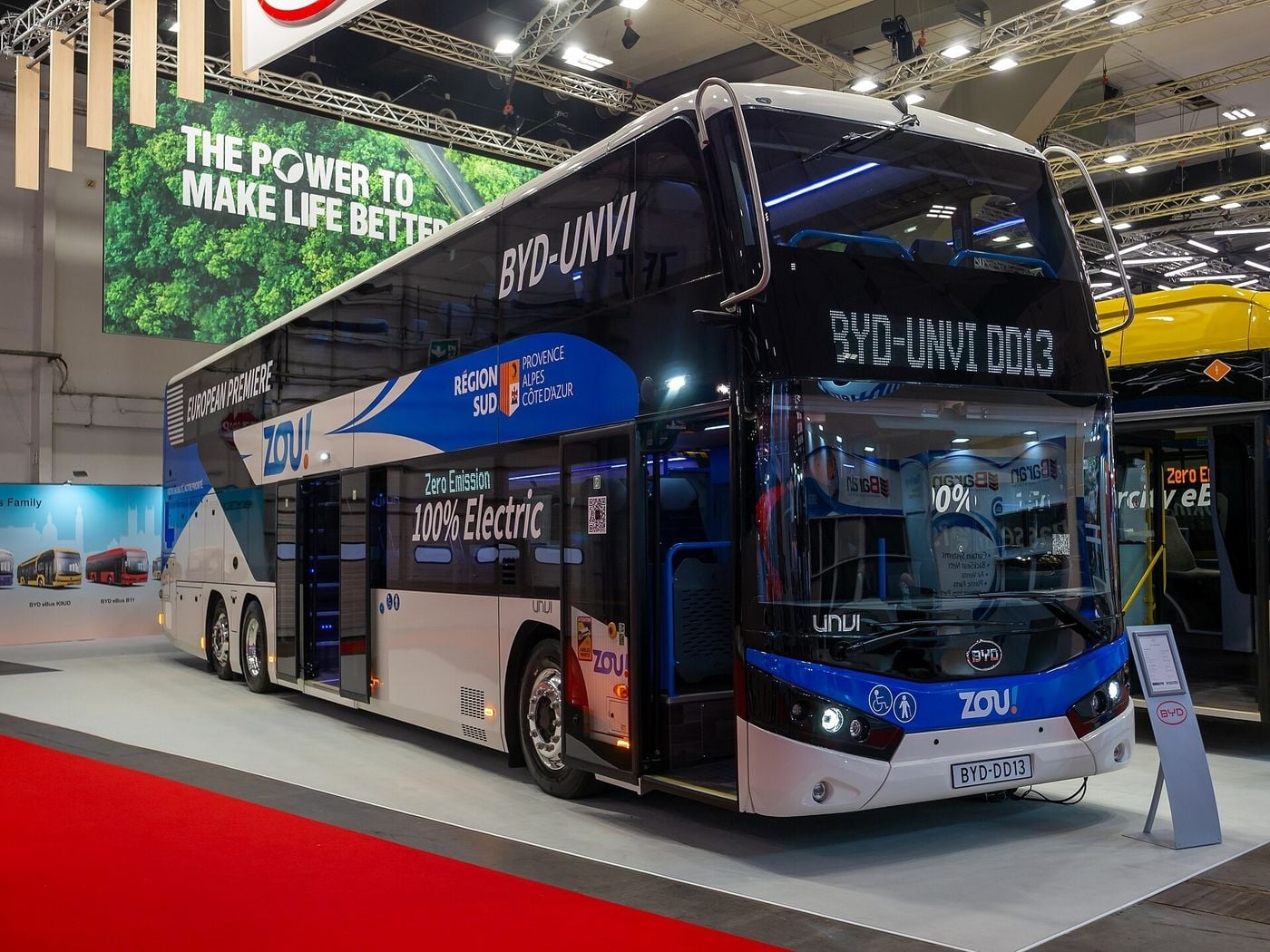
BYD’s press release of 11 October 2023 says that the BYD-UNVI DD13 made its world premiere on the BYD stand at Busworld 2023, held from 7 to 12 October at Brussels Expo; one of its opening bullet points speaks of the European debut of the “BYD-UNVI DD13 Double-Decker coach” there. The release describes the vehicle as a “13-metre customisable pure-electric intercity double-decker coach” from a collaboration between BYD and UNVI, which it calls a European coach bodybuild specialist, bringing together BYD’s battery and chassis technology and UNVI’s body design and build. It says the coach is equipped with ADAS and that BYD collaborated with UNVI “to produce a new 13-metre double-decker coach for European public transport operators”. The release gives no other figure for the DD13.
The product page and the brochure give the body type as low entry and do not use the word double-decker; the brochure’s side, front and rear drawings show a vehicle with two decks and three axles. No document opened gives a start of series production or names an earlier generation. The bus in the cover photograph stands on the BYD stand at Busworld Europe 2023.
Electric drive
The DD13 has no combustion engine. Both documents give two wheel hub motors of 150 kW each, which the brochure names as BYD wheel hub motors; the product page heads the figure “Max.motor power(kW)”. The brochure’s chassis table places the motors in the middle of the three axles, the “Drive axle (mid axle)”, which it gives as a “BYD axle with integrated BYD wheel hub motors”. The same table lists a BYD 6-in-1 controller and, as the battery management system, the BYD BTMS. No document opened gives a continuous power, a torque, a gearbox, an axle ratio or a top speed.
Battery, range and charging
The battery is a BYD LFP battery of 484 kWh: the product page gives the capacity as “Up to 484 kWh”, the brochure’s chassis table as “BYD LFP 484 kWh”. No document opened says whether this is an installed or usable capacity. The product page gives the range as “Up to 350 km(Sort II)”; the brochure gives no range, and no document opened states a load or temperature for the figure.
Both documents give plug-in charging to the CCS standard. The product page lists “Plug-in charging (CCS)”; the brochure’s charging table lists “1* DC Plug in charging (CCS)”, marked with a filled dot (●), and “2* DC Plug in charging (CCS)”, marked with an open circle (○). No document opened gives a charging power or a charging time.
Chassis, suspension, steering and brakes
The brochure’s chassis table gives three axles: a ZF independent suspension at the front, the BYD drive axle with its integrated wheel hub motors in the middle, and a ZF tag axle with a rear axle steering system. The wheelbase is 6,565 mm from the front to the middle axle and 1,500 mm from the middle to the rear axle. The front and drive axles run on 275/70R22.5 tyres, the steerable rear axle on 315/60R22.5. The suspension is ECAS (Electronic-Controlled Air Suspension) with a kneeling function; how such a system sets the ride height is covered in ECAS air suspension.
Steering is EHPS (Electric Hydraulic Power Steering). Under the braking system the brochure lists EBS (Electronic Braking System) with ASR (Acceleration Slip Regulation), and ESC (Electronic Stability Control System). No document opened gives the brake type, an axle load or a turning circle.
Body, dimensions and weights
| Item | As printed |
|---|---|
| Vehicle category | M3 Class II intercity coach |
| Vehicle length | 13700 mm |
| Vehicle width | 2550 mm |
| Vehicle height | 3999 mm |
| Wheelbase front to mid | 6565 mm |
| Wheelbase mid to rear | 1500 mm |
| Front and rear overhang | 2,385/3,250 mm |
| Angle of approach/departure | 8°/8.5° |
| Body type | Low Entry |
| Max G.V.W | 27 T |
| Tire size | Front and drive axles: 275/70R22.5; steerable rear axle: 315/60R22.5 |
| Passenger numbers | Up to 77 |
The product page gives the same dimensions as “13,700/2,550/3,999 mm” and the gross vehicle weight as “26.1t”, against the brochure’s 27 T. The brochure gives the body frame as “UNVI SIL High strength steel body”. Its body table lists a digital and a mechanical exterior rearview mirror, a manual, an electric and an electric and manual dual mode wheelchair ramp, and a bicycle rack; a filled dot stands against the digital mirror and the manual ramp, an open circle against the other items, and the brochure prints no key to the two marks. No document opened gives the number of seats on each deck, a standee count, a door arrangement, an interior height or a kerb weight. Vehicle classes are covered in bus classes explained, and the dimensions and rules for two-deck vehicles in double-decker buses.
Safety and driver-assistance systems
The brochure’s safety table lists R155/R156 (cyber security certification), Driver Drowsiness and Attention Warning (DDAW), Blind Spot Information System (BSIS), Lane Departure Warning System (LDWS), Forward Collision Warning (FCW), Headway Monitoring & Warning (HMW), Pedestrian & Cyclist Collision Warning (PCW), Traffic Sign Recognition (TSR), Speed Limit Indicator (SLI), Intelligent Speed Assistance (ISA), an Alcolock, Reversing Detection (RVCS) and Tyre Pressure Monitoring (TPMS), each with a filled dot, and R66 (vehicle rollover certification), R29 (driver protection) and R93 (front underrun protection), each with an open circle. The product page gives the safety certification as “R155/R156,ISA,ADAS”. The rollover requirement is covered in bus rollover strength (R66), and the systems the European rules require in mandatory driver assistance systems.
Source notes
All figures are from BYD Europe documents. The BYD-UNVI DD13 product page (undated, read on 14 November 2026) and the 6-page BYD-UNVI DD13 brochure (undated, reference 0923-BPS-V1) agree on a body 13,700 mm long, 2,550 mm wide and 3,999 mm high, wheelbases of 6,565 mm and 1,500 mm, the body type Low entry, up to 77 passengers, a 484 kWh LFP battery, two wheel hub motors of 150 kW each and CCS plug-in charging. They differ on the gross vehicle weight: 26.1 t on the product page, a Max G.V.W of 27 T in the brochure. The product page gives the battery capacity as up to 484 kWh and the range as up to 350 km with the note Sort II; the brochure gives no range. The brochure classes the vehicle as an M3 Class II intercity coach and names a ZF independent front suspension, a BYD drive axle (mid axle) with integrated wheel hub motors and a ZF tag axle with rear axle steering. The product page and the brochure do not use the word double-decker, and the brochure’s drawings show two decks; BYD’s press release of 11 October 2023 calls the BYD-UNVI DD13 a 13-metre pure-electric intercity double-decker coach made with UNVI and says it made its world premiere at Busworld 2023. No document opened gives a start of series production, seats, standees, a door arrangement, a kerb weight, a turning circle, a top speed, a continuous motor power, a torque, a gearbox or a charging power.
Quick answers
- What axle configurations does the BYD UNVI DD13 come in?
- Three-axle (ZF tag axle with rear axle steering system).
- What battery capacity does the BYD UNVI DD13 have?
- Battery capacity: 484 kWh; Range: 350 km.
- How long is the BYD UNVI DD13?
- Length: 13 700 mm; Wheelbase: 6 565 mm.
More BYD on this site
Sources
- BYD-UNVI DD13 — product page and technical specifications — BYD Europe
- BYD-UNVI DD13 brochure (reference 0923-BPS-V1) — BYD Europe B.V.
- BYD Introduces a Double Entry of New eBus Innovation at Busworld 2023 — BYD Europe, 11 Oct 2023