Setra
Setra MultiClass 500 LE
Setra's four MultiClass 500 low-entry buses, from the 10,510 mm S 510 LE to the three-axle S 518 LE: dimensions, OM 936 and OM 470 engines, gearboxes and safety systems.
- 220–290 kW
- Euro VI
- 12.21 m
- 19.5 t
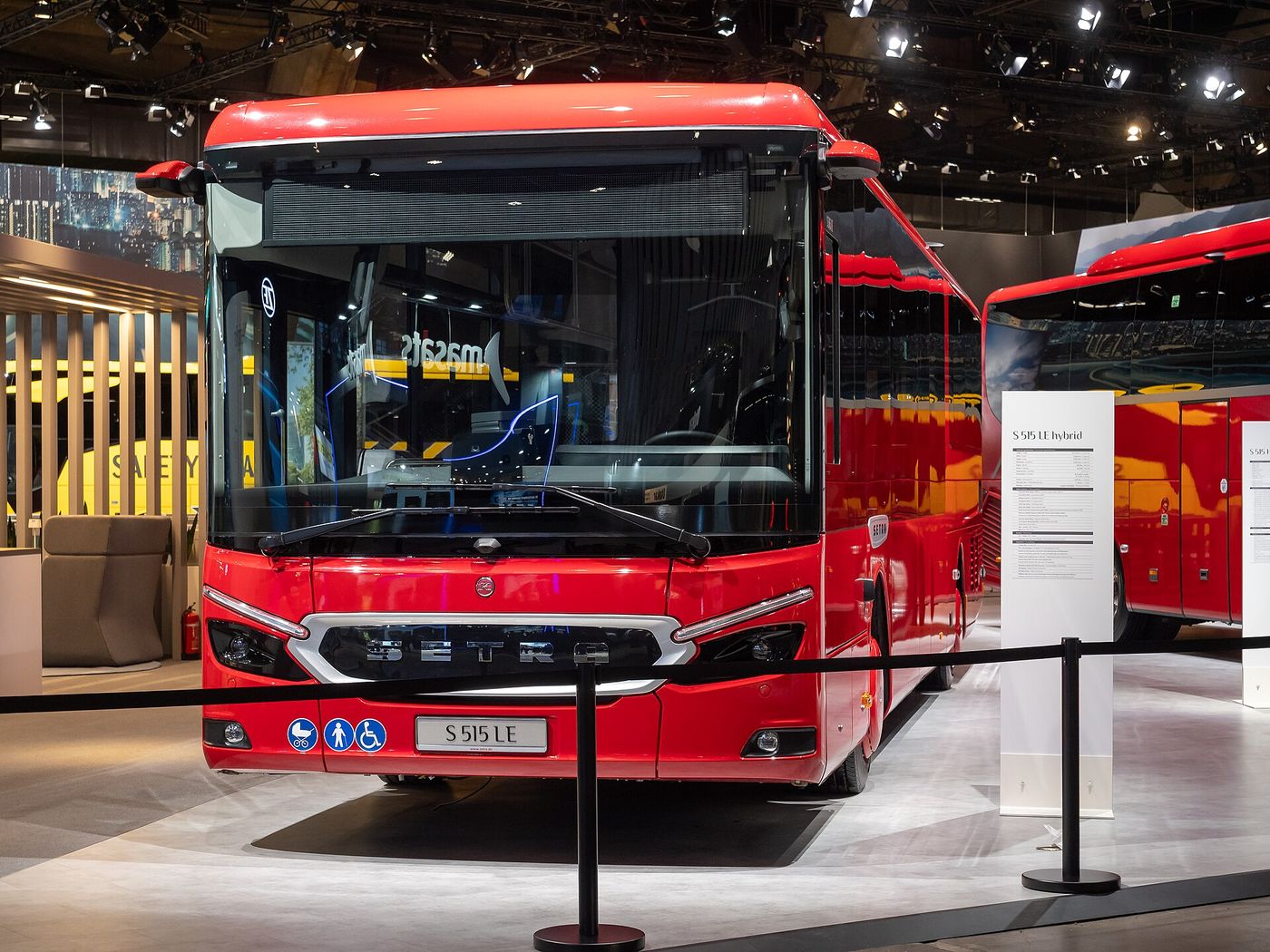

Model overview
- Segment
- Bus
- Emission
- Euro VI
- Transmission
- Mercedes-Benz GO 190-6 (S 510 LE, S 515 LE, S 516 LE); Mercedes-Benz GO 250-8, PowerShift 3 (S 518 LE)
- Gross vehicle
- 19 500 kg
- Length
- 12 210 mm
- Wheelbase
- 6 200 mm
- Turning circle
- 21 776 mm
- Capacity
- 51 seats (model page); passenger capacity 22–129 (data sheet)
- Doors
- 2 doors
Engine families
- Power
- 220–260 kW
- Torque
- 1200–1400 Nm
- Power
- 290 kW
- Torque
- 1900 Nm
The MultiClass 500 is Setra’s series of low-entry buses. Setra’s model page describes it as “a modern low-entry bus model series for urban, regional and intercity transport” and calls it “the new MultiClass 500”; its data sheet names Daimler Buses GmbH of Leinfelden-Echterdingen as provider and the brand as “Setra – A Daimler Truck AG Brand”. Setra’s international site lists four LE models: the S 510 LE, S 515 LE, S 516 LE and S 518 LE. The model page describes “the two-stage low-entry concept consisting of a low floor and a high floor section”, with a low floor at the front for entry and a high floor at the rear, and names its uses “as an intercity and city bus, school bus or staff shuttle – also available as a hybrid model”. Setra’s high-deck coaches are described on the ComfortClass and TopClass pages.
The specification tables on this page come from Setra’s “Technical data and equipment” sheet for the MultiClass 500, footed 02/2026, which the international site served on 26 October 2026; the descriptions come from Setra’s international MultiClass 500 model page, opened the same day. The sheet marks equipment ● standard and ○ optional, and prints a dash where a model has neither mark. Neither document gives a market-launch date or the dates of earlier MultiClass generations.
Four models on the data sheet
| Row on the sheet | S 510 LE | S 515 LE | S 516 LE | S 518 LE |
|---|---|---|---|---|
| Length | 10,510 | 12,210 | 12,920 | 14,520 |
| Length incl. mirrors | 10,835 | 12,535 | 13,245 | 14,845 |
| Width | 2,550 | 2,550 | 2,550 | 2,550 |
| Height incl. air-conditioning system | 3,315 | 3,315 | 3,315 | 3,315 |
| Wheelbase, front axle to drive axle | 4,500 | 6,200 | 6,910 | 6,910 |
| Wheelbase, drive axle to trailing axle | - | - | - | 1,600 |
| Overhang at front | 2,710 | 2,710 | 2,710 | 2,710 |
| Overhang at rear | 3,300 | 3,300 | 3,300 | 3,300 |
| Turning circle min. | 17,318 | 21,776 | 23,642 | 23,424 |
| Ring width of turning circles min. | 6,049 | 6,828 | 7,153 | 7,145 |
| Track circle minimal | 13,413 | 17,859 | 19,723 | 19,382 |
| Swing-out dimension | 884 | 698 | 641 | 1,502 |
| Wheel impact front axle max. | 53/46° | 53/46° | 53/46° | 54/46-21.5/15.5° |
| Slope angle front / rear | 7° / 7° | 7° / 7° | 7° / 7° | 7° / 7° |
All four share a width of 2,550 mm, a height including the air-conditioning system of 3,315 mm, front and rear overhangs of 2,710 mm and 3,300 mm, 275/70 R22.5 tyres and a cockpit height of 809 mm. The sheet prints a “Turning circle” row and a “Turning circle min.” row with the same figures, and a dash in the row for the inner standing height of the central aisle.
The trailing-axle rows carry a dash for the S 510 LE, S 515 LE and S 516 LE; for the S 518 LE the sheet gives a trailing axle with active steering and independent suspension, with a wheelbase of 1,600 mm from the drive axle. Setra’s model page calls the S 510 LE, “With a length of 10.5 metres”, a “two-axle vehicle”, for which “even a three door variant is possible”, and the S 518 LE a “14.5-metre-long” “three-axle vehicle”. It describes the S 515 LE as “Setra’s universal low-entry bus for city and intercity routes”, 12 metres long, the S 516 LE as an all-rounder for “city-oriented intercity transport” and the S 518 LE as built for “routes with increased passenger volumes”.
| Row on the sheet | S 510 LE | S 515 LE | S 516 LE | S 518 LE |
|---|---|---|---|---|
| Gross vehicle weight | 19,500 kg | 19,500 kg | 19,500 kg | 24,750 kg |
| Max. axle load, front / drive axle | 7,500 / 12,600 kg | 7,500 / 12,600 kg | 7,500 / 12,600 kg | 7,500 / 12,600 kg |
| Permissible weight, trailing axle | - | - | - | 5,750 kg |
| Fuel tank | 300 l | 300 l | 300 l | 300 l |
| AdBlue tank | 53 l | 53 l | 53 l | 53 l |
| Luggage compartment | - | - | - | - |
| Additional storage area | 0.46 m³ | 0.46 m³ | 0.46 m³ | 0.77 m³ |
| Passenger capacity min. / max. | 18 / 99 | 22 / 129 | 23 / 135 | 23 / 156 |
| Number of doors | 2 | 2 | 2 | 2 |
On page 3 the fuel row is headed “Capacity fuel tank left / right” but gives one figure per model; page 10 repeats 300 l of fuel and 53 l of AdBlue. The sheet has no row for the number of seats. Setra’s model page gives the S 515 LE 51 seats and the S 516 LE “up to 55 seats”, and says of the S 518 LE: “With a maximum capacity of 122 passengers”; the sheet gives that model a maximum passenger capacity of 156. The model page says the S 518 LE has “up to three doors”, where the sheet’s door row reads 2 for every model.
Engines and gearboxes
| Row on the sheet | S 510 LE | S 515 LE | S 516 LE | S 518 LE |
|---|---|---|---|---|
| Engine | OM 936 Euro VI | OM 936 Euro VI | OM 936 Euro VI | OM 470 Euro VI |
| Output / max. torque | 220 kW / 1,200 Nm | 220 kW / 1,200 Nm | 220 kW / 1,200 Nm | 290 kW / 1,900 Nm |
| At speed | 1,200 rpm | 1,200 rpm | 1,200 rpm | 1,100 rpm |
| Engine 2* | OM 936 Euro VI | OM 936 Euro VI | OM 936 Euro VI | - |
| Output / max. torque 2* | 260 kW / 1,400 Nm | 260 kW / 1,400 Nm | 260 kW / 1,400 Nm | - |
| At speed 2* | 1,200 rpm | 1,200 rpm | 1,200 rpm | - |
| Displacement | 7.7 l | 7.7 l | 7.7 l | 10.7 l |
| Transmission | Mercedes-Benz GO 190-6 | Mercedes-Benz GO 190-6 | Mercedes-Benz GO 190-6 | Mercedes-Benz GO 250-8, PowerShift 3 |
Every engine on the sheet is a 6-cylinder in-line engine, and the EU emissions standard row reads “VI” for all four models. The S 510 LE, S 515 LE and S 516 LE have the Mercedes-Benz OM 936 of 7.7 litres at 220 kW, with a second, starred OM 936 row at 260 kW; the S 518 LE has the Mercedes-Benz OM 470 of 10.7 litres at 290 kW, with no starred row. Setra’s model page says the OM 936 complies with “the Euro VI Stage E emissions standard” and that the performance characteristics of the engines “enable downsizing, i.e. reducing the displacement with the same output”. Of the OM 470 it says: “From 1,100 1/min, a torque of 2,100 Nm is available. Despite its compactness, the top-of-the-range variant achieves 335 kW of performance.” The sheet gives the OM 470 in the S 518 LE 290 kW and 1,900 Nm. The sub-stages of Euro VI are set out in Euro 6 and Euro 7 explained.
The model page describes a hybrid version with a “48 V hybrid system”: “The module’s 14 kW electric motor generates energy when coasting and braking, thus supporting the diesel engine when moving off and idling”, and the system has autonomous energy management. It names the hybrid variant for the S 515 LE, which “uses every stop for energy recovery on bus routes with a large number of stops”, and a “hybrid drive concept” for the S 516 LE. The sheet has no hybrid row.
The transmission row reads “Mercedes-Benz GO 190-6” for the S 510 LE, S 515 LE and S 516 LE. For the S 518 LE the cell is printed on two lines as “Mercedes-Benz GO 250-8, PowerShift 3, 8”; the model page credits that model’s consumption on intercity routes to “its optimised aerodynamics and a new generation of gearboxes”. The sheet has no starred transmission row.
Axles, suspension and brakes
On all four models the sheet gives power steering, a ZF front axle with independent wheel suspension and an anti-roll bar, and a Mercedes-Benz RO 440 driven axle, with an anti-roll bar on the drive axle as an option. Air suspension with electronic level control (ENR) is standard; a raising and lowering system and kneeling are optional. The S 518 LE adds the actively steered, independently suspended trailing axle.
Pneumatic disc brakes on all axles, the Electronic Stability Programme (ESP), an electronically controlled braking system (EBS), ABS, Brake Assist (BAS), Acceleration Slip Regulation (ASR), a retarder limiter (RL) and the parking brake are standard on all four; a retarder, an automatic bus-stop brake with pull-away lock and a HOLD function are optional. Several marks carry the addition “for class 2”: ASR in all four columns, ESP in all four columns of the safety table, and in the brakes table ESP in the S 510 LE, S 516 LE and S 518 LE columns and EBS in the S 515 LE column. The sheet does not say which classification its “class 2” refers to; how UN Regulation No 107 sorts buses into classes is set out in bus classes, and retarders in retarders and engine braking. The model page names an electronic parking brake, which it lists with the multifunction steering wheel and the individually adjustable seat as standard.
Doors, floor and access
The doors swing outward on every model. Door 1 has a clear opening width of 905 mm and door 2 of 1,155 mm. The entry height at door 1 is 307 mm on the S 510 LE and 309 mm or 310 mm on the other three; at door 2 it is 328 mm on the S 510 LE and 332 mm on the others. The central-aisle floor lies 336 mm above the road on the S 510 LE and 350 mm on the S 515 LE, S 516 LE and S 518 LE, with a pedestal height of 297 mm. The rows for the step heights, the door position and a lift carry a dash. A wheelchair space and kneeling are optional on all four; the requirements behind them are covered in bus accessibility. Double glazing and a heatable windscreen are optional.
Seats and driver’s workplace
The sheet marks the Setra Transit seat standard and the Passage and Route seats optional on all four models; the Voyage, Voyage Plus and Voyage Ambassador rows carry a dash. The model page describes the Route seat’s “extremely robust workmanship”, the Transit’s “highly stable construction, durable surfaces and easy cleaning properties” and the Passage’s “fully upholstered seats”. The driver’s seat is the air-sprung GRAMMER Linea MSG 90.6 P, with an ISRI 6860 with an integrated pneumatic system and a 3-point seat belt as an option.
The model page names three cockpit variants, Cockpit City, Basic cockpit and Cockpit City Basic, with the multifunction steering wheel, the individually adjustable seat and the electronic parking brake as standard. The sheet gives a cockpit height of 809 mm on every model.
Heating, air conditioning and lighting
Blower heating for the passenger compartment is standard on all four; driver’s-area air conditioning and the EvoCool Basic system are optional on all four, and EvoCool light Basic is optional on the S 510 LE, S 515 LE and S 516 LE. The rows for an under-seat fan heater, a waistline heater and EvoCool TopAir carry a dash. The sheet gives a passenger-compartment cooling output of 24 kW for EvoCool light Basic and 32 kW for EvoCool Basic on the S 510 LE, S 515 LE and S 516 LE, and 39 kW for EvoCool Basic on the S 518 LE. Its rows for the driver’s-area air conditioning and the heating power at the driver’s seat read 8 and 18 on all four, under the unit “[hp/kW]”. Refrigerant filling is 2.8 kg for EvoCool light Basic without driver’s-area air conditioning and 4 kg with it, 6.5 kg for the 32 kW EvoCool Basic and 7.5 kg for the 39 kW unit; the matching CO₂-equivalent rows read 4.004, 5.72, 9.295 and 10.725 under the unit “[lbs/t]”.
Low beam, high beam, LED headlamps, LED daytime running lights and front fog lamps are standard; cornering lights, position lights and ambient lighting for reversing are optional. The model page describes LED headlights with a light conductor, marked with an asterisk, that “combines indicators, daytime driving lights and clearance lamps along a chrome strip”, a centrally positioned Kässbohrer badge and the Setra logo, and an “ample profile, painted in the vehicle’s colour” that marks the offset between the low-floor and high-floor sections.
Safety and assistance systems
On the sheet, Attention Assist 2, tyre pressure monitoring (TPM), Sideguard Assist 2, Frontguard Assist, ESP, a reversing camera, Traffic Sign Assist, an extinguishing system, a rain-light sensor and flat wiper blades with water fed through the blade are standard on all four models. Lane Assist (SPA), Preventive Brake Assist 2, a reversing buzzer, the 360° camera and MirrorCam are optional. The rows for adaptive cruise control (ART), Front Collision Guard (FCG) and Active Drive Assist 2 carry a dash. The sheet marks rollover strength in accordance with ECE-R 66.02 standard, and a row citing ECE R29 reads “ECE-R29.03” in every column. What UN Regulation No 66 asks of a bus is in rollover strength, and the systems the EU requires in mandatory driver assistance systems.
The model page and the sheet’s descriptive page describe the systems. Preventive Brake Assist 2 is called “the second generation of Active Brake Assist”: it warns of collisions with moving pedestrians and cyclists and with stationary and moving objects, and, in the model page’s words, “In the event of an acute risk of collision, the driver is alerted by a visual and audible warning and partial braking is automatically initiated.” Sideguard Assist 2 supports the driver “on both sides in critical turning situations with possibly restricted visibility”. The model page gives Frontguard Assist a working range “up to 15 km/h” when moving off or driving slowly; the sheet writes “up to 9.3 mph”. Attention Assist 2 warns visually and acoustically when it detects signs of drowsiness or inattention; Traffic Sign Assist uses GPS and a camera to check the vehicle speed against the traffic rules in force. Lane Assist warns the driver with a vibration on the corresponding side of the driver’s seat. The 360° camera uses four cameras, and the sheet places its 10-inch screen on the A-pillar above the cockpit; MirrorCam uses high-resolution cameras, and the model page says it “eliminates the blind spot when turning right”.
Fuel-saving systems
Predictive Powertrain Control (PPC) and Driver Score are optional on all four models; tyre pressure monitoring is standard. The model page says PPC “integrates a driving style adapted to the topography into the automatic gearshift system”, “drives on country roads, takes junctions and roundabouts into account and is networked with the adaptive cruise control”, and “can be used from a speed of 15 km/h”. Driver Score evaluates driving “in four categories - acceleration, braking, uniformity and coasting”, and the page adds: “Information on the vehicle status, such as low fill levels of fuel, AdBlue or engine oil, is also relevant.” Of tyre pressure, the model page says that “a tyre inflation pressure set too low by 0.5 bar can increase fuel consumption by up to 5%”; the wheel electronics sit on the inside of the rim at the valve. Setra writes that it has “reduced drag coefficient, weight and consumption” in the MultiClass 500, without giving figures.
Source notes
The grid above describes the S 515 LE: 12,210 mm long on a 6,200 mm wheelbase, 2,550 mm wide and 3,315 mm high, with a gross vehicle weight of 19,500 kg. Setra’s data sheet lists three other MultiClass 500 LE models: the S 510 LE at 10,510 mm, the S 516 LE at 12,920 mm and the three-axle S 518 LE at 14,520 mm. The S 510 LE, S 515 LE and S 516 LE have the 7.7-litre OM 936 at 220 kW, or 260 kW as an option, and a gross vehicle weight of 19,500 kg; the S 518 LE has the 10.7-litre OM 470 at 290 kW and a gross vehicle weight of 24,750 kg. Setra’s model page gives the S 515 LE 51 seats and the S 518 LE a maximum capacity of 122 passengers, where the data sheet gives 156.
Quick answers
- Which engines are available in the Setra MultiClass 500 LE?
- The record for the Setra MultiClass 500 LE covers these engine families: Mercedes-Benz OM 936 (7.7 l), Mercedes-Benz OM 470 (10.7 l). Output spans 220–290 kW and 1200–1900 Nm.
- What emission standard does the Setra MultiClass 500 LE meet?
- Euro VI.
- Which transmission does the Setra MultiClass 500 LE use?
- Transmission: Mercedes-Benz GO 190-6 (S 510 LE, S 515 LE, S 516 LE); Mercedes-Benz GO 250-8, PowerShift 3 (S 518 LE).
- What is the gross vehicle weight of the Setra MultiClass 500 LE?
- Gross vehicle weight: 19 500 kg.
- How long is the Setra MultiClass 500 LE?
- Length: 12 210 mm; Wheelbase: 6 200 mm.
- How many passengers does the Setra MultiClass 500 LE carry?
- Capacity: 51 seats (model page); passenger capacity 22–129 (data sheet).
Articles that mention the Setra MultiClass 500 LE
More Setra on this site
Sources
- MultiClass 500 — technical data and equipment (data sheet, footer 02/2026) — Setra / Daimler Buses
- MultiClass 500 — model page — Setra Buses International