Isuzu
Isuzu Citivolt 12
Anadolu Isuzu's 12-metre battery-electric city bus as its catalogue lists it: ZF AVE 130 drive at 2 x 125 kW, LFP battery of 449 or 361 kWh, 180 kW CCS charging, up to 100 passengers.
- 12.03 m
- 19.5 t
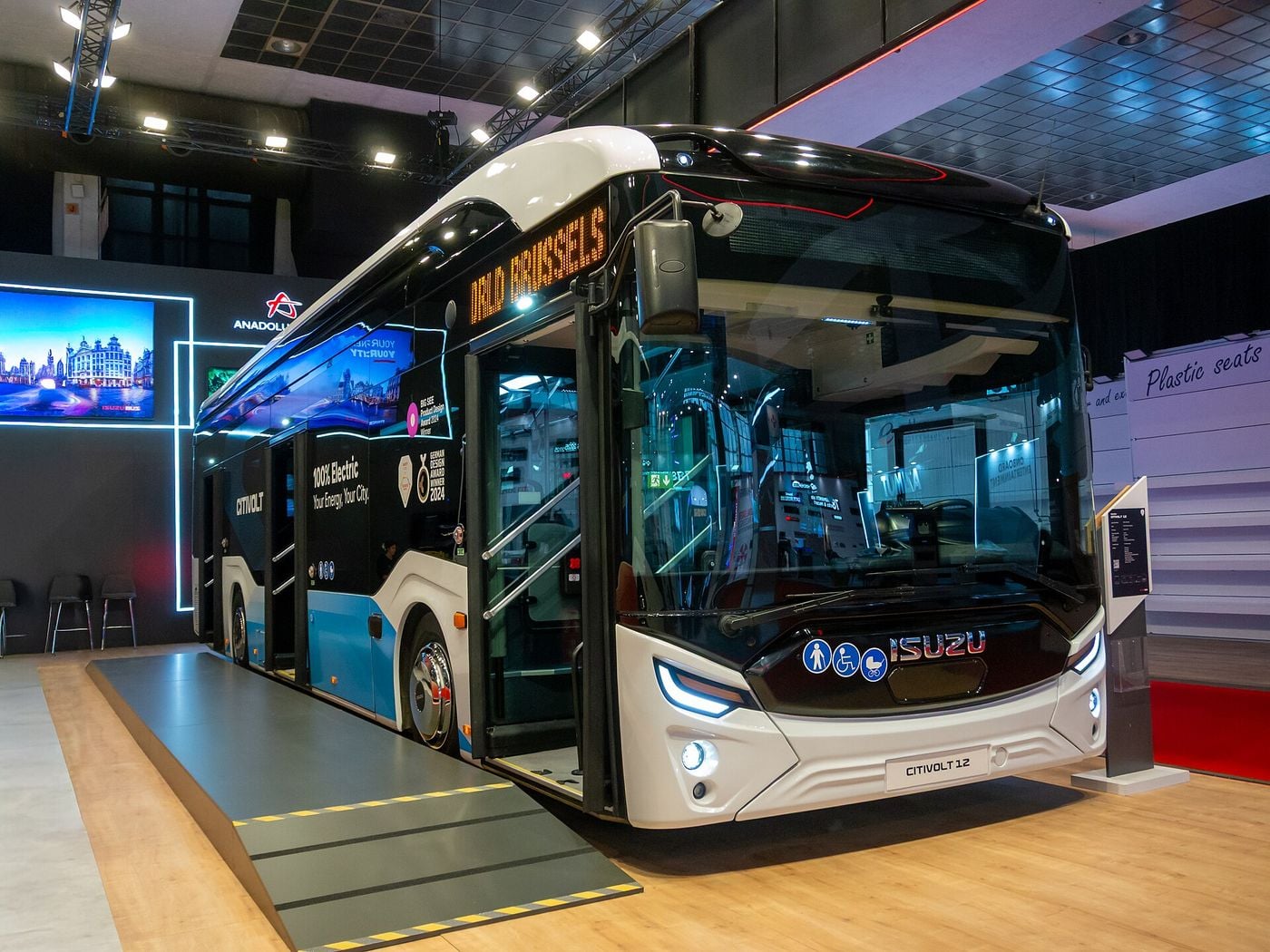

Model overview
- Segment
- Bus
- Transmission
- Direct drive
- Gross vehicle
- 19 500 kg
- Battery capacity
- 361–449 kWh
- Charging
- 180 kW (CCS Type 2)
- Length
- 12 030 mm
- Wheelbase
- 5 850 mm
- Capacity
- 34 + 48 (449 kWh) or 66 (361 kWh)
- Doors
- 3 service doors, double-leaf, inward-opening, electric
The Citivolt 12 is a 12-metre battery-electric low-floor city bus from Anadolu Isuzu, sold under the Isuzu name: the maker’s model page is headed “Isuzu Citivolt 12” and its catalogue “CITIVOLT 12”. The figures on this page come from Anadolu Isuzu’s own documents, from isuzu.com.tr and anadoluisuzu.com.tr: the two-page Turkish Citivolt 12 catalogue (a PDF created on 20 July 2026, with no printed date), the Citivolt 12 model page on isuzu.com.tr in its Turkish, English and German versions (undated, read on 27 October 2026), and four Anadolu Isuzu news releases in Turkish dated 8 November 2023, 20 January 2024, 18 June 2025 and 13 October 2025. The release of June 2025 says that Anadolu Isuzu’s vehicles are developed by Turkish engineers and produced in Türkiye. How battery-electric city buses work in general is set out in electric buses explained.
Shows, awards and naming
Anadolu Isuzu’s release of 20 January 2024 says the 12-metre Citivolt was first presented at the IAA Transportation show in Hanover in autumn 2022. The release of 8 November 2023 reports that the CitiVolt was exhibited at Busworld Europe in Brussels, held from 7 to 12 October 2023, and that it received an Excellence award in the “GÜVENLİ OTOBÜS” (safe bus) category of the Busworld Vehicle Awards 2023. The January 2024 release reports a “German Design Award Winner” award in the passenger vehicles category of the German Design Awards 2024.
In 2025 Anadolu Isuzu showed the Citivolt 12 at the UITP Summit 2025 in Hamburg, held from 15 to 18 June 2025, and at Busworld Europe 2025 in Brussels, from 4 to 9 October 2025. The release of 13 October 2025 describes it as a 12-metre city bus designed for electric urban transport that produces no exhaust emissions in use, with a low-floor structure and barrier-free access. The catalogue’s cover prints the line “ŞEHRİN YENİ AKIMI” (“the city’s new current”) under the model name, and “SIFIR EMİSYON” (zero emission) in a row of short items below it.
The releases of 2023 and January 2024 write the name “CitiVolt” and “Citivolt” (the January 2024 release also “CitiVOLT”); the 2025 releases write “Citivolt 12” (the October release also “Citivolt”). The model page writes “Citivolt 12” in its heading and “CitiVolt” in its text, and the catalogue prints “CITIVOLT 12”. No document opened gives a start of series production or describes an earlier generation.
Electric drive
The catalogue gives the drive type as “Bataryalı Elektrikli Araç (BEV)” (battery-electric vehicle), the motor type as “Elektrikli Motor - Dogrudan Tahrik” (electric motor, direct drive) and the motor model as “ZF AVE 130”. It prints “Maksimum Net Güç (kW) 2x125” (maximum net power) and “Sürekli Güç (kW) 2 x 87 (30 min, ECE - R 85)” (continuous power), and the maximum torque as “2x11000 (on wheels)”, with no unit. The sheet does not state the number of motors in words. The model page gives “Maksimum Güç (kW/rpm) 2 x 125 kW” and, in English, “Max. Power (kW/rpm) 2 x 125 kW”, with no engine speed; its German version prints “Max. Leistung / Dauerleistung 2 x 125 kW” (maximum power / continuous power), where the catalogue’s continuous power is 2 x 87 kW. The operating voltage is 660 V.
The auxiliary brake row reads “Rejeneratif Frenleme Sistemi” (regenerative braking system). No document opened gives a top speed or a gradeability figure.
Battery, range and charging
The catalogue lists an LFP battery (“Pil Tipi LFP”) with a capacity printed as “449 (S), 361 (O)”: 449 kWh as standard and 361 kWh as an option, in the sheet’s own key “S: Standart O: Opsiyonel”. The battery location row reads “Araç Üzeri” (literally “on the vehicle”). The model page lists “361 kWh, 449 kWh” in its Turkish and English versions without marking either as standard; its German version lists “299 kWh, 361 kWh, 403 kWh, 449 kWh”. No other document opened gives 299 or 403 kWh. No document says whether the figures are installed or usable capacity; the difference is explained in installed vs usable battery capacity, and what LFP stands for in battery chemistries in heavy trucks.
The documents give two range figures. The catalogue’s technical table prints “Menzil (km) 540 km’ye kadar” (up to 540 km). The catalogue’s cover prints “TEK ŞARJDA 480 KM YOL” (480 km on a single charge), the model page “480 km’ye kadar menzil” (range up to 480 km), in English “up to 480 km” and in German “bis zu 480 km”, and the release of January 2024 says the Citivolt series has a range of 480 km on a single charge. No document names a test cycle or ties a range figure to a battery size.
Charging is by “Plug in CCS Type 2”, with “DC Plug in - 180 kW” listed as standard. The technical table gives the charging time as “1,5 Saate Kadar (%0-%80)”, up to 1.5 hours from 0 to 80 per cent, and names no battery for it. The cover prints “3 SAATTE HIZLI ŞARJ” (fast charging in 3 hours), and the January 2024 release says the Citivolt series can be fast-charged in only three hours; neither gives a state of charge or a charging power for that time. No document opened lists pantograph charging or an AC charging option. Depot and opportunity charging of buses in general are covered in charging electric trucks and buses.
Dimensions and weight
| Row | Catalogue label | Figure |
|---|---|---|
| Length | Uzunluk | 12,030 |
| Width | Genişlik | 2,550 |
| Height | Yükseklik | 3,400 |
| Wheelbase | Dingil Aralığı | 5,850 |
| Front overhang | Ön Uzantı | 2,700 |
| Rear overhang | Arka Uzantı | 3,480 |
| Maximum laden weight | Azami Yüklü Ağırlık | 19,500 |
The model page gives the length as “12m”. The catalogue’s footnote says that its weight figures are for information only and show nominal values for the base vehicle configuration, and that the final weight and carrying capacity may vary with the model, equipment, body configuration and auxiliary equipment chosen and with the fuel level. No document opened gives a kerb weight, axle loads, a turning circle or a wheel formula.
Body, suspension, brakes and steering
The body is listed as “Monokok, Komple Kataforez Kaplama Gövde”, a monocoque with full cataphoresis coating. The front suspension is “Havalı Süspansiyon - 2 Hava Körügü Bagımsız Süspansiyon” (air suspension with two air bellows, independent) and the rear “Havalı Süspansiyon - 4 Hava Körügü” (air suspension with four air bellows). A kneeling system (“Yana Eğilme Sistemi”) is standard.
The brakes are discs front and rear, in a system described as “ESC ve ABS’li Çift Devreli Otomatik Ayarlı, Tam Havalı Fren Sistemi”: a dual-circuit, automatically adjusted, full-air brake system with ESC and ABS. The parking brake is electrically controlled, and regenerative braking is the auxiliary brake. The steering is electro-hydraulic (“Elektrik Hidrolik Direksiyon”). The tyre size is 275/70 R22.5. A tow bar at the front is standard, and automatic front-axle lubrication is an option.
Doors, access and passenger capacity
The catalogue lists three service doors (“Servis Kapıları Sayısı 3”), “Çift Kanatlı, İçe Açılır, Elektrikli”: double-leaf, inward-opening and electrically operated. A ramp for disabled passengers (“Engelli Rampası”) and a remote control (“Uzaktan Kumanda”) are standard in the same group. The model page says that the low-floor platform and wide doors give passengers fully barrier-free access. The accessibility rules for buses are set out in bus accessibility under UN Regulation 107.
| Catalogue row | Battery | Passengers |
|---|---|---|
| Standard passenger capacity | 449 kWh | 34 seated + 48 standing |
| Standard passenger capacity | 361 kWh | 34 seated + 66 standing |
| Standard layout with wheelchair | 449 kWh | 34 seated + 1 wheelchair + 44 standing |
| Maximum passenger capacity | 361 kWh | 100 |
The catalogue adds “*Farklı oturma düzenleri mevcuttur.” (different seating layouts are available). The model page gives “98 yolcuya kadar” (up to 98 passengers) in Turkish and “up to 115 passengers” in English (“Bis zu 115 Fahrgäste” in German), and names no battery; the catalogue’s maximum is 100, with the 361 kWh battery. Passenger windows are of the sliding type, single-glazed as standard and double-glazed as an option.
Safety and driver-assistance systems
The catalogue’s equipment list, under “Güvenlik & Sürüş Konforu” (safety and driving comfort), marks as standard a speed limiter, a tachograph, ABS, ASR, EBS, ESC/ESP, a bus-stop brake (“Durak Freni BSB”), a parking sensor, a spare wheel, a tyre inflation kit, a reversing warning system, a fire extinguisher, fire detection in the motor compartment (“Motor Odası Yangın Algılama”), a fire detection system for the battery area, daytime running lights (DRL), an additional stop lamp, a locking system, a battery master switch and a multiplex system. EBD is an option.
A second column marks as standard alcohol interlock preparation (“Alkolmetre Hazırlığı”), a lane-tracking system abbreviated LDWS (“Şerit Takip Sistemi”), a tyre pressure monitoring system (TPMS), driver drowsiness and attention warning (DDAW), an emergency braking system (“Acil Durum Fren Sistemi”), a blind spot information system (BSIS), a moving off information system (MOIS), a cyber security system and intelligent speed assistance (ISA). The catalogue names no regulation beside these entries. Which of these systems the EU makes mandatory, and from when, is set out in mandatory driver assistance systems.
Driver’s area, climate and equipment
Heating is by fan convector heaters at the front, middle and rear and an electric heater, both standard; a pre-heater is an option. Air conditioning is standard, with an air outlet for the driver and a heating function (“Isıtmalı Klima”). The windscreen is single-piece laminated, and the driver’s side window is heated and electrically controlled.
The driver has an air-operated, adjustable seat, a driver’s cabin, a manual windscreen sun blind (automatic as an option), electrically controlled side mirrors, heated horn-type side mirrors, a front bumper mirror, a driver’s lamp and a USB charging socket. The January 2024 release mentions a customisable display (“kişiselleştirilebilir gösterge ekranı”) at the driver’s place.
In the passenger area, ceiling lighting, stop buttons with a panel and a digital route display (“Dijital Hat Levhası”) are standard, and USB sockets for passengers are an option. Camera systems, a recording device (DVR), a radio with MP3, SD card and USB, a monitor or LCD screen, a digital clock, Wi-Fi preparation and a driver’s loudspeaker are standard; a passenger-area announcement system is an option. Metallic paint is an option.
Source notes
The figures above are from Anadolu Isuzu’s Turkish Citivolt 12 catalogue (PDF created 20 July 2026) and the Citivolt 12 model page on isuzu.com.tr in Turkish, English and German (read 27 October 2026): a 12,030 mm long battery-electric low-floor city bus with a ZF AVE 130 drive, direct drive, printed as 2 x 125 kW maximum net power and 2 x 87 kW continuous power (30 min, ECE R 85), maximum torque printed as 2 x 11000 on wheels with no unit, and an operating voltage of 660 V; an LFP battery of 449 kWh standard or 361 kWh optional, which the documents do not split into installed and usable capacity; plug-in CCS Type 2 charging at 180 kW DC as standard, up to 1.5 hours from 0 to 80 per cent; width 2,550 mm, height 3,400 mm, wheelbase 5,850 mm, front overhang 2,700 mm, rear overhang 3,480 mm and a maximum laden weight of 19,500 kg, which the catalogue gives as a nominal value for the base vehicle; tyres 275/70 R22.5; three double-leaf, inward-opening electric service doors; 34 seated and 48 standing with the 449 kWh battery, 34 seated and 66 standing with the 361 kWh battery, 34 seated, one wheelchair and 44 standing in the wheelchair layout, and a maximum of 100 passengers with the 361 kWh battery. The documents disagree on range, charging time, capacity, battery sizes and continuous power: the catalogue’s technical table gives up to 540 km, while its cover gives 480 km on one charge and the model page up to 480 km in all three languages; the cover gives fast charging in 3 hours beside the table’s 1.5 hours; the Turkish model page gives up to 98 passengers, its English and German versions up to 115; the German version lists batteries of 299, 361, 403 and 449 kWh and prints 2 x 125 kW under maximum power / continuous power. No test cycle is named for either range. Anadolu Isuzu’s releases date the bus through shows: first presented at IAA Transportation in Hanover in autumn 2022, an Excellence award in the Safe Bus category of the Busworld Vehicle Awards 2023, the German Design Award Winner title of the German Design Awards 2024, and exhibits at the UITP Summit 2025 in Hamburg and at Busworld Europe 2025 in Brussels.
Quick answers
- Which transmission does the Isuzu Citivolt 12 use?
- Transmission: Direct drive.
- What is the gross vehicle weight of the Isuzu Citivolt 12?
- Gross vehicle weight: 19 500 kg.
- What battery capacity does the Isuzu Citivolt 12 have?
- Battery capacity: 361–449 kWh; Charging: 180 kW (CCS Type 2).
- How long is the Isuzu Citivolt 12?
- Length: 12 030 mm; Wheelbase: 5 850 mm.
- How many passengers does the Isuzu Citivolt 12 carry?
- Capacity: 34; Standing places: 48 (449 kWh) or 66 (361 kWh).
Articles that mention the Isuzu Citivolt 12
More Isuzu on this site
Sources
- Citivolt 12 — katalog (PDF, Türkiye, created 20 July 2026) — Anadolu Isuzu Otomotiv Sanayi ve Ticaret A.Ş., 20 Jul 2026
- Isuzu Citivolt 12 — model page (Türkiye) — Anadolu Isuzu Otomotiv Sanayi ve Ticaret A.Ş.
- Isuzu Citivolt 12 — model page (English version) — Anadolu Isuzu Otomotiv Sanayi ve Ticaret A.Ş.
- Isuzu Citivolt 12 — model page (German version) — Anadolu Isuzu Otomotiv Sanayi ve Ticaret A.Ş.
- Anadolu Isuzu, Busworld Europe Brüksel Fuarı'na elektrikli araçları ile katıldı (news) — Anadolu Isuzu Otomotiv Sanayi ve Ticaret A.Ş., 8 Nov 2023
- Anadolu Isuzu’nun CitiVolt modeli Anadolu Isuzu’ya bir ödül daha getirdi (news) — Anadolu Isuzu Otomotiv Sanayi ve Ticaret A.Ş., 20 Jan 2024
- Anadolu Isuzu, UITP Zirvesi’nde %100 elektrikli Citivolt 12 ve NovoCiti VOLT modellerini sergiledi (news) — Anadolu Isuzu Otomotiv Sanayi ve Ticaret A.Ş., 18 Jun 2025
- Anadolu Isuzu Busworld Europe 2025’te Yenilikçi Modellerini Sergiledi (news) — Anadolu Isuzu Otomotiv Sanayi ve Ticaret A.Ş., 13 Oct 2025