Isuzu
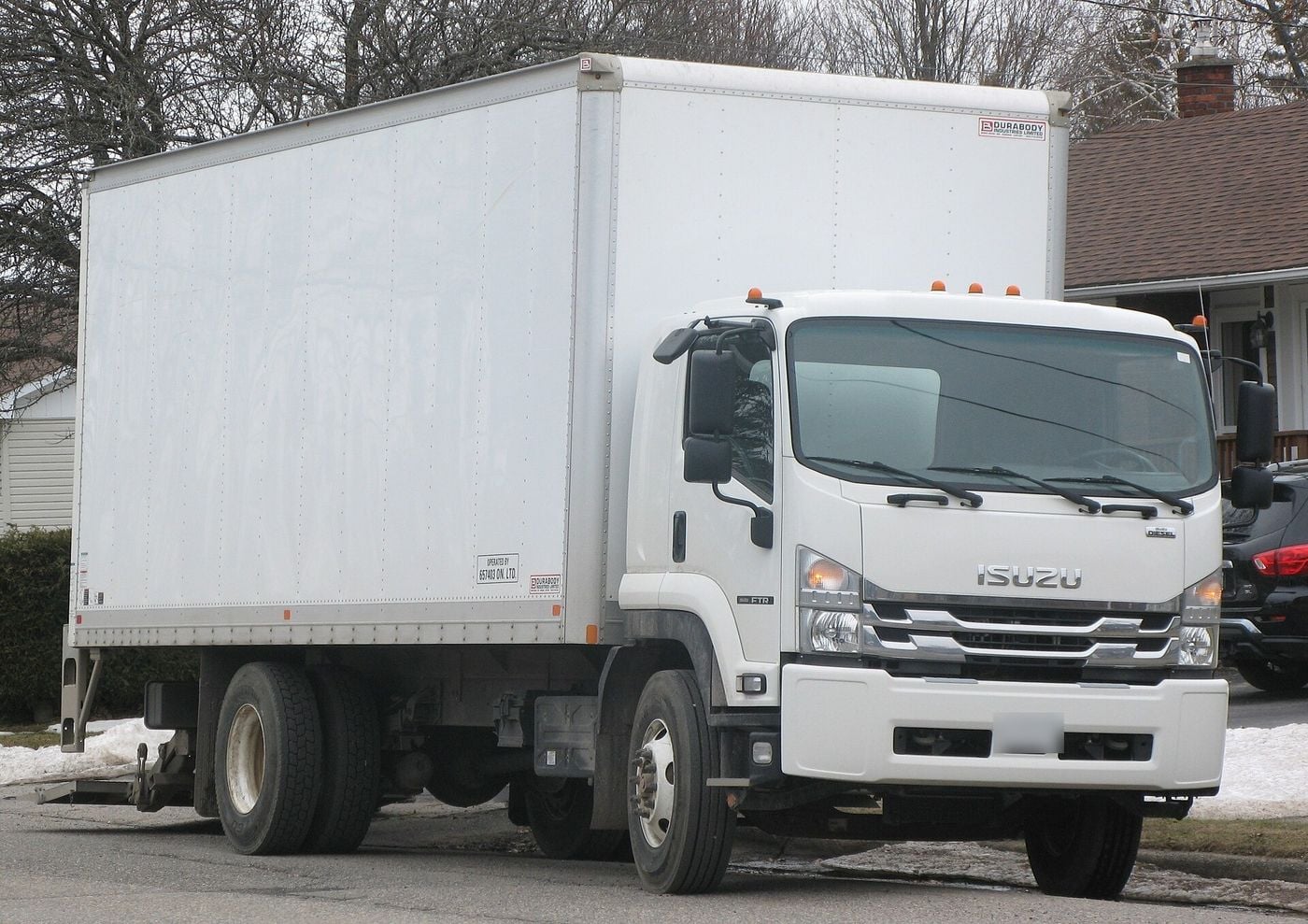
Isuzu F Series
Isuzu Australia's all-new F Series: 46 medium-duty models at 11,000 to 26,000 kg GVM, 4HK1 and DB6A diesels from 154 to 221 kW, cabs, gearboxes and ADAS.
- 4 configurations
- 154–221 kW
- ADR80/04

Model overview
- Segment
- Distribution
- Axle configurations
- 4 (4x2…)
- Emission
- ADR80/04
- Transmission
- Manual, automated manual with torque converter (TC-AMT) or Allison 6-speed automatic, depending on model
- Gross combination
- 36 t (top of the GCM range of the 4x2, 6x2 and 6x4 cab-chassis models)
Axle configurations: 4x2 · 6x2 · 6x4 · 4x4
Engine families
- Power
- 154–177 kW
- Torque
- 726–765 Nm
- Power
- 191–221 kW
The F Series is Isuzu’s medium-duty truck range as Isuzu Australia Limited presents it on isuzu.com.au. Its overview page introduces “The all-new Isuzu F Series. Power redefined.”, with “newly developed engines, and improved driver comfort and safety”, and gives the range as 46 models across 12 sub-series at a gross vehicle mass (GVM) of 11,000 to 26,000 kg. This page is built from that overview page and Isuzu Australia’s Our Range page, read on 4 November 2026; from the F Series features, safety and accessories pages and the list of historical spec sheets, read on 14 November 2026; from the brochure for the all-new F Series, whose file name carries “2024” and whose back page carries the print reference MAR2025 FSA/ISZS2076; and from the F Series brochure of September 2023 (SEP2023 FSA/ISZS1757), which describes the range with the earlier six-cylinder engine. None of the web pages carries a date of its own, and every figure is for the Australian market. Isuzu Australia’s range menu lists the FX Series, at a GVM of 17,000 to 26,000 kg, as a series of its own; Isuzu’s lighter N-series is covered in Isuzu N-series from Anadolu Isuzu’s documents for Türkiye.
Range, weights and wheelbases
The overview page groups the F Series into model cards by body type. A fifth card, Dual Control, shows no models.
| Card | Models | GVM | GCM | Power | Torque |
|---|---|---|---|---|---|
| Cab-Chassis | 20 | 11,000–26,000 kg | 15,500–36,000 kg | 154–221 kW | 706–984 Nm |
| Crew | 4 | 11,000–17,000 kg | 15,500–32,000 kg | 154–191 kW | 706–883 Nm |
| Tipper | 2 | 11,000–14,000 kg | 18,500–21,000 kg | 177–191 kW | 765–883 Nm |
| Freightpack | 3 | 11,000–26,000 kg | 18,500–32,000 kg | 177–221 kW | 765–984 Nm |
The brochure’s “Specifications table” groups the range by drive and body instead and names the sub-series in each group.
| 4x2, 6x2, 6x4 | 4x4 | Crew cab | Ready-To-Work Tipper | Ready-To-Work Freightpack | |
|---|---|---|---|---|---|
| Sub-series | FRR, FRD, FSR, FSD, FVR, FVD, FVL, FVZ, FVY | FSS, FTS | FRR, FVD, FSS, FTS | FRR, FSR | FRR, FSR, FVL |
| GVM | 11,000–26,000 kg | 11,000–15,000 kg | 11,000–17,000 kg | 11,000–14,000 kg | 11,000–26,000 kg |
| GCM | 15,500–36,000 kg | 15,500–21,000 kg | 15,500–32,000 kg | 15,500–21,000 kg | 15,500–32,000 kg |
| Power | 177–221 kW | 154–191 kW | 154–191 kW | – | – |
| Torque | 765–981 Nm | 706–883 Nm | 706–883 Nm | – | – |
| Cab | Standard, Wide | Standard, Wide | Crew standard, Crew wide | Standard | Standard, Wide |
| Wheelbase | 3.8–7.0 m | 3.8–4.3 m | 3.8–6.5 m | – | – |
| Transmission | MT, AT and AM | MT and AT | MT, AT and AM | AT and AM | AT and AM |
The two documents differ in places. The overview page gives the cab-chassis models 154–221 kW and 706–984 Nm; the brochure gives its 4x2, 6x2 and 6x4 column 177–221 kW and 765–981 Nm. For the Tipper and the Freightpack the overview page gives a GCM from 18,500 kg and the brochure from 15,500 kg. The brochure prints no power, torque or wheelbase in its two Ready-To-Work columns. How GVM and GCM relate is set out in truck weights and gross combination weight.
The brochure introduces the Ready-to-Work range as “Coming soon”, a selection of bodied trucks “designed and built to our specifications”. The F Series Tipper comes in 11,000 kg and 14,000 kg GVM variants. The F Series Freightpack is, in the brochure, “available in five models”, with 10-pallet, 12-pallet or 14-pallet curtainside bodies; the overview page’s Freightpack card shows 3 models. The brochure describes the 4x4 range as “purpose-built for off-road conditions”. No document opened for the all-new range gives the makes or types of its axles, suspension and brakes, its tank capacities, its overall dimensions or its kerb weights.
Cabs
The F Series has standard and wide cabs, and crew cabs in standard and wide versions. The overview page gives both the standard and the wide cab for weights of 11,000 to 26,000 kg and describes the wide cab as having more room for passengers; crew cab variants are available across the FRR, FSS, FTS and FVD models. The brochure states “The hero of the next generation F Series is its sleek new cab design” and says the cab “offers a more comfortable drive and improved cooling, air flow and driving performance”. It lists Daytime Running Lights, an Automatic Lighting System and an energy-absorbing space inside the front panel, designed to reduce injury to pedestrians and vulnerable road users in low-speed collisions. The cabin glass gives, in Isuzu’s figures, up to 59% infrared and 99% ultraviolet protection in the windscreen and up to 90% ultraviolet protection in the door and backlight glass.
Inside, the brochure lists a new Digital Instrument Cluster and a full-colour 7-inch TFT multi-information display between the speedometer and the tachometer. The MyIsuzu Co-Pilot multimedia system has a 10.1-inch touch screen, Apple CarPlay, Android Auto and digital radio stations, with hands-free Bluetooth and truck-specific navigation as standard. The features page names the driver’s seat as the ISRI 6860 air-suspension seat, with an integrated seat belt with pre-tensioner, a head restraint, dual-stage air lumbar and lateral support, an integrated pneumatic system and an adjustable shock absorber; the brochure adds seat ventilation and heating, an armrest on selected models and a rapid-descend function for getting in and out. The steering wheel tilts and telescopes, has a smaller diameter and carries controls for the multi-information display, the safety systems, cruise control and the audio-visual unit. Automatic Climate Control is fitted; Crew Cab and 4x4 models use an electric Manual Climate Control system.
Further equipment on the features page and in the brochure: an Auto Wiper System with a rain sensor, Bi-LED headlamps, an LED daytime running light strip in the headlamps, LED cornering lamps on selected models, an Automatic Lighting System front and rear, and a Passive Entry and Start System on all models except the Crew Cab. The accessories page offers front and side cameras “that complement the standard rear camera” and a tyre pressure monitoring system shown on the MyIsuzu Co-Pilot screen. The brochure lists colours for selected models: Trans Blue, Dark Blue, Purplish Blue, Marine Blue, Sunbelt Green, Woodland Green, Sahara Beige, Wheatland Yellow, Highway Orange, Cardinal Red, Geranium Red, Arc White, Polar White and “Al. Gray”.
Engines
The brochure says the all-new engines are “Manufactured by Isuzu at the Tochigi Engine Plant” and “meet the ADR80/04 exhaust emissions regulations”, and that they use AdBlue with Selective Catalytic Reduction (SCR); on the six-cylinder engine an Exhaust Gas Recirculation (EGR) system “is not required”.
| Engine | Cylinders | Power | Torque | Emission standard named |
|---|---|---|---|---|
| Isuzu 4HK1 | 4 | 154 kW (210 PS) | 726 Nm | Japanese pPNLT |
| Isuzu 4HK1 | 4 | 177 kW (240 PS) | 765 Nm | Japanese pPNLT |
| Isuzu DB6A | 6 | 191 kW (260 PS) | not given | Euro-VI |
| Isuzu DB6A | 6 | 221 kW (300 PS) | not given | Euro-VI |
On the overview page the four-cylinder 4HK1 has two-stage turbos; the brochure describes “a smart twin turbo variant for maximum boost capability”. The engine’s versions in other markets are set out in Isuzu 4HK1 engine. The six-cylinder DB6A is, in the brochure, “Based on the proven B6.7 engine”, with specification and electronic calibration settings “unique to the DB6A”, and has an intercooled turbocharger. It carries the i-Brake, which the brochure calls “an integrated Jacobs Engine Compression Brake that offers far superior retardation over the previous 6-Cylinder exhaust brake”; compression brakes of this kind are described in what is a Jake Brake. The brochure’s table heads its rows “Power (kW @ RPM)” and “Torque (Nm @ RPM)” but prints spans only. No document opened gives the displacement of either engine, an engine speed or the torque of each DB6A rating.
Transmissions
The overview page gives the F Series “with manual, Automated Manual Transmission with Torque Converter (TC-AMT) or Allison Automatic, depending on model”, and says the Allison 6-speed automatic “is available on many of our F Series trucks”. In the brochure’s table the 4x2, 6x2 and 6x4 models and the crew cabs are listed with manual, automatic and automated manual gearboxes, the 4x4 models with manual and automatic, and both Ready-To-Work ranges with automatic and automated manual. No document opened gives the number of gears of the manual or the automated manual gearbox of the all-new range. The two automatic types are covered in Allison automatic transmissions and automated manual transmissions.
Safety and driver-assistance systems
Isuzu’s driver-assistance systems (ADAS) on the F Series use what the safety page calls “a highly effective combination of an optical sensor and a milliwave radar”: the camera identifies an object and the radar measures its distance and relative speed. The safety page and the brochure list these systems:
- Advanced Emergency Braking (AEB), which can apply the brakes automatically if the driver does not brake for a pedestrian, cyclist or vehicle.
- Full Speed Adaptive Cruise Control (FACC), which “will work at any speed, so if the vehicle ahead comes to a stop, the truck will too”; the safety page’s list marks it “AMT only”.
- Lane Keeping Assist (LKA), which can steer the truck back to a central lane position in cruise control, “Only available on FV F Series 6-Cylinder models”.
- Traffic Sign Recognition (TSR) and the Intelligent Speed Limiter, which lets the driver set the speed limiter to a newly detected limit; both “AMT only”.
- Adaptive Driving Beam, which switches off sections of the LED high beam for oncoming vehicles.
- Intersection Warning System, with side-mounted short-range radars that detect cars, bicycles and pedestrians at intersections, “4x2 only” on the safety page and “On selected models” in the brochure. Isuzu Australia’s Our Range page, on the all-new range of N, F and FX Series trucks, names “Intersection Emergency Braking” among the upgraded ADAS features.
- Forward Collision Warning, Distance Warning System with four pre-set minimum distances, Lane Departure Warning with two sensitivity settings or off, and Traffic Movement Warning for a vehicle ahead that moves off.
- Attention Assist System, which alerts the driver to inconsistent steering input above 70 km/hr on the safety page and above 60 km/hr in the brochure.
- Electronic Stability Control, Anti-Skid Regulator, Anti-Lock Braking System, Hill-Start Aid, Cab Tilt Warning, a Customisable Speed Limiter and, on 4x4 models, a No-Spin differential with an automatic locking dog system.
The two documents describe some sensors differently: the safety page’s list gives FACC and Forward Collision Warning a stereo camera, while the brochure gives FACC “a radar and camera” and Forward Collision Warning “an optical sensor and milliwave radar”. The safety page gives Hill-Start Aid on trucks with manual transmissions, the brochure on those with manual and automated manual transmissions. On the speed limiter the brochure adds that models “with a GVM above 12,000kg are limited by law to 100km/h”.
The passive safety features, grouped in the brochure as Isuzu’s Cabin Occupant Safety Systems (COSS), are dual airbags for the driver and the front passenger, seat-belt pretensioners on both front seats, anti-intrusion bars in the doors, an ECE-R93 Front Underrun Protection Device mounted behind the front bumper, and a cab built to the ECE-R29 standard. Isuzu calls ECE-R29 “a global test certification from the United Nations” and states that the rating “isn’t currently mandatory in Australia”. Front underrun protection is covered in underrun protection and Mansfield bars.
Earlier F Series ranges
Isuzu Australia’s F Series brochure of September 2023 gives the range at a GVM of 11,000 to 24,000 kg and a GCM of 16,000 to 36,000 kg. Its four-cylinder Isuzu 4HK1 “easily meets the current Euro V emission rules” and delivers 154 kW or 177 kW (210PS / 240PS) with 726 Nm and 765 Nm from a two-stage turbocharger, with an Idle-Stop System and the TC-AMT. Its six-cylinder Isuzu 6HK1, with an intercooled variable nozzle turbocharger, delivers 191 kW and 221 kW (260PS / 300PS) with 761 Nm and 981 Nm. In that brochure the FV range comes in 4x2, 6x2 lazy-axle and 6x4 tandem-drive configurations with the 6HK1-TCS (221kW/300PS) and Meritor axle and brake combinations: the FVR with steel and the FVD with Hendrickson HAS airbag suspension, the 6x2 FVL with airbag rear suspension, and the 6x4 FVZ with steel and the FVY with airbag rear suspension. The 4x2 and 6x2 FV models each have a ZF 9-speed manual or an Allison 3K Series 6-speed automatic gearbox.
The brochure’s table names the FRR / FRD 110-240, FSR 120-240, FRR / FRD 110-260, FSR / FSD 140/120-260, FTR 150-260, FVR / FVD 165-300, FVL 240-300 and FVZ / FVY 240-300 cab-chassis models, the FSS 110-210 and FTS 139-260 4x4 models, the FRR 110-260 and FVD 165-260 crew cabs and the FSS 110-210 CREW and FTS 139-260 CREW, with N-4HK1-TCH, N-4HK1-TCS, 6HK1-TCC and 6HK1-TCS engines. Its ADAS features were “only standard on FRR 110-240, FRD 110-240 and FSR 140/120-240 Models”, with ESC also standard on the FTR and FV models. It lists LED low beams with halogen high beams, a standard rear camera, heated and powered mirrors with integrated spotters, the ISRI 6860/875 air-suspension driver’s seat as standard on all F Series models, and a 10.1-inch MyIsuzu Co-Pilot screen with DAB+ stations.
Isuzu Australia’s list of historical spec sheets carries FVR sheets from 1984 (FVR 11NT, FVR 12H and FVR 12N), FSR sheets from 1986 and FTR and FTS sheets from 1987. Its last FRR, FSR, FTR and FVR entries are in 2021, and its FVZ and FVY entries run to 2024.
Source notes
Isuzu Australia’s F Series pages (overview read 4 November 2026; features, safety and accessories read 14 November 2026) and its brochure for the all-new F Series (print reference MAR2025 FSA/ISZS2076) give the range for Australia: 46 configurable models across 12 sub-series, GVM 11,000 to 26,000 kg and GCM 15,500 to 36,000 kg. The four-cylinder Isuzu 4HK1 gives 154 kW (210 PS) with 726 Nm or 177 kW (240 PS) with 765 Nm; the six-cylinder Isuzu DB6A, based on the B6.7 engine and meeting Euro-VI, gives 191 kW (260 PS) or 221 kW (300 PS) and has the i-Brake compression brake. Isuzu states that the all-new engines meet ADR80/04 and use AdBlue with SCR. Gearboxes are manual, automated manual with torque converter (TC-AMT) or Allison 6-speed automatic, depending on model. The brochure’s table gives 4x2, 6x2, 6x4 and 4x4 cab-chassis models, standard, wide and crew cabs and wheelbases of 3.8 to 7.0 m; the overview page gives 706 to 984 Nm for the cab-chassis models, the brochure 765 to 981 Nm for its 4x2, 6x2 and 6x4 column. Isuzu Australia’s F Series brochure of September 2023 gives the 4HK1 at Euro V, the six-cylinder 6HK1 at 191 kW and 221 kW with 761 Nm and 981 Nm, GVM 11,000 to 24,000 kg and GCM 16,000 to 36,000 kg. No document opened gives engine displacements, the axles and suspension of the all-new range, overall dimensions or kerb weights.
Quick answers
- Which engines are available in the Isuzu F Series?
- The record for the Isuzu F Series covers these engine families: Isuzu 4HK1, Isuzu DB6A. Output spans 154–221 kW.
- What axle configurations does the Isuzu F Series come in?
- 4x2, 6x2, 6x4, 4x4.
- What emission standard does the Isuzu F Series meet?
- ADR80/04.
- Which transmission does the Isuzu F Series use?
- Transmission: Manual, automated manual with torque converter (TC-AMT) or Allison 6-speed automatic, depending on model.
- What is the gross combination weight of the Isuzu F Series?
- Gross combination weight: 36 t (top of the GCM range of the 4x2, 6x2 and 6x4 cab-chassis models).
Isuzu models on this site, side by side
| Segment | Axle configurations | Power | Torque | Gross combination | |
|---|---|---|---|---|---|
| Isuzu F Series | Distribution | 4 configurations | 154–221 kW | 726–765 Nm | 36 t |
| Isuzu N-series | Distribution | 110–140 kW | 375–510 Nm |
More Isuzu on this site
Sources
- Isuzu F Series — overview page, Australia (read 4 November 2026) — Isuzu Australia Limited
- Isuzu F Series — features page, Australia (read 14 November 2026) — Isuzu Australia Limited
- Isuzu F Series — safety page, Australia (read 14 November 2026) — Isuzu Australia Limited
- Isuzu F Series — accessories page, Australia (read 14 November 2026) — Isuzu Australia Limited
- The all-new Isuzu F Series — brochure (PDF, Australia, print reference MAR2025 FSA/ISZS2076) — Isuzu Australia Limited
- Isuzu's F Series — brochure (PDF, Australia, September 2023, SEP2023 FSA/ISZS1757) — Isuzu Australia Limited
- Our Range — Isuzu truck series, Australia (read 4 November 2026) — Isuzu Australia Limited
- Historical spec sheets — list, Australia (read 14 November 2026) — Isuzu Australia Limited