Scania
Scania Touring
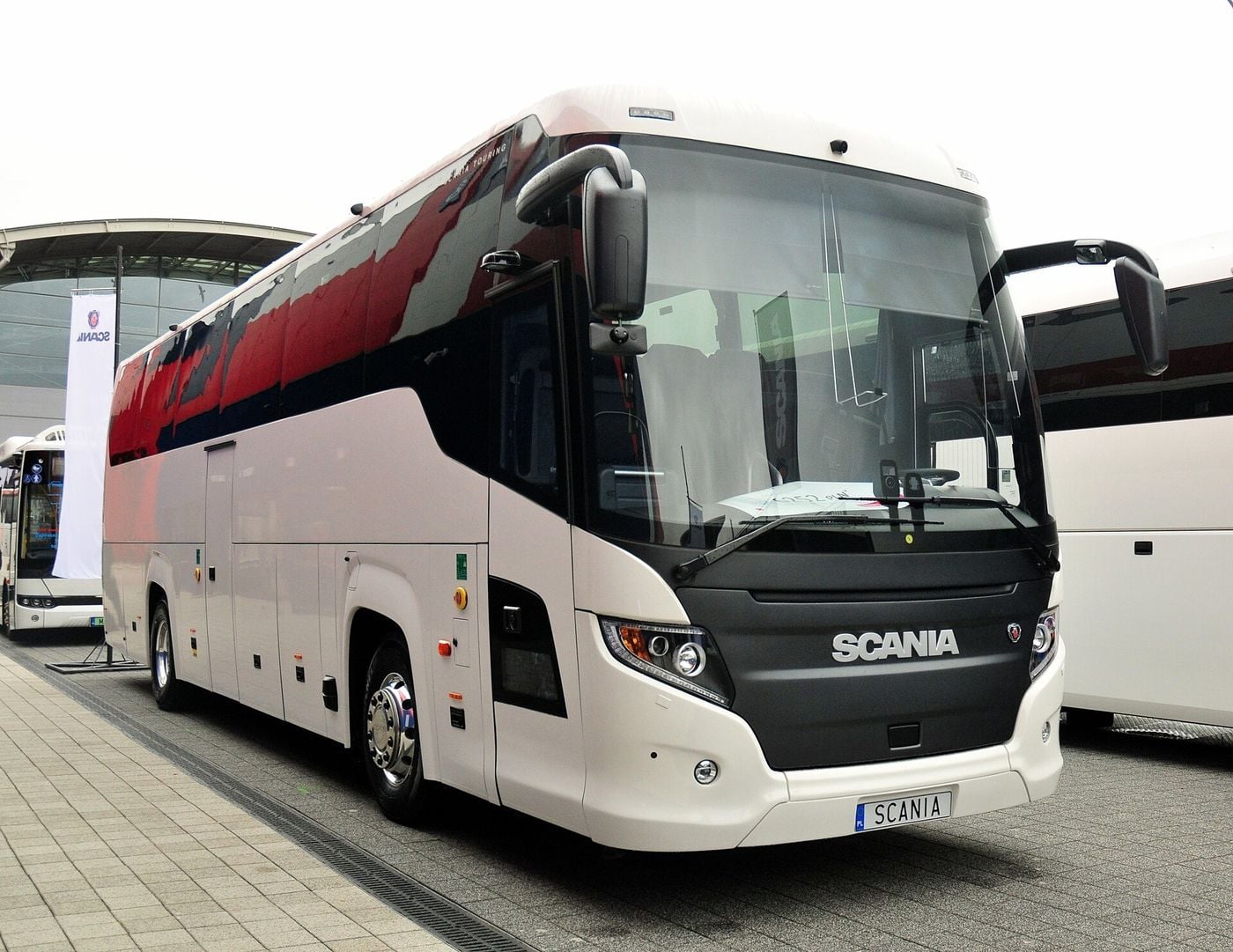
Scania's new generation Touring high-decker: 10.9 to 14.7 m on two or three axles, Super 11 and 13 engines of 350 to 500 hp, up to 67 seats, per the 2026.10 data sheet.
- 2 configurations
- 257–368 kW
- Euro 6

Model overview
- Segment
- Bus
- Axle configurations
- 2 (4x2…)
- Emission
- Euro 6
- Transmission
- 14-speed Scania Opticruise automated manual gearbox, retarder optional; 6-speed ZF Ecolife 2 fully automatic gearbox, Super 11 only
- Capacity
- Up to 67 seated passengers
- Doors
- 1-0-1 on the 10.9 m coach, 1-1-0 on the other lengths
Axle configurations: 4x2 · 6x2*4
Engine families
- Power
- 257–316 kW
- Torque
- 1800–2200 Nm
- Power
- 306–368 kW
- Torque
- 2300–2650 Nm
The Touring is Scania’s high-deck coach. Scania’s product page describes it as “a high-decker coach for long-distance and travel operations”, and the campaign page for the current version opens with the line “The new generation Scania Touring is finally here.” Scania’s documents call it the New Generation Scania Touring, under the slogan “Built by every road”, and the product page speaks of “The new, distinctive Scania-designed body”.
This page is built from Scania documents read on 14 November 2026: the two-page technical specification “New Generation Scania Touring”, Edition 2026.10 (26MC149); the product brochure of the same edition (26MC151); the campaign page “New generation Scania Touring - Built by every road”; Scania’s international Touring product page, which the campaign page lists with the date 13 Oct 2026; Scania’s feature page on its new bus and coach powertrain; and the Touring page of Scania’s UK site. No Scania document opened gives a launch date, a gross vehicle weight, axle loads other than the front axle’s load capacity, a wheelbase, a turning circle, an exact swept volume for either engine, or technical data for the BEV option the specification mentions.
Lengths, axles and doors
The specification offers the Touring on two axles (4x2) or on three with a steered tag axle (6x2*4), with left-hand or right-hand drive. Width is 2.5 m or 2.55 m and height 3.8 m.
| Steering position | Axles | Length | Door configuration |
|---|---|---|---|
| Left-hand drive | 2 | 10.9 m | 1-0-1 |
| Left-hand drive | 2 | 12.3 m | 1-1-0 |
| Left-hand drive | 2 | 13 m | 1-1-0 |
| Left-hand drive | 3 | 13.2 m | 1-1-0 |
| Left-hand drive | 3 | 13.9 m | 1-1-0 |
| Left-hand drive | 3 | 14.7 m | 1-1-0 |
| Right-hand drive | 2 | 10.9 m | 1-0-1 |
| Right-hand drive | 2 | 13 m | 1-1-0 |
| Right-hand drive | 3 | 13.2 m | 1-1-0 |
| Right-hand drive | 3 | 13.9 m | 1-1-0 |
The product page prints the same ten configurations, with the 13 m coaches written as “13.0 m”, gives the range as “10.9 m to 14.7 m, depending on configuration”, and lists the wheel configurations as “2-axle (4x2) and 3-axle with steered tag axle (6x2 and 6x2*4)”. The Touring has either a flat floor or a lowered aisle that allows full standing height in the passenger area. The product page says the floor is raised over that of the predecessor.
The campaign page shows two suggested configurations. “Essential” is a two-axle coach with a vehicle length given as “10,99 m”, a Scania Super 11 of 350 hp with a ZF gearbox, physical rear-view mirrors, “Solid - Signal white” paint, Kiel Avance X Comfort seats, overhead racks without hatches, and no galley or toilet. “Sophisticated” is a three-axle coach of 14.70 m with a Scania Super 13 of 500 hp and Scania Opticruise, storage compartments above the wheelhouses, digital rear-view mirrors, “Metallic - Royal silver” paint, tinted passenger windows, light sand walls, a wooden-pattern floor, Kiel Avance X Luxury seats, ambient lighting, overhead racks with hatches, a galley and a toilet. The specification gives the shortest two-axle coach as 10.9 m.
Super engines and gearboxes
The specification lists six output steps of the Scania Super powertrain, three for the 11-litre engine and three for the 13-litre, under the heading “Combustion (Euro 6, SCR emissions control)”.
| Engine | Output | Torque | Fuel options |
|---|---|---|---|
| 11-litre Super | 350 hp (257 kW) | 1,800 Nm at 950-1,360 r/min | HVO, diesel |
| 11-litre Super | 390 hp (287 kW) | 2,000 Nm at 950-1,360 r/min | Biodiesel/FAME, HVO, diesel |
| 11-litre Super | 430 hp (316 kW) | 2,200 Nm at 950-1,360 r/min | Biodiesel/FAME, HVO, diesel |
| 13-litre Super | 420 hp (306 kW) | 2,300 Nm at 900-1,280 r/min | HVO, diesel |
| 13-litre Super | 460 hp (338 kW) | 2,500 Nm at 900-1,280 r/min | Biodiesel/FAME, HVO, diesel |
| 13-litre Super | 500 hp (368 kW) | 2,650 Nm at 900-1,320 r/min | Biodiesel/FAME, HVO, diesel |
HVO and diesel are listed for every step, and Biodiesel/FAME for every step except the 350 hp 11-litre and the 420 hp 13-litre. The renewable diesel behind the HVO entries is described in what HVO is.
Scania’s powertrain feature page says the bus and coach platform is “built on components and engineering from Scania’s award-winning SUPER powertrain for trucks – but adapted for buses and coaches”. It presents the 11-litre as an additional engine size, “More powerful and efficient than our 9-litre” and “Smaller and lighter than our 13-litre”, designed with “Variable Valve Braking using cam phaser technology”. Calculated in VECTO declaration mode against their predecessors, the same page gives representative fuel savings of 8% for the 13-litre Super powertrain and 10% for the 11-litre, “with various factors influencing actual outcome”. The brochure gives “representative fuel and emissions savings of 8–10%” in its list of design features and 10% against the predecessors in its main text, and says the powertrains “are prepared to meet tougher emissions regulations, including Euro 7”. The campaign page credits the Super powertrain with “a 25% longer service life”. The 13-litre engine family is covered in Scania’s 13-litre engine, and the simulation behind such declared figures in what VECTO is.
Two gearboxes are listed: a “14-speed manual automated gearbox with Scania Opticruise and retarder (optional)” and a “6-speed fully automatic gearbox (ZF Ecolife 2)”, which the specification and the brochure mark “only available for the Super 11”; the product page lists both without that restriction. Fuel capacity is 275 – 460 litres. The brochure also names Cruise Control with Active Prediction, pulse and glide, and stop/start functions. How an automated manual gearbox works is set out in automated manual transmissions.
Chassis, suspension, brakes and electrical system
The brochure says the front axle, “in combination with the ability to use wide tyres, enables a load capacity of 8 tonnes”, and describes an independent front suspension, adding “(Rigid front suspension also available.)”. Suspension is full air with an electronic level control system (ELC), with total raising or lowering of the chassis height and a kneeling instep along the whole front or the whole side. Tyre sizes, front and rear, are 295/80, 315/60, 315/70 and 315/80, on aluminium or steel rims.
The specification’s brakes and safety equipment are disc brakes, an Electronic Brake System (EBS), an Anti-Lock Brake System (ABS), emergency brake indication, an electro-pneumatic parking brake, traction control (TC), hill hold, a bus stop brake, a rear view camera, fire extinguishing equipment in the engine compartment, and an emergency mirror and hammers. The brochure says the electro-pneumatic parking brake “locks the brakes until acceleration is activated”, and lists underrun protection with rigid beams in the front and rear and impact protection with rigid beams in the front and on the sides. It also says the coach is designed to protect components “such as steering and aftertreatment systems” in a collision.
The electrical system has 24 V batteries of 150, 170, 180, 210 or 230 Ah or a dual battery system, and an alternator of 150, 180, 2x150 or 2x180 A.
Body and exterior
The specification describes “a distinctive waterdrop body that reduces air drag”. The brochure says the waterdrop shape extends from the front of the coach to the back, “tapering more sharply over the last metre at the rear”, with an integrated roof spoiler set at an angle for the air flow at the back. A honeycomb pattern runs through the front bumper and headlights, the fog and cornering lights, the window black-offs, the rear engine hatch and the rear tail lights. The exterior lights are 100% LED, and the rear light profile has additional top-mounted brake lights and rear indicator lights.
The digital rear-view mirrors have their screens on the A-pillar, according to the brochure. The campaign page’s FAQ calls them “Optional digital rear-view mirrors”, and its Essential configuration has physical mirrors. The rules under which cameras replace mirrors are set out in camera-monitor systems.
Optional equipment in the specification’s doors and windows section is tinted, double-glazed side and rear windows; it also lists a wheelchair lift and electrically adjustable, heated mirrors. Under its luggage compartments the specification lists manually-operated top-hinged doors and manually- or pneumatically-operated parallel hinged doors.
Driver area
The driver seat is a heated ISRI NTS2 with a 3-point seatbelt. The Smart Dash digital interface gains a central information display that, in the brochure’s words, gives access to “the infotainment system and other equipment – e.g., navigation, reverse camera and phone” and is compatible with Apple CarPlay. The B-pillar has moved back 90 mm, the front windscreen is wider and taller, with sun blinds that overlap in the middle, the electric driver window is bigger, and the Scania City Safe Window is “a lower window in the front entrance door”. The brochure also names flexible switch placement through CAN functionality.
The specification’s driver-area equipment is a map reading light, an electrically-operated driver’s window, electric sun blinds on the windscreen, a refrigerator in the dashboard, a driver’s bunk, an alcolock, a microphone, a ticket machine, Scania remote control, the Smart Dash digital interface and an infotainment system. The guide seat is a Kiel Avance X with a 3-point seatbelt and a guide microphone.
Passenger area and luggage
The specification gives “Up to 67 seated passengers”; the product page adds that passenger capacity depends on vehicle configuration and equipment. The passenger seats are Kiel Avance X in Comfort or Luxury form, with lateral adjustment as standard, 2- or 3-point seatbelts, built-in USB ports (USB-C in the brochure), a magazine holder, aisle armrest, footrest, a foldable table with cup holder at each seat, a coat hanger, ISOFIX attachment for a baby seat and a waste bin, with the seats on rails.
Passenger-area equipment in the specification is overhead luggage shelves with or without hatches, integrated service sets, camera surveillance, an infotainment system, interior ambient lighting, a mat in the aisle, front and steps, a soft ceiling, LED strips on the ceiling, aisle and stairs (optional on the luggage shelves and side panels), a JTM kitchen, a toilet and LED reading lights. The brochure gives solid grey walls and flooring as basic options and light sand walls with wooden-pattern floors as high-end options, and describes a wider front entrance with wider, deeper steps lit by LEDs. The campaign page names larger seat numbers and a window icon.
The specification says the underfloor luggage volume has increased by 14.5% “for the three-axle options of the combustion powertrain”; the brochure gives an increase of up to 14.5% from “The higher floor and improved storage solutions”, and the campaign page up to 14.5% from “The higher floor and new wheel-arch storage”. In the specification, storage is optional above all the wheel arches with a combustion engine; for the BEV option, it gives optional storage above the front and tag axles. The overhead luggage shelf has “Approx. 40% more space than before”.
Safety and driver-assistance systems
The specification lists Anti-lock Braking System (ABS), vulnerable road user detection at the rear, advanced driver distraction warning, Driver Attention Support, alcolock preparation, a speed limiter, the Electronic Stability Programme (ESP), an Acoustic Vehicle Alerting System (AVAS), Advanced Emergency Brake (AEB), vulnerable road user collision warning at the side, safety belt warning for driver and guide, Tyre Pressure Monitoring (TPM), speed sign information, emergency braking indication, Event Data Recording (EDR), fire detectors, axle load monitoring and warning, Lane Departure Warning (LDW), blind spot warning, forward distance alert, a reverse audible alarm, Cruise Control (CC), Cruise Control with Active Prediction (CCAP), Adaptive cruise control (ACC), Speed Sign Cruise Control (SSCC), Curve Speed Cruise Control (CSCC), downhill speed control, hill hold, acceleration control, Lane Departure Warning with active steering, Lane Change Collision Prevention (LCCP), a reverse speed limiter, vulnerable road user collision warning at the front, vulnerable road user moving-off inhibit at the front, interactive driver training, automatic dipped beam and a rain sensor.
The brochure speaks of “a range of active safety functions that follow and go beyond the General Safety Regulations”, and also names Lane Keep Assist and an alcolock/breathalyser system. The EU requirements for such systems are set out in mandatory driver assistance systems.
Other Touring engines on Scania’s pages
Scania’s international product page lists, beside the six Super rows it marks “Only available with the new generation Scania Touring”, five Euro 6 diesel steps with SCR: a 9-litre of 360 Hp (265 kW) and 1700 Nm, and 13-litre steps of 370 Hp (272 kW) and 1900 Nm, 410 Hp (302 kW) and 2150 Nm, 450 Hp (331 kW) and 2350 Nm, and 500 Hp (368 kW) and 2550 Nm. It also lists a gas powertrain with EGR emissions control: a 13-litre of 410 Hp (302 kW) and 2000 Nm for biogas and natural gas, with a fuel capacity of 670 litres and a 12-speed gearbox with Scania Opticruise. The page does not say which Touring these rows apply to. It reports that Scania received the Sustainable Bus Award 2025 in the coach category “for the gas-driven Scania Touring LBG/LNG”.
Scania’s UK Touring page, headed “High Decker”, does not mention a new generation. It gives right-hand-drive lengths of 10.9 - 12.1 m and the same 9-litre and four 13-litre diesel steps, the 13-litre marked “Not available on 2 axle chassis”; a usable fuel capacity of 275 - 460 litres; a 6-speed fully automatic gearbox for the 9-litre and for the 13-litre at 370 and 410 “with reduced torque”; and a 12-speed gearbox with Scania Opticruise. It says the strengthened front axle raises the load capacity “from 7.5 to 8.0 tonnes”, gives fuel savings “by as much as 6%”, and speaks of “total design and production control over chassis, powertrain and body”. It links product specifications for Touring lengths of 10.9 m, 12.1 m, and 13.3 m and 13.7 m. No document opened dates this version or the start of the new generation.
Source notes
The figures above come from Scania’s technical specification for the new generation Scania Touring, Edition 2026.10 (26MC149). The coach has two axles (4x2) or three with a steered tag axle (6x2*4). With left-hand drive it is offered at 10.9, 12.3 and 13 m on two axles and 13.2, 13.9 and 14.7 m on three; with right-hand drive at 10.9 and 13 m on two axles and 13.2 and 13.9 m on three. Width is 2.5 m or 2.55 m and height 3.8 m. The Euro 6 engines, all with SCR, are the Scania Super 11-litre at 350, 390 and 430 hp (257, 287 and 316 kW) with 1,800 to 2,200 Nm, and the Super 13-litre at 420, 460 and 500 hp (306, 338 and 368 kW) with 2,300 to 2,650 Nm. The gearbox is a 14-speed Scania Opticruise with an optional retarder, or a 6-speed ZF Ecolife 2 automatic for the Super 11 only, and fuel capacity is 275 to 460 litres. Up to 67 passengers are seated. No Scania document opened gives a gross vehicle weight, a wheelbase, a turning circle, an exact swept volume for either engine or technical data for the BEV option the specification mentions.
Quick answers
- Which engines are available in the Scania Touring?
- The record for the Scania Touring covers these engine families: Scania Super 11-litre, Scania Super 13-litre. Output spans 257–368 kW and 1800–2650 Nm.
- What axle configurations does the Scania Touring come in?
- 4x2, 6x2*4.
- What emission standard does the Scania Touring meet?
- Euro 6.
- Which transmission does the Scania Touring use?
- Transmission: 14-speed Scania Opticruise automated manual gearbox, retarder optional; 6-speed ZF Ecolife 2 fully automatic gearbox, Super 11 only.
- How many passengers does the Scania Touring carry?
- Capacity: Up to 67 seated passengers.
More Scania on this site
Sources
- New Generation Scania Touring — technical specification (Edition 2026.10, 26MC149) — Scania CV AB
- New Generation Scania Touring — Built by every road (product brochure, Edition 2026.10, 26MC151) — Scania CV AB
- New generation Scania Touring — Built by every road (campaign page) — Scania Group
- Scania Touring — high decker coach for long-distance travel (product page) — Scania Group
- Scania new bus and coach powertrain generation (feature page) — Scania Group
- Scania Touring — High Decker (Scania United Kingdom product page) — Scania (Great Britain) Limited