CNG trucks and buses: UN R110 cylinder types, 20 MPa filling and makers' models
UN Regulation No 110 types the gas cylinders of CNG trucks and buses CNG-1 to CNG-4 and bases them on 20 MPa at 15 °C: the 2015 text, AFIR refuelling points and makers' models.
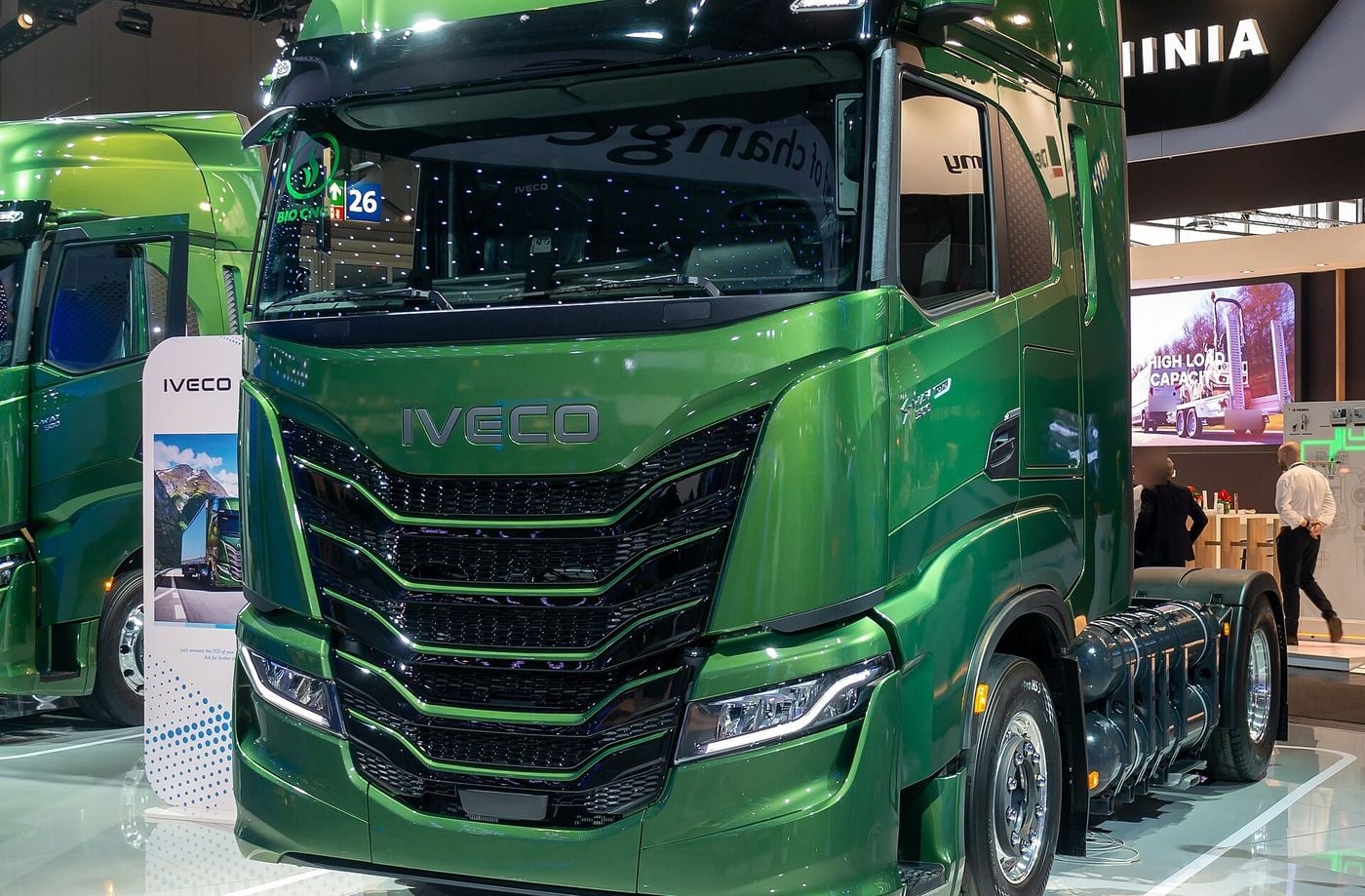
A CNG truck or bus runs on natural gas that it carries as a compressed gas in high-pressure cylinders on the vehicle. UN Regulation No 110 covers the specific components of category M and N vehicles that use compressed natural gas (CNG) or liquefied natural gas (LNG) in their propulsion system, and the installation of those components in the vehicle. In the text the European Union published in its Official Journal on 30 June 2015, the Regulation sorts gas cylinders into four types, CNG-1 to CNG-4, bases them on a working pressure of 20 MPa settled at 15 °C with a maximum filling pressure of 26 MPa, and caps a cylinder’s service life at 20 years. The UN has amended the Regulation since; the most recent notifications are dated 24 June 2025 and include amendments binding from 12 June 2025. In the European Union, the Alternative Fuels Infrastructure Regulation (AFIR) sets the fuelling pressure and connector of CNG refuelling points, but no target for their number. Anadolu Isuzu, Gillig, Iveco Bus, MAN and Otokar describe CNG or natural gas buses on their own pages, and Iveco a CNG version of its Eurocargo truck.
Status as of 14 November 2026. Read on that day: UN Regulation No 110 in the text published in the Official Journal of the European Union, OJ L 166 of 30 June 2015, in English and in the German, Spanish, French, Italian and Polish versions, from the Publications Office of the European Union; the UN Treaty Collection’s status sheet for the Regulation and its depositary notification C.N.318.2025; Regulation (EU) 2023/1804 (AFIR) in its Official Journal text, whose Article 2(4), Article 17(6), Article 21(1) and Annex II points 4.1 and 4.2 read the same in its consolidated text of 8 January 2026; and the makers’ pages and documents named in the table below. The Official Journal publication of Regulation No 110 states that “Only the original UN/ECE texts have legal effect under international public law.”
Compressed natural gas on the vehicle
Regulation No 110 defines a “CNG system” as “an assembly of components (container(s) or cylinder(s), valves, flexible fuel lines, etc.) and connecting parts (rigid fuel lines, pipes fitting, etc.) fitted on motor vehicles using CNG in their propulsion system” (paragraph 4.10), and a container, or cylinder, as “any storage system used for compressed natural gas” (paragraph 4.12). Its Part I covers the approval of the components themselves and Part II the approval of a vehicle with regard to their installation; both apply to vehicles of categories M and N, the categories explained in vehicle categories M, N and O.
Paragraph 3 sorts the components by pressure and function. Class 0 covers “High pressure parts including tubes and fittings containing CNG at a pressure higher than 3 MPa and up to 26 MPa”; Class 1 covers medium-pressure parts, Class 2 low-pressure parts, Class 3 medium-pressure parts such as safety valves or parts protected by a safety valve, Class 4 parts at a pressure lower than 20 kPa, and Class 5 parts in contact with temperatures below -40 °C. The gas cylinders are Class 0 parts (Annex 3A, paragraph 1). These component classes are not the cylinder types described below.
The same Regulation covers liquefied natural gas, and on an LNG vehicle the parts “downstream from the vaporiser shall be considered as CNG components” (paragraph 4.11). The difference in energy density between liquefied and compressed gas, and LNG trucks themselves, are covered in LNG and bio-LNG trucks, which also quotes AFIR’s Article 2(4)(c), the provision that lists CNG and LNG among the “non-renewable alternative fuels and transitional fossil fuels”.
Four cylinder types: CNG-1 to CNG-4
Paragraph 4.13.1 and Annex 3A, the annex on high-pressure cylinders for the on-board storage of CNG, name four types of container. Annex 3A also says on what each type’s life rests.
| Type | Construction, in the Regulation’s words | Basis of the cylinder’s life (Annex 3A, paragraph 1) |
|---|---|---|
| CNG-1 | “metal” | For metal and metal-lined cylinders, “the cylinder life is based upon the rate of fatigue crack growth” |
| CNG-2 | “metal liner reinforced with resin impregnated continuous filament (hoop wrapped)” | Metal-lined: rate of fatigue crack growth |
| CNG-3 | “metal liner reinforced with resin impregnated continuous filament (fully wrapped)” | Metal-lined: rate of fatigue crack growth |
| CNG-4 | “resin impregnated continuous filament with a non-metallic liner (all composite)” | For all-composite cylinders with non-metallic non-load bearing liners, the “safe life” is demonstrated by “appropriate design methods, design qualification testing and manufacturing controls” |
The German and Polish versions of the 2015 text keep the designations CNG-1 to CNG-4; the Spanish, French and Italian versions write them GNC-1 to GNC-4. Makers’ documents do not always use either. MAN’s Lion’s City G page lists “Gas cylinders type 4”, Iveco Bus’s natural gas data sheet for the Crossway Line and Pop prints its CNG tank as “Class III” with a “Class IV” option, and Gillig’s CNG page speaks of “lightweight composite fuel cylinders”. In Regulation No 110, Class 0 to Class 5 are the classes into which paragraph 3 sorts components by pressure and function.
Pressure: 20 MPa settled, 26 MPa at filling
Regulation No 110 defines working pressure as “the maximum pressure to which a component is designed to be subjected to and which is the basis for determining the strength of the component under consideration”, and adds: “For CNG cylinder, the settled pressure of 20 MPa at a uniform temperature of 15 °C” (paragraph 4.4). Service pressure is “the settled pressure at a uniform gas temperature of 15 °C” (paragraph 4.2). Annex 3A is “based upon a working pressure for natural gas as a fuel of 20 MPa settled at 15 °C with a maximum filling pressure of 26 MPa”; other working pressures “can be accommodated by adjusting the pressure by the appropriate factor (ratio)”, so that in the annex’s own example a 25 MPa working pressure system multiplies the pressures by 1.25 (paragraph 1).
Paragraph 4.2 of the annex limits the cylinder pressure to a pressure that would settle to 20 MPa at a settled temperature of 15 °C, and to “26 MPa, immediately after filling, regardless of temperature”. The cylinders are designed to be filled to a settled pressure of 20 MPa, which the annex also writes as 200 bar, up to 1,000 times per year of service (paragraph 4.3), and for a settled gas temperature from -40 °C to 65 °C (paragraph 4.4.1). The refuelling side of the same figures is set in the EU by AFIR.
| Item | UN Regulation No 110, on the vehicle | AFIR Annex II, at the refuelling point |
|---|---|---|
| Reference pressure | Working pressure of a CNG cylinder: 20 MPa settled at a uniform temperature of 15 °C (paragraph 4.4) | Fuelling pressure (service pressure): 20.0 MPa gauge (200 bar) at 15 °C (point 4.1) |
| Upper limit | 26 MPa immediately after filling, regardless of temperature (Annex 3A, paragraph 4.2) | Maximum fuelling pressure of 26.0 MPa with temperature compensation, in accordance with EN ISO 16923:2018 (point 4.1) |
| Refuelling connector | The list of references names ISO 14469-1:2004 and ISO 14469-2:2007, each a CNG refuelling connector of “20 MPa (200 bar)” (paragraph 2) | The connector profile “shall comply with Regulation No 110”, referring to parts I and II of EN ISO 14469:2017 (point 4.2) |
Service life, markings and the 48-month visual inspection
Under Annex 3A, “The service life of the cylinder shall be defined by the manufacturer and may vary with applications.” The definition of service life is based on filling the cylinder 1,000 times a year for a minimum of 15,000 fills, and “The maximum service life shall be 20 years” (paragraph 1). Paragraph 4.1.3 repeats the 20 years and says the service life is to be specified by the cylinder designer.
Paragraph 11 of the annex requires clear permanent markings on each cylinder, “not less than 6 mm high”. The mandatory ones begin with “CNG ONLY” and “DO NOT USE AFTER XX/XXXX”, where the figures give the month and year of expiry, and a footnote adds: “The expiry date shall not exceed the specified service life.” The other mandatory items include the manufacturer’s identification, a part number and a serial number unique to each cylinder, the working pressure and temperature, the ECE Regulation number with the cylinder type and certification registration number, and the pressure relief devices or valves qualified for use with the cylinder. The annex’s example of the mandatory markings includes the lines “20 MPa/15 °C” and “ECE R 110 CNG-2 (registration No …)”.
Paragraph 4.1.4 of the annex sets one interval: “Each cylinder shall be visually inspected at least every 48 months after the date of its entry into service on the vehicle (vehicle registration), and at the time of any reinstallation, for external damage and deterioration, including under the support straps.” The inspection “shall be performed by a competent agency approved or recognised by the Regulatory Authority, in accordance with the manufacturer’s specifications”.
The green CNG label on buses
Paragraph 18.1.8.1 requires vehicles of categories M2 and M3 equipped with a CNG system to be labelled as specified in Annex 6. The label goes on the front and rear of the vehicle and on the outside of the doors on the right-hand side of a left-hand-drive vehicle, or on the left-hand side of a right-hand-drive vehicle (paragraph 18.1.8.3). Annex 6, whose heading also names categories N2 and N3, describes a weather-resistant sticker with a green background, a white or white reflecting border and white or white reflecting letters, 110 to 150 mm wide and 80 to 110 mm high, with characters at least 25 mm high and 4 mm thick and the word “CNG” centred in the middle. Vehicles of the same categories with an LNG system carry a sticker of the same design with the word “LNG” (paragraph 18.1.8.2 and Annex 7).
Regulation No 110 after 2015
The 2015 Official Journal text incorporates “all valid text up to” Supplement 2 to the 01 series of amendments, which entered into force on 9 October 2014. The UN Treaty Collection gives 28 December 2000 as the date the Regulation entered into force, and its status sheet lists the Contracting Parties applying it, among them the European Union, Norway, the Russian Federation, Serbia, Switzerland, Türkiye, Ukraine and the United Kingdom. The sheet records amendment notifications in later years as well, the latest seven of them dated 24 June 2025.
One of those seven, C.N.318.2025, says that amendments communicated to the Contracting Parties by a notification of 12 December 2024 “are considered to be adopted and are binding upon all Contracting Parties applying the above United Nations Regulation as of 12 June 2025”. Their text is document ECE/TRANS/WP.29/2024/107, which the notification places on the website of the UN Economic Commission for Europe. That website could not be read on 14 November 2026, so the cylinder types, pressures, service life, markings, inspection interval and label above are those of the 2015 text; whether the later amendments changed any of them could not be checked.
AFIR: rules for CNG refuelling points, no target for their number
Regulation (EU) 2023/1804 on the deployment of alternative fuels infrastructure has applied since 13 April 2024 (Article 26). Article 21(1) says “The technical specifications set out in Annex II shall apply”, and point 4.1 of Annex II reads: “Refuelling points for compressed natural gas (CNG) for motor vehicles shall comply with a fuelling pressure (service pressure) of 20,0 MPa gauge (200 bar) at 15 °C. A maximum fuelling pressure of 26,0 MPa with ‘temperature compensation’ is permitted in accordance with standard EN ISO 16923:2018.” Point 4.2 ties the connector profile to Regulation No 110, “referring to parts I and II in standard EN ISO 14469:2017”.
The Regulation’s articles on road infrastructure set targets for recharging points (Articles 3 and 4) and for hydrogen refuelling (Article 6), and Article 8 deals with liquefied methane; none of them concerns CNG. CNG appears in Article 17(6), under which the Commission “shall make publicly available and regularly update information on the national targets and the objectives submitted by each Member State” regarding, among other things, “the number of publicly accessible refuelling points for CNG for motor vehicles” (point (g)). Recital 8 says that “liquefied petroleum gas (LPG) and compressed natural gas (CNG) vehicles, for which sufficient infrastructure network already exists across the Union are expected gradually to be replaced by zero-emission powertrains”. The heavy-duty recharging targets are set out in AFIR charging targets for trucks, the hydrogen targets in hydrogen refuelling for trucks in Europe and the liquefied methane article in LNG and bio-LNG trucks.
Makers’ CNG trucks and buses
| Maker | Model | Vehicle | Engine, as printed | Gas storage, as printed | Document |
|---|---|---|---|---|---|
| Anadolu Isuzu | Citiport 12 CNG | City bus, 12 m, up to 92 passengers | Cummins 8.9L; 235 kW (315HP) at 2,000 rpm; 1,357 Nm at 1,300–1,400 rpm | Not given on the page | Product page |
| Anadolu Isuzu | Citiport 18 CNG | City bus, 18 m, up to 145 passengers | Cummins 8.9L; 269 kW (360 HP) at 2,100 rpm; 1,584 Nm at 1,300 rpm | Not given on the page | Product page |
| Gillig | CNG bus | Transit bus in 29, 35 and 40 ft lengths | Cummins L9N, “powered by compressed natural gas (CNG)” | “lightweight composite fuel cylinders” | CNG page |
| Iveco | Eurocargo CNG | Truck, a range Iveco gives as 7.5 to 19 tonnes, with the CNG engines “available across the range” | Tector 7 CNG, 6.7 litres; 220, 250 and 280 hp | Up to 1,100 litres of gas cylinder capacity | Press release, 15 November 2023 |
| Iveco Bus | Crossway Line and Pop, natural gas, Euro VI Step E | Bus, 12,097 or 12,962 mm long, 55 or 59 passenger seats | Cursor 9, 8.7 litres, six cylinders in line; 265 kW (360 hp); 1,600 Nm at 1,200 rpm | 1,280 litres, printed “Class III”; 1,260 litres “Class IV” as an option; filling “NGV 1 & NGV 2 on right hand side” | Data sheet, September 2023 |
| MAN | Lion’s City 12 G, 18 G and 19 G | City bus, 12.2 m with 37 seats, 18.1 m with 49, 18.7 m with 53 | E1856 LOH Euro 6, the “MAN E18 natural gas engine”, a four-valve in-line six-cylinder | “Gas cylinders type 4” under the roof, capacity up to 1,875 litres | Lion’s City G page |
| Otokar | Kent C CNG | City bus, 10.80 or 12 m, up to 87 passengers, 2 or 3 doors | Natural gas, 221 kW (300 hp), Euro 6 | Not given on the page | Model page |
The model pages with CNG or natural gas versions give more detail. For buses: the Isuzu Citiport, the BMC Procity, the Gillig Low Floor, the Iveco Crossway, Crossway LE, Streetway and Urbanway, the MAN Lion’s City and the Otokar Kent and Territo. For trucks: the Iveco Daily, Eurocargo, S-Way, Stralis and X-Way, the Mack Granite, the Peterbilt 537 and 548, the Renault Trucks D, the Scania G-series, P-series and L-series and the Volvo FE. Several of the engines are described under the FPT Cursor 9, FPT Tector 7, Cummins L9 and MAN E18.
Gross weights and passenger capacities of CNG city buses are listed in bus weight and seating capacity, and the other drivelines of city buses in city bus propulsion. The conditions for gas-powered vehicles on the Channel Tunnel freight shuttle are set out in trucks on ferries, trains and the Channel Tunnel, and the treatment of CNG vehicles in individual low-emission zones in low-emission zones for trucks and buses in Europe.
Biomethane as bio-CNG
AFIR lists “biomass fuels, including biogas” among its “renewable fuels” (Article 2(4)(b)), and its recital 5 ties the use of fossil gaseous or liquid fuels to “increasing blending with or replacement by renewable fuels such as bio-methane”. On the makers’ side, Iveco’s Eurocargo release of 15 November 2023 speaks of CNG vehicles “When they run on biomethane”, and Gillig’s CNG page names Renewable Natural Gas (RNG) as a fuel for its CNG buses. How the EU’s CO2 rules for new heavy vehicles treat biomethane, and the end of the German toll exemption for gas trucks, are set out in LNG and bio-LNG trucks; the gas qualities MAN gives for its city bus engine are listed under MAN E18.
Quick answers
- What is a CNG truck or bus?
- A truck or bus whose engine runs on natural gas carried on the vehicle as a compressed gas in high-pressure cylinders. UN Regulation No 110 covers the approval of the CNG components of category M and N vehicles and of their installation in the vehicle, and defines a container, or cylinder, as any storage system used for compressed natural gas. The EU's Alternative Fuels Infrastructure Regulation (AFIR), Regulation (EU) 2023/1804, lists CNG among the non-renewable alternative fuels and transitional fossil fuels.
- What pressure is CNG stored at in a truck or bus?
- In the text of UN Regulation No 110 that the EU published in its Official Journal in 2015, the working pressure of a CNG cylinder is 20 MPa settled at a uniform temperature of 15 °C, which the annex on cylinders also writes as 200 bar, and the pressure is limited to 26 MPa immediately after filling, regardless of temperature; the annex adds that other working pressures can be accommodated by adjusting the pressures by a factor. The EU's AFIR requires CNG refuelling points to fill at 20.0 MPa gauge (200 bar) at 15 °C and permits up to 26.0 MPa with temperature compensation under EN ISO 16923:2018.
- What do CNG-1, CNG-2, CNG-3 and CNG-4 mean?
- They are the four cylinder types of UN Regulation No 110 in its 2015 text: CNG-1 is metal; CNG-2 is a metal liner reinforced with resin-impregnated continuous filament, hoop wrapped; CNG-3 is the same fully wrapped; CNG-4 is resin-impregnated continuous filament with a non-metallic liner, all composite. The Spanish, French and Italian versions of the text write the types as GNC-1 to GNC-4.
- How long can a CNG cylinder stay in service?
- As long as its manufacturer specifies, up to 20 years, under the 2015 text of UN Regulation No 110. Each cylinder carries the marking DO NOT USE AFTER with the month and year of expiry, which may not be later than the specified service life, and has to be visually inspected at least every 48 months after it enters service on the vehicle, and at any reinstallation, by a competent agency approved or recognised by the Regulatory Authority. The UN has amended the Regulation since; among the amendments is a set binding from 12 June 2025, whose text could not be read.
- Does AFIR require CNG refuelling stations?
- AFIR sets no target for their number. The Regulation, which has applied since 13 April 2024, sets the fuelling pressure and connector profile of CNG refuelling points in Annex II; its articles on road infrastructure set targets for recharging and hydrogen and deal with liquefied methane, and for CNG Article 17(6)(g) has the Commission publish information on the Member States' national targets and objectives regarding the number of publicly accessible CNG refuelling points. Recital 8 expects CNG vehicles, for which sufficient infrastructure already exists across the Union, to be replaced gradually by zero-emission powertrains.
Models in this article
Sources
- UN Regulation No 110 — uniform provisions concerning the approval of specific components of motor vehicles using CNG and/or LNG in their propulsion system and of vehicles with regard to their installation, text incorporating Supplement 2 to the 01 series of amendments (OJ L 166, 30.6.2015): paragraphs 1 to 4.13.1 and 18.1.8, Annex 3A paragraphs 1, 4.1.3 to 4.4.1 and 11, Annexes 6 and 7; English, German, Spanish, French, Italian and Polish versions — Publications Office of the European Union, 30 Jun 2015
- United Nations Regulation No. 110 — status of treaty XI-B-16-110: entry into force, texts, amendment notifications and Contracting Parties applying the Regulation (read on 14 November 2026) — United Nations Treaty Collection
- Depositary notification C.N.318.2025.TREATIES-XI.B.16.110 — amendments to United Nations Regulation No. 110, 24 June 2025 — United Nations, Secretary-General as depositary, 24 Jun 2025
- Regulation (EU) 2023/1804 of the European Parliament and of the Council of 13 September 2023 on the deployment of alternative fuels infrastructure (AFIR) — Official Journal text (OJ L 234, 22.9.2023): recitals 5 and 8, Articles 2(4), 3, 4, 6, 8, 17(6), 21(1) and 26, Annex II points 4.1 and 4.2; Articles 2(4), 17(6), 21(1) and Annex II points 4.1 and 4.2 also in the consolidated text of 8 January 2026 — Publications Office of the European Union, 13 Sept 2023
- Citiport 12 CNG — product page with technical data (Turkish, read on 14 November 2026) — Anadolu Isuzu Otomotiv Sanayi ve Ticaret A.Ş.
- Citiport 18 CNG — product page with technical data (Turkish, read on 14 November 2026) — Anadolu Isuzu Otomotiv Sanayi ve Ticaret A.Ş.
- Compressed natural gas (CNG) — GILLIG CNG bus page (read on 14 November 2026) — GILLIG LLC
- New Eurocargo introduces new technology and natural gas across the range making it 'the right fit for every mission' (press release, Turin, 15 November 2023) — Iveco S.p.A., 15 Nov 2023
- CROSSWAY LINE / POP 12/13 m — NATURAL GAS EURO VI STEP E (international data sheet, September 2023) — Iveco Bus
- MAN Lion's City G — natural gas city bus page with data sheet entries for the Lion's City 12 G, 18 G and 19 G (read on 14 November 2026) — MAN Truck & Bus
- KENT C CNG — model page (English), Otokar commercial vehicles (read on 14 November 2026) — Otokar Otomotiv ve Savunma Sanayi A.Ş.